Blog

  • How to Add Instagram Link to Facebook Bio?

    How to Add Instagram Link to Facebook Bio?

    If you’re looking to promote your Instagram profile and boost your online presence, adding your Instagram link to your Facebook bio can be a highly effective strategy. By doing so, you can reach a broader audience and potentially attract more followers, which can help you take your social media game to the next level.

    For creators and marketers who care about link performance, Replug.io lets you brand, shorten, and track your shared URLs so every click tells a story.

    In this guide, we’ll explore the steps involved in adding an Instagram link to your Facebook bio on both computer and mobile devices, as well as some tips on how to make the most of Replug’s bio link feature.

    How to add Instagram link to Facebook bio on a mobile device?

    Here’s a step-by-step guide on how to add your Instagram link to your Facebook bio on a mobile device:

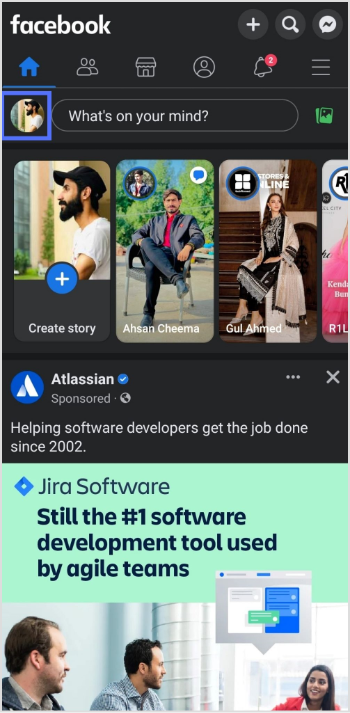
    Step 1: Open the Facebook app on your mobile and tap your profile icon. 

    profile icon

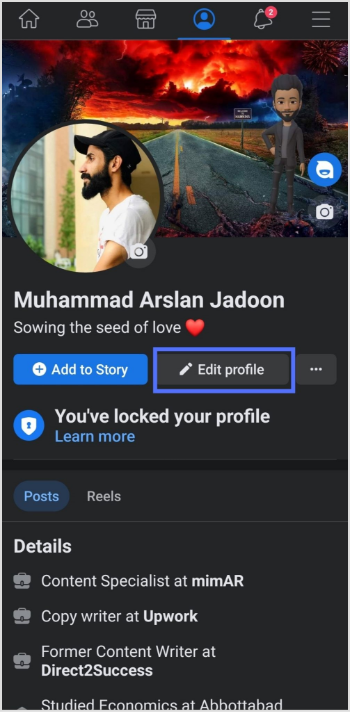
    Step 2: Tap the “edit profile” button.

    edit profile

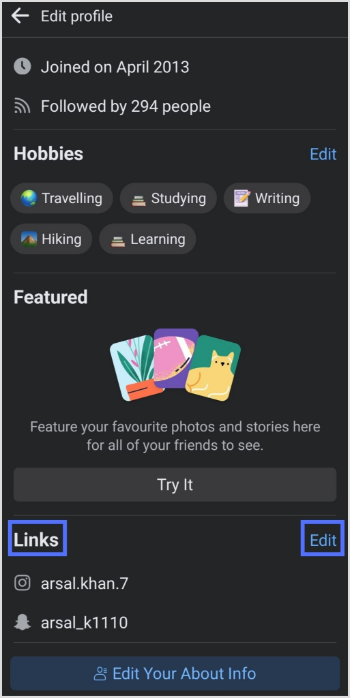
    Step 3: In the edit profile section, scroll down to the “links” section and tap “edit”. 

    links-edit

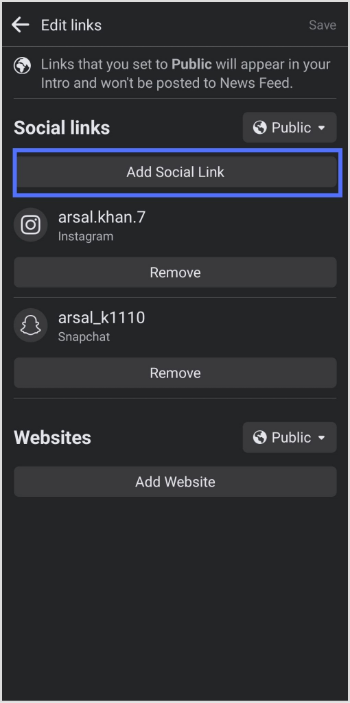
    Step 4: Tap the “add social link” button. 

    add social link

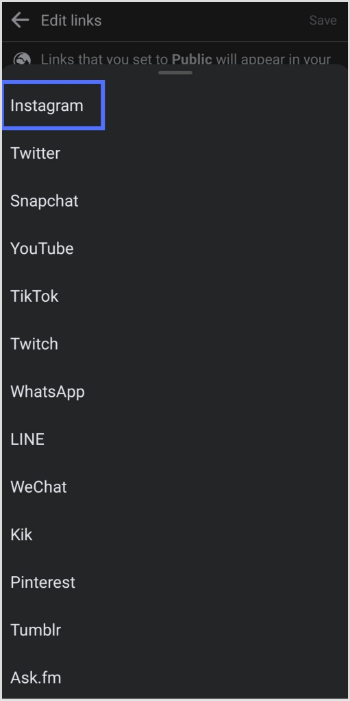
    Step 5: Tap the “platform” button and choose Instagram from the list. 

    select Instagram

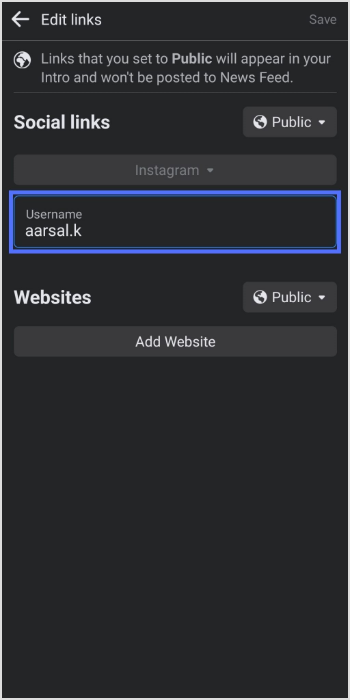
    Step 6: Enter your Instagram account “user name” and tap save

    enter username & save

    Also Read: How to put a link in your Facebook bio?

    How to add Instagram link to Facebook bio on a computer device?

    Step 1: Log in to Facebook on your computer browser. 

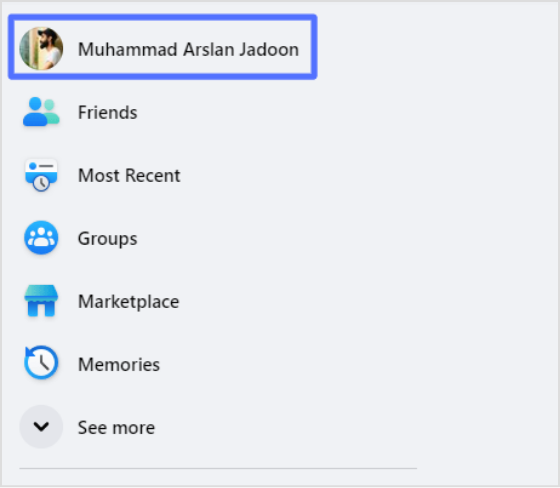
    Step 2: Click on your profile name on the top left side. 

    profile name

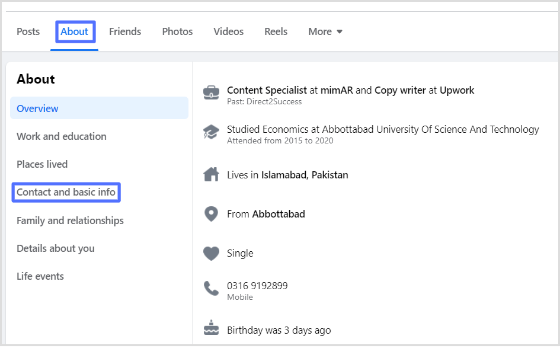
    Step 3: Click “about”, then “contact and basic info”

    about-basic info

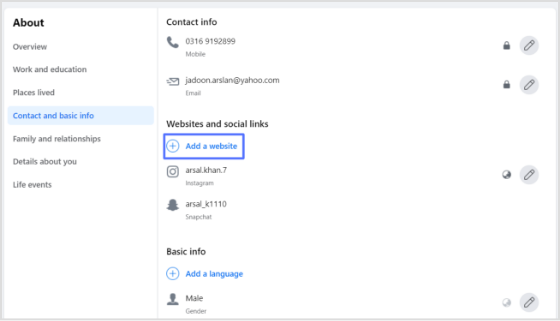
    Step 4: Click the “add website button” under the “website and social links” section. 

    add website

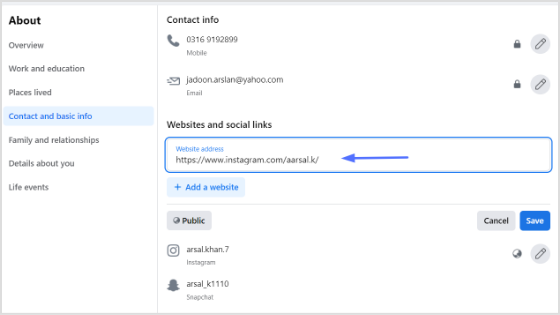
    Step 5: Paste your Instagram URL in the URL field and click save. You’ll have your Instagram link in the Facebook bio. 

    paste url

    You may also like: How to unlink Facebook and Instagram?

    Also, don’t forget to give this Facebook link in bio tool a try. It will assist in boosting your engagement exceptionally.

    Frequently asked questions

    Why can’t I see my Instagram link in my Facebook bio?

    If you cannot see your Instagram link in your Facebook bio, make sure you have added it correctly by following the steps above. Also, check that your Instagram account is not set to private, as private accounts cannot be linked to Facebook bios.

    Why is my Instagram link not clickable in my Facebook bio?

    If your Instagram link is not clickable in your Facebook bio, it may be because you have not entered the link correctly, or your Instagram account may be set to private.

    Trending:

    How To Save TikTok Videos Without The Watermark?

    How to add a link in bio to your Instagram profile?

    How to create a QR code for a URL?

    TikTok Trends for Businesses, Brands, and Others

  • How to do A/B testing the easy way: step-by-step guide

    How to do A/B testing the easy way: step-by-step guide

    A/B testing, also known as split testing, is a technique used by marketers and web developers to compare two or more variations of a website or marketing campaign to determine which version performs better. 

    In A/B testing, traffic is split between the different variations, and the results are measured to see which version has a higher conversion rate, click-through rate, or other key performance indicators. By using data to make informed decisions, A/B testing can help improve the effectiveness of websites, email campaigns, ads, and other marketing efforts.

    However, to get the most out of your A/B testing efforts, it’s important to have a clear and organized approach. One way to achieve this is by using a URL management tool. By using shortened URLs, you can easily track clicks and engagement rates for each variation, and make data-driven decisions about which version to roll out to your audience. 

    In this guide, we’ll walk you through the process of A/B testing step by step, while incorporating a URL shortener tool to streamline your testing efforts. Let’s get started!

    How to do AB testing using a link management tool?

    Replug is a great choice as an A/B testing tool for anyone looking. Along with effective A/B testing, this all-in-one link management platform offers advanced features such as link customization and analytics, retargeting, deep linking and call-to-action overlays, which can help boost your conversions even further. 

    Plus, with easy integration with popular tools like Google Analytics and social media platforms, Replug can be seamlessly integrated into your existing marketing stack.

    Step 1: Sign in to Replug or create an account for free. 

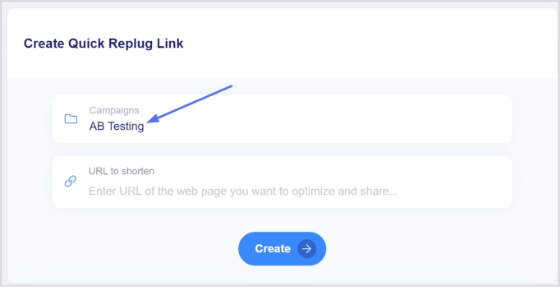
    Step 2: On the main dashboard click “select your campaign” under “create quick Replug link” to choose a campaign name. 

    Note: If you are new to Replug you need to create a campaign name first. To do so, go to “Manage” and click “campaigns” then “new campaign.”  

    campaign

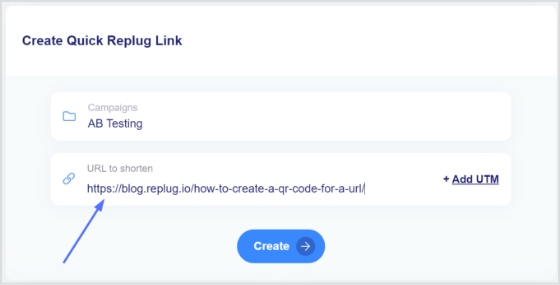
    Step 3: Once created or selected a campaign, paste the original link on which you want to perform the AB test in the “URL to shorten” section under the “select your campaign” section. 

    url to shorten

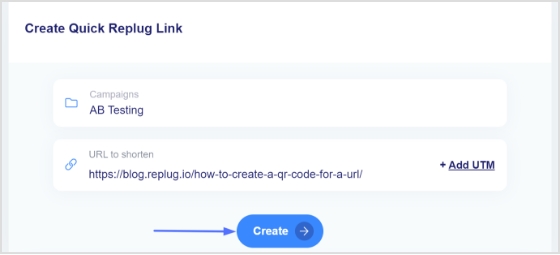
    Step 4: Click create to first create a shortened version of your link. 

    create

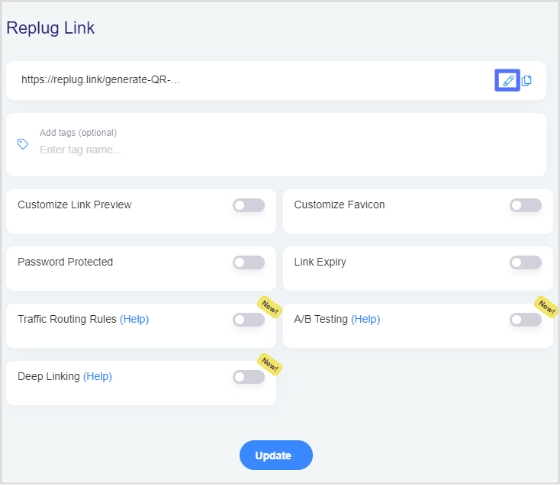
    Step 5: Click the edit icon to customize your link. 

    edit icon

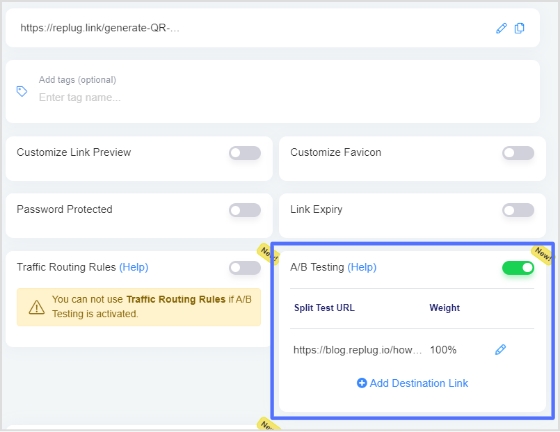
    Step 6: To enable A/B Testing, toggle the AB testing slider button before saving your link. Doing so will automatically set your destination URL as the first A/B Testing link with 100% weightage. 

    To add more URLs, simply click on the “Add Destination Link” button.

    enable AB testing

    Also Read: UTM Tracking Through Replug

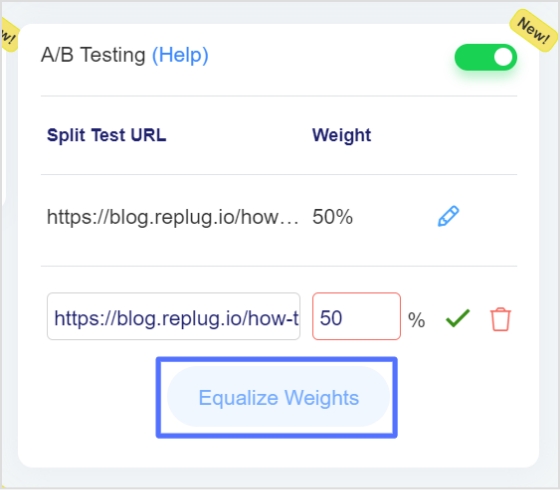
    Step 7: You can allocate different weightage to each URL, provided that the total weightage adds up to 100%. 

    Additionally, you can use the “Equalize Weights” button to evenly distribute the weightage among all the URLs.

    equalize waight

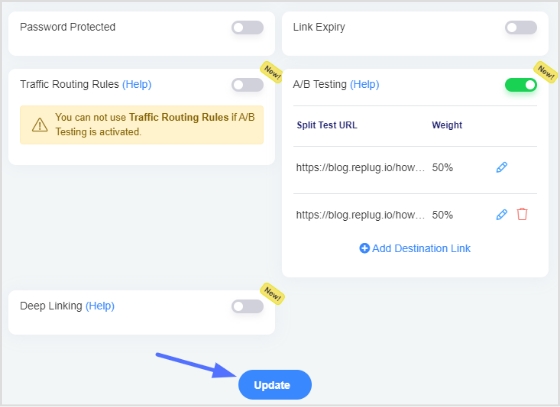
    Step 8: Now that you’ve enabled the A/B Testing feature, click the update button and you’re all set to save your branded link. 

    Start grabbing your audience’s attention by sharing your short link created by Replug.

    update button

    Also Read: How to Create UTM Links: A Step-by-Step Guide

    Important Points:

    • The Weightage does not depend on the previous visits or clicks and also does not strictly constrained.
    • The final destination URL is selected based on the defined weightage every time  the short link is.
    • Link cannot be saved in A/B Testing if the campaign type is CTA and the mentioned link does not allow Iframe (In order to display a web page inside another website, we make use of the iFrame. The source website must allow showing their website content in an iframe. If the source website doesn’t allow an iframe header, Replug shows a warning while creating CTA Campaigns)

    Also Read: What is a Tracking URL and How Does it Work?

    FAQs

    How can A/B testing help me improve my marketing campaigns?

    A/B testing allows you to test and optimize different versions of your marketing campaigns to find out what works best for your audience. This can help you improve click-through rates, and conversions, and ultimately drive more revenue or leads.

    How is the final destination URL selected in A/B testing?

    The final destination URL is selected based on the defined weightage every time the short link is clicked. This ensures that each URL gets a fair chance of being clicked and the A/B testing results are accurate.

    Does the weightage in A/B testing depend on previous visits or clicks?

    No, the weightage in A/B testing is not dependent on previous visits or clicks. Instead, you can allocate different weightage to each URL, ensuring that the total weightage adds up to 100%.

    Can I allocate different weightage to each URL in A/B testing?

    Yes, you can allocate different weightage to each URL in A/B testing, ensuring that the total weightage adds up to 100%. This allows you to test multiple versions of your content and find out what works best for your audience.

    How do I interpret the results of my A/B testing in Replug?

    You can view the results of your A/B testing campaigns in Replug’s dashboard, which shows you the click-through rates and conversions for each URL. This can help you determine which version of your content is more effective and make data-driven decisions.

    How often should I run A/B testing on my links and campaigns?

    The frequency of A/B testing depends on your goals and the amount of traffic you receive. As a general rule, it’s a good idea to test your campaigns regularly and make adjustments based on the results.

    Trending:

    How To Save TikTok Videos Without The Watermark?

    Social Media Risks For Brands. How To Avoid Them?


  • Link management made simple: The ultimate guide for 2026

    Link management made simple: The ultimate guide for 2026

    Link management can feel like herding cats. One team member uses a raw UTM link, someone else pastes a long tracking URL, and pretty soon, you have no idea which click came from where. Yet every click carries power.

    Studies show branded short links can lift click-through rates by around one-third compared with generic links, meaning messy URLs are leaving real money on the table.

    Across channels, a single brand may share hundreds of links every month. Without proper link management, tracking performance, protecting online reputation, and staying consistent is almost impossible.

    This guide walks through what link management is, how it works, and how tools like Replug help you keep every link organized, on brand, and trackable.

    First up is the foundation: what exactly is link management, and why does it matter so much in 2026?

    What is link management?

    Link management is the process of creating, organizing, branding, and tracking all the URLs your marketing team shares.

    The main goal is simple: control every link so you can improve performance, keep your brand consistent, and understand what really drives results. Instead of treating links as throwaway items, link management treats them as small but powerful marketing assets.

    It matters because links sit everywhere, i.e., on ads and landing pages, newsletters and transactional emails, social posts and bio links, QR codes and print materials, influencer campaigns and partner content, etc.

    When they are random and untracked, reporting becomes disordered and growth slows. But if they are planned and measured, you get clean data, a better user experience, and more confident decisions.

    Key aspects of link management:

    • Customization and branding turn ugly, long URLs into short, branded links that look professional and build trust. People are more likely to click when they recognize your brand name. This is especially helpful on crowded feeds where every character counts.
    • Performance tracking adds click data to every link so you know which channels, posts, and campaigns work best. You can see sources, locations, devices, and trends effortlessly. That information guides smarter content and budget choices.
    • Organization keeps your growing library of links searchable and tidy. With tags, folders, and campaigns, you can quickly pull reports by client, product, or promotion. That structure saves time for marketing teams and agencies.
    • Efficiency comes from using one place to create, edit, and manage links instead of scattered spreadsheets. New team members can follow the same process, which reduces mistakes and duplicated work.
    • Flexibility means you can update destinations, pause links, or redirect traffic without changing the visible URL. You keep the same shared link while adapting offers, pages, and tests as your strategy changes.

    Core link management features

    Modern link management tools and platforms do far more than shorten URLs. They give you control over every part of the click path: from the domain your audience sees, to the page they land on, to the data you record along the way.

    These core features are what separate true link management from a basic shortener tool.

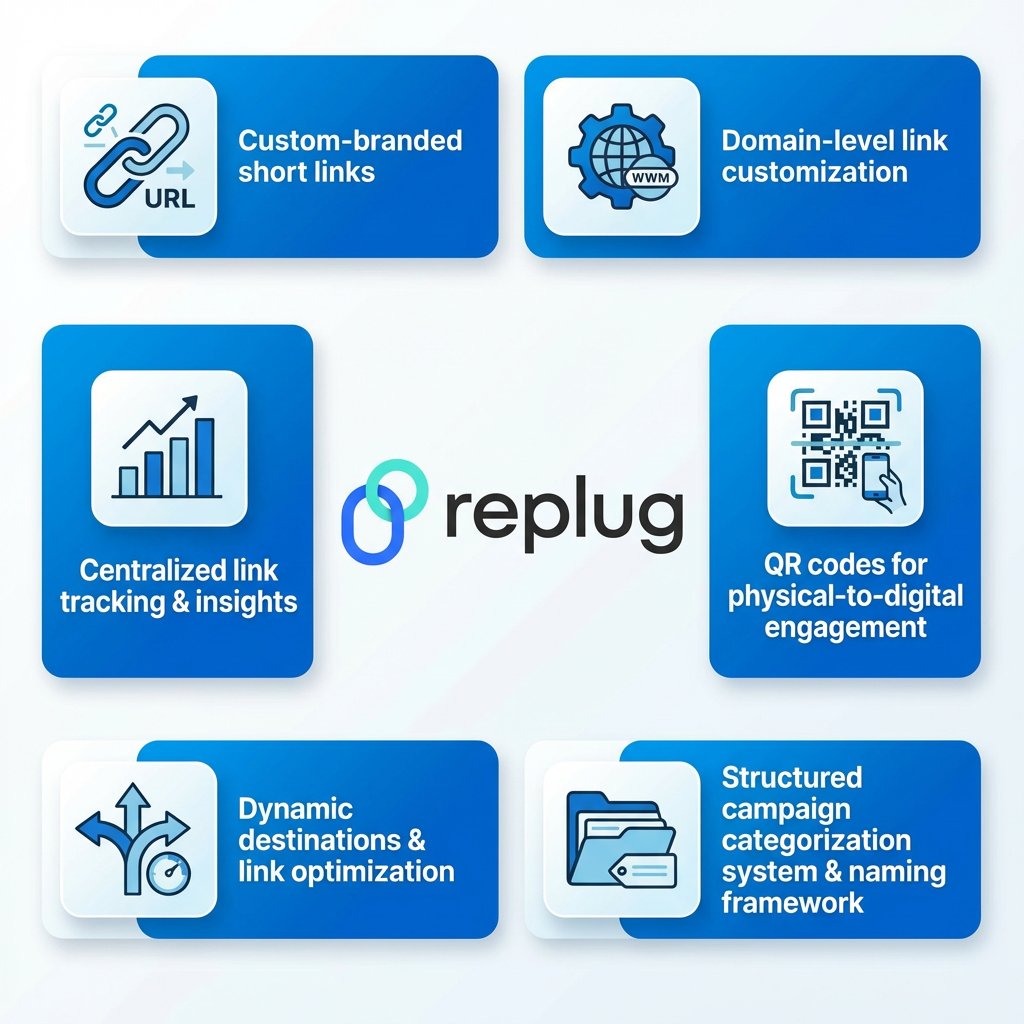
    Core link management features

    Custom-branded short links

    Custom-branded links replace random characters with your own domain and meaningful slugs. Instead of a generic service name, people see something like yourbrand.link or go.youragency.com.

    This builds trust and signals a professional approach. Branded links also help protect your online reputation because scammers usually rely on generic domains.

    Good branded link practices include:

    • Keeping slugs human-readable (for example, /spring-sale instead of /x7Fg4)
    • Matching naming with your campaign structure
    • Avoiding misleading language that might feel spammy

    Domain-level link customization

    With domain-level control, you can manage multiple custom domains and workspaces from a single dashboard. Agencies can keep each client on a separate domain, while bigger companies can split links by product line or region.

    This setup keeps reporting clean and prevents confusion when many teams work in the same account.

    In Replug, this kind of setup makes it easy to:

    • Keep client or department activity clearly separated
    • Enforce naming and branding rules per workspace
    • Share access only with the people who should see each domain

    Centralized link tracking & insights

    Centralized tracking pulls all click data into a single analytics view. It is a practice backed by research on how to unlock the power of data linkage to enable more informed, evidence-based decision-making.

    You see which campaigns are winning across email, social, ads, QR codes, and influencers. In Replug, you can filter by campaign, country, device, or referrer, so you can quickly answer questions like which platform drives the highest conversion rate this month.

    Centralized link analytics also help you:

    • Compare paid vs. organic results without jumping across tools
    • Identify content that keeps working long after launch
    • Spot suspicious traffic spikes or bots before they skew decisions

    Dynamic destinations & link optimization

    Dynamic links let you change where a URL sends people without editing the link they already have. You can route traffic based on date, location, device, or A/B tests.

    For example, you can:

    • Send mobile users to app deep links and desktop users to your main site
    • Send visitors from different countries to localized pages
    • Split traffic between two landing pages and keep the better performer for long-term use

    With Replug, these rules are managed from a single dashboard, so your team can adapt campaigns without asking developers to change hard-coded URLs.

    Structured campaign categorization system & naming framework

    A clear naming framework is the quiet hero of modern link management. When every link follows the same style or pattern for campaigns, sources, and content, reporting becomes far easier.

    Tags and folders mirror your real marketing structure, such as clients, quarters, or product launches.

    Replug supports:

    • Tags for grouping by campaign, product, or channel
    • Folders and workspaces for clients or internal teams
    • Bulk actions, so cleaning up old campaigns and links stays simple

    Over time, this structure turns your link library into a searchable archive rather than a pile of random URLs.

    QR codes for physical-to-digital engagement

    Smart QR codes bridge offline experiences with online tracking. A single short link can generate a dynamic QR code for packaging, flyers, events, or in-store displays.

    Because the QR code points to your managed link, you can change the destination later and still keep all scans tracked in the same analytics view.

    Practical uses include:

    • Product packaging that leads to how-to videos or upsell pages
    • Event badges that link to schedules, maps, or feedback forms
    • Print ads that direct readers to time-limited offers

    Major advantages of effective link management

    When link management is set up well, it touches nearly every part of your marketing. You get better data, smoother experiences, and more predictable results from the same content and spend. These benefits add up fast for social media managers, agencies, and in-house teams.

    Major advantages of effective link management

    Improved SEO & site authority

    Clean internal and external links help search engines crawl your site more easily. When redirects are tidy and old links are updated instead of left broken, you avoid wasting link equity.

    Over time, this supports stronger site authority, which works alongside your link-building services packages instead of fighting against them.

    Some SEO-friendly link practices are:

    • Redirecting outdated campaign URLs to relevant evergreen pages
    • Avoiding endless redirect chains that slow pages down
    • Updating links in high-traffic content when pages move

    Better user experience & navigation

    Short branded URLs and accurate redirects create smoother paths for visitors. People reach the right page the first time, rather than encountering 404 errors or confusing chains.

    That simple experience lowers frustration, especially on mobile, and supports repeat visits and word of mouth.

    With a managed link setup, you can:

    • Fix mis-typed or outdated links without editing every post
    • Guide users from generic links to the most relevant product or article
    • Keep printed materials useful long after the original campaign ends

    Centralized control & efficiency

    With link management in one place, you do not need dozens of random documents to store URLs. Team members know exactly where to create, edit, and search links. This central control is especially helpful for agencies dealing with many clients or brands with several departments posting content every day.

    Centralization helps you:

    • Reduce duplicate links that distort your reporting
    • Speed up onboarding for new team members
    • Keep permissions and access under control

    Advanced analytics & data tracking

    Click data from every channel feeds into one precise analytics view. You can see which posts, ads, or emails lead to meaningful actions instead of guessing.

    Replug takes this further with conversion tracking and UTM support, so you can connect clicks to leads and sales rather than just counting traffic.

    Consistent branding & more efficient marketing

    Branded links show your name across all channels, from TikTok bios to email signatures. That steady presence supports online reputation and makes your content easier to recognize.

    When every link follows the same style, your team spends less time reworking assets and more time testing new ideas.

    Consistent link branding can:

    • Make affiliate and partner promotions feel less intrusive
    • Help customers spot genuine offers vs. scams
    • Tie together campaigns across different networks and devices

    Improved collaboration & increased conversions

    Shared workspaces, tags, and standardized naming make it easier for teams and agencies to collaborate. Designers, writers, and media buyers can all use the same links with confidence.

    That alignment speeds up launches, reduces broken URLs, and creates more chances to guide clicks toward high-converting offers.

    This is especially useful when:

    • Multiple agencies work on the same brand
    • Different regions handle their own campaigns under one domain
    • Subject-matter experts contribute content, but marketing owns tracking

    Flexibility & redirecting

    Campaigns change often. A link that promoted a flash sale last week might now need to go to a general category page.

    With proper link management, you update the destination once you’re inside the platform, and all existing clicks follow the new path. No need to edit old posts, ads, or QR codes.

    This flexible control helps you:

    • Keep promotions current without chasing old placements
    • React quickly when products sell out or prices change
    • Direct crisis communication traffic to updated information

    Optimized resource allocation

    When you know which channels and campaigns drive the best results, budget planning becomes far easier. Underperforming sources are simple to spot.

    Teams that sell link-building service packages can use this data to clearly demonstrate value to clients and adjust tactics without guesswork.

    You can:

    • Allocate more spend to channels that drive revenue, not just clicks
    • Reduce waste in campaigns that bring low-quality traffic
    • Prioritize content formats that lead to conversions or signups

    Common link management challenges

    Even with great tools, link management can get messy without a proper plan. As your number of campaigns and teammates grows, problems tend to show up in the same places. Knowing these issues ahead of time helps you avoid them or fix them quickly.

    Common link management challenges

    Scalability & organization

    What works for 10 links might fall apart at 10,000 links. Without folders, tags, or a clear naming style, older URLs become hard to find. New team members may create duplicate links or forget to add link tracking.

    In such a case, a platform like Replug helps by providing dedicated workspaces, search, and bulk actions that scale with your marketing.

    To stay organized as you grow:

    • Agree on naming standards from the start
    • Train every new collaborator on how to create links
    • Schedule periodic cleanups to archive or retire old campaigns

    Quality & relevance

    Outdated or low-quality destinations waste traffic. Maybe a blog post is no longer accurate, or a product is out of stock. If no one regularly reviews links, people keep clicking and end up on weak pages.

    A review schedule plus clear ownership for each campaign keeps links pointing to content that still matches your message.

    A simple checklist for link quality:

    • Is the destination page still live and accurate?
    • Does it reflect your brand and current pricing or offers?
    • Does it give visitors a clear next step?

    Time-consuming process

    Manually building UTMs, shortening URLs, and pasting them across platforms takes significant time. It also increases the risk of small typing mistakes.

    Automation within a link management platform, such as RSS-based link creation or browser extensions, speeds up daily work so you can focus on strategy rather than copy-paste tasks.

    Replug can help by:

    • Auto-generating branded short links from new content
    • Applying saved UTM templates for common campaigns
    • Integrating with tools you already use for publishing

    Broken links & redirects

    Any site update or migration can create broken links. Without central tracking, you might not notice until a customer complains. Tools that monitor click errors and allow fast redirect updates fix this problem.

    Replug supports easy redirect changes so you can keep traffic flowing even as your site structure changes.

    You can:

    • Create replacement destinations for popular but outdated URLs
    • Track 404 patterns to spot recurring issues
    • Update QR code targets without reprinting materials

    Tracking & ROI

    If some links are tracked and others are not, reports become unreliable. It is hard to prove the return on ad spend, influencer fees, or content production.

    Standardizing link creation and using a single platform for tracking keeps your numbers clean. That makes it much easier to show a clear ROI to executives or clients.

    Algorithm compliance

    Social and ad platforms can change rules for link formats or tracking parameters. If your links look spammy or break guidelines, reach may drop.

    Good link management includes watching platform updates, keeping links user-friendly, and avoiding tricks that might trigger filters or harm performance over time.

    Practical tips:

    • Avoid excessive redirect chains that slow loading
    • Keep link text and preview content honest
    • Test links in “preview” modes of ad platforms before scaling

    Internal linking complexity

    Large sites often face tangled internal link structures. Old pages might still receive traffic from many internal URLs, and cleaning them up manually is hard.

    Using tracked short links for key internal paths gives you clearer data on how people move through your site and makes later changes easier.

    This approach lets you:

    • Analyze how users move between content clusters
    • Retire or merge pages without losing insight
    • Route visitors toward higher-value sections of your site

    Lack of insight from untracked links

    Every untracked link is a blind spot. You may be paying for content promotion or influencer work without seeing a direct impact.

    By swapping raw URLs for managed, trackable links, you get visibility across campaigns. This is also a core part of true link management that goes beyond vanity metrics.

    Even simple steps like standardizing links in email signatures or support replies can reveal surprising patterns in how customers find key pages.

    Examples of how businesses use link management in 2026

    Different teams use link management in different ways, but they all share the same goal: make every click count. Here are common use cases that show how marketers, agencies, and creators put these tools to work in real campaigns.

    Branded & shortened links for trust

    Brands use short, branded URLs across social bios, paid ads, and print. A clean link with their name feels far safer than a random string. This trust boost often leads to higher click-through rates, especially on platforms where audiences are cautious about spam or phishing attempts.

    For example:

    • A SaaS company uses go.example.com/free-trial in all ads
    • A retailer adds a branded short link to product packaging for care tips
    • A creator uses one consistent bio link across platforms, updated behind the scenes

    Tracking marketing campaigns

    Every paid and organic campaign gets its own tracked link. Social media managers create separate URLs for each post style or audience, then compare results in one dashboard. This helps them decide which creative and copy styles to scale and which to retire.

    With Replug, teams can:

    • Auto-attach UTM parameters based on campaign presets
    • Group links by theme (product launch, event, seasonal sale)
    • Export reports for clients or internal stakeholders in a few clicks

    “Pay-by-link” for invoicing & sales

    Service businesses send customers secure payment or checkout links instead of long invoices. With link management, those pay-by-link URLs are branded, trackable, and easy to update if the offer changes. Teams can see how many invoices were opened, which helps with follow-up and cash flow planning.

    This method works well for:

    • One-off services or consulting sessions
    • Deposits for events or bookings
    • Fast-checkout offers in DMs or live chats

    SMS & reminder automation

    Short links are perfect for SMS, WhatsApp, and reminder messages where character limits matter. A hospital, gym, or salon can send appointment reminders with a link that tracks confirmations and no-shows. Over time, they can test different reminder timings and wording for better response rates.

    Typical flows include:

    • “Confirm/cancel” appointment pages
    • Post-visit feedback forms
    • Renewal or rebooking offers sent after a visit

    Dynamic redirects for campaigns

    Retailers and SaaS companies use a single evergreen promo link that changes its destination over time. During a holiday sale, it leads to a special offer page, then it switches back to a general pricing page. Because the visible link stays constant, they can reuse it in ads, QR codes, and emails without confusion.

    Dynamic redirects make it easier to:

    • Run flash sales without creating new URLs every time
    • Test new offers while keeping old posts and videos active
    • Retire discounts while preserving clean redirect paths

    In-person selling with QR codes

    At events, pop-up stores, or trade shows, sales teams use QR codes tied to tracked links. People scan from banners, product tags, or display screens and land on targeted landing pages. Later, one can see which booth or event layout produced the most scans and signups.

    This data helps you:

    • Compare performance between locations or dates
    • Refine booth design or signage based on real engagement
    • Follow up with different offers depending on where the scan happened

    Personalized customer journeys

    Marketers create slightly different links for segments such as new leads, returning buyers, or VIP members. Each group lands on a page that matches their stage, not a generic homepage. Over time, this kind of routing tends to raise conversion rates and customer lifetime value.

    In Replug, you can:

    • Duplicate a base link and adjust destinations per segment
    • Track how each audience responds to similar offers
    • Fine-tune upsell and cross-sell flows based on results

    Customer experience

    Support teams include branded short links in help articles, chat replies, and follow-up emails. Because each link is tracked, they see which resources customers actually use. That insight guides improvements in documentation and helps reduce repeat tickets.

    For example, you can:

    • Identify which FAQs get the most traffic from support replies
    • Spot gaps where customers keep asking for help
    • Test new help-center layouts by routing traffic through managed links

    Event promotions

    Event organizers create a set of tracked links for each promotion channel: email, partners, paid social, influencers, and local posters with QR codes. After the event, they know exactly which channels drove registrations and check-ins, which shapes budgets for the next run.

    Data from event links can reveal:

    • Which partners brought the highest-intent attendees
    • How early-bird vs. last-minute offers performed
    • Which content pieces led people to sign up, not just click

    A/B testing

    Marketing teams use link rotation or A/B testing to route traffic from a single short link to multiple variants. A link management platform like Replug can distribute clicks across several landing pages or offers, then show which one performs best. Once a winner emerges, the team routes all traffic to that winner without changing the shared URL.

    This makes it easier to test:

    • Long-form vs. short-form landing pages
    • Different price points or bundles
    • Alternate headlines, hero images, or calls to action

    Top link management tools to streamline your workflow (2026)

    There are many tools that can shorten links, but fewer that truly support full link management. The best choice depends on your team size, tech stack, and reporting needs.

    Here is a quick comparison of leading options, with Replug at the center for marketers who want data, branding, and conversion features in one place.

    ToolBest forHighlights
    ReplugMarketers and agencies needing full controlBranded links, advanced analytics, retargeting pixels, CTA overlays, A/B testing, dynamic QR codes, and white-label options for agencies.
    BitlySimple use cases and basic link trackingEasy-to-use interface with custom domains, basic analytics, and integrations with popular social and automation tools.
    RebrandlyBrands focused on domain level customizationStrong focus on custom domains and branded links, plus team features for managing multiple brands from one account.
    LinklyMarketers wanting detailed traffic rulesGood for geo targeting, device targeting, and affiliate-style routing, plus link tracking for paid campaigns.
    Dub.coProduct teams and startupsOpen source background, API friendly, and flexible tracking options for technical users who like customization.
    BL.INKLarger organizations with data needsEnterprise features, detailed reporting, and governance controls suited for bigger teams with strict compliance rules.
    TinyURLQuick public shortening with minimal setupVery simple shortener for one-off links, with some options for branded domains and tracking on paid plans.
    PrettyLinksWordPress-based businessesWorks as a WordPress plugin that manages affiliate links and redirects directly from the site admin area.

    Link management vs. link tracking: Key differences explained!

    People often use the terms “link management” and “link tracking” as if they mean the same thing. In practice, tracking is only one part of the wider management picture.
    Understanding the difference helps you choose tools and workflows that support both daily work and long-term growth.

    AspectLink managementLink tracking
    DefinitionComplete process for creating, organizing, branding, routing, and measuring links across channelsRecording and analyzing clicks and related metrics on specific URLs
    ScopeCovers link creation, naming rules, redirects, branding, access control, and reportingFocuses mainly on click counts, sources, and basic performance data
    GoalGive teams central control over every link so campaigns stay organized and on brandShow how many people clicked a link and where they came from
    ActionsCreate links, edit destinations, group by campaigns, assign tags, manage QR codes, and share accessPlace tracking parameters, read reports, compare click results between links
    ComponentsCustom domains, short links, QR codes, folders, tags, UTM builders, and analytics in one platformTracking pixels, analytics reports, and sometimes simple shorteners or redirect tools

    In simple terms, link tracking tells you what happened, whereas link management gives you the tools and structure to do something about it.

    Earn success in your marketing campaigns with Replug’s link management tool

    Replug is an all-in-one link management platform built for marketers, agencies, and creators who care about data and branding.

    At its core, Replug works as a custom URL shortener powered by advanced routing, retargeting, and analytics. That means every link you share can carry your domain, your message, and rich performance data.

    Inside Replug, you can:

    • Create branded short links in seconds
    • Organize them with tags, folders, and campaigns
    • Track every click in a clean, filterable dashboard
    • Add retargeting pixels for ad platforms
    • Run A/B tests on up to ten destinations from a single link
    • Layer on call-to-action overlays to capture leads from curated content
    • Generate dynamic QR codes and deep links that connect offline and in-app experiences to the same reporting
    Replug Branded Short Links CTA
    A complete link management solution
    for marketing professionals & agencies.
    Try Replug for free

    Many professionals trust Replug to manage links for social media, email, paid ads, and influencer work. If you are ready for true link management instead of scattered spreadsheets, the Replug link management tool gives you the control and insight needed to improve results without adding extra tools. Try it now!

    Summing up

    Links might look small, but they carry the weight of your campaigns, content, and brand trust.

    When link management is messy, reporting falls apart, and it is hard to prove what actually works. But when it is organized, branded, and backed by strong analytics, every click turns into a clear signal you can act on.

    By using features such as custom domains, dynamic redirects, QR codes, and centralized tracking, you make life easier for your team and clearer for your audience. Tools like Replug bring these pieces together so you can plan, test, and refine with confidence.

    Start treating your links as real marketing assets, and your campaigns in 2026 will feel far more controlled and predictable.

    Frequently asked questions

    Is link management legit?

    Yes, link management is a standard practice used by brands, agencies, and creators of all sizes. It gives structure to how you create, track, and update URLs. When done correctly, it improves user trust and makes your reporting far more accurate.

    What is the LMP link management protocol?

    LMP usually refers to the Link Management Protocol used in computer networking, not marketing. It helps network devices coordinate the setup and maintenance of links. For marketers, link management is more about URLs, tracking, and analytics than low-level network behavior.

    What is link asset management?

    Link asset management means treating each URL as a small digital asset. You track where it is used, how it performs, and when it should change or expire. This approach keeps your campaigns tidy and avoids wasted clicks on outdated or broken pages.

    What is a link management platform?

    A link management platform is a tool that centralizes link creation, branding, tracking, and organization. Replug is one example, offering custom domains, analytics, retargeting, and QR codes in one dashboard. These platforms replace chaotic spreadsheets with a single source of truth for all your links.

    What is branded link management?

    Branded link managementfocuses on using your own domains and naming style for every short link. Instead of generic service URLs, you share links that clearly show your unique brand name. This supports online reputation, improves click-through rates, and makes your content easier to recognize.

    What is link management in computer networks?

    In networking, link management refers to how devices set up, monitor, and adjust physical or logical connections. It deals with things like link health, capacity, and failover. While the term is similar, this is separate from marketing-focused link management for URLs.

    Would it be possible to automate link creation?

    Yes, many platforms support automation through integrations, RSS feeds, or browser extensions. Replug, for example, can generate short links automatically from new content or imports. This saves time and makes it easier to keep tracking consistently across large campaigns.

    Is it possible to integrate link management with my existing stack?

    In most cases, yes! Modern link management tools connect with social schedulers, email platforms, ad managers, and analytics tools, hassle-free. Replug also supports integrations and web-based widgets, so your links and data flow smoothly into systems you already use.

    How does link management differ from basic link shorteners?

    Basic link shorteners primarily replace long URLs with shorter ones and provide minimal statistics. Link management, on the other hand, covers branding, routing rules, QR codes, collaboration, and deep analytics. It is designed for teams that run ongoing campaigns rather than one-time personal links.

    How do teams use link management in real workflows?

    Teams use link management to standardize UTM tags, create branded links for every campaign, and track results across channels. Agencies bake it into client reporting, while in-house marketers use it to test offers, protect online reputation, and refine content. With a platform like Replug, these tasks happen in one place rather than across many separate tools.

  • How to link Instagram to Facebook?

    How to link Instagram to Facebook?

    In today’s digital age, social media platforms have become a powerful tool for individuals and businesses to connect with their audience and grow their online presence. 

    Instagram and Facebook are two of the most popular social media platforms, with millions of users worldwide. While both platforms are distinct and have unique features, linking your Instagram account to Facebook can provide numerous benefits, including cross-promotion, increased visibility, efficiency, and access to insights.

    Let’s discuss how to link Instagram to Facebook and why you want to do so.

    How to link Instagram to Facebook?

    When you link your Instagram account to Facebook, you can take advantage of the integration of the accounts centre. The accounts centre is a feature that allows you to manage your connected accounts in one place, including Instagram and Facebook. Adding your Instagram account to your duplicate accounts centre as your Facebook account allows you to easily share your Instagram content directly with Facebook.

    Here’s how to link your Instagram to Facebook via the accounts center:

    On a mobile phone:

    Step 1: Open the Instagram app on your mobile device.

    Step 2: Go to your profile by tapping the profile icon at the bottom right corner of the screen.

    profile icon

    Step 3: Tap the three horizontal lines at the top right corner of the screen to access the options menu.

    3 horizontol lines

    Step 4: Tap on Settings on your mobile screen. 

    setting
    Replug Branded Short Links CTA
    Maximize marketing ROI
    by transforming ordinary URLs into
    branded short links that convert.
    Try Replug for free

    Step 5: Scroll down and tap on the accounts centre. 

    accounts centre

    Step 6: Tap on accounts under account settings.

    accounts

    Step 7: Here, you can add or remove an account. Also, you can add multiple Facebook and Instagram accounts. Tap add account and follow the instructions. 

    add or remove accouunt

    Also Read: How To Boost Social Media Conversion: 10 Proven Tricks

    On a computer device

    Step 1: Log in to Instagram from your computer device. 

    Step 2: Go to your profile by clicking the profile at the bottom of the left-side menu. 

    profile

    Step 3: Click on more with three horizontal lines at the left bottom side, then click setting. 

    more and setting

    Step 4: Scroll down on your profile section and click accounts centre. 

    account centre

    Step 5: Now, click on accounts. 

    accounts

    Step 6: You can add or remove an account in the account section. Add an account by clicking on add accounts and following the instructions.

    add accounts

    Important note:

    Linking your Instagram account to Facebook and using the Accounts Centre is an effective way to streamline your social media marketing efforts and improve your online presence. 

    By adding your Instagram account to the same Accounts Centre as your Facebook account, you can easily manage your connected accounts in one place and share content, such as stories and posts, directly from Instagram to Facebook. This can save you time and effort while helping you reach a wider audience and gain new followers and engagement on both platforms. 

    Integrating Instagram and Facebook through the Accounts Centre is a valuable tool for individuals and businesses looking to improve their social media presence and expand their reach.

    Also, keep one thing in mind that if you’re managing multiple social profiles and sharing links across platforms, posts, stories, or ads, a dedicated link management platform can help you organize and track all your URLs from one place, hassle-free. And when you share links, whether to your profile, or external content, using a branded short URL makes it a trustworthy option for your audience and quite easier to remember!

    You may also like: How to unlink Facebook and Instagram?

    Frequently asked questions

    Why should I link my Instagram account to my Facebook page?

    Linking your Instagram account to your Facebook page allows you to cross-promote your content and reach a wider audience. You can also manage both accounts from a single location, making sharing content and tracking your analytics easier.

    Can I link multiple Instagram accounts to a single Facebook page?

    Yes, you can link multiple Instagram accounts to a single Facebook page. To do this, repeat the linking process for each Instagram account you want to connect.

    Trending:

    Effective Risk Management Strategies to Manage Social Media Risks

    How To Save TikTok Videos Without The Watermark?

    How to create a call to action using a URL shortener?

  • How to get more followers on TikTok?

    How to get more followers on TikTok?

    Do you know? TikTok has 1.59 billion active users as of the tail-end of 2025! It is now the 5th most used social media networking site following Facebook, YouTube, Instagram, and WhatsApp.

    But, do you ever wonder how people get to thousands of followers on TikTok? How do they get so many likes and comments on their videos? What kind of content do they post? 

    Well, this blog will answer all questions along with 14-time tested strategies to get you more visibility on TikTok.

    14 Hacks To Increase Followers On TikTok

    Whether you’re a seasoned TikTok user or just getting started, the following tips will help you take your content to the next level and build a thriving community on TikTok.

    1. Hook your viewers in the first 2-3 seconds

    Let’s take an example:

    Hey there! Welcome to my TikTok! Are you ready for a mind-blowing, jaw-dropping experience? Well, then you’ve come to the right place! In just a few seconds, I’m going to share with you a secret that will change your life forever. So, stay tuned and don’t blink, or you might miss it!

    How to write the best hook?

    Use attention-grabbing words like “mind-blowing,” “jaw-dropping,” “amazing,” “insane,” “unbelievable,” or “shocking” are great examples of attention-grabbing words that can hook viewers.

    Hook sentence

    • Create a sense of curiosity by teasing viewers with a snippet of your content without giving away too much. Use phrases like “you won’t believe what happens next” or “wait until you see the ending.”
    • Use humor within the first few seconds, you’ll have their attention. Try using puns, jokes, or witty comments to hook your viewers.
    • Use visuals to grab viewers’ attention. Use a bold or contrasting color scheme, interesting background, or an unexpected scene to make your video stand out.
    Attention grabbing hook
    • Use music to set the mood and tone of your video, and can also help hook viewers in. Choose a catchy song or use a soundbite that is trending on TikTok to make your video more engaging.

    2. Memes, memes, and more memes

    Memes are a great way to attract more followers on TikTok! 

    • memes
      Keep up with the TikTok trends and incorporate them into your videos. Use popular hashtags like
      #meme, #fyp, or #trending to reach a wider audience.

      Create your own memes by adding funny captions or voiceovers to popular images or videos. Make sure to add your own unique twist to make it stand out from others.

      Make it
      relatable by using situations or experiences that everyone can relate to, or memes that are specific to your niche.

      Use humor by adding puns, jokes, or funny reactions to make your memes more engaging.

      Be consistent and post regularly. 

    3. Cross promote on other platforms

    Cross-promotion on different social media sites is a great way to expand your reach and gain new followers or customers.

    Share your TikTok profile

    TikTok has a feature that allows you to share your profile directly with your followers on other platforms. You can access this feature by tapping the “Share Profile” button on your TikTok profile page.

    Share your TikTok videos

    cross platform sharing

    You can share your TikTok videos on platforms such as Instagram, Facebook, Twitter, or YouTube to reach a wider audience. Make sure to use relevant hashtags and add a call-to-action to follow your TikTok profile.

    Share bio links across the platform

    biolinks

    Make sure to include your TikTok bio link in your other social media accounts bio. This makes it easy for your followers to find and follow you on TikTok.

    4. Post when your audience is online

    post on the best time

    TikTok provides analytics for pro accounts, that help you determine when your audience is most active on the app. You can also experiment with different posting times to see what works best for your content.
    If you have a global audience, it’s important to consider time zones when planning your posts.

    Related read: What is the Best Time to Post on TikTok?

    5. Invest in TikTok ads

    invest in TikTok ads

    Before investing in TikTok ads, set clear goals for your campaign. Are you looking to increase brand awareness, drive website traffic, or increase sales? Having a clear goal in mind will help you determine the best ad format and targeting options for your campaign.

    Retargeting campaigns can also be a powerful way to reach people who have already shown interest in your brand or product. 

    By defining your audience, setting your budget, choosing the right ad format, creating engaging content, and tracking and optimizing your retargeting campaign, you can maximize the effectiveness of your retargeting ads on TikTok.

    6. Use trending filters, hashtags & sounds

    Go with the trend

    Stay up-to-date with the latest trends on TikTok by browsing the “For You” page or using the “Discover” tab to explore new content. 

    TikTok sounds

    This will help you identify popular filters, hashtags, and sounds that you can use in your own content. Try to incorporate trending elements by keeping your content unique & creative. Similar content is unlikely to drive any engagements.

    7. Partner up with other TikTok influencers

    TikTok influencer partnerships


    Look for TikTok influencers in your niche or industry who have a similar target audience to yours. You can use TikTok’s search function to find relevant accounts, or use third-party influencer marketing platforms to connect with other creators.

    Once you’ve identified potential partners, reach out to them and start building a relationship. Comment on their posts, share their content and engage with them on the platform to establish a connection.

    Now you have established connections try to create a joint video, do a duet, or create content that complements each other’s brands.

    Track the performance of your partnership and make adjustments as needed. Use TikTok’s analytics to measure engagement, reach, and follower growth to determine the effectiveness of your collaboration.

    8. Create content for your target audience

    As a TikToker, one of the most important things you can do to gain and retain followers is to create content that appeals to your target audience. To resonate your content with your followers, conduct research on your target audience and identify their interests, needs, and preferences. 

    9. Use duet/stitch to work with other TikTok creators

    TikTok collaboration with other creators is also an effective way to increase your followers. You can use the Duet or Stitch feature.
    Duet allows you to create a video that appears next to another user’s video, while Stitch lets you use up to five seconds of another user’s video in your own. 

    Using either feature, you can create content with other TikTok creators and potentially reach a wider audience.

    DuetorStitch


    Find a video that you want to include in your own video, click on the share button, and then select the Stitch option. You can then choose up to five seconds of the original video to include in your own video.

    To make a duet on TikTok, find a video that you want to react to, click on the share button, and then select the Duet option. You can then record your own video next to the original video, reacting to it or adding your own unique spin.

    10. Educate your TikTok followers

    TikTok-QA-sessions
    educate TikTok Followers

    Educating your TikTok followers can help you stand out from other creators on Platform. It will help you build trust, establish yourself as an authority in your niche, and create engaging content.

    Start by identifying topics that your target audience is interested in or wants to learn more about. You can share tips, insights, or knowledge about a particular subject. This could be anything from cooking and fitness to personal finance and mental health.

    create-engaging-content

    Once you’ve identified your topic, create short, informative videos that share valuable information in an engaging way. Use clear, concise language, and include visuals, text overlays, or animations, to help illustrate your points.
    Also, try to engage with your followers in QA sessions, respond to comments, and incorporate their feedback into your content.
    Remember, education doesn’t have to be boring. You can add humor, creativity, and personality to your educational content to make it more engaging and memorable.

    11. Ask questions or create a poll

    Asking questions or creating a poll on TikTok is a great way to gain new followers and encourage them to participate in your content. 

    This tip will help you get valuable feedback from your audience, learn more about their interests and preferences, and even generate ideas for future content.

    ask-a-question-

    To create a poll on TikTok, go to the “Create” tab and select “Poll.” You can then add your question and up to two answer options. Your followers can then vote on the poll by selecting one of the answer options.

    To ask a question, simply include it in your video or caption and encourage your followers to respond in the comments. You can also use the “Stitch” feature to ask a question in response to another user’s video.

    12. Analyze your TikTok insights & measure ROI

    Analyzing your TikTok insights and measuring the ROI (return on investment) of your efforts is crucial to understanding what’s working and what’s not on the platform. 
    By tracking your metrics, you can learn more about your audience, track content performance, and identify areas for improvement.

    To access your TikTok insights, go to your profile and click on the three-dot icon in the top right corner. From there, select “Analytics” to view your insights, which include data on your follower demographics, video views, engagement, and more.

    TikTok-analytics

    To measure the ROI of your TikTok efforts, start by setting clear goals for your content. For example, your goal might be to increase your followers, drive traffic to your website, or generate leads.
    Once you’ve set your goals, track your progress by monitoring key metrics such as likes, comments, shares, and click-through rates. 

    You can also use tracking tools such as ContentStudio & Usermaven to measure the impact of your TikTok content on your website traffic and conversions.

    13. When in doubt, post a video of your cat or dog

    post-cat-video

    When all else fails, posting pictures or videos of your cat or dog can engage your followers and boost your TikTok content. Pets are always a popular topic on social media, and they can help add a personal touch to your content that resonates with your audience.
    Try to capture cute or funny moments that showcase your pet’s personality. You can also add captions or text overlays to your content to give more insight into your pet’s life.

    It’s important to make sure that your content is relevant to your niche and your target audience. Try to find ways to tie in your pets to your content in a meaningful way, such as featuring them in a cooking video or using them to demonstrate a fitness exercise.

    14. Try TikTok growth tools to increase engagement

    You can Fast track your TikTok campaign by following mentioned user-friendly tools.

    Replug

    It is one of the best link management tool. With the help of Replug.io, you will be able to create short links that are branded, route traffic, cloak links & perform cross-platform sharing using bio link and deep links.

    This link management tool retargets visitors who have already shown interest in your links and routes them to high-converting pages based on their language, location, & device.

    You can also monitor real-time analytics & create bio links for your TikTok bio section.

    Try the 14-day free trial!

    ContentStudio

    ContentStudio-
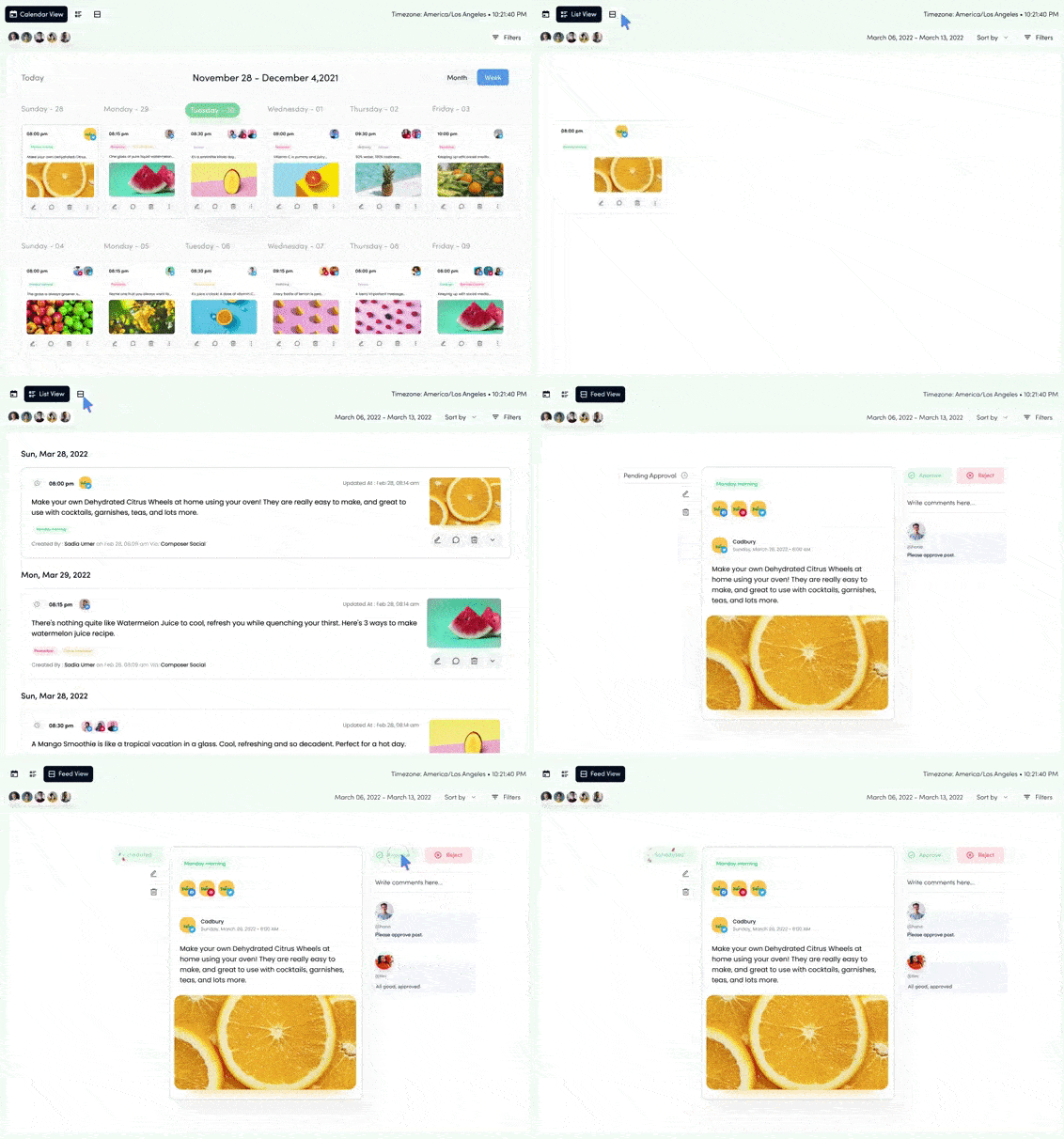
    ContentStudio-Scheduling

    Its a social media management tool. It helps you in post-scheduling, tracking analytics, monitoring conversions & tracking engagements. As a TikTok scheduling & publishing tool, you can upload media from your device’s gallery, add hashtags, and captions and upload it to your TikTok account.

    Simultaneously schedule multiple TikTok videos on multiple accounts. Contentstudio’s advanced analytics feature will give you detailed insights about your content performance across all social media channels.

    ContentStudio offers 14 days free trial.

    CapCut

    Capcut

    This is an all-in-one video editing app. Trending stickers and unique typefaces are included, and it is tailored to meet your TikTok requirements. Additionally, it is free to use.

    TikTok and CapCut have the same owners that make both apps filled with the same features & capabilities.

    Quik 

    Quik

    Quik app is the ultimate companion for all content creators on TikTok. The beat-synchronized themes and transitions in this TikTok editing app will inevitably match your content to produce stunning and shareable modifications.

    Final words

    In conclusion, getting more followers on TikTok requires a combination of creativity, consistency, and engagement. 

    It’s important to understand your audience, create high-quality content, anduse relevant hashtags to increase visibility. 

    Additionally, collaborating with other creators, participating in challenges, and leveraging TikTok’s algorithm can help you reach a wider audience. 

    With dedication and effort, anyone can grow their TikTok following and build a thriving community of fans. 

    Keep experimenting with new content ideas and strategies, and don’t be afraid to be yourself and let your personality shine through in your videos. 

    Good Luck & Happy TikToking!
    You may also like:
    TikTok For Business: Strategies to Promote Small Businesses
    How to Make Money on TikTok?
    How to create a TikTok account?

  • Track your success: How to create a tracking link?

    Track your success: How to create a tracking link?

    Link tracking is essential for businesses looking to improve their marketing efforts and understand their audience’s engagement. By monitoring clicks on specific links within a marketing campaign, businesses can gather valuable data and make informed decisions that lead to increased conversions and a better return on investment.

    For example, imagine a business has created a landing page, an email marketing campaign, or a newsletter to promote its product or service. These marketing efforts require links that redirect the audience to the offered product or service. To ensure the success of future marketing communications and interactions, the business needs to know which links are being clicked by the audience.

    This information is valuable for businesses as it reveals engagement statistics and helps evaluate the marketing campaign’s success. By tracking clicks on specific links, businesses can gather data on the number of clicks, the location of clicks, and the time of clicks, which can then be used to improve future marketing efforts and increase conversions.

    Also Read: How to Create a perfect Call-To-Action (CTA) For Maximum Conversion

    How to Create a Tracking Link with Replug: Step-by-Step Process

    Shortening URLs for link tracking with Replug is a quick and simple process. Follow the steps below:

    Step 1: Sign in to Replug or create an account for free. 

    Step 2: Select the desired campaign on the main dashboard or create a new one in a few seconds. 

    Note: To create a new tracking link, you must create a campaign or select an existing one.

    campaign

    Step 3: Paste the link you want to track in the “URL to shorten” section below the “select your campaign” section. 

    Note: You can also add the UTM parameters to your link. Learn how to add UTM parameters. 

    URL to shorten

    Step 4: Click the create button to create your shortened URL

    create

    Step 5: Now, you have the shortened version of your link. Click the edit icon to customize your link.

    shorten link

    Step 6: Click the update button after editing the link, and you’ve your tracking URL ready. 

    update button


    Replug Branded Short Links CTA
    Maximize marketing ROI
    by transforming ordinary URLs into
    branded short links that convert.
    Try Replug for free

    Check the tracking parameters:

    Step 7: Go to the main dashboard, click manage and select Replug links from the drop-down menu. 

    manage and replug links

    Step 8: You’ll find your newly created link in the Replug links section. Click the three dots at the opposite side of the link, then click view stats. 

    view stats

    Step 9: You can view the tracking parameters, which include clicks, unique clicks, conversion, and conversion rate. 

    Note: You can also view the detailed stats on this page by scrolling down. For clarification, watch the video below.

    How to create a tracking link

    Note: For a quick and effective way to shorten your links while tracking performance, try link shortener free.

    Also Read: What Is A Vanity URL & How To Track It?

    Frequently asked questions 

    What is a tracking URL?

    A tracking URL is a hyperlink that tracks clicks on a specific link. It usually contains additional parameters and codes used by tracking software to track the clicks’ source, location, and behavior. The information collected through tracking URLs can be used for various purposes, such as website analytics, marketing campaigns, and conversion tracking.

    How do tracking links work?

    Tracking links work by redirecting clicks from the original link to a tracking link that contains additional parameters. When a user clicks on the tracking link, the tracking software records the information about the click, such as the source, location, and behavior of the user.

    The tracking software then sends the user to the original link while keeping a record of the information gathered through the tracking link. This information can then be analyzed to improve marketing strategies, track conversions, and gather insights into user behavior. The tracking process is typically transparent to the user and occurs in the background without affecting the user experience.

    You may also like:

    What Are Tracking Pixels?

    How to Create a QR code for a URL?

    Campaign Tracking: Data-Driven Tools for Marketers

  • How to get followers on Instagram fast?

    How to get followers on Instagram fast?

    Instagram is one of the most popular social media platforms in the world. It has over 1 billion users and is used by people of all ages. With so many people using it, it can be a great way to build a following and grow your brand. But how do you get followers on Instagram fast? 

    In this article, we’ll discuss how to get followers on Instagram quickly and easily.

    How to Grow Your Instagram Following?

    It’s no secret that Instagram is a great platform to build a following and promote your business. But it can also be a difficult platform to crack, especially if you’re just starting.

    The good news is that you can use simple strategies to quickly and easily grow your Instagram following. By following these tips, you can get more followers on Instagram and start to see the results you want.

    Also Read: 21 Instagram Story hacks to boost your engagement

    How to Get Followers on Instagram Fast – 5 Tips

    Now that you know the benefits of growing your following on Instagram, let’s look at some tips and strategies to get more followers quickly.

    Tip 1: Optimize Your Profile

    Optimizing your profile is the first step to getting more followers on Instagram. Your profile is your first impression and needs to be attractive and engaging. Choose a profile picture representing your brand or personality, and use a clear and concise bio explaining who you are and what you do. Make sure your bio includes relevant keywords that people might be searching for.

    optimize your profile

    Also Read: How to link Instagram to TikTok?

    Tip 2: Post high-quality content consistently

    Posting high-quality content consistently is crucial to gain more followers on Instagram. Create a content strategy and stick to it. Plan out what you want to post, when you want to post it, and how you want to present it. Your content should be visually appealing, informative, and engaging. Use captions to provide context or tell a story that complements the visual content.

    Tip 3: Use the Right Hashtags

    Hashtags are an excellent way to increase your reach on Instagram. Use relevant and popular hashtags related to your content, niche, or industry. Research the most popular hashtags in your industry and use them in your posts. Don’t overuse hashtags, as they may make your post appear spammy. Use up to 30 hashtags per post for the best results.

    use-relevant-hashtags

    Replug Branded Short Links CTA
    Maximize marketing ROI
    by transforming ordinary URLs into
    branded short links that convert.
    Try Replug for free

    Tip 4: Engage with your followers

    Engagement is essential if you want to gain more followers on Instagram. Respond to comments, like and comment on other people’s posts, and participate in Instagram challenges and trends. Show your followers that you care about them and value their opinions. This can help build a loyal following and attract more people to your account.

    Engage with followers

    Also Read: How to add a link in bio to your Instagram profile?

    Tip 5: Collaborate with other accounts

    Collaborating with other accounts can help you gain more followers on Instagram. Find other accounts in your niche or industry and reach out to them. You can collaborate on a post, a giveaway, or an Instagram Live session. This can help you reach a new audience and gain new followers. For brands, using influencer marketing platforms can make collaborations easier by connecting you with the right creators who align with your audience and goals.

    Tip 6: Run Instagram Ads

    Running Instagram ads is a great way to reach a larger audience and gain more followers. Instagram ads can target specific demographics, interests, and behaviors, making it easier to reach the right audience. You can run ads that promote your account or a specific post, which can help you gain more followers and increase engagement.

    Instagram ads

    Tip 7: Host giveaways

    Hosting giveaways is a popular way to gain more followers on Instagram. You can create a giveaway that requires people to follow your account, like your post, and tag their friends. This can help increase engagement and attract new followers. Ensure the giveaway is relevant to your brand or niche and provides value to your followers.

    Tip 8: Use Bio Links

    Another effective way to grow on Instagram is by using bio links. Instagram allows you to add one clickable link to your bio, which you can use to promote your website, blog, or product. Here’s how you can make the most of your bio link:

    • Use a link shortener: To make your bio link more memorable and clickable, use a custom link shortener. This will also help you track clicks and analyze the performance of your bio link. Consider Replug, as it is an all-in-one link management platform offering notable features at hand.
    • Change your link frequently: Changing your bio link frequently can encourage your followers to check your profile regularly. You can use your bio link to promote your latest blog post, a new product, or a current promotion. By changing your bio link often, you can keep your followers engaged and interested in what you offer.
    • Use a call-to-action: Use a call-to-action in your bio to encourage your followers to click on your link. For example, you can write “Shop now,” “Get your free guide,” or “Join our community” to entice your followers to click on your bio link.
    • Use a landing page: Using a bio link, use a page relevant to your content or promotion. The landing page should be visually appealing, easy to navigate and provide value to your followers. This can help increase the chances of your followers converting into customers or subscribers.

    Final thoughts

    It takes time, effort, and consistency to grow on Instagram. You can attract a more influential and engaged audience by optimizing your profile, posting high-quality content, using hashtags, engaging with your followers, collaborating with other accounts, running Instagram ads, and using bio links. Remember to be authentic and genuine and provide value to your followers. You can grow your Instagram following and achieve your goals with the right strategy and mindset.

    Trending:

    How to add YouTube links to Instagram story?

  • What are tracking pixels & how do they work?

    What are tracking pixels & how do they work?

    What is a tracking pixel?

    A tracking pixel is a pixel tag or code snippet that triggers the tracking system when a visitor lands on a website page after clicking on a specific link or CTA.

    A tracking pixel works by placing it on a website or in an email and tracking the data that helps the marketer or advertiser analyze and track the campaign performances.

    Have you ever noticed how quickly you land on a “thank you” page when you finish the checkout process on an e-commerce site?

    Do you know that the largest websites, such as e-commerce platforms, social media platforms, and web portals, track their website visitors?

    Websites and apps track their users because it helps them navigate in the right direction or understand what they need to accomplish.

    In some cases, a tiny image file is added to the website or app, which usually goes unnoticed by the naked eye. While in some instances, a tracking pixel could also be a piece of code that goes into the website page URL and helps marketers track performance through clickability.

    Adding a tracking pixel on any web or app property is to collect user data to understand their behaviors, actions, and choices.

    Furthermore, it is used to track the activity of users on a website or email campaign to determine the success of the campaign.

    Let’s do this. Shall we?

    Why do you need tracking pixels?


    TrackingPixel_Info-
    Source: https://blog.shareasale.com/2016/01/25/tracking-pixels-101/

    Tracking performance is the essence of any marketing campaign, as it helps marketers understand how their marketing efforts will pan out.

    Here are four areas where tracking pixels comes in handy:

    i. Analyzing website traffic: Tracking pixels can gather data on how users interact with a website. This can help website owners understand which pages are most popular, how users navigate through the site, and where they are coming from.

    ii. Measuring the effectiveness of online advertising: Tracking pixels can measure the success of online advertising campaigns by tracking how many users click on an advertisement and then go on to make a purchase or complete some other desired action.

    iii. Targeting users with relevant advertisements: Tracking pixels can be used to track user behavior and interests, which can be used to show targeted advertisements to users that are more likely to be interested in them.

    iv, Email marketing campaign: Tracking pixels can be used to track the success of email marketing campaigns by measuring how many users open the email and click on links within it.

    No doubt, tracking pixels are important for businesses and marketers, as they allow them to gather data on how users interact with their websites and emails regardless of the platform.

    Moreover, it enables marketers and advertisers to use this information to improve their marketing efforts and relaunch their advertising campaigns more effectively.

    What are the different types of tracking pixels?

    There are two main types of tracking pixels used in digital marketing:

    Conversion Pixels

    Conversion pixels play a vital role in tracking conversions on websites and apps. For example, you may have seen “thank you” or “also check these” pages while buying products online. Such pages trigger or direct visitors to specific pages when they notice a conversion. And conversion pixels help perform this action.

    Now a product sale isn’t the only conversion. In fact, a generated lead or downloaded file is also a conversion. It depends on the campaign type and what the marketer or advertiser wants from the audience.

    Retargeting Pixels

    retargeting-pixel

    One of the most popular tracking pixels is the retargeting pixels. It’s used in retargeting campaigns in the digital marketing field. Retargeting is a marketing strategy of targeting the audience that has visited their website or landing page to convert visitors into subscribers or paid users.

    Retargeting is usually done through paid advertising. However, the targeting process begins earlier by adding a tracking parameter to the URL or the website code. Hence, the retargeting pixel collects visitor data and helps marketers reach the same audience through paid ads.

    How does tracking pixels work?

    Tracking pixels are used to track the users’ online behavior, such as the pages they visit, the links they click on, and the products they purchase.

    A tracking pixel is a piece of code that embeds into the website code or URL to track the performance of the page or link.

    In some cases, tracking pixels are tiny, transparent images placed on web pages or emails to track user behavior.

    Advertisers often use tracking pixels to track the effectiveness of their online advertising campaigns. They can also be used by website owners to track the traffic to their sites and to understand the demographics of their users.

    The way tracking pixels works is that they are often placed in the HTML code of a web page or in the body of an email. They can be implemented using JavaScript or iFrame.

    Example: Suppose a user visits a website or opens an email that contains a tracking pixel; the pixel sends a request to the server that hosts the pixel.

    This request includes information about the user’s browser, such as the user’s IP address, the type of device they are using, and the type of browser they are using.

    The server then records this information and stores it in a database. This information can be used by the webmaster or by the sender of the email to analyze the user’s behavior and tailor their marketing efforts.

    How to Set Up a Tracking Pixel Using Replug?

    Replug is a powerful free link shortener tool that allows brands and marketers to create short, branded URLs for marketing such as for social media, email marketing, and online advertising.

    It is an efficient link optimization platform, that offers UTM embedding, URL tracking, branded URLs, deep links, and other services, to open up the opportunity to retarget the audience easily.

    As Replug records data of the users’ behavior on the short links, it makes it possible for marketers and brands to retarget those people through different advertising channels.

    Replug plays an anchor role in setting up a retargeting campaign for brands and advertisers using pixel tracking.

    Here’s how you can set up tracking pixels using Replug:

    Step #1: Create a Replug account

    log-in-to-your-account

    To get started with Replug, you must first create a Replug account. Then, you just need to visit the Replug website and sign-up for a free trial account to start the process.

    Once you’ve created your Replug account, log in to your account to explore the features this URL-shortening tool has to offer.

    After the successful login to your Replug account, you’ll see the Replug dashboard, where the process begins.

    Pay close attention to all the steps for setting up a tracking pixel using Replug before jumping the gun. And more importantly, don’t create a short link right after landing on the dashboard area because you’d have missed out on a few steps.

    Step: #2: Setup your brand in the Replug account

    All the steps are crucial to setting up the retargeting pixel using Replug. Now select the appropriate brand or create a new one, just in case.

    Creating a brand on Replug would only take a few seconds. It’s highly unlikely that most readers have already set up their brands on Replug since most would be new users.

    To create a brand:

    Create a Brand

    1. Go to the “Manage” page from the dashboard header menu and click “Brands.”
    2. Option.”
    3. Click on the “Add Brand” button to get started with creating a brand.

    Once it’s done, click the “next” button to proceed.

    Step #3: Make a new campaign

    The next up is creating a new Replug campaign in line with your retargeting campaign. But first, ensure you’ve set up the brand on Replug properly.

    click campaign

    Now go to the “Manage” drop-down from the top menu and click on the “Campaigns” button, and then select “New Campaign” to get started.

    new campaign

    At this point, you’d have to select an already existing brand or create a new brand. Since you have just created a new brand, continue with the created brand in the Replug account.

    Step #4: Select retargeting as the campaign type

    select-campaign-type

    It’s one of the most important steps in the retargeting campaign because it sets the direction of the campaign. This is the part where you name your campaign and choose its type.

    Provide a name for your campaign and select the custom domain if required in the campaign. Otherwise, you can skip the custom domain section.

    However, make sure that you check the retargeting pixel option before moving on to the next step. Once you choose the retargeting pixel, it becomes crystal clear to the Replug platform that it’s a retargeting campaign.
    Also read: Retargeting Ad Examples That Convert & Drive Growth

    Step #5: Add your retargeting code

    Everything seems quite easy until this point, and I’ll ensure the last step goes as smoothly as possible.

    Now, this is the part where you select the social media platform to run your retargeting ad campaign.

    add-retargeting-pixel

    The way it works is that marketers choose the social media platform, give the pixel a name, and finally enter the pixel ID from the respective social media platform such as Facebook pixel id.

    Once everything is done, you’re all set to launch your retargeting campaign using Replug.

    Also read: How to find my Twitter Pixel ID?

    What are the key differences between a pixel and cookie?

    A pixel is a small piece of code placed on a website or in an email. It is often used to track a user’s activity on the website or email and to send this information back to the company or organization that placed the pixel.

    Pixels are typically used to track website visitors and to understand how they interact with the website.

    A cookie is a tiny chunk of data that is stored on the visitor’s computer by a website. It is used to remember certain information about the user, such as their preferences or login information. In addition, cookies are often used to personalize the user experience and to track a user’s activity on a website.

    There are some key differences between pixels and cookies:

    Purpose/Goal: Pixels are primarily used for tracking and analytics, while cookies are used for personalization and tracking.

    Placement: Pixels are placed on websites or in emails, while cookies are stored on a user’s computer.

    Size: Pixels are typically very small (a few hundred bytes), while cookies can be larger (up to 4KB).

    Duration: Pixels are usually short-lived and expire after a certain period. At the same time, cookies can persist for extended periods, depending on how they are configured.

    Privacy: Pixels can be used to track users across different websites and devices, which has raised privacy concerns. Cookies are generally less controversial, but they can also be used to track users and their activity.

    Also read: How To Utilize Replug for Facebook Retargeting Ads?

    FAQs about tracking pixels

    Is tracking pixel legal?

    Tracking pixels are legal as long as they comply with relevant laws and regulations, such as the General Data Protection Regulation (GDPR) in the European Union. Therefore, once the users comply with all the legal requirements, there shouldn’t be any problem regarding using tracking pixels.

    Is a tracking pixel a cookie?

    A tracking pixel is a small, transparent image file that is placed on a website or in an email. It is often used for tracking and analysis purposes. A tracking pixel is not the same as a cookie, a small piece of data stored on a user’s device and used for tracking and personalization targeting.

    Does pixel track steps?

    A tracking pixel does not track steps, but it can be used to track a user’s actions on a website or in an email. For example, a tracking pixel can be used to track how many people opened an email or clicked on a link.

    Is tracking pixel free?

    Tracking pixels may or may not be free to use. Some tracking pixels are provided by third-party vendors and may require a subscription or fee to use. However, social media platforms provide pixels for retargeting purposes that are free to use for advertisers.

    How to block tracking pixels?

    You can use a browser extension that blocks tracking systems set by websites to block tracking pixels. Furthermore, you can also adjust your browser settings to block or limit the use of cookies.

    Will users know if I’m using a tracking pixel?

    In most cases, users will not know if a tracking pixel is being used on a website or in an email. This is because tracking pixels are typically small and transparent, and they do not interact with the user in any way. However, as described above, users can use tools to detect and block tracking pixels.

  • How to create a vanity URL?

    How to create a vanity URL?

    Vanity URLs are a valuable tool for branding, marketing, and tracking efforts and can help to improve the overall user experience.

    This quick guide will teach you how to create a vanity URL in just a few simple steps and explain what making a vanity URL entails. 

    Let’s begin!

    Vanity URLs: how do you set them up?

    Creating a vanity URL can make it easier to remember a web address and can also build brand consistency. To create a vanity URL, you can either use a link management tool or a content management system (CMS).

    • A link management tool is a standalone platform that specializes in creating custom short links. You simply enter the long URL you want to shorten, and the URL shortener tool generates a vanity URL within seconds.
    • A CMS, on the other hand, is a platform used to manage the content of a website. Some CMSs’ have built-in redirect functionality, but others may require a redirect plugin to create a vanity URL. To use a CMS to create a vanity URL, you would set up a redirect from the custom short link to the longer, original URL.

    In either case, a vanity URL can be easily shared and is a useful tool for branding and marketing.

    Also read: What is a vanity URL & how to track it?

    How to create a vanity URL using a link management tool?

    Creating a vanity URL using a link management tool has several benefits, such as:

    • A memorable URL can increase click-through rates and drive more traffic to a website.
    • Vanity URLs can be tracked and measured, enabling businesses to gain a deeper understanding of their campaigns. 
    • A link management tool can allow for the creation of multiple vanity URLs, making it easier to manage multiple campaigns and track their performance. 

    Boost your marketing with Replug’s vanity URL builder

    By using Replug’s vanity URL builder, businesses can improve the efficiency and effectiveness of their marketing efforts, increase click-through rates, and drive more traffic to their website.

    Here’s how you can create a vanity URL using Replug:

    Step 1: Sign in to Replug or create an account for free.

    replug-signup

    Step 2: Once you’re on the main Replug dashboard, simply enter the long URL in the bar under “Quickly Shorten your link”:

    link-shortening

    Step 3: Click on the blue arrow button to autogenerate your vanity URL using Replug:

    vanity-url

    Step 4: Your vanity URL will be generated. You can customize the URL slug using the edit icon to fit your needs:

    custom-url-slug

    Step 5: Save and share your shortened, memorable link:

    save-vanity-url

    Also read: How to shorten a link using a URL shortener

    How to make your vanity URL more clickable?

    To make your vanity URL more clickable using Replug, follow these steps:

    Choose a short and memorable vanity URL: The shorter the URL, the easier it will be for your audience to remember and click on it.

    Use a relevant keyword: Use keywords relevant to the content behind the link so people know what they’re clicking on.

    Use a recognizable brand name: If your brand has a recognizable name, use it in your vanity URL to build trust and make it more recognizable.

    Create a custom domain: Replug allows you to create a custom domain for your short links, which can make your links look more professional and increase clicks.

    Add a call-to-action (CTA): Adding a CTA to your vanity URL can encourage people to click on it. For example, “Click here to learn more” or “Get your discount now”.

    Use UTM parameters: Utilize UTM parameters to track the performance of your links and make data-driven decisions about future link campaigns.

    Test and iterate: Test your vanity URL and track its performance to see what’s working and what’s not. Make changes and improvements based on the data you collect.


    Boost ROI with branded URLs - Replug dashboard showing performance metrics and branded URL creation
    Boost ROI with
    branded URLs!

    Enhance your marketing campaigns by creating shareable, trackable, and fully multi-purpose customizable branded URLs.

    Try Replug for free

    See Also:

    How to rename a link using Replug?

    What Is Affiliate Link Cloaking & How To Do It?


  • How to create and use branded short links for SMS marketing: A detailed guide!

    How to create and use branded short links for SMS marketing: A detailed guide!

    Looking for a way to connect with your customers and boost engagement without getting lost in crowded inboxes? SMS marketing is the accurate answer. It provides a direct, effective, and highly engaging way to reach your audience instantly.

    But why stop there? By incorporating branded short links into your SMS campaigns, you can save valuable character space while gaining powerful insights into how your audience interacts with your messages.

    Whether you’re a small business owner aiming to expand your reach or a marketer looking to supercharge your campaigns, SMS links can help you achieve your goals pretty well.

    Let’s explore how these branded short links can transform your SMS strategy and drive measurable results!

    What are short links for SMS?

    Short links for SMS are shortened URLs used in SMS marketing messages to conserve valuable character space and enhance tracking and analytics. 

    These links function by redirecting users to the intended landing page or website while tracking data, including clicks, time spent on the page, and conversion rates.

    When sending SMS messages, businesses often have a limited number of characters to work with. By using short links, they can include more information in their messages while still maintaining a clear and concise message. 

    Short links also allow firms to track click-through rates and other valuable data that can be used to optimize their SMS marketing campaigns.

    How to create a branded shortened link for SMS marketing

    Getting started with crafting short links for SMS marketing is pretty straightforward. All you need is a reliable custom link shortener, and you’re ready to optimize your campaigns. 

    Here’s a step-by-step guide to help you set things up the right way:

    Step #1: Use a dedicated SMS platform

    Before you start shortening and sending links, it’s essential to have a dedicated SMS marketing platform in place. 

    These platforms are specifically designed for managing large-scale SMS campaigns. They offer features like audience segmentation, automation, compliance with SMS regulations, and message scheduling. 

    A good SMS platform ensures your messages are delivered efficiently and at the right time, helping you maximize engagement and ROI. 

    Tools like Replug and Twilio integrate seamlessly with link shorteners, providing a solid foundation for your campaigns.

    Step #2: Choose a link-shortening tool

    Once your SMS platform is ready, the next step is to pick and configure a link-shortening tool. 

    Replug is a top-tier option that goes beyond basic shortening, offering powerful features such as click tracking, branded domains, retargeting, and in-depth analytics. 

    These capabilities help you monitor link performance, build trust with custom URLs, and ultimately drive better results from your SMS campaigns. 

    Don’t settle for less when it comes to SMS marketing. Sign up for Replug today and start seeing results!

    Step #3: Create your shortened link

    Let’s say you select Replug as your link-shortening tool. You can create a shortened link for your SMS campaign by simply pasting your original URL into Replug’s “Shortened link” box and generating a new, shortened link within seconds.

    Shorten SMS link

    Step #4: Use a custom domain

    To strengthen brand consistency and recognition, personalize your short link with a custom domain. Instead of using a generic shortener domain, your SMS messages can include your brand name in the slug. This not only looks professional but also builds credibility with your audience. So, add accordingly!

    Add your custom domain

    Step #5: Add link preview

    Some devices display a small link preview when a shortened link is shared. With Replug, you can customize its appearance hassle-free, adding a title, description, or image that makes your link more attractive and clickable.

    Customize link preview

    Step #6: Route links

    Advanced tools like Replug let you set up link routing. This means you can send different users to different destinations based on factors like location, device type, or campaign variations. It’s quite beneficial for A/B testing or running multi-location promotions.

    Add traffic routing rules
    Add traffic routing rules

    Step #7: Include a strong call to action (CTA)

    To encourage customers to click on your shortened link, include a clear call-to-action in your SMS message. For example, you could say “Click here to try our new pizza flavor!” with the shortened link included in the message.

    Step #8: Add deep links

    Deep links allow you to send users directly to a specific page within your app or website, rather than just the homepage. This saves customers valuable time and increases conversions. For instance, an e-commerce brand can send shoppers straight to a product checkout page. 

    By following the steps outlined above, you can easily create a branded shortened link tailored for SMS marketing that promotes trust, engagement, and CTR.

    Why use short links in SMS marketing?

    Short links are a must-have tool for businesses seeking to upgrade their SMS marketing strategy. Here are some convincing reasons why you must utilize short links for SMS marketing.

    To save space (character count limits)

    SMS messages have a 160-character limit, so every character counts. Shortened links take up less space, giving businesses more room to communicate their message effectively. 

    For example, a retailer can send a message with a shortened link to a product page, allowing them to provide a brief description and the link in one message.

    For click tracking & analytics

    Shortened links can be used to track clicks and engagement, giving enterprises valuable data on the effectiveness of their campaigns. 

    For instance, a charity can send an SMS message with a shortened link to a donation page. By tracking clicks on the link, they can determine the success of the campaign and adjust future ones accordingly.

    For an optimized mobile experience

    Most people access SMS messages on their mobile devices, and shortened links can lead to a better user experience on these gadgets.

    For example, an airline can send an SMS message with a shortened link to a mobile boarding pass. This makes it much easier for passengers to access and use the pass on their smartphones.

    To increase brand recognition

    Shortened links can be customized with branded domains, helping to increase brand recognition and trust. 

    For instance, a fashion brand can send an SMS message with a shortened link to a new collection, using a branded domain.

    For seamless A/B testing

    Shortened links can be used for A/B testing and optimization of SMS campaigns. 

    For example, an online retailer can send two different SMS messages with different shortened links to a product page and track which link receives more clicks. They can then optimize future campaigns for increased engagement.

    To enhance trust & click-through rates (CTR)

    Branded shortened links look cleaner and more trustworthy than long, generic URLs. When recipients see a familiar brand name in the link, they’re more likely to click, leading to higher engagement and conversions.

    For instance, a fitness app can send an SMS with a branded short link, such as “fitco.app/joinnow”, which appears more reliable than a random string of characters.

    For better deliverability

    SMS messages containing long or suspicious-looking links may get flagged by carriers or filtered as spam. Short, clean links reduce the risk of this happening, ensuring your message reaches the recipient’s inbox without interruption.

    For example, a financial service can use a shortened, verified link to send account update notifications, reducing the chances of carrier rejection or message filtering.

    For additional data points

    Shortened links can capture additional data, such as device type, location, and time of click, providing deeper insights into audience behavior and preferences. This ultimately helps to refine future campaigns.

    For instance, a restaurant chain can use shortened links in SMS campaigns to track which city or time slot gets the most reservations, tailoring promotions based on that data.

    Also read: How to use shortened URLs for marketing

    How brands use short links for SMS marketing: Check out the examples

    Here are a few ways renowned brands are utilizing short links in their SMS marketing efforts.

    Dunkin’ Donuts

    Dunkin’ Donuts uses SMS marketing to send exclusive deals and promotions to its customers. 

    To track the success of their campaigns, they use shortened links that lead customers to a landing page with the offer. 

    This enables Dunkin’ Donuts to measure engagement and optimize its campaigns for improved results.

    Subway

    Subway uses SMS marketing to send coupons and special offers to its consumers. 

    To provide a better user experience, they use shortened links that lead customers to a mobile-friendly coupon page. This allows them to redeem the offer on their mobile devices easily.

    Coca-Cola

    Coca-Cola uses this technique to promote new products and events to its customers. 

    To increase brand recognition, they use custom domains for their shortened links. For example, they might use a link like “www.coke.com/newproduct” to promote a new product launch.

    Nordstrom

    Nordstrom utilizes SMS marketing to send personalized recommendations to its clients. 

    To track engagement and improve their recommendations, they use shortened links that lead customers to a product page with more information about the recommended item.

    Zara

    Zara uses this marketing strategy to promote new collections and limited-time offers to its customers. 

    To increase engagement and drive sales, they use shortened links that direct customers to a product page featuring the collection or offer.

    These are just a few examples of how brands are using short links for SMS marketing to enhance their campaigns and achieve their marketing goals.

    Example of a good and bad SMS with shortened links

    The way you incorporate shortened links in SMS marketing can significantly impact your campaign’s effectiveness. A well-crafted message with a shortened link should be clear, relevant, and aligned with your brand, encouraging trust and clicks. 

    On the other hand, a poorly written SMS with an unbranded or unclear link can confuse recipients, lower click-through rates, and even trigger spam filters. 

    Below is a precise example to illustrate the right and wrong ways to use shortened links in your SMS campaigns.

    Good SMS Example:

    Hi Sarah! Our Fall Sale is now live 🍁 — enjoy 30% off all items this week only! Shop now: brandshop.co/fall30

    Why it’s good:

    • Personalized greeting
    • Clear offer and urgency
    • Branded short link (adds trust)
    • Friendly, concise tone

    Bad SMS Example:

    SALE NOW ON! Click here for 30% off: bit.ly/3xY2zZq

    Why it’s bad:

    • All caps feel forceful
    • No personalization
    • Vague message
    • Generic, unbranded link (may seem suspicious)

    Wrapping Up

    In conclusion, branded short links are a powerful tool for SMS marketing, offering enhanced brand recognition, improved click-through rates, and valuable analytics. 

    By creating concise, trustworthy, and trackable links, brands can optimize their campaigns and drive engagement effectively. 

    As shown through examples, well-crafted SMS with branded links resonate with audiences, while poorly designed ones risk losing trust. 

    By following the steps outlined to create and implement these links, businesses can strengthen their SMS marketing strategy. This ensures messages are impactful, professional, and aligned with their brand identity, ultimately facilitating stronger connections with customers in a competitive digital landscape.

    Frequently asked questions

    Why SMS Marketing matters for digital marketers?

    SMS marketing is essential for digital marketers in 2026 due to its 98% open rate and rapid 90% read-within-3-minute delivery. It enables direct, immediate customer engagement that far surpasses email. 

    With 66% of businesses adopting SMS software and increasing budgets, it drives high ROI through personalization and AI integration in omnichannel strategies.

    How effective is an SMS campaign including short URLs?

    SMS campaigns with short URLs achieve 98% open rates and 36% click-through rates, with 28% of recipients clicking links for enhanced tracking and conversions. 

    Short URLs optimize message length, boost readability, and support 45% response rates, making them 30% more cost-effective than traditional methods.

    What are the best link shorteners for SMS marketing in 2026?

    Replug stands out for SMS marketing with its all-in-one link management, retargeting, and bio tools tailored for marketers. 
    Bitly offers trusted, simple shortening with strong analytics and brand recognition for reliable campaign tracking. 
    Klaviyo integrates AI-driven SMS with short link support for personalization, while
    Twilio enables programmable SMS workflows incorporating shortened URLs for scalable engagement.

    How can I optimize my SMS marketing campaigns using short links?

    Use branded short links to enhance trust, reduce character count, and lower SMS costs while maintaining clear, concise messaging. Draw click tracking and analytics from shorteners to measure engagement, A/B test variations, and direct to mobile-optimized landing pages for higher conversions.