Every time you type a web address into your browser, a lot more is happening behind the scenes than you might think.
Today, the internet hosts over 1.4 billion websites, and roughly 252,000 new sites are created every single day. With such massive scale, the web relies on precise systems to identify and locate resources quickly, and that’s where terms like URI and URL come into play.
Most people use these terms interchangeably, but they’re not exactly the same. In fact, a URL is actually a type of URI, designed specifically to locate a resource on the web. Understanding this subtle difference can help developers, SEO specialists, and tech enthusiasts better grasp how web addressing truly works.
So before you assume they mean the same thing, let’s break down the key distinctions between URI vs URL.
URI vs URL: Key differences that you must know!
People often say “URI” and “URL” as if they are interchangeable. In reality, a URL is one specific type of URI, and each serves a slightly different job. The table below highlights the core differences so the URI vs URL debate finally makes sense.
| Aspect | URI | URL |
| Purpose | Identify a resource by name, location, or both. | Identify a resource and show where and how to access it. |
| Scope | Broad category that includes URLs and URNs. | Narrower group that always acts as a locator. |
| Persistence | Can be long term, especially when used as stable names. | Often changes when domains, servers, or paths change. |
| Relationship | Every URL is a URI, but not every URI is a URL. | A URL is a specific kind of URI. |
| Syntax | General form scheme:[//authority]path[?query][#fragment]. | Follows URI syntax but implies a network access method. |
| Example | mailto:hello@example.com, urn:isbn:978-3-16-148410-0. | https://replug.io/blog/uri-vs-url. |
| Use cases | Namespaces, app schemes, abstract identifiers, standards. | Web pages, APIs over HTTP, marketing links, file downloads. |
| When to use | When speaking broadly about identifiers or standards. | When you mean a clickable web address or tracking link. |
What is a URI?
A Uniform Resource Identifier (URI) is a string that identifies a resource. That resource might be a web page, an image, a phone number, or even a book in a catalog. URI is the big umbrella in the URI vs URL discussion: URLs and URNs both sit under it.
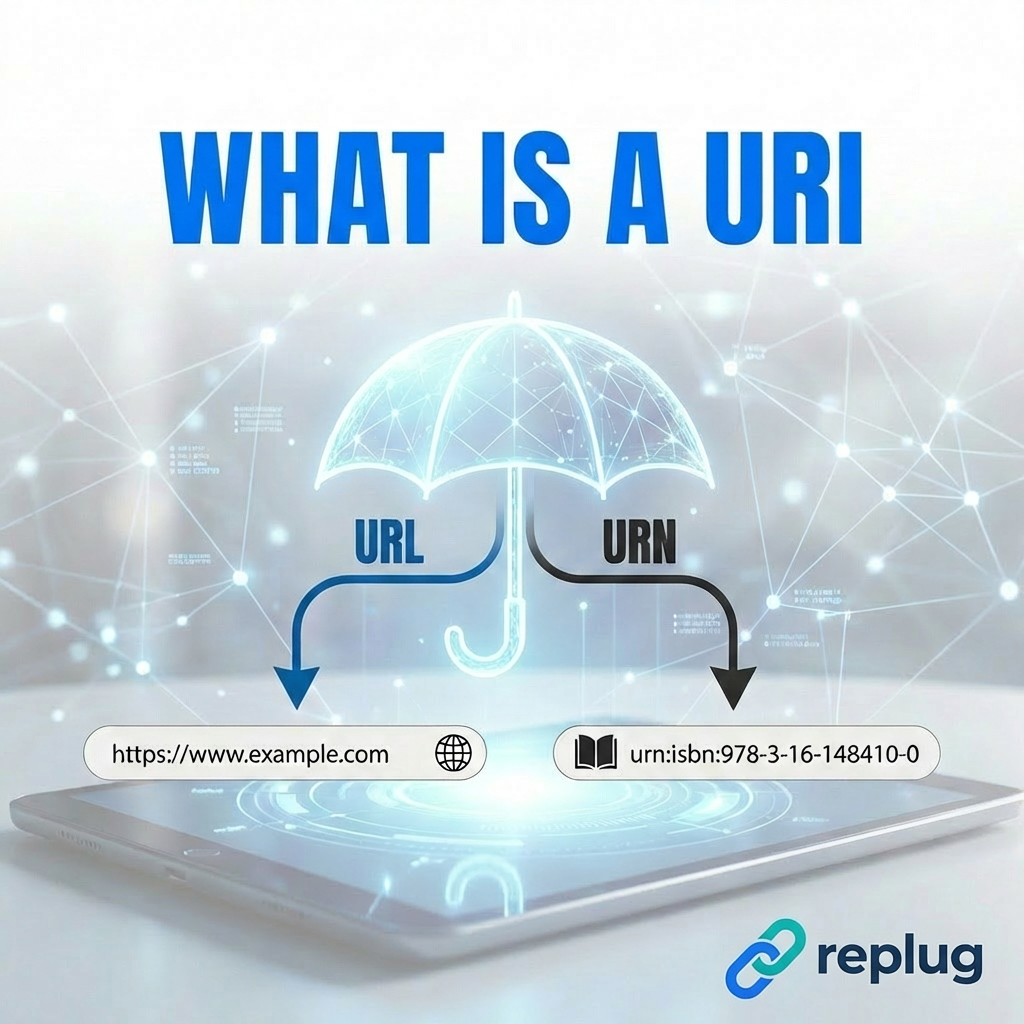
The main job of a URI is “identification.” It may also show how to reach the resource, but it does not have to. That is why every URL is a URI, while not every URI is a URL.
Syntax of a URI
The URI syntax or structure follows a shared pattern, even though different schemes use it in different ways. A common generic form looks like this:
scheme:[//authority]path[?query][#fragment]
Each part has a specific role:
- Scheme: Tells the client what kind of identifier it is, such as
https,mailto,tel, orurn. - Authority: Often holds the host name and sometimes user info and port, such as
www.example.comorapp.replug.io. - Path: Points to a more specific resource under that authority, like
/blog/uri-vs-url. - Query: Adds extra data, such as
?utm_source=email, often used for tracking or filtering. - Fragment: Jumps to a specific part of the resource, such as
#pricingon a long page.
Not every URI needs every part, but they all follow this overall pattern.
URI examples
URIs show up all around daily browsing and app use, not just as website addresses. Some look like classic web links, while others look more like commands.
Here are clear examples of URIs:
https://replug.io(a URI that is also a URL to Replug’s homepage)mailto:support@replug.io(a URI that starts an email to that address)tel:+1-800-555-1234(a URI that can start a call on a phone)urn:isbn:978-3-16-148410-0(names a book by its ISBN without saying where it lives)ftp://files.example.com/data.csv(points toward a file on an FTP server)
Real-world use cases of URI
URIs appear anywhere software requires a consistent way to point at something, even when there is no browser window in sight.
- App launchers and handlers (URI schemes) use custom schemes so links can open apps hassle-free. For instance, a link like
myapp://profile/123can open a profile screen inside a mobile app rather than a web page. This is still a URI, even though it does not use HTTP. - Web resources are the URIs that people see the most.
https://replug.io/blog/uri-vs-urlis both a URL and a URI, because it identifies a resource and describes how to reach it over HTTPS. - API resource identification uses URIs to mark data objects. In a REST API,
/users/42underhttps://api.example.comacts as the identifier for a specific user, and teams often refer to it as a resource URI. - Unique identifiers for data appear in systems like RDF or XML namespaces, where URIs act like global names. They might look like URLs but are used mainly as stable identifiers inside data.
- Data URIs for embedding let developers include small files directly in HTML or CSS using a
data:scheme. A single URI can hold an image in base64 format, which removes the need for a separate file request.
What is a URL?
A Uniform Resource Locator (URL)is the kind of URI almost everyone knows as a web address. It both identifies a resource and explains how to reach it over a network. This is the “locator” side of the URI vs URL comparison.
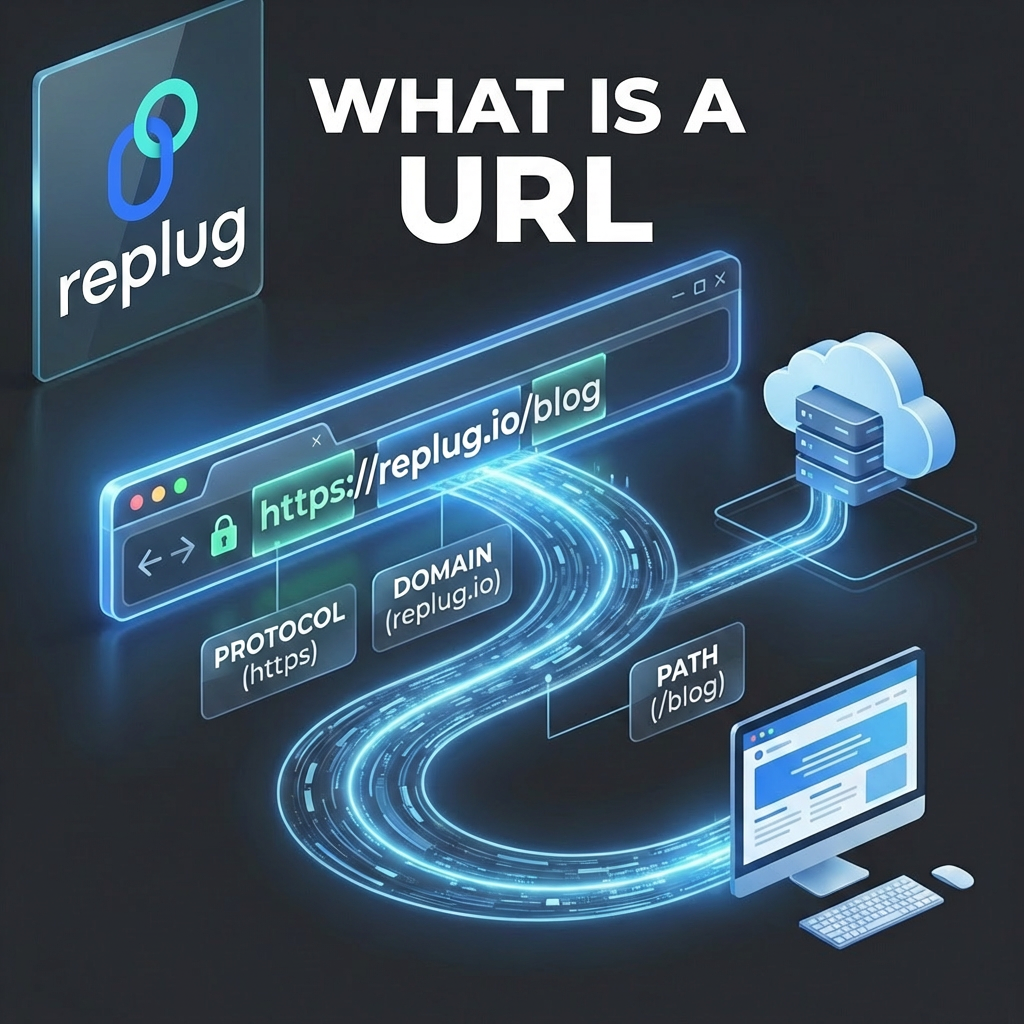
Every time someone types https://replug.io into a browser or taps a short link in a campaign, they are using a URL. It has a clear protocol, a domain, and often a path and extra parameters.
Syntax of a URL
A typical URL follows a more specific pattern than the general URI form. It must include a scheme that defines a network protocol, and it often includes an authority and path.
Common parts of a URL are:
- Scheme (protocol): Usually
httporhttps, which defines how the browser talks to the server. - Domain name: For example
replug.ioorblog.replug.io, which points to the server that will answer the request. - Port: May appear when a non-default one is needed, such as
:8080. - Path: Shows which resource to fetch, such as
/features/url-shortener. - Query parameters: Like
?utm_source=twitter&utm_medium=social, which add tracking or filters. Marketing professionals work with these all the time in campaigns. - Fragment (anchor): Like
#pricing, which tells the browser to scroll to a specific section on the page.
Together, these pieces describe both what to fetch and how to reach it.
URL examples
URLs are everywhere, from simple homepages to complex tracking links. All of the following are URLs and, by definition, also URIs:
https://replug.io(loads the main Replug site over HTTPS)https://replug.io/blog/uri-vs-url(goes straight to a specific blog article on URI vs URL)https://app.replug.io/login?next=/dashboard(a login page that also passes a next-step path as a query)https://yourbrand.link/summer-sale(can be a branded short link that redirects to a longer destination)ftp://downloads.example.com/manual.pdf(uses FTP instead of HTTP to fetch a PDF file)
Real-world use cases of URL
URLs power almost every web and app experience, especially for marketers and tech teams who care about traffic and tracking.
- Web browsing and information access rely on URLs for every page view. When someone types a domain or clicks a link in search results, the browser uses the full URL to request the right HTML, CSS, images, and scripts.
- APIs and web services use URLs as endpoints for requests, such as
https://api.example.com/v1/users. Each endpoint URL maps to a specific action, making it easy for teams to document and test interfaces. - Marketing and tracking center on URLs with UTM tags and redirects. With Replug, marketers can shorten long campaign URLs, keep brand domains in front of users, and track every click on channels like social, email, and SMS from one dashboard.
- Deep linking and app functionality use special URLs to open specific screens inside apps. These links can send a user straight from a campaign into a product page or cart screen seamlessly.
- SEO and site structure depend on clear, readable URLs. Clean paths like
/blog/uri-vs-urlsignal topic focus to search engines and make it easier for humans to understand where a link leads. - Object/blob URLs appear when browsers create temporary links to in-memory files, such as
blob:https://example.com/.... These URLs never leave the local browser, but they still follow URL standard rules. - System workflow and documentation often list URLs to admin panels, dashboards, or webhooks. Clear naming and consistent URL patterns help teams understand how different parts of a system connect.
When to use URI vs URL
Both terms are correct, but they fit different conversations more properly. Knowing when to say URI vs URL keeps specs, docs, and meetings clear.
- Use URI when talking about identifiers in standards, architecture diagrams, or low-level API design. In these contexts, people may work with URLs and URNs together, so the broader term makes more sense. It signals that you care about the idea of identification, not just web addresses.
- Use URL when you mean a real, clickable web address. That includes landing pages, tracking links, deep links, and API endpoints built on HTTP or HTTPS. For marketers and social media managers, saying URL is almost always the clearest choice when planning campaigns.
- Use both terms together when you want to be precise, for example, in technical documentation: “This API exposes three resource URIs, all of which are available as HTTPS URLs.”
How are URIs and URLs related?
The URI vs URL confusion mostly comes from their close relationship. A URI is the general idea of “an identifier string,” and a URL is one specialized form that includes location and access method.
The table below shows how these two line up without lunging into heavy theory.
| Aspect | URI | URL |
| Definition | Any formatted identifier for a resource. | A URI that also acts as a network locator. |
| Subset relationship | Big set that includes URLs and URNs. | Smaller set that fits entirely inside the URI group. |
| Analogy | “Animal” in a biology chart. | “Dog” inside the animal group. |
| Types | Includes URLs, URNs, and other scheme-based identifiers. | Mostly HTTP, HTTPS, FTP, and similar network locators. |
| Components | May use scheme, authority, path, query, and fragment. | Uses the same pieces but always has a real access scheme. |
Difference between URI vs URL vs URN
So far, URI vs URL has been the main focus, but URN is part of the picture too. A URN is a URI that acts like a long-lasting name, without any built-in location.
This table lines up all three so the roles are crystal clear.
| Aspect | URI | URL | URN |
| Stands for | Uniform Resource Identifier | Uniform Resource Locator | Uniform Resource Name |
| Definition | General string that identifies a resource. | URI that identifies and locates a resource on a network. | URI that names a resource in a stable way. |
| Purpose/Function | Provide a standard way to refer to resources. | Tell clients where the resource is and how to get it. | Give a long-term, location-free label for a resource. |
| Relationship | Superset that contains URLs and URNs. | Subset of URIs focused on location. | Subset of URIs focused on naming. |
| Persistence | Varies by use. | Can change with hosting or routing changes. | Designed to stay the same even if the resource moves. |
| Key feature | Flexible and scheme-based. | Includes protocol and usually a domain or IP. | Uses the urn: scheme with a namespace and specific string. |
| Example | mailto:info@example.com. | https://replug.io/blog/uri-vs-url-vs-urn. | urn:isbn:978-3-16-148410-0. |
If you need to remember only one thing, just remember this formula: URI is the family name, and URL and URN are two members of that family.
Wrapping up
Knowing the actual difference between URI and URL turns vague tech jargon into clear signals about how web addresses work.
- URIs are the broad idea of identifiers,
- URLs are the web-ready locators everyone clicks, and
- URNs are stable names in more specialized systems.
When those URLs start feeding real visitors into campaigns, a tool like Replug becomes very helpful.
Replug is an all-in-one link management platform that turns long URLs into clean, branded short links, adds tracking, supports deep linking, and centralizes analytics. Its URL shortener sits at the center of that stack, helping teams share smarter links across social media, email, SMS, and more.
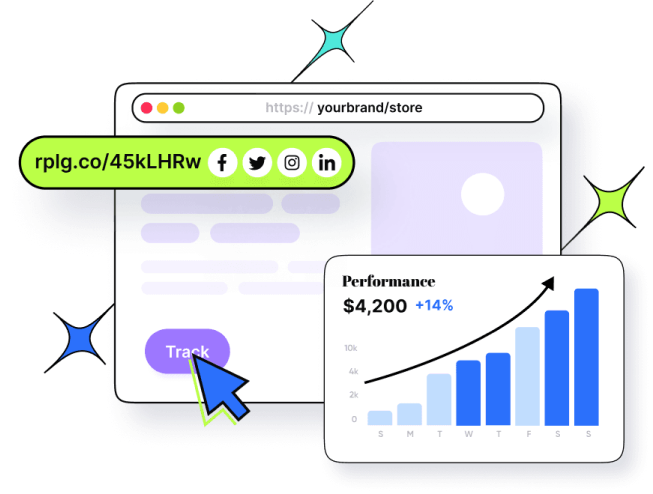

If your team works with a lot of marketing links or campaigns, trying Replug for your link management and reporting can make daily work much easier. Give it a try today!
Frequently asked questions
Is URI the same as URL?
No! A URL is one type of URI, but not every URI is a URL. URI is the broad term for identifiers, while a URL always shows where the resource lives and how to reach it.
What is URI vs URL vs endpoint?
A URI is any formatted identifier, and a URL is a URI that also acts as a locator. An endpoint is a specific URL in an API where requests are sent, such as https://api.example.com/v1/users. In short, every endpoint is a URL, and every URL is a URI.
What is URI vs URL vs path?
A URI is the general identifier, and a URL is the locator-style URI. The path is only one part of a URL or URI, usually the part after the domain, like /products/123. You cannot send a request with a bare path alone. It needs a full URL.
Can a URI be an IP address?
A plain IP address by itself is not a URI. When used inside something like http://192.0.2.1/home, the full string becomes a URL, which also counts as a URI. The scheme and structure are what make it a URI. IP addresses are commonly used in the authority section of a URI to specify the location of a server, often replacing a domain name.
Are URIs or URLs more commonly used?
In everyday language, people say URL much more frequently. However, in technical specs and formal documents, writers typically use URI because it covers both URLs and URNs. So, URI vs URL is mostly a question of audience and context.
Which one should I use, a URI or a URL?
For marketing, SEO, and most business chats, use a URL. That word clearly points to clickable web addresses and tracking links. Use URI when writing technical docs or API specs that might include URLs and other identifier types together.
How to convert a URL to a URI?
You do not need to convert anything, because every URL is already a URI. If someone asks for a resource URI, you can safely provide the same string you use as the URL.
Why is it important to know the difference between URI vs URL?
Clear URI vs URL usage helps teams avoid confusion in docs, code, and meetings. It also makes API contracts, SEO plans, and tracking setups easier to read and maintain. Small clarity gains here can prevent bugs and miscommunication later.
Can a URI be both a URL and a URN?
In practice, no! A given string is treated either as a URL, which locates a resource, or as a URN, which only names it. Both sit inside the larger URI group, but they play different roles.
What are absolute vs relative URIs and URLs?
An absolute URI or URL includes everything needed to reach a resource, such as https://replug.io/blog. A relative one depends on a base, for example, /blog when the browser already knows the current domain. Developers often use relative paths inside sites and absolute URLs in emails, ads, and social posts.