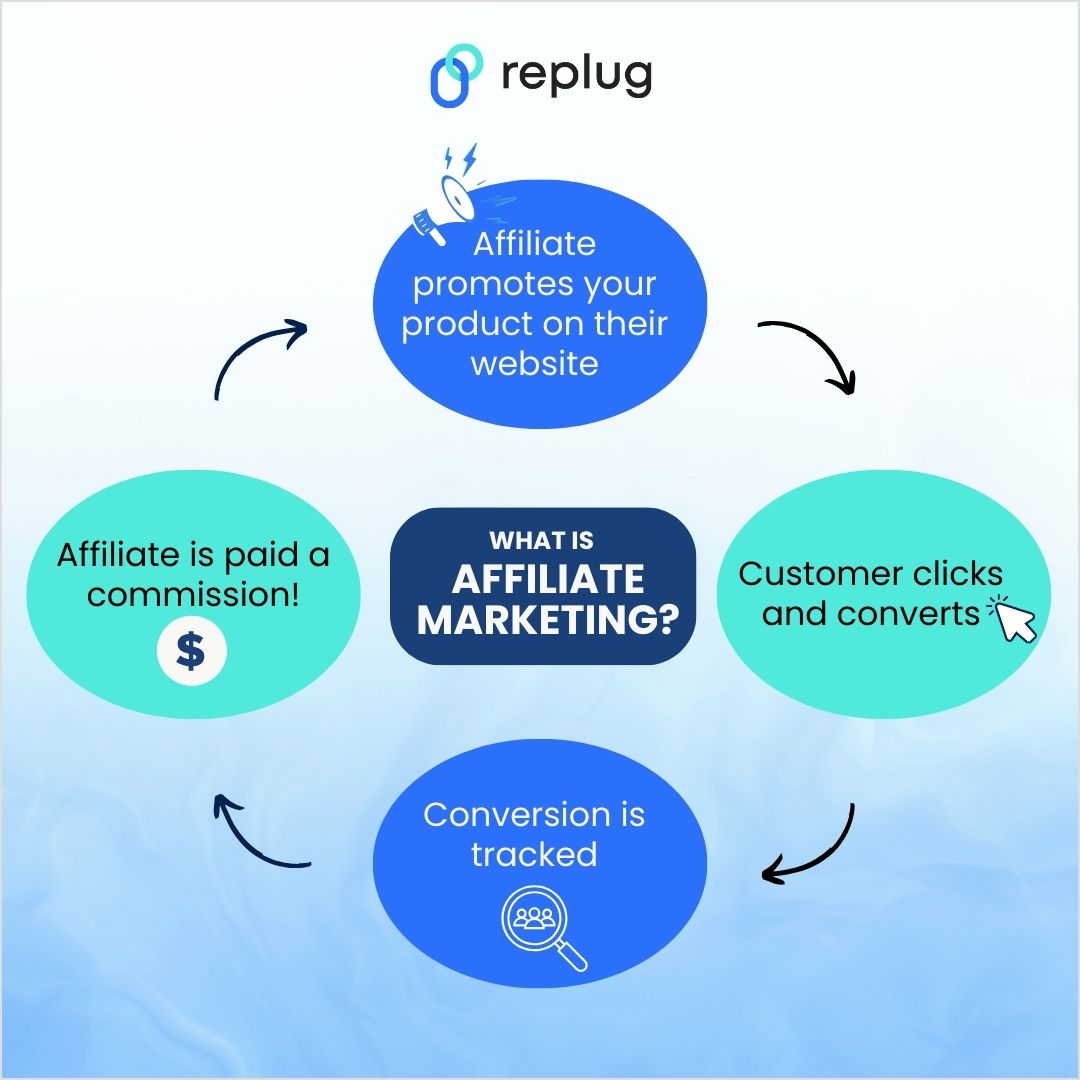
Affiliate marketing is one of the easiest ways to earn money online – whether you’re a creator, blogger, or run a business. And it all starts with a single link: the affiliate link.
Think of it as your personal tracking link. When someone clicks it and makes a purchase, you get paid. It’s that simple. But how does it actually work? And how can you make the most of it?
Let’s walk you through the basics, plus how tools like Replug can take your affiliate strategy to the next level.
Maximize marketing ROI
by transforming ordinary URLs into branded short links that convert.
Try Replug for free
Merchants (also called advertisers or retailers) who sell products or services
Affiliates (publishers or partners) who promote those products
Consumers who purchase the products through affiliate recommendations
The affiliate acts as an intermediary, connecting potential customers to merchants. In return for driving sales, the affiliate receives a percentage of each successful transaction.
What are affiliate links?
An affiliate link is a unique URL assigned to an affiliate (that’s you!) by a company or brand. When someone clicks on that link, makes a purchase, or completes a specific action, you earn a commission. Simple as that.
How affiliate links actually work?
When a merchant sets up an affiliate program, they generate unique tracking links for each affiliate. These links contain tracking parameters or cookies that identify:
The affiliate’s ID – A unique identifier assigned to each affiliate partner
The specific product being promoted – Often indicated in the URL structure
The campaign or promotional channel – To track which marketing efforts are most effective
Here’s what happens behind the scenes when someone clicks an affiliate link:
A consumer clicks on the affiliate link in a blog post, video description, or social media post
The link redirects them to the merchant’s website
A tracking cookie is placed in the consumer’s browser (typically lasting 7-90 days)
If the consumer makes a purchase within the cookie’s duration, the sale is attributed to the affiliate.
The merchant’s affiliate system (such as ReferralCandy) records the transaction and assigns the commission to the affiliate
Managing affiliate links
Every click matters in affiliate marketing. Replug helps you take control, track performance, boost conversions, and stay organized effortlessly.
Alongside managing affiliate URLs, many marketers also use tools like Referral Factory to build referral programs that work hand-in-hand with their affiliate strategy, letting them generate unique referral links, track conversions, and automate rewards for every successful referral.
For businesses running larger affiliate programs, an affiliate fraud detection tool can also help identify suspicious clicks, fake conversions, and other fraudulent activity before it impacts commissions or marketing budgets.
Here’s where Replug comes in
Affiliate links are powerful, but let’s be honest, they’re often long, messy, and not exactly click-worthy. That’s where this efficient custom link maker comes into play.
With Replug, you can:
Shorten and brand your affiliate links (turn that long URL into short branded URL)
Track clicks and conversions in real time with detailed analytics
Retarget users who click your affiliate links with ads, even if they don’t purchase right away
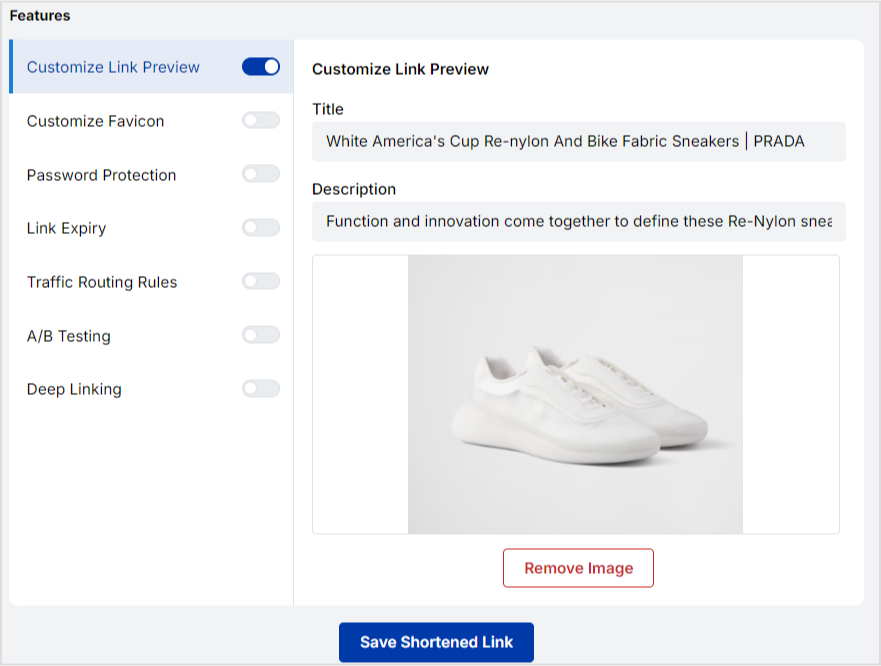
Customize link previews for better engagement across social platforms
Here’s how to shorten an affiliate link using Replug
Step 1:
Go to Replug and log in to your account. If you don’t have an account, sign up for free.
Step 2:
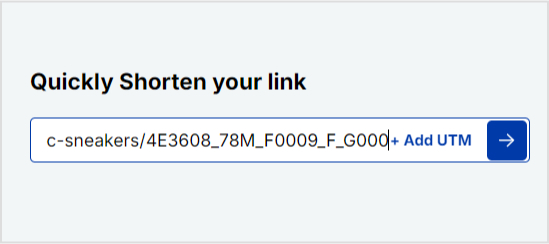
On the Replug dashboard, locate the “Quickly shorten your URL” field. And paste your affiliate link into the box.
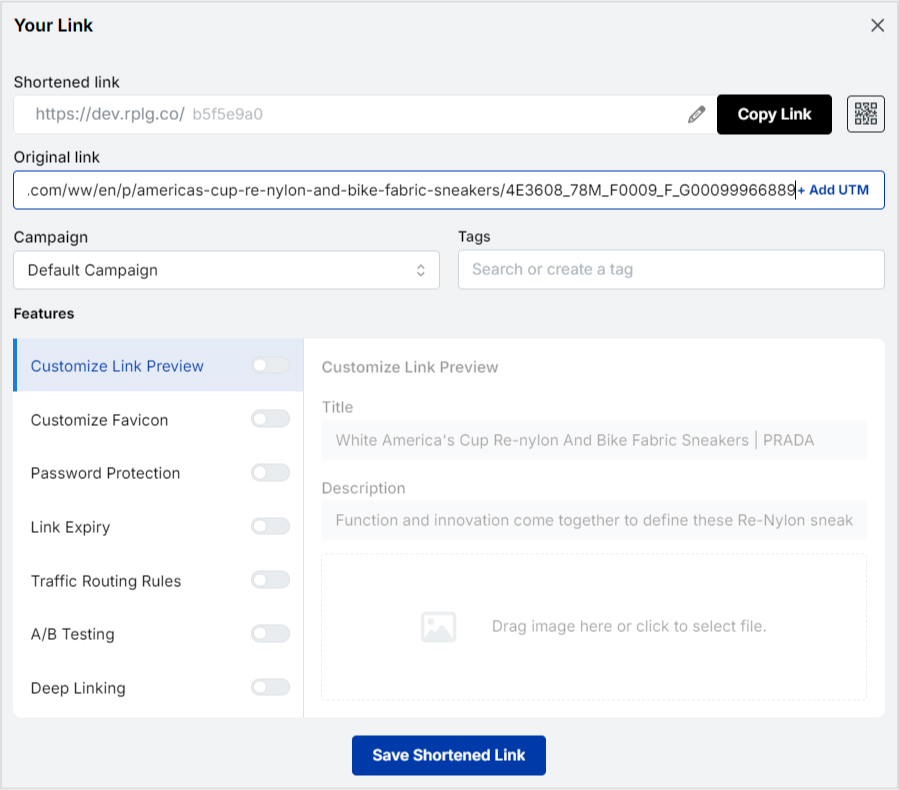
Press Enter, and a pop-up window will appear. Here, you can customize the link to create a branded and recognizable URL.
Click the “Checkmark” to generate your shortened Replug link.
Step 3: (Additional step)
Replug offers powerful tools to help you maximize your affiliate earnings:
Social media isn’t just for memes and viral trends anymore, it’s a powerhouse for ecommerce businesses. With more than half of social media marketers using platforms to sell products directly within apps, brands are leveraging social media to boost conversions. In fact, 87% of sellers say social selling has been effective for their business and has helped them increase ecommerce sales.
If you’re looking for ways to increase ecommerce sales through social media, you’re in the right place. This guide will walk you through proven strategies to turn your social media presence into a revenue-driving machine.
The role of social media in ecommerce growth
Social media has revolutionized how businesses operate, especially in ecommerce. What started as a platform for connecting with friends and sharing updates has now become a powerful tool for driving online sales and building brand loyalty. If you’re running an online store, understanding the role of social media in ecommerce growth is no longer optional; it’s essential.
With global ecommerce sales reaching an estimated $5.8 trillion in 2023 and projected to grow by 39% in the coming years, social media has emerged as a key driver of this growth (Statista). From increasing product discoverability to streamlining the purchase process, social media offers countless opportunities for businesses to connect with their audience and increase sales.
Why social media is a game-changer for online sales
Social media has fundamentally changed how consumers shop and interact with brands. Here’s why it’s a game-changer for online sales:
Elevates product discoverability: Targeted ads, engaging content, and collaborations introduce products to a broader audience.
Streamlines purchases: Features like Instagram Shop, Facebook Marketplace, and TikTok’s shopping tools simplify transactions.
Builds customer loyalty: Direct engagement, personalized responses, and community efforts build strong relationships and repeat sales.
Influencer marketing: Partnering with influencers builds brand credibility and connects products with engaged audiences.
Precision targeting: Social media allows brands to target specific demographics, increasing ROI and marketing efficiency.
Capitalizing on mobile shopping: As 60% of US adults consider mobile shopping essential, optimizing social shopping for mobile users enhances conversions.
16 ways to increase ecommerce sales through social media
1. Sell directly on social media platforms
Social commerce is gaining momentum, with 63% of businesses already using it to amplify sales. It simplifies the path from discovery to checkout, encouraging impulse buys and improving conversion rates.
Social commerce is the buying and selling of products directly within social media platforms, allowing users to shop without leaving the app.
By enabling businesses to sell directly on platforms like Instagram, Facebook, TikTok, and Pinterest, social commerce creates a seamless shopping experience. With 90% of people more likely to buy from brands they follow on social media, in-app features like checkout and “tap-to-buy” buttons make purchasing easy and drive sales while users browse.
Setting up shops on Instagram, Facebook, TikTok & Pinterest
To take advantage of this growing trend, you need to set up shops on the platforms your customers are using. Here’s how:
Instagram & Facebook: Build a virtual storefront that lets users browse and purchase directly from posts, stories, or shop sections.
TikTok: Integrate products into videos and live streams for instant sales.
Pinterest: Use shoppable pins that link directly to product pages, making it easy for users to shop as they explore.
These tools create frictionless shopping experiences that can boost conversions.
Live shopping: Turning engagement into sales
Live shopping is growing on platforms like TikTok and Instagram, where brands can host real-time events to showcase products, engage with viewers, and offer exclusive deals. This creates urgency and encourages immediate purchases, helping businesses build trust with followers and strengthen relationships.
2. Choose the right social media platforms
Not all social media platforms are created equal, especially when it comes to ecommerce. Identifying where your target audience spends their time is key to maximizing sales. Here’s a breakdown of the best platforms for driving ecommerce sales:
Aligning your brand with the right platform for your audience can drive engagement and boost e-commerce sales.
How to identify the right platform for your business
To determine which platform works best for you, consider these questions:
Who is my target audience? Each platform caters to different demographics. If you’re targeting younger consumers, TikTok might be your best option, while Facebook or Instagram can reach a broader age range.
What content works best for my business? Visual-heavy brands may excel on Instagram and Pinterest, while TikTok is perfect for businesses creating fun, engaging video content.
What are my business goals? Whether you’re focused on immediate sales or building and increasing brand awareness, each platform offers features that can help you meet specific goals (e.g., shoppable posts, live streams, ads).
Choosing the right social media platform for your ecommerce business comes down to understanding where your audience spends time and how they engage with content. A well-planned strategy, combined with effective eCommerce website development, can enhance user experience and drive better engagement
3. Use social media management tools
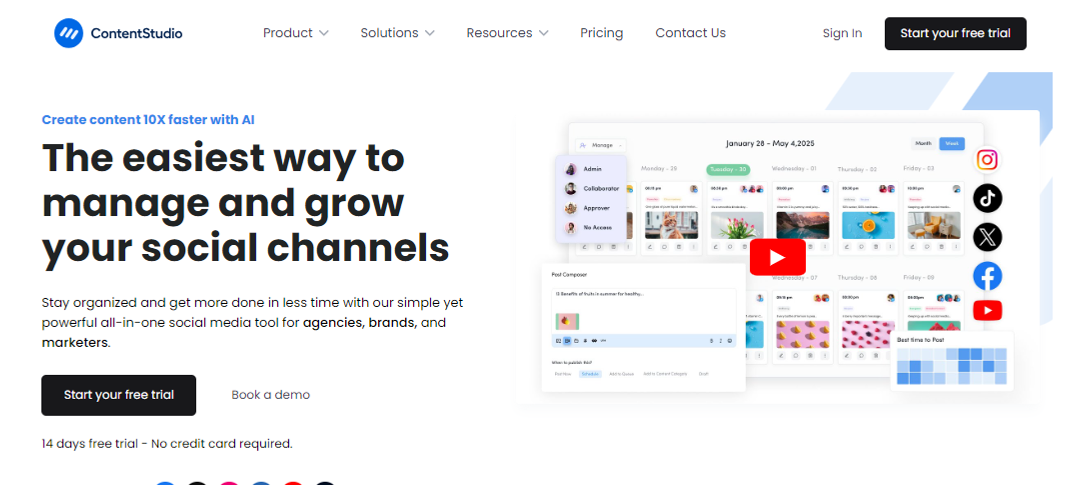
Social media management is a key factor in increasing ecommerce sales, and tools like ContentStudio can make a significant difference. These tools help businesses plan, schedule, and manage content across multiple platforms, simplifying the process and driving better results.
Benefits of ContentStudio for ecommerce
Content scheduling: Easily schedule posts in advance to maintain a steady content flow. ContentStudio offers this feature, helping you stay on top of your social media presence.
Content planning: With a built-in content calendar, ContentStudio allows for effortless planning and automation. This saves time and allows businesses to focus on creating quality content.
Content management: Handling multiple social media accounts from one platform is made easy with ContentStudio, which supports integration with Facebook, Instagram, Twitter, and others.
Such social media tools streamline the process of content scheduling, planning, and multi-account management, ultimately increasing e-commerce sales.
4. Increase sales with deep links
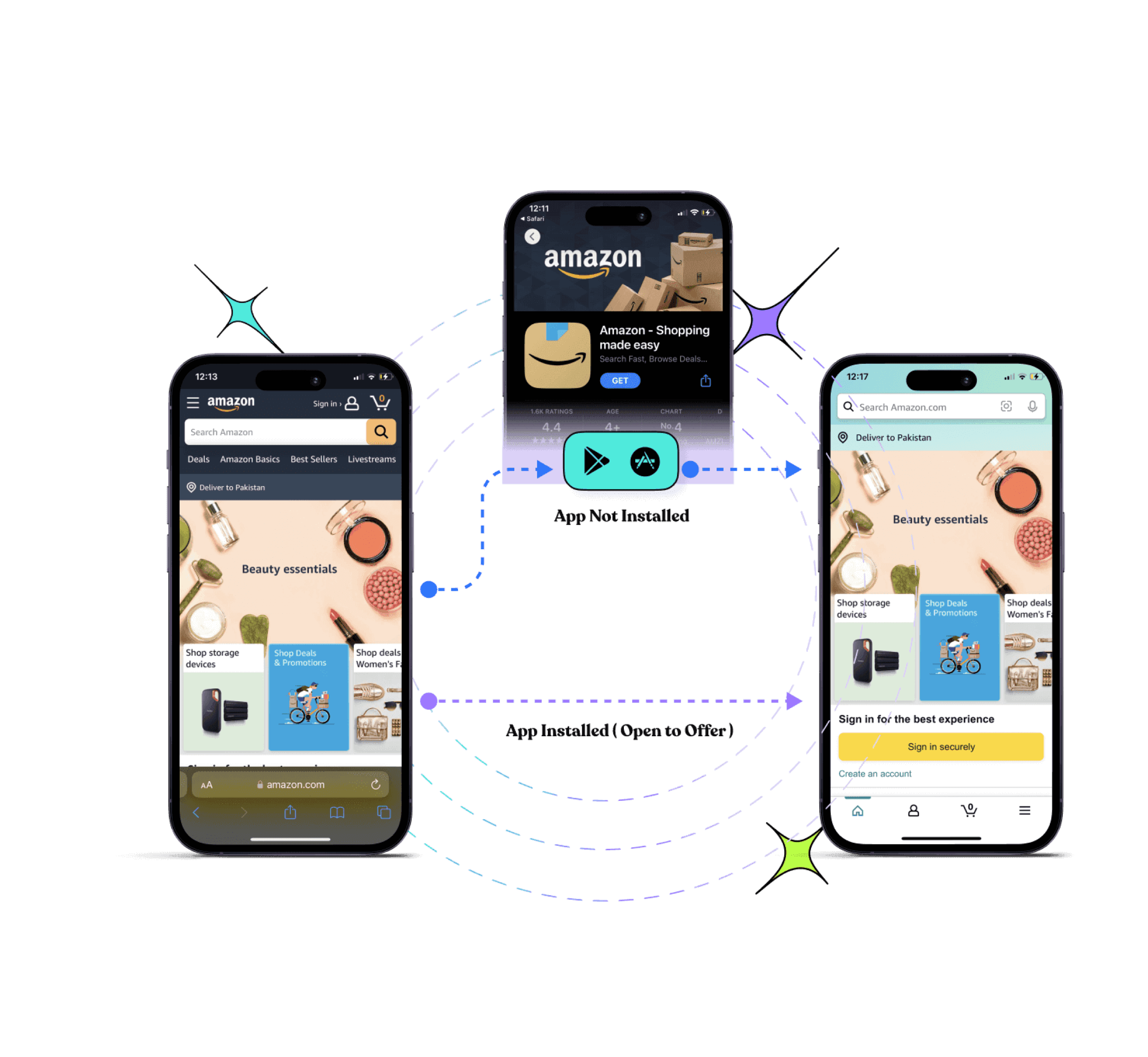
With Replug’s deep linking, you can guide potential customers directly to the content that matters most, whether they have your app installed or not. This means less friction and more opportunities to convert visitors into paying customers.
Here are the key advantages of deep lining:
Boost your app’s discovery: Whether users have your app installed or not, Replug’s deep links ensure they’re taken to the right destination on your ecommerce store, leading to higher chances of a successful purchase.
Drive traffic to your app from anywhere: Promote your app across social media, ads, emails, and more by using just one deep link to direct users to your app store or in-app content, reducing drop-off and increasing engagement.
Streamline the conversion funnel: Deep links allow you to bypass unnecessary steps, sending users straight to specific products or offers, increasing the likelihood of a purchase and improving sales.
Re-engage and win back users: With push notifications and targeted emails featuring deep links, you can bring back users who’ve lapsed, driving them back to your app and increasing retention.
Create deep links for any platform: Whether you’re marketing on Instagram, YouTube, or other apps, Replug’s social media deep links ensure users get exactly where they need to go, enhancing their experience and increasing conversions.
Drive more clicks, conversions, and app installations by deep linking
to your favorite platforms.
Try deep links for free
5. Leverage social media analytics for better targeting
Social media analytics play a vital role in optimizing marketing strategies by providing insights into customer behavior. Here are key ways to leverage analytics for better targeting and improving sales:
Understanding customer behavior through data
Through analyzing social media metrics such as likes, comments, and shares, businesses can uncover what resonates most with their audience. This data helps in crafting more personalized content and offers, improving engagement and conversions.
Tracking key metrics (CTR, engagement, ROI)
Tracking the right social media metrics is essential to assess the performance of your campaigns. Key metrics to monitor include:
Helps determine the financial success of your campaign.
Segmentation and audience insights for personalized marketing
Segmentation tools allow you to categorize your audience based on factors like behaviors, interests, and demographics. By personalizing campaigns for different segments, you can ensure that your content is more relevant, increasing the chances of conversion.
Cart abandonment & retargeting strategies
Social media analytics can help identify abandoned carts. With Replug’s retargeting pixel feature, you can easily track website visitors who didn’t complete their purchase and retarget them with personalized ads across various platforms.
A complete link management solution
for marketing professionals & agencies.
Try Replug for free
6. Get creative with social media content
The best part about social media? You can literally do whatever you want with your visuals! The freedom is unmatched, and it’s the perfect place to show off your products in ways that would be impossible in traditional marketing. From eye-catching video animations to scroll-stopping reels and behind-the-scenes content, the possibilities are endless. Want to level up your visuals even more?
Understanding the product photography cost can help you plan for high-impact content that adds an immersive, interactive edge to your social media strategy. Here are a few strategies to enhance your ecommerce sales using creative social media content:
Visual experimentation: Go wild with your content! Reels, carousels, stories—use all of it. Glossier keeps it dreamy and soft, while Rhode makes their products look so luxurious it’s almost unfair.
Sensory marketing: Make them feel something! Jacquemus creates bold, eye-catching visuals that draw people in, while Summer Fridays nails the soothing vibes that make their skincare impossible to ignore.
Oversized visuals: Big, bold, in-your-face visuals? Yes, please! Typology and The Ordinary keep it clean yet attention-grabbing, making their minimalist designs feel bold and premium.
Keep up with the trends: Jump on the trends! TikTok challenges, viral hashtags, or whatever’s blowing up—this stuff works. Airbnb absolutely nails it when it comes to following the trends.
the @barbie dreamhouse is back on airbnb. but this time—ken’s hosting. the pink palace has been revamped with maximum kenergy and is ready for guests. booking opens on july 17 at 10am PT. 🛼 barbie airbnb kendreamhouse don’t miss BarbieTheMovie only in theaters july 21.
Using memes: Memes are your secret weapon. They make your brand feel approachable and human. Wendy’s is a master at roasting the internet, and MoonPie is a meme machine that knows exactly how to turn the joke into a brand moment.
Interactive content: Get your followers involved! Polls, quizzes, and “choose your own adventure” stories make your audience feel like they’re a part of the experience. Starbucks uses Instagram polls to tease new drinks and get people buzzing.
Behind-the-scenes content: Everyone loves a sneak peek! Show what goes into your products or how your team works behind the scenes. Ben & Jerry’s shares quirky, fun content that lets their personality shine and keeps people connected.
User-generated content (UGC): Turn your customers into your best marketers. Repost their photos or videos using your products. Nike is fantastic at this, turning their customers into the face of their brand.
Social media is your playground. Don’t be afraid to experiment, have fun, and do what works!
7. Reduce cart abandonment with retargeting pixels
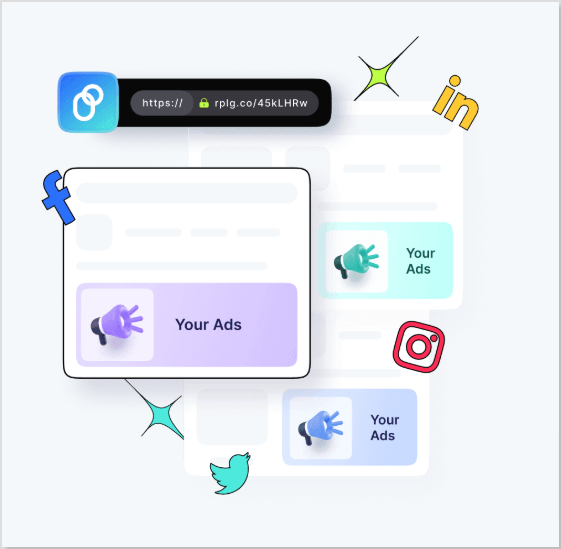
Retargeting is an essential tactic for bringing back lost visitors. Replug’s retargeting feature allows you to reach customers who have shown interest in your product but didn’t make a purchase.
Through personalized ads, you can encourage these users to return and complete their transactions, ultimately improving your conversion rates. Let’s dig into the benefits:
No coding required: Add your retargeting pixel to any link in seconds, without coding or technical skills.
Build your custom audience: With every click on your retargeted links, you can add users to your custom audience list for future remarketing campaigns, increasing your chances of conversion.
Reduce cart abandonments: Remind users who have abandoned their cart to complete their purchase, offering them an incentive to return, such as discounts or free shipping.
Add powerful CTAs to retargeted links: Replug makes it easy to add call-to-action buttons to your retargeting links, further encouraging users to click through and take action.
Leverage analytics for smarter retargeting: Use real-time analytics to track clicks, conversions, and campaign performance, helping you optimize your strategy and improve ROI.
Influencer marketing has become a powerful tool in ecommerce. By collaborating with influencers, you can increase brand awareness and drive traffic to your e-commerce store. The key is to find the right influencers and structure your partnerships for maximum return on investment (ROI).
Finding the right influencers for your niche
Choosing the right influencers depends on your brand’s niche. Whether you’re selling beauty products, tech gadgets, or fashion, it’s crucial to partner with influencers whose audience aligns with your target market.
Suppose your brand is leaning into e-commerce beverages. In that case, you can even launch a small-batch custom instant coffee line through a private-label platform, making influencer-driven campaigns easier to scale without having to handle production yourself.
And, if you’re in the beauty industry, collaborating with makeup artists on platforms like Instagram or TikTok can be effective.
Micro vs. macro influencers: which one drives more conversions?
Understanding the differences between micro and macro influencers can help you decide which one will provide the best results for your brand.
Aspect
Micro-influencers
Macro-influencers
Follower count
1K to 100K
100K+
Engagement rate
High (platforms like Instagram, TikTok)
Lower (more common on Facebook, Instagram)
Cost
Affordable
Expensive
ROI potential
High for conversions (Instagram, TikTok, YouTube)
High for brand awareness (Instagram, YouTube, Facebook)
Structuring influencer collaborations for ROI
To maximize the ROI of influencer collaborations, make sure to clearly define goals, set expectations, and track performance. Here are some strategies:
Offer clear value: Ensure that the partnership benefits both you and the influencer. Whether it’s through affiliate commissions, free products, or exposure, make the incentive attractive.
Use affiliate link cloaking: With Replug’s link cloaking feature, you can disguise long and messy affiliate links, making them look clean and professional. This improves the user experience and builds trust with your audience.
Create authentic content: Allow influencers creative freedom to produce content that resonates with their audience. Authentic content usually performs better and feels more genuine to followers.
Track performance: Use trackable links, promo codes, or UTM parameters to measure the effectiveness of influencer campaigns. Tools like Replug can help you generate and manage these trackable links, giving you insights into how well each influencer is driving sales.
Leverage multiple platforms: Don’t limit yourself to just one platform. A combination of Instagram, TikTok, and YouTube can help you reach a wider audience.
Maximize marketing ROI
by transforming ordinary URLs into branded short links that convert.
Try Replug for free
9. Drive engagement with QR codes
QR codes are an incredibly versatile tool for linking offline and online marketing efforts. Replug’s dynamic QR codes allow you to engage customers in-store, on print ads, or on packaging, building your brand presence both online and offline with detailed tracking to optimize your marketing strategies.
Here’s how it works:
Create instant QR codes: Generate QR codes for any shortened link and instantly connect users to your digital presence. This is perfect for stores, events, promotions, and more!
Enhance marketing with QR codes: Use QR codes for promotions, app installs, payments, digital menus, and more, integrating them into your physical marketing materials to bridge the gap between offline and online engagement.
Enjoy unlimited scans: Replug’s QR codes never expire, so you can keep reusing them without worrying about link expiration. Plus, you can update the destination URL anytime to keep your content relevant.
Track scans and conversions: With Replug’s link analytics, you can monitor how well your QR codes are performing. You can track scans, user actions, and conversions to optimize future campaigns.
10. Enhance brand visibility with branded links
When promoting products on social media, the links you share can make or break a sale. Branded links instantly make your product promotions look more trustworthy, professional, and click-worthy.
Instead of using long, random URLs or generic shorteners, Replug helps you create customized short links with its trustworthy short URL generator that feature your brand name, leading to higher engagement, more clicks, and, ultimately, more sales.
Why branded links drive more clicks & sales?
Shoppers are hesitant to click on unfamiliar links, especially on social media. Branded links eliminate that hesitation by making your product promotions look more authentic and credible.
Enhance click-through rates: Branded links can boost CTR by up to 39%, helping you drive more traffic to product pages.
Enhance brand trust: Customers are more likely to click when they recognize the brand in the link, leading to higher conversions.
Make promotions look cleaner: Instead of messy, long URLs, branded links keep your posts sleek and professional.
Prevent link suspicion: Generic short links can look spammy. A branded link reassures customers they’re landing on a legitimate product page.
Track campaign performance: With Replug’s click analytics, you can monitor which links get the most clicks and optimize your strategy for better results.
How to use branded links to increase ecommerce sales on social media?
Branded links aren’t just for looks; they’re a powerful tool to drive more purchases from your social media audience. Here’s how to use them effectively:
Strategy
How it helps
Add to product promotions
Makes product links look professional and clickable.
Use in influencer campaigns
Enhances credibility and directs traffic to your store.
Optimize for limited-time offers
Creates urgency and makes discount links easy to share.
Include in retargeting ads
Recaptures lost customers and drives them back to checkout.
Leverage UTM tracking
Helps track which social media platforms drive the most conversions.
11. Combining organic & paid strategies
To maximize your ecommerce sales, you need to blend organic content with paid ads. Organic content builds trust and long-term relationships, while paid ads on platforms like Instagram, Facebook, and TikTok give you a quick visibility boost. The key is knowing where and how to apply each strategy for optimal results.
Organic content: Building trust and engagement
Organic posts on platforms like Instagram, Facebook, and TikTok can help you nurture relationships with followers. When done right, your content doesn’t just show off your products—it builds trust. And trust is a major driver of sales. According to McKinsey, there was a 20% increase in consumers shifting to ecommerce in 2020, and 68% of social media marketers say they use it to direct traffic to their websites.
Platform
Organic Strategy
Instagram & Facebook
Regularly post engaging content like stories and reels, showcase products, and use shopping features like product tags.
TikTok
Use fun, creative videos that blend entertainment and promotion, and take advantage of the platform’s viral potential.
Paid campaigns: Quick visibility and actionable results
Paid campaigns on Facebook, Instagram, and TikTok allow you to target audiences based on data-driven insights. With Instagram, TikTok, and Facebook offering the highest ROI for social selling (HubSpot), these platforms provide great opportunities for ecommerce brands to thrive. Reaching thousands of people by running ads on Reddit’s public discussion platforms can provide excellent visibility and boost sales.
Additionally, Mobile commerce is expected to make up 44% of the ecommerce market in the United States by 2025, and platforms like Instagram and Facebook are designed to make mobile shopping as convenient as possible.
Platform
Paid Strategy
Instagram
Run carousel ads and story ads with a clear CTA, driving traffic to your product pages or website.
Facebook
Leverage dynamic ads that show personalized product recommendations based on user behavior.
TikTok
Use native ads like In-Feed ads to engage a younger audience and drive immediate purchases.
Driving traffic to your ecommerce store requires a blend of strategic efforts to nurture visibility, engage your audience, and convert them into customers. Let’s break it down:
Using link in bio tools for better conversions
Link-in-bio tools are essential for platforms like Instagram and TikTok, where only one clickable link is allowed in the bio. Tools like Replug allow you to showcase multiple links, such as product pages, blog posts, or special promotions. By directing traffic to a central hub, these tools simplify navigation, improve the user experience, and ultimately increase conversions. This feature allows your audience to easily find and purchase products directly from your bio.
Optimizing your social media for SEO is crucial for getting noticed. Here are some strategies to improve discoverability:
Profile optimization: Use clear, concise descriptions with relevant keywords in your bio. Ensure that your e-commerce website and contact details are easily visible.
Hashtags: Include trending and niche-specific hashtags in your posts. Hashtags increase your content’s visibility and help users find your store through social media search.
Engaging content: Post content that is shareable and engaging. The more people interact with your posts, the higher the chance of being seen by potential customers.
Your blog content can play a big role in driving traffic. Here’s how to make the most out of it:
Share blog snippets: Post visually engaging excerpts or summaries of your blog posts to drive traffic from social media. Add call-to-action phrases like “Learn more” or “Shop now.”
Engagement: Share blog posts and encourage your followers to engage with the content by asking questions or sharing their thoughts in the comments.
Consistency: Schedule regular blog post shares using social media management tools to keep your audience engaged and always have fresh content going out at peak times.
When you consistently share blog content across your social media channels, you expand your reach, drive traffic to your store, and build lasting relationships with your audience.
13. Leveraging user-generated content (UGC)
User-generated content (UGC) is one of the most effective ways to build trust with your audience and increase ecommerce sales. When customers share their experiences, whether through reviews, photos, or videos, it feels more authentic and relatable. According to Stackla, 79% of people trust UGC over branded content, making it a powerful tool to drive conversions.
Why UGC boosts conversions & engagement
UGC acts as social proof, showing potential customers that real people love your products. This kind of content is often perceived as more genuine than traditional advertising. When your existing customers share their positive experiences, it creates a ripple effect, encouraging others to follow suit and purchase from your brand.
A study found that the average consumer reads 10 online reviews before buying a new product. This makes UGC not only valuable for engagement but also crucial for converting leads into sales.
Encouraging customers to share reviews and testimonials
Reviews and testimonials are key to creating a strong foundation of trust. You should encourage customers to leave feedback by:
Offering incentives like discounts or exclusive access to products.
Highlighting positive reviews on your social media platforms to show appreciation and strenghten confidence in new customers.
Making it easy to leave reviews by integrating review options directly on your website or via email after a purchase.
When customers see that others are enjoying your products, they’re more likely to trust your brand and make a purchase.
Running UGC contests & giveaways for maximum reach
UGC contests and giveaways are great ways to encourage customer engagement and expand your reach. For example:
Host a photo contest where customers share photos of themselves using your products, with the chance to win a prize.
Encourage creative content such as short videos, reviews, or stories, which you can repost on your social media profiles.
Not only does this build community, but it also generates free shareable content that you can reuse in marketing campaigns.
14. Use shoppable posts
Shoppable posts help brands sell directly through social media platforms, eliminating the need for customers to leave the app to make a purchase. Here’s how you can use shoppable posts across different platforms:
Platform
How to use shoppable posts
Key benefit
Instagram
– Tag products in posts, stories, and reels. – Link your product catalog to your profile.
Direct in-app purchases and enhanced user experience.
Facebook
– Set up a Facebook Shop and tag products in posts. – Use “Shop Now” buttons.
Easy transition from post to product purchase.
Pinterest
– Use “Product Pins” to tag products. – Show real-time pricing.
Seamless shopping experience without leaving the platform.
TikTok
– Tag products in videos and live streams. – Connect your product catalog.
Maintaining a consistent presence on social media is crucial for increasing ecommerce sales and building brand awareness. However, the key to success lies in finding the right balance between posting frequently and maintaining quality content.
Here are some strategies to help you post consistently and keep your audience engaged:
The importance of a content calendar: A content calendar helps you stay on top of trends, plan for promotions, and stay consistent without scrambling for ideas at the last minute. With tools like ContentStudio, you can schedule your posts across multiple platforms, track performance, and align your content with important dates or sales events.
Finding the right posting frequency: It’s tempting to want to post as much as possible, but flooding your followers’ feeds can actually hurt engagement. On the flip side, posting too infrequently may cause your audience to forget about you. The key is to find a posting frequency that aligns with your audience’s preferences.
Engaging with your audience: Respond to DMs, like and comment on followers’ posts, and reply to comments on your stories and posts. Social media algorithms also reward engagement, meaning your content is more likely to be seen if you actively engage with your followers.
Social media isn’t just about posting—it’s about listening, too. Customers constantly share feedback, opinions, and experiences, giving ecommerce brands direct insights into their needs and expectations. Social listening tools help track these conversations, identify trends, and refine marketing strategies in real-time.
Here’s how it helps:
Monitoring brand mentions & customer conversations: Tools like Brandwatch, Mention, and Sprout Social allow businesses to track brand mentions across platforms, helping them respond to feedback, resolve issues, and engage with customers more effectively.
Identifying trends & buying behavior changes: Platforms like BuzzSumo and Talkwalker analyze trending topics, hashtags, and competitor activities, helping brands spot shifts in consumer behavior and adapt their strategies accordingly.
Using social listening means making informed decisions based on what customers are actually saying, not just guessing.
Key benefits of using social media for ecommerce
Using social media for ecommerce offers a wide range of benefits that can help your business grow. Here are some of the most significant advantages:
1. Increased traffic and conversions: Engaging content, ads, and deep linking drive users to product pages, reducing drop-offs. This is particularly important given the average cart abandonment rate of 70.19%. For instance, offering incentives like free shipping can motivate online shoppers.
2. Higher ROI through social selling: Platforms like Instagram, TikTok, and Facebook offer the highest ROI for social selling. Features such as shoppable posts, live shopping events, and influencer collaborations enable brands to monetize their social presence effectively.
3. Personalized marketing: Tailored content, loyalty programs, and targeted promotions enhance customer retention. For instance, according to eMarteker, features such asloyalty programs (63.4%) and exclusive offers (62.5%) are considered the most valuable to US consumers.
4. Reduced cart abandonment: Social media can help address common reasons for cart abandonment, such as unexpected costs (47%) and forced account creation (25%) (Forbes). This valuable data can reduce friction in the buying process and encourage customers to complete their purchases.
5. Building brand loyalty: Social media enables brands to engage with their audience on a deeper level. Through interactive content, user-generated posts, and community-building efforts, businesses can build long-term relationships with their customers.
Conclusion
Social media has evolved into a powerful ecommerce engine. By leveraging the right platforms, creative content strategies, influencer collaborations, and data-driven ecommerce marketing, businesses can drive traffic and build lasting relationships with customers.
Integrating advanced tools like Replug further amplifies sales potential, offering features like deep links, branded short URLs, and retargeting pixels to enhance marketing effectiveness.
A complete link management solution
for marketing professionals & agencies.
Try Replug for free
FAQs on how to increase ecommerce sales using social media
How can social media drive ecommerce sales?
Social media increases brand visibility, allows businesses to engage directly with customers, and offers shoppable posts that simplify the buying process. With targeted ads and influencer collaborations, brands can drive traffic and conversions.
Which social media platform is best for ecommerce?
The ideal platform depends on your audience. Instagram and Facebook are great for visual products, TikTok works well for younger demographics, and Pinterest is effective for high-intent shoppers.
How does Replug help in increasing ecommerce sales through social media?
Replug increases ecommerce sales through social media by offering branded short links, deep linking, and retargeting pixels, allowing businesses to optimize traffic, track engagement, and improve conversions.
What is deep linking, and why is it important for increasing ecommerce sales?
Deep linking directs users to specific product pages within an app instead of a generic homepage, reducing friction and increasing the likelihood of purchase. Replug’s deep linking feature ensures a seamless shopping experience.
How can I reduce cart abandonment using social media?
Using retargeting ads, engaging with customers through DMs, and promoting limited-time offers can encourage users to complete their purchases. Replug’s retargeting pixel allows businesses to reach users who abandon their carts and re-engage them effectively.
How often should I post on social media for ecommerce success?
Consistency is key. Posting at least 3-5 times per week ensures visibility and engagement. Using scheduling tools like ContentStudio can help maintain a steady posting schedule without overwhelming your audience.
If you’re looking to monetize your online presence, affiliate marketing is one of the most effective ways to do so. And when it comes to affiliate marketing, Amazon offers one of the largest and most trusted programs: Amazon Associates.
Amazon accounts for nearly half of the affiliate marketing industry, with more than 900,000 affiliate partners capitalizing on its vast marketplace. With millions of products available and a high consumer trust factor, Amazon makes it easy for affiliates to drive traffic and earn commissions.
This guide will walk you through everything you need to know about becoming an Amazon affiliate, from signing up to maximizing your earnings.
So, let’s get started!
What is the Amazon Affiliate Program?
The Amazon Affiliate (Associates) Program, similar to Replug’s affiliate program, is an affiliate marketing initiative that allows content creators, bloggers, publishers, and influencers to earn a commission by promoting Amazon products. When an affiliate shares an Amazon link and a visitor makes a purchase, the affiliate earns a percentage of the sale.
How does Amazon’s affiliate program work?
Here’s how it works:
1. Sign up for the program.
2. Choose products to promote that align with your niche.
3. Share affiliate links on your blog, website, or social media.
4. Earn a commission when a user purchases through your link.
Amazon’s commission rates range from 1% to 10%, depending on the product category. Additionally, affiliates earn commissions not just on the promoted product but on all purchases made within 24 hours of clicking their link.
Prerequisites to start with the Amazon affiliate program
Before joining the Amazon Affiliate program, you should have a few basic things ready:
A content platform: A website, blog, YouTube channel, mobile app, or public social media page where you will share affiliate links.
Original content: Your platform should contain helpful, original posts related to the products you plan to promote.
An Amazon account: You need a regular Amazon account to register for the affiliate program.
Valid tax and payment details: Amazon requires tax information and a bank account to send commissions.
Compliance with Amazon policies: Your content must follow Amazon’s guidelines and should not include harmful, misleading, or restricted material.
Once approved, you must generate at least three qualifying sales within 180 days to keep your affiliate account active.
What are the requirements to be an Amazon affiliate?
To join the Amazon Associates Program, you need to meet specific eligibility criteria. Here are some requirements for becoming an Amazon affiliate:
General requirements to qualify
Requirement
Description
Website/blog
Must have at least 10 original and recently published posts.
Social media
Platforms like Facebook, Instagram, Twitter, YouTube, TikTok, and Twitch are eligible, provided you have at least 500 followers.
Content quality
Your content should be engaging, informative, and original to attract users.
Activity requirement
You must make at least three sales within the first 180 days to stay active
Active audience
Your platform should have a real and engaged audience that regularly interacts with your content and clicks on the links you share.
Disclosure requirement
You must clearly disclose that you earn commissions from affiliate links near your content or links.
Common reasons for rejection
If your application fails at some point in the process, these could be potential reasons:
Lack of sufficient content (empty or incomplete websites)
Insufficient traffic or engagement
Improper use of affiliate links
Failure to generate three qualifying sales in the first 180 days
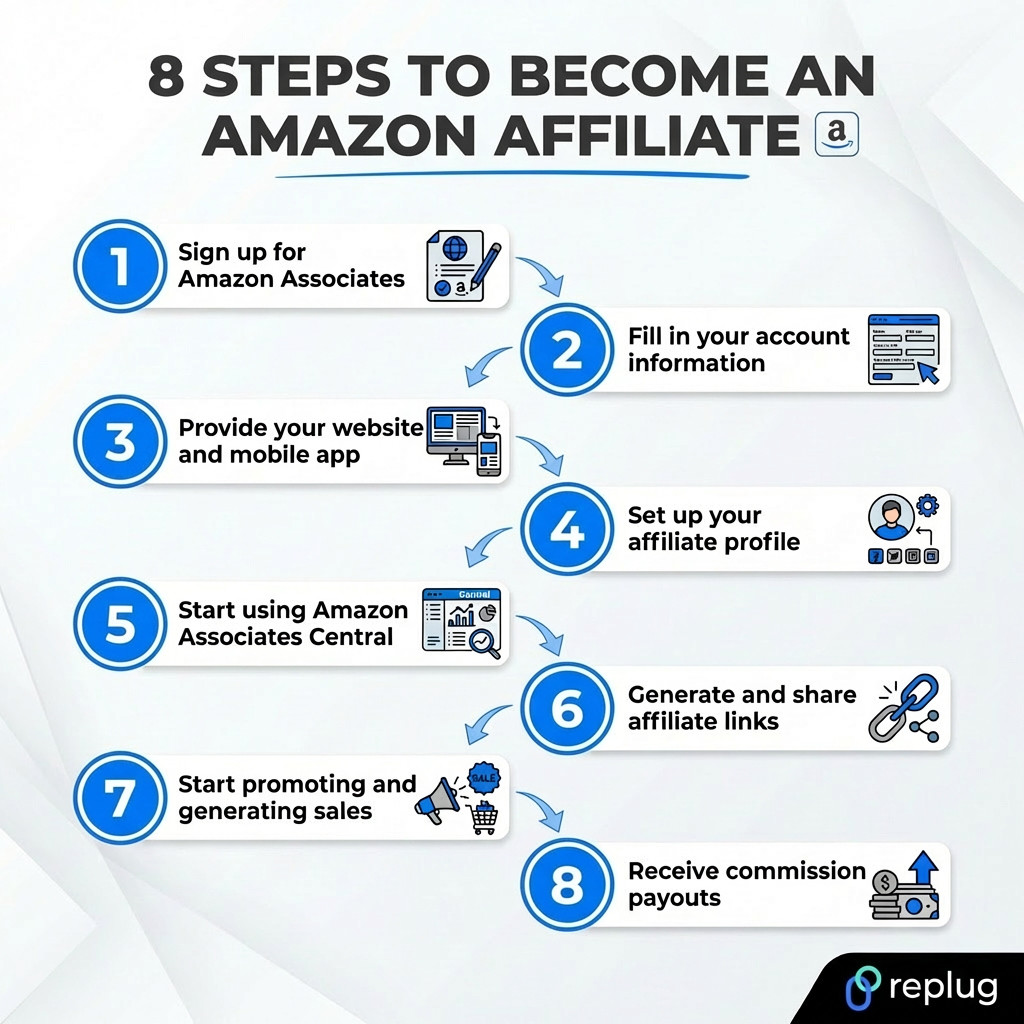
How to become an Amazon affiliate: 8-step guide
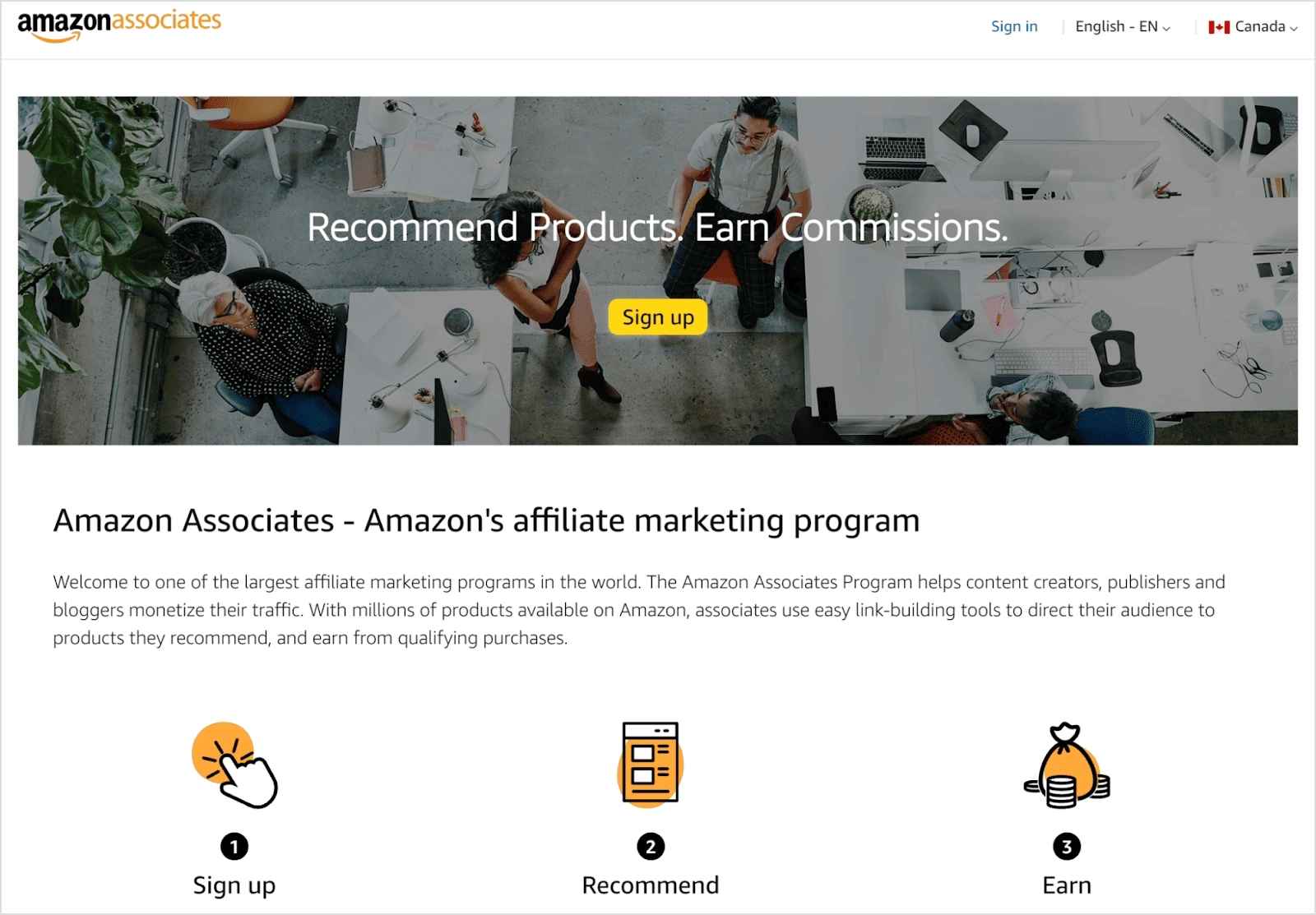
Step #01. Sign up for Amazon Associates
Go to Amazon Associates.
Click Sign up and create a new account.
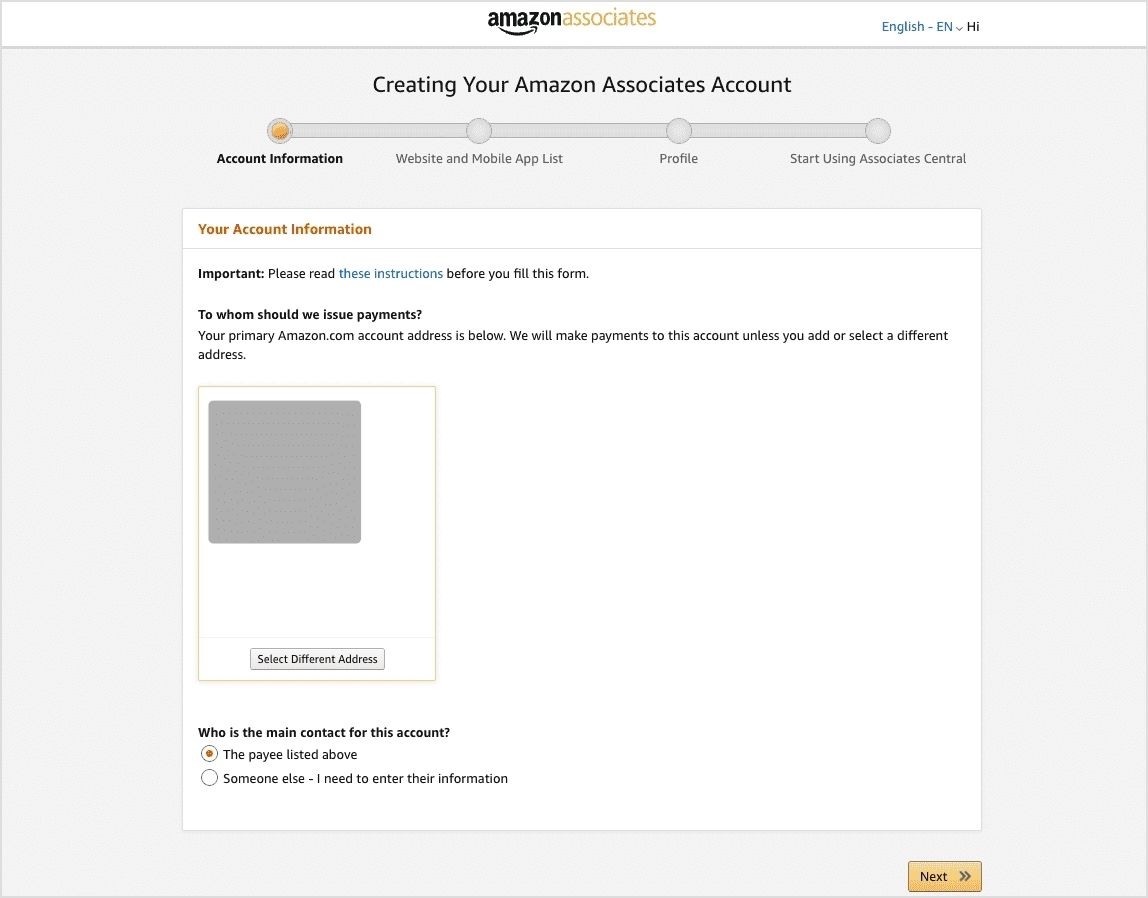
Step #02. Fill in your account information
Provide personal information and details about your affiliate channel.
Select the main contact for the account.
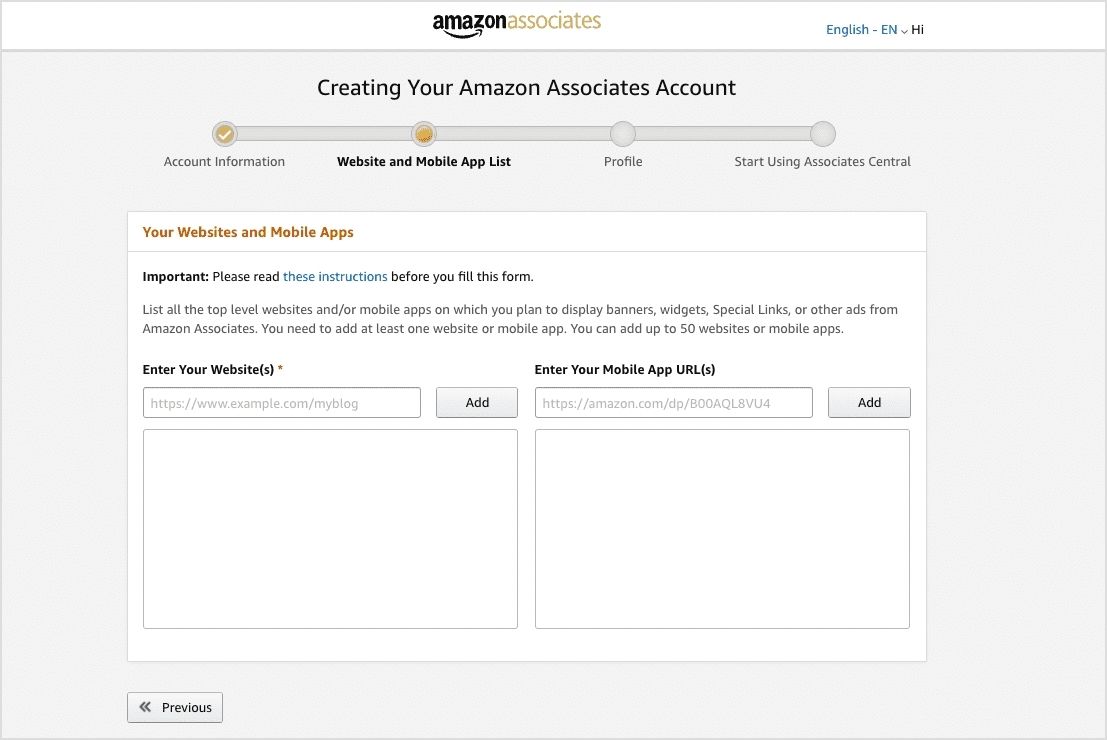
Step #03. Provide your website or social media details and mobile app
Add the URL of your website(s), and mobile app(s).
You can add up to 50 websites or mobile apps.
If using social media, ensure it meets the 500-follower requirement.
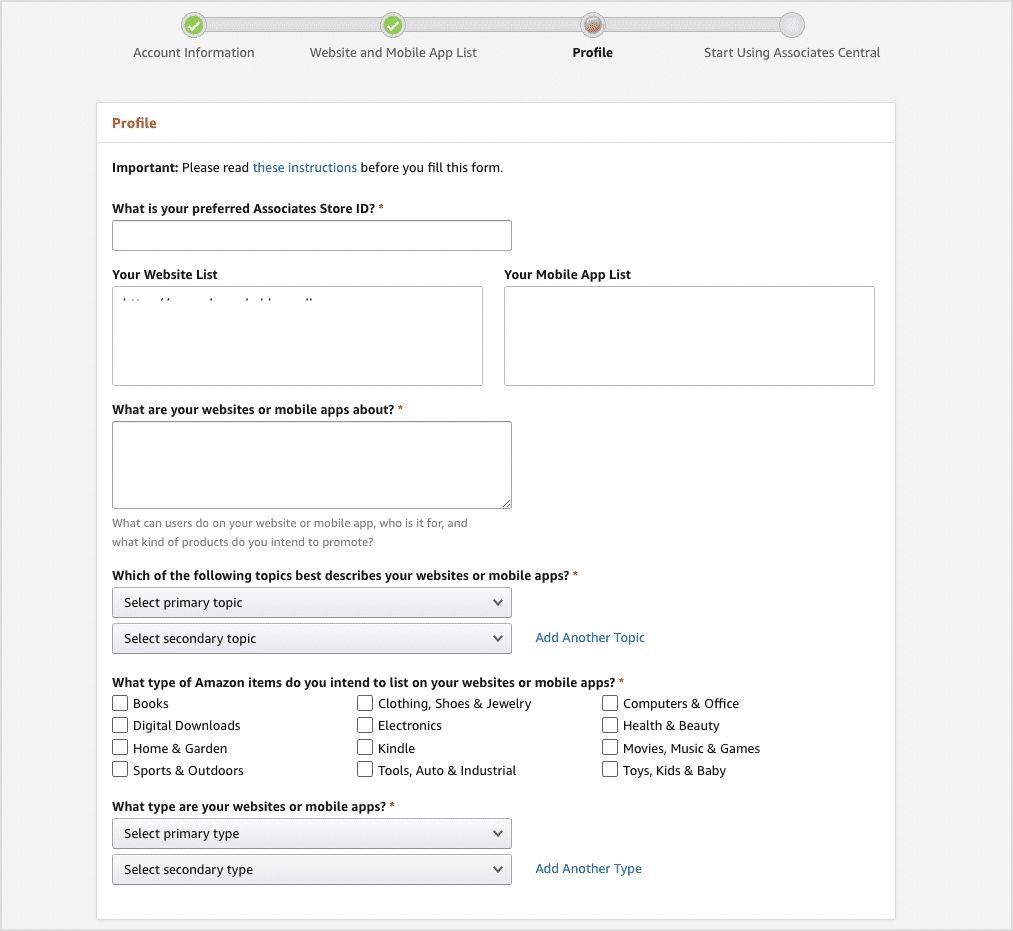
Step #04. Set up your affiliate profile
Provide your store name and create a unique store ID.
Select topics and categories related to your niche.
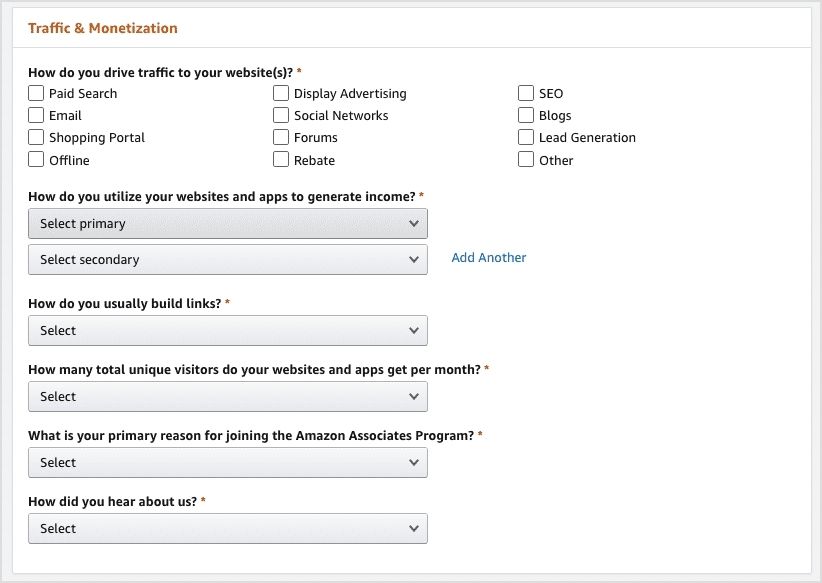
Explain how you drive traffic (SEO, social networks, email marketing, etc.).
Complete the security CAPTCHA and agree to the conditions.
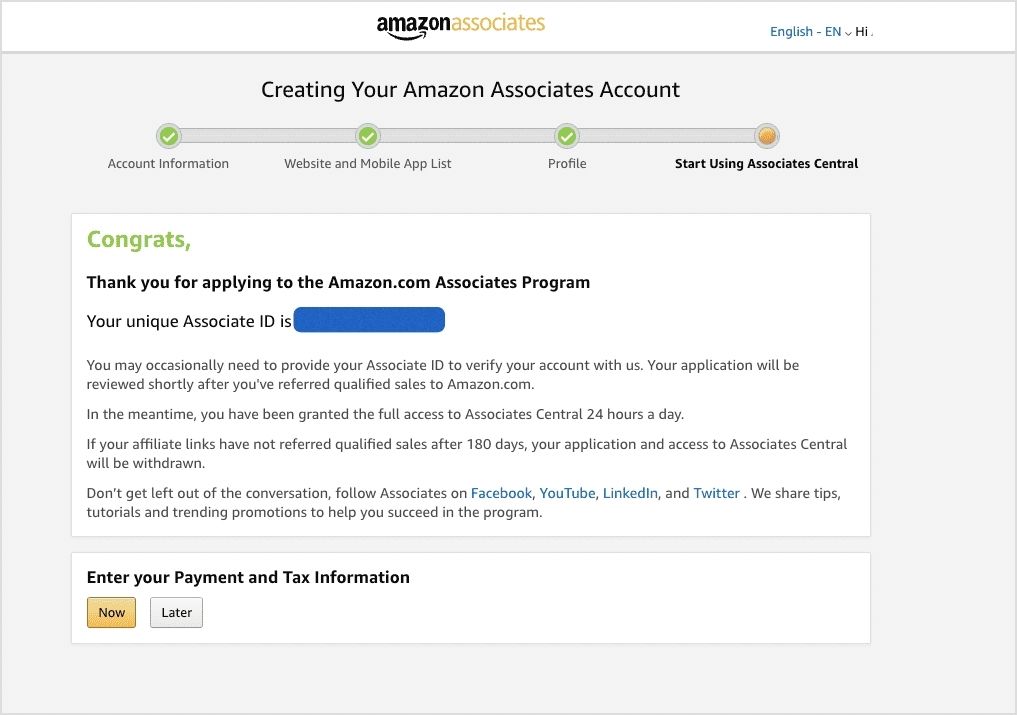
Step #05. Start using Amazon Associates Central
That’s all! You have successfully applied to the Amazon Associate Program.
Enter payment and tax information (now or later).
You will have several options for getting paid as an Amazon affiliate.
Complete tax forms (especially for non-US affiliates).
Step #06. Generate and share affiliate links
Log in to your Associate account. Now, all your links will be tagged with your unique Associate ID.
Go to the product linking menu in the Associates Central dashboard.
Search for Amazon products and create custom links containing your Associate ID.
Alternatively, you can use Amazon’s SiteStripe tool (for desktop) or GetLink (for mobile) to create affiliate links.
Embed your affiliate link in blog posts, videos, or social media captions, etc.
Before you start promoting products through the Amazon Associates program, it’s important to understand its policies. These rules explain how affiliates should promote products, earn commissions, and use Amazon’s content or trademarks properly. Following them helps you stay compliant and keep earning from the program.
Below are the main policy areas you should know:
Participation requirements: Affiliates must follow Amazon’s operating agreement and ensure their website, app, or social media content is appropriate, legal, and not misleading. You also cannot misuse Amazon content or promote Amazon in unauthorized ways.
Commission income statement: This policy explains how affiliates earn commissions. You get paid when someone clicks your special affiliate link and makes a qualifying purchase within the session (usually within 24 hours of the click).
Product statement: It outlines which products qualify for commissions and the rules around promoting them, including exclusions or restrictions on certain digital items and categories.
Trademark guidelines: Affiliates must use Amazon trademarks, logos, and brand names only as permitted. Misusing Amazon branding or modifying trademarks can lead to account suspension.
IP license & usage requirements: Amazon gives affiliates a limited license to use its product images, text, APIs, and other program content only for promoting Amazon products according to program rules.
Mobile application policy: If you promote Amazon products through a mobile app, it must meet Amazon’s requirements and be properly registered in your affiliate account before using affiliate links.
Amazon influencer program policy: This policy applies to creators who promote products through social media and have an Amazon storefront. Influencers must meet eligibility requirements and follow the same operating agreement rules.
Amazon creator ads boost program policy: This program allows creators to boost or promote content that features Amazon products. Participants must follow advertising guidelines and program rules when promoting such content.
In short, these policies ensure that affiliates promote Amazon products fairly, use Amazon’s resources properly, and maintain trust with customers.
How to become an Amazon affiliate on different platforms in 2026
You don’t always need a website to promote Amazon products. Many affiliates today use social media platforms to share recommendations and earn commissions.
The idea is simple: create useful content, share your affiliate links, and guide people to products they may want to buy.
Below are simple ways to get started on different platforms.
How to become an Amazon affiliate on Facebook
Step #01: Create a Facebook page or public group around a niche (e.g., gadgets, home decor, fitness gear).
Step #02: Sign up for the Amazon Associates program and list your Facebook page URL during registration.
Step #03: Generate your affiliate links using the Amazon SiteStripe tool.
Step #04: Share helpful posts such as product reviews, recommendations, or “top picks.”
Step #05: Add your affiliate link in the post and include a short disclosure (e.g., “As an Amazon Associate, I earn from qualifying purchases”).
Step #06: Stay active by posting regularly and engaging with comments to build trust with your audience.
How to become an Amazon affiliate on Instagram
Step #01: Create a niche-based Instagram account (tech products, beauty tools, home items, etc.).
Step #02: Apply to the Amazon Associates program and include your Instagram profile URL.
Step #03: Post product photos, reels, or short reviews showing how the product works.
Step #04: Add your affiliate link in your bio or use a link-in-bio tool.
Step #05: Mention the product in captions and guide users to the link in your bio.
Step #06: Always add a clear disclosure like #ador #AmazonAssociate when sharing affiliate links.
How to become an Amazon affiliate on Pinterest
Step #01: Create a Pinterest business account and choose a niche for your boards.
Step #02: Apply for the Amazon Associates program and list your Pinterest profile as your platform.
Step #04: Add your Amazon affiliate link to the pin destination URL.
Step #05: Write helpful pin descriptions so users understand what the product is about.
Step #06: Clearly disclose that the pin contains an affiliate link to stay transparent.
How to become an Amazon affiliate on Reddit
Step #01: Join relevant subreddits related to your niche (for example, gadgets, home tools, or fitness gear).
Step #02: Spend time engaging with the community by answering questions and sharing useful insights.
Step #03: Provide genuine product recommendations when they are relevant to the discussion.
Step #04: Instead of spamming links, share helpful posts or guides that include your affiliate link when appropriate.
Step #05: Always follow each subreddit’s rules because many communities restrict direct promotional links.
Note: Many Reddit users warn that excessive affiliate links can get posts removed or accounts flagged, so focusing on helpful advice works much better.
In short, the process is similar across platforms: create useful content, build trust with your audience, and share affiliate links in a transparent way. When done consistently, social platforms can become a strong source of Amazon affiliate income.
Pros and cons of the Amazon Affiliate Program
While Amazon’s affiliate program offers several benefits, it also comes with some challenges. Here’s a breakdown to help you decide if it’s the right choice for you:
Pros
Cons
Access to millions of products
Low commission rates on some categories
Trusted brand with high conversion rates
Short 24-hour cookie window
Easy integration with websites & blogs
Commissions get cancelled if products are returned
Works with multiple content platforms
Payouts can take up to 60 days
How much do Amazon affiliates earn?
Amazon affiliate earnings are highly variable, influenced by factors like:
audience size and engagement,
niche selection,
content quality,
conversion rates, and
Amazon’s commission structure
Beginners with smaller audiences and developing strategies typically earn modestly at first. While top Amazon affiliates can earn substantial amounts, the range is broad.
Influencer Marketing Hub reports an average annual income of $55,434 for Amazon affiliates. However, some studies suggest affiliate marketers may earn less than $20,000 annually. According to ZipRecruiter, the national average annual salary for an Amazon affiliate is $77,893, with top earners making over $127,000 per year.
Top performers, often with established online platforms like popular websites, influential blogs, and large, engaged audiences, can see monthly earnings ranging from thousands to hundreds of thousands of dollars. Pinpointing an exact starting income is difficult, but optimization is key to maximizing initial earnings.
Here’s a rough estimate of earnings:
Earning level
Monthly income range
Beginner
$50 – $300
Intermediate
$1,000 – $10,000
Advanced
$10,000 – $100,000+
Advanced strategies to boost your Amazon affiliate income
Once you’ve joined the Amazon Associates Program, implementing advanced strategies can help you increase your earnings. If you’re wondering how to make the most of the program, these strategies will help:
1. Utilize email marketing
You can use newsletters to drive traffic to blog posts containing affiliate links. This strategy helps build trust and long-term engagement with your audience while improving your chances of making sales as an Amazon affiliate marketer.
2. Create video reviews
YouTube is a powerful tool for affiliate marketing. High-quality, detailed video reviews often lead to better engagement and conversion rates than traditional blog posts. Many successful affiliates use video content to showcase products, making it a great approach for those learning how to become an Amazon affiliate seller.
3. Run paid ads
Consider running PPC (pay-per-click) campaigns on Google or Facebook to direct traffic to high-converting affiliate content. To boost your affiliate content’s reach, utilizing targeted ads can be a powerful strategy.
Consider exploring a pay-per-click software to streamline and optimize your campaign management for maximum ROI. Paid ads can help you reach a wider audience and generate more commissions.
4. Build an affiliate funnel
Create a landing page that provides value (such as a free guide or checklist) in exchange for an email sign-up. Then, nurture leads through email marketing and direct them to your affiliate links over time.
5. Optimize for voice search
With the rise of smart assistants like Alexa and Google Home, optimizing content for voice search can help you attract additional organic traffic. Structuring content in a conversational, question-answer format improves its chances of appearing in voice search results. If you want to make money, voice search is highly beneficial.
Replug.io is a powerful link management tool that enhances affiliate marketing by offering multiple features designed to increase conversions and track performance.
Here’s how:
1. Affiliate link cloaking and customization
Amazon prohibits traditional link cloaking, but with Replug, you can create custom, branded short links that look cleaner and more professional. These links increase trust and click-through rates.
2. Bio links for affiliates
Replug enables affiliates to create a single bio link containing multiple Amazon affiliate links. This feature is useful for social media platforms like Instagram and TikTok, where users can only place one clickable link in their bio.
3. QR codes for affiliate links
Replug lets you generate dynamic QR codes linked to your affiliate URLs, making it easier for users to scan and visit product pages instantly. This is especially useful for physical marketing materials and events.
4. Advanced link tracking
With Replug, you can track real-time clicks and geotargeting statistics on your Amazon affiliate links. This data helps affiliates understand which products perform best and optimize their earnings by employing the best marketing strategies.
5. Deep linking capabilities
Deep linking ensures that when users click your affiliate links, they are taken directly to the product page within the Amazon app (if installed). This improves user experience and increases conversion rates.
Affiliates promoting Amazon product sales or limited-time offers can use Replug to set up link expiration for their affiliate links, preventing broken pages and seamlessly redirecting users to active deals.
8. Retargeting pixel integration
Replug lets affiliates add retargeting pixels to their affiliate links. If a user clicks but does not complete a purchase, they can be retargeted with ads, increasing the likelihood of conversions.
9. Bridge pages with custom CTAs
Replug enables affiliates to create bridge pages with eye-catching call-to-action (CTA) buttons, warming up potential buyers before directing them to Amazon. Using Replug in conjunction with Amazon Associates enhances link performance, improves tracking accuracy, and maximizes affiliate revenue.
10. Amazon link shortener for cleaner and more shareable URLs
Replug’s Amazon link shortener allows affiliates to transform long, cluttered Amazon URLs into short, branded links that are easier to share across platforms.
Shortened links not only look more professional but also perform better in posts, messages, and ads, especially on character-limited platforms like Twitter or SMS. By using branded short links, affiliates can maintain trust with their audience while improving link clickability and engagement.
If you’re serious and curious about how to become a pro Amazon affiliate marketer, integrating Replug into your strategy can provide better results.
A complete link management solution
for marketing professionals & agencies.
Try Replug for free
Wrapping up
The Amazon Associates Program is an excellent way to monetize your content and generate passive income. By learning how to become an affiliate on Amazon, you can take advantage of one of the most trusted affiliate programs.
Utilizing tools like Replug, affiliates can boost conversions, track user engagement, and maximize earnings effortlessly. From custom short links to click tracking and retargeting, Replug offers powerful solutions for Amazon affiliates.
Frequently asked questions
Is it free to become an Amazon affiliate?
Yes, joining the Amazon affiliate program (Amazon Associates) is completely free. There are no registration fees or monthly charges. You can create an account, generate affiliate links, and start promoting products without paying anything. However, you might spend money on things like a website, hosting, or affiliate marketing tools to grow your traffic.
How to become an Amazon affiliate with no money?
You can start the Amazon affiliate program without any investment. Here’s how to become an Amazon affiliate for free by following these steps:
1. Create a free content platform (YouTube, TikTok, Instagram, or a free blog). 2. Sign up for the Amazon Associates program. 3. Add your platform details during registration. 4. Generate affiliate links for relevant products. 5. Share helpful content and include your links.
You don’t need a website! Amazon allows affiliates to promote products through social media or content platforms.
How long does it take to become an Amazon affiliate?
Becoming an Amazon affiliate is quite fast. The signup process usually takes 30–45 minutes, and Amazon typically reviews applications within 24 hours to a few days (often 1–3 days). Once approved, you can start sharing affiliate links immediately. However, you must generate at least three qualifying sales within the first 180 days to keep your account active.
How to sign up for the Amazon affiliate program without a website?
You can join the Amazon Associates program without a website by using a public social media account or YouTube channel as your platform.
Steps:
1. Go to the Amazon Associates signup page. 2. Create your account. 3. When asked for a website, enter the URL of your YouTube channel or social media page (e.g., Instagram, Facebook, TikTok). 4. Submit your application and wait for approval. 5. After approval, generate affiliate links and share them in your content.
Your account must be public, active, and contain original content for Amazon to approve the application.
What are the best strategies to maximize profits from the Amazon affiliate program?
Some effective ways to increase earnings include:
– Choose a focused niche (tech, home gadgets, fitness, etc.). – Write honest product reviews and comparisons. – Target high-intent keywords like “best,” “review,” or “vs.” – Promote products with good demand and reasonable prices. – Use SEO and social media to bring consistent traffic. – Build trust with helpful, unbiased recommendations.
These strategies help improve clicks and conversions over time.
1. Log in to your Amazon Associates dashboard. 2. Find the product you want to promote on Amazon. 3. Use the SiteStripe bar or “Get Link” option. 4. Choose the link format (text, image, or short link). 5. Copy the affiliate link and share it in your content.
When someone clicks the link and makes a purchase, you earn a commission.
How to earn $100 per day through the affiliate marketing program offered by Amazon?
To reach around $100 per day, focus on consistent traffic and product selection:
– Create content targeting buyer-intent keywords (e.g., “best laptop under $1000”). – Promote products with higher prices or better commission categories. – Publish multiple articles, videos, or posts targeting different products. – Use SEO, Pinterest, YouTube, or social media to drive traffic. – Build a library of content that generates sales daily.
With steady traffic and well-placed affiliate links, reaching $100/day becomes achievable over time.
Ever wondered how influencers, bloggers, and even everyday people turn their online presence into a steady income stream? Say hello to affiliate marketing.
Here’s how it works: You promote products you love, and every time someone makes a purchase through your unique link, you earn a commission. No need to create your own product or handle customer service—just share what excites you!
Affiliate marketing can be a game-changer whether you’re a blogger, YouTuber, or a newbie. To back this up, according to research, the average affiliate marketer earns around $8,038 per month, proving just how lucrative this side hustle can be!
Hence, we’ve broken down how to become an affiliate marketer into five simple steps, from choosing your niche to optimizing your links so you can start earning in no time.
By the end of this blog, you’ll have everything you need to kickstart your affiliate marketing journey. So, grab a cup of coffee, and let’s get to it!
What is affiliate marketing?
Affiliate marketing is a performance-based marketing model where you, as an affiliate, promote someone else’s products or services. In return, you earn a commission when people take specific actions (usually a sale or a lead) through your marketing efforts.
What is affiliate marketing?
It’s one of the most accessible and low-risk ways to start making money online because you don’t need to create products or manage inventory; you just need to focus on promotion.
The win-win?
It’s a mutually beneficial arrangement. As a marketing professional, you’re helping businesses expand their reach while being rewarded for your promotional efforts.
Where to find affiliate programs?
There are three main ways to find affiliate programs.
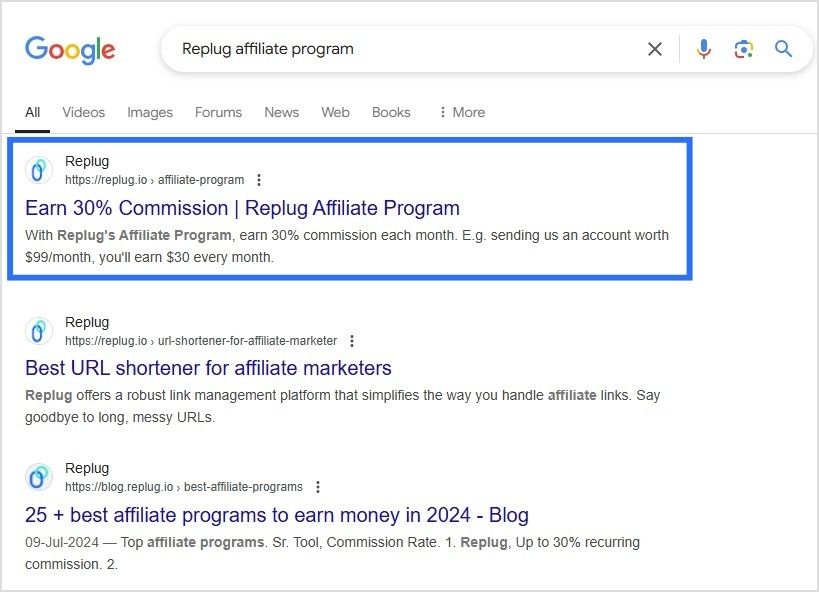
Process: Search for “[company name] affiliate program” to find their sign-up page. Example: Quick search for “Replug affiliate program” will direct you to their page, where you can easily apply.
Direct outreach
Process: Call the company’s customer service or marketing team and pitch your idea to promote their products for a commission. Example: Small businesses may be open to starting an affiliate program if they see the potential benefits.
Here’s a screenshot of what searching “Replug affiliate program” on Google search engine looks like:
5 steps to become an affiliate marketer
To succeed in affiliate marketing, it’s important to understand that it’s not just about sharing affiliate links. Building a solid foundation will set you up for long-term success. Here are five crucial steps to guide you in the right direction:
Step 1: Choose your niche and target audience
Choosing a niche is the first and most critical step in your affiliate marketing journey. Your niche defines what products you will promote and who your target audience is. A niche is a focused market, like tech gadgets, beauty, health, fitness, or travel. The more specific your niche, the more you can tailor your content to meet your audience’s needs.
For example, instead of just promoting general fitness products, you could focus on a specific sub-niche like home workout equipment for busy professionals or vegan supplements for athletes. A well-defined niche helps you stand out and build a dedicated audience that trusts your recommendations.
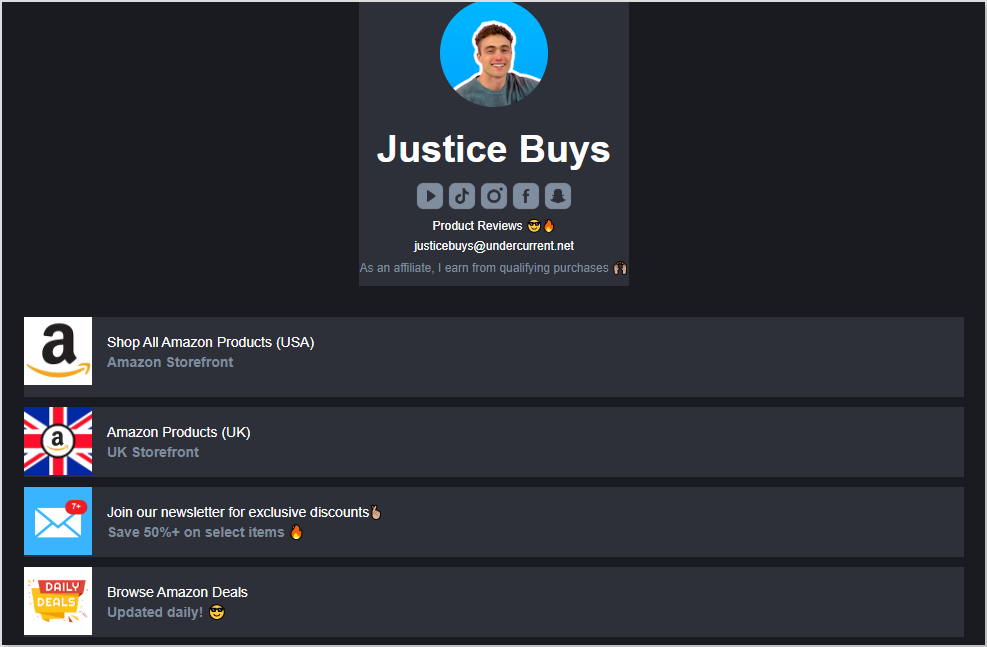
Here’s how Justice Buys, a leading Amazon content creator and affiliate marketer, earns a commission by promoting products to Amazon buyers:
How to choose the right niche:
Identify your passions or areas of interest.
Assess the demand and profitability of the niche (use tools like Google Trends).
Evaluate the competition—make sure there’s space for your voice.
Once you’ve picked your niche, it’s time to identify your target audience. Are they beginners or experienced? What are their pain points, and what solutions are they looking for?
Step 2: Analyze the competition
Understanding the competition helps you position yourself strategically. Look at other affiliate marketers in your niche. What are they doing well? What’s missing from their content? Are there areas where you can improve?
Check out popular blogs, social media accounts, and YouTube channels that cover your niche. What affiliate products are they promoting? What content formats are they using? This research helps you understand how you can differentiate yourself and bring something fresh to the table.
Choosing the right affiliate programs can make or break your success. You don’t want to promote products you don’t believe in, or that don’t resonate with your audience. Ideally, your affiliate products should align with your niche and audience’s needs.
Some key factors to consider when selecting affiliate programs:
Commission rate: How much will you earn per sale? Some affiliate programs offer a one-time payment, while others offer recurring commissions (which are great for long-term income).
Cookie duration: This refers to how long you’ll receive a commission after a customer clicks on your affiliate link. A longer cookie duration is preferable.
Product quality: Make sure the products you promote are high quality, as your reputation as a trusted marketer is on the line.
Popular affiliate programs include:
Amazon Associates (great for a wide range of products)
ShareASale (offers diverse merchants across multiple industries)
ClickBank (digital products with high commissions)
Mind-blowing fact (and stat): Around 75,659 companies are using the Amazon Associates affiliate program!
It’s that’s not your cue to become an affiliate marketer… why, just why?
Step 4: Build your marketing platform
Your marketing platform is the space where you’ll share your affiliate content. Whether it’s a blog, YouTube channel, podcast, or social media account, you need a platform to connect with your audience and deliver value. You don’t need to be everywhere; focus on the platforms your audience frequents most.
Ways to build your platform:
Start a blog: A blog gives you control over your content and audience. Create long-form posts, product reviews, tutorials, and guides. Use SEO to rank your content and attract organic traffic.
YouTube: Create video content with affiliate links in the description. Videos work great for product demonstrations, reviews, and tutorials.
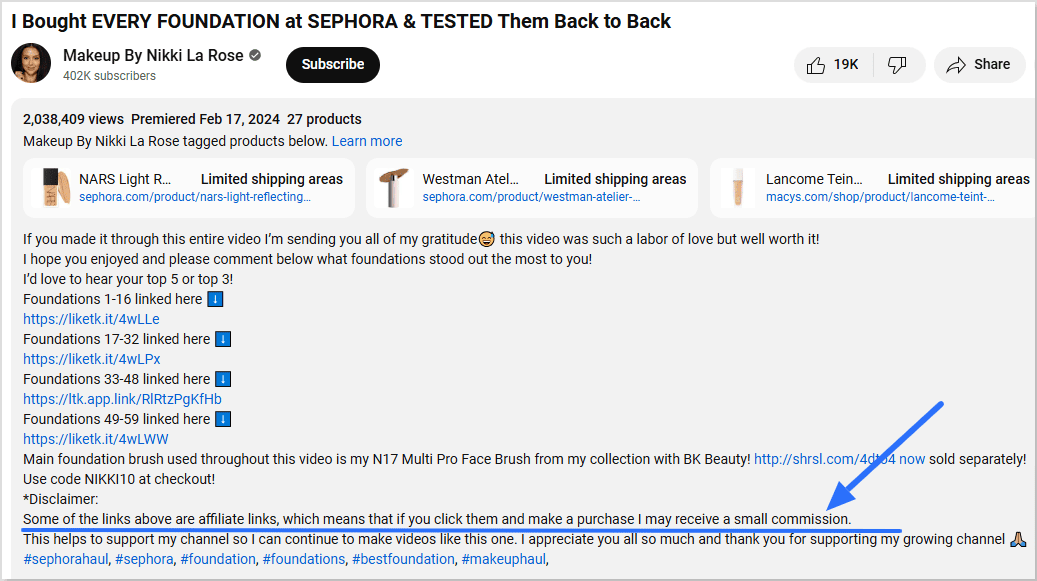
Here’s an example of how Nikki La Rose, a famous beauty YouTuber influencer. She writes down multiple affiliate links to the products she uses in her YouTube videos.
Social Media: Instagram, Facebook, TikTok, and Pinterest are visual platforms where you can promote affiliate products using affiliate links in your bio or story swipe-ups.
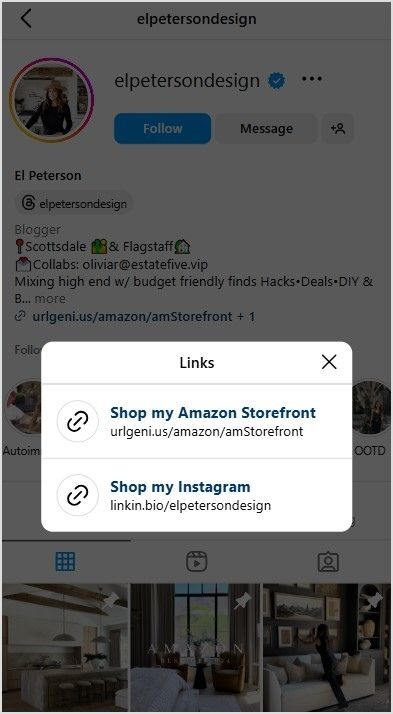
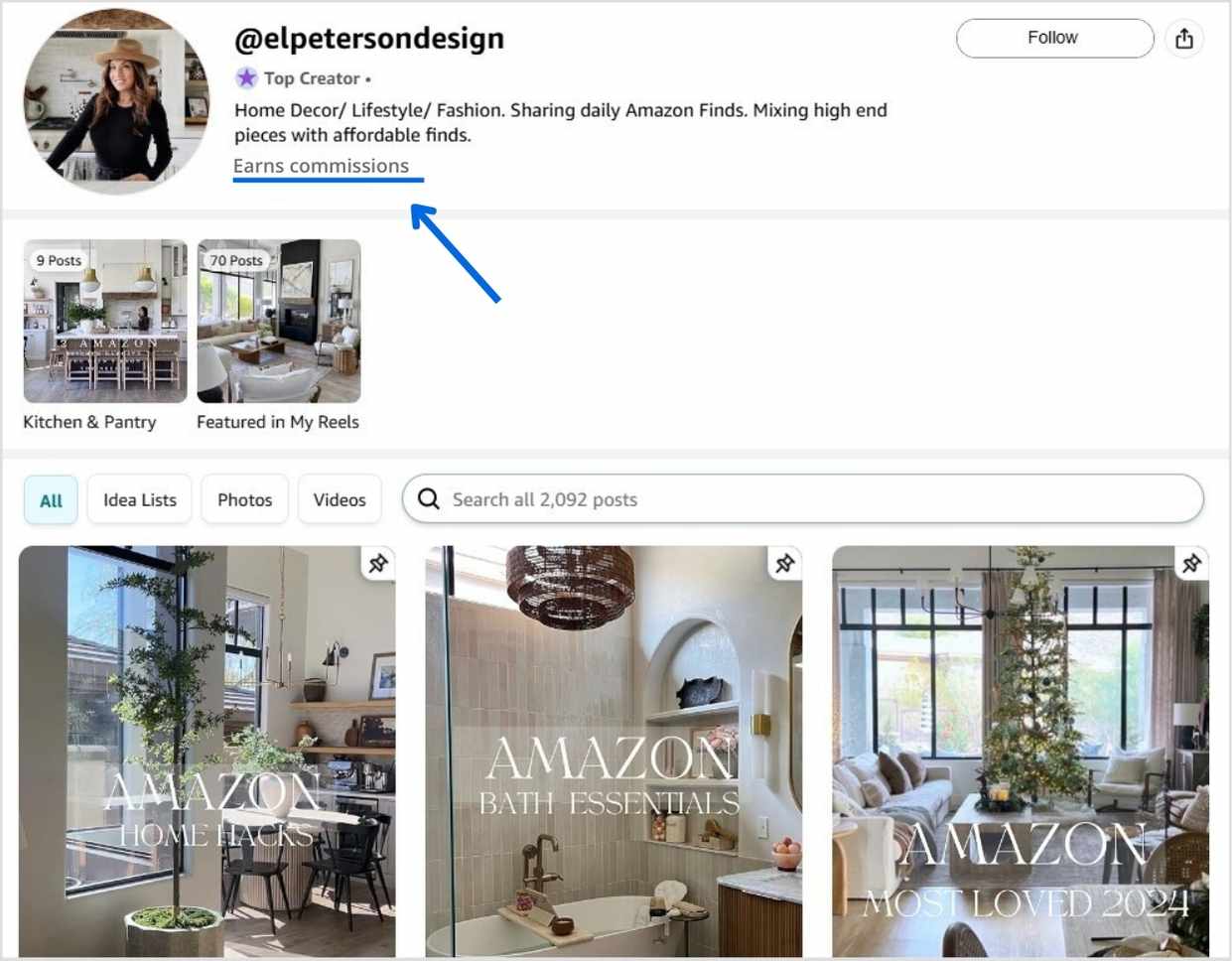
Check out how El Peterson, a popular content creator and affiliate marketer, links her Instagram bio with her Amazon Storefront.
Now comes the fun part—creating content! Affiliate marketing is all about providing value through content that informs, educates, and entertains. Whether you’re writing blog posts, creating videos, or sharing social media updates, always prioritize quality content that meets your audience’s needs.
For instance, let’s say you’re promoting fitness products. Instead of simply adding an affiliate link in a post saying “Buy this product,” create content that helps your audience solve a problem.
Content should always feel authentic and trustworthy. People are more likely to click on your affiliate links if they feel they can trust your recommendations.
How to become an affiliate marketer with Replug
Now that you know the basics of affiliate marketing, let’s talk about how you can streamline your process using Replug for shortening and managing your affiliate links.
Steps to get started with Replug:
Go to Replug’s website and click on “Affiliate marketing program” in the Resources dropdown.
Access the affiliate program page and click on “Become a Replug affiliate” button.
Register for an account or sign in if you already have an account.
Complete the application form
Add in all the necessary information and click “Update”.
Access your affiliate dashboard and add in the payout method.
Link shortening: Make your affiliate links clean and more appealing with this top-notch custom URL shortener, improving click-through rates.
Link cloaking: Protect your affiliate links from looking spammy, increasing click-through rates.
Custom branding: Reinforce your brand’s identity by customizing your links with branded domains.
Analytics: Get detailed performance tracking, such as click tracking and geotargeting, giving you insights into which links perform the best.
Bio links: Share multiple affiliate offers on a single landing page and direct your audience there via a simple bio link.
QR codes: Quickly generate a custom QR code for your affiliate links. This way, your followers can quickly scan your code, and upon making a purchase, you earn a commission.
Cross-platform integration: Integrate with social media, email campaigns, and other platforms so your links perform better everywhere.
Branded links: Turn generic affiliate links into branded links that are more clickable and trustworthy.
Link retargeting: Retarget users who clicked on your affiliate links but didn’t convert, driving them back to your offers.
Boost ROI with branded URLs!
Enhance your marketing campaigns by creating shareable, trackable, and fully multi-purpose
customizable branded URLs.
Tracking and optimization are key to affiliate marketing success. Replug’s powerful analytics allow you to monitor every aspect of your links’ performance. You can see which pages, social media posts, or marketing strategies are driving the most traffic.
Here’s how you can track and optimize your affiliate links effectively:
A/B testing: Replug allows you to test different versions of your affiliate links to determine which one performs better.
Click tracking: See which links get the most clicks and optimize your content strategy to focus on high-converting links.
Optimize for SEO: Replug’s custom URL features also help improve your SEO by ensuring your affiliate links are clean, readable, and keyword-optimized.
UTM builder: You can add UTM parameters to your affiliate links using Replug. This way, you can track the performance of your affiliate campaign depending on the UTM medium that you choose.
Conclusion
Affiliate marketing is a great way to earn passive income by promoting products you love and believe in. With the right approach, it can be a lucrative and sustainable business model. By following the steps in this guide, choosing the right affiliate programs, and optimizing your efforts using tools like Replug, you can maximize your affiliate marketing success.
A complete link management solution
for marketing professionals & agencies.
Try Replug for free
FAQs on how to become an affiliate marketer
How long does it take to make money with affiliate marketing?
It typically takes a few months to start seeing substantial income from affiliate marketing. It depends on factors such as your niche, marketing efforts, and audience engagement.
How do I find affiliate programs?
You can find affiliate programs through networks like Amazon Associates, CJ Affiliate, ShareASale, or directly on the websites of brands you admire.
How do I track the performance of my affiliate links?
Replug offers detailed analytics that help you track clicks, geographical data, and more. You can use this data to optimize your affiliate links and boost performance.
Amazon is the world’s largest online marketplace, and learning how to sell on Amazon can open up endless opportunities for entrepreneurs and established businesses alike. Whether you’re looking to start a side hustle, expand your existing business, or dive into e-commerce for the first time, Amazon provides a vast customer base and a streamlined selling process. However, with approximately 1.9 million sellers actively competing for attention, success requires strategy, research, and the right approach.
In this guide, we’ll break down the steps to help you start selling on Amazon, from setting up your account to marketing your products effectively.
Let’s get started!
The algorithm has changed
Imagine launching your Amazon store, excited to see sales rolling in, only to find your product buried on page seven of search results.
Ouch!
That’s because Amazon’s A10 algorithm doesn’t work like it used to. Gone are the days when you could simply throw money at PPC ads and expect to rank.
Previously, the A9 algorithm prioritized PPC sales, meaning you could run ads, generate sales, and climb the rankings quickly. A10 focuses more on relevance, customer satisfaction, and organic sales. Today, organic ranking, customer engagement, and external traffic play a much bigger role in your success.
What’s new?
Organic sales matter more: The algorithm favors products that sell well without paid ads.
External traffic is king: Amazon rewards sellers who bring traffic from Google, blogs, or social media.
PPC ads have less impact: You still need ads, but PPC sales don’t boost rankings like before.
Customer engagement counts: Good reviews, seller ratings, and response time affect ranking.
So, how do you win with A10? Let’s break it down.
Understanding Amazon seller accounts and costs
Before we begin, it’s wise to learn how Amazon structures its selling options. The platform offers two main selling plans: Individual and Professional. Both plans connect through Amazon Seller Central. Whether you aim to sell on Amazon for free or build a large-scale business, understanding these plans helps you pick the right path.
Individual vs. professional selling plans
Individual sellers
Pay a per-item fee of $0.99 whenever they sell a product.
Have no monthly subscription fee.
Rely on basic tools for selling on Amazon.
Often allows listing fewer than 40 items per month.
Professional sellers
Pay a monthly subscription fee of $39.99.
Don’t pay that extra $0.99 fee per item.
Can access advanced selling features, such as bulk listing tools and reports.
Sell in certain restricted categories that aren’t open to individual sellers.
Think about how many products you plan to list each month. If you expect higher sales, the Professional plan typically offers better value. However, the Individual plan is a solid choice if you’re selling fewer than 40 items per month.
Fees you should expect
One of the most common questions is: How much does it cost to sell on Amazon? Beyond your selling plan charges, here are additional fees to keep in mind when increasing sales on Amazon:
Referral fees: Amazon takes a percentage (often 8–15%) of each sale. This varies by product category.
Fulfillment fees: Using Amazon FBA requires payment for storage and shipping services.
Closing fees: These are charged on certain media categories (books, DVDs, and so on).
Setting up your seller account
Wondering how to become an Amazon seller and set up your account?
You’ll need the following:
A valid email address or Amazon customer account.
A credit card that Amazon can charge.
Government-issued ID for verification.
Tax details (depending on your country).
Phone number for verification.
Bank account to receive earnings.
Once you gather these items, you can register through Amazon Seller Central. Be sure to read and agree to Amazon’s terms of service.
After your account is live, you can start exploring how to sell products on Amazon, manage listings, and monitor performance. Let’s begin:
To list a product on Amazon, you have two options:
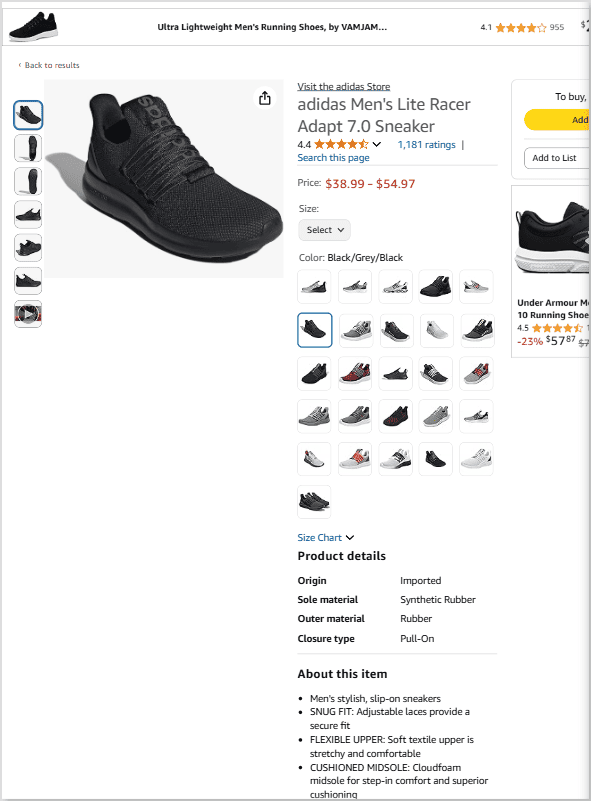
Existing products: If the product is already being sold on Amazon, it has an Amazon Standard Identification Number (ASIN). Your listing will be merged with the existing product page, showing all sellers offering that item.
New products (Private label): If you’re introducing a product that’s not yet on Amazon, like your exclusive line of eco-friendly water bottles, you’ll create a brand new listing.
Suppose you’re selling eco-friendly water bottles that you sourced from a supplier, and an existing listing is already on Amazon for the same product.
Start by copying the ASIN from the “product details” section of the current listing.
Log into Seller Central, click Catalog, and select Add Products. Paste the ASIN into the search bar to find the listing.
Choose the condition of your item (New, Used, etc.) from the dropdown and select Sell this product.
Set your price, select your fulfillment option (FBM or FBA), and follow the prompts.
You can create your SKU by clicking Save and Finish. The listing will be added to your Manage Inventory page in Seller Central.
Now, let’s look at adding a completely new product, for instance, “BrewNest Coffee Dripper”:
From Seller Central, click Add a product, then select I’m adding a product not sold on Amazon.
Select your product category and fill in all necessary details (title, price, description, photos, and fulfillment method).
Once everything is filled out, click Save and Finish. Your product will be submitted for approval.
After approval, Amazon will assign an ASIN and list it for sale. You can manage it through your Manage Inventory page.
When your product page goes live, customers can find it by searching Amazon. With the right marketing and a quality product, your orders should start coming in.
A well-defined plan makes all the difference when figuring out what to sell on Amazon. Whether you’re interested in private label items, retail arbitrage, or something else, assessing each model and performing thorough product research is highly recommended. If you’re exploring print-on-demand, Podbase is a helpful platform that simplifies product creation and order fulfillment, making it easier to test and scale custom product ideas.
Various selling methods
Private label: You work with a supplier to manufacture goods under your own brand. This approach can yield notable margins but typically requires more upfront costs. Shops like Alibaba can help you find private-label products.
White labeling: You sell generic products with your own brand name or logo. No manufacturing or design experience is needed.
Wholesale: You buy existing branded items in bulk and resell them. It’s a stable method but can involve heavier competition.
Retail arbitrage: You look for discounted items in retail stores and resell them on Amazon at a markup. This model can have minimal startup costs but takes time to hunt for bargains. Places like BestBuy, Target, and Walmart are useful examples to start with.
Dropshipping: You connect buyers with a supplier who ships products directly. This can cut down on inventory management, though you might have less control over product quality.
Product research tactics
Effective product research answers the question, “Where to buy products to sell on Amazon in a profitable way?” Here are several strategies:
Check for Amazon’s Best Sellers list. Popular product categories may have fierce competition, so look for underserved niches to boost your brand awareness.
Study customer reviews and ratings. Gain insights into what aspects of the product customers appreciate or dislike. This feedback can help you improve your listings, address potential issues, and align your offerings with customer expectations.
Do keyword research. Use tools like Helium 10 or Jungle Scout to find high-volume, relevant keywords that potential customers are searching for. This will help improve your product’s visibility and increase sales.
Review Amazon’s product restrictions. Before selling, thoroughly go through Amazon’s product restrictions to ensure compliance. Some items, like fine art and surveillance equipment, are prohibited, while others require pre-approval.
Keep seasonality in mind. Consider how seasonality affects your cash flow. There might be a possibility that an item booms in the summer but slumps in the winter.
What makes a good product?
Wondering if your product is good enough to sell on Amazon? Here are some things to keep in mind if you want your product to sell like hotcakes:
Profit margins: After subtracting Amazon fees, shipping, and any production costs, does your item still turn a strong profit?
Moderate competition: Look for subcategories or specialized areas where you can differentiate your offering.
Manageable size: Heavier or larger goods can mean bigger shipping expenses.
Durability: Fragile items have a higher risk of returns and negative reviews.
Year-round demand: Some products sell steadily all year round, while others are tied to holiday seasons or trends.
When asking yourself, “How to sell my product on Amazon so it stands out?” focus on finding an item that balances demand, profitability, and strong branding opportunities.
Boost ROI with branded URLs!
Enhance your marketing campaigns by creating shareable, trackable, and fully multi-purpose
customizable branded URLs.
The best way to attract Amazon shoppers is through well-crafted product listings. You need to ensure that your product listing is clear and has engaging content so you don’t risk falling behind in Amazon search results.
Essential elements of a winning listing
Title: Include your main keyword—maybe “Bluetooth Headphones” or “Organic Dog Treats.” Keep titles concise (under 200 characters) and add main details (brand, model, color, size).
Images: Crisp, high-resolution photos from different angles can make or break a sale. Lifestyle images that show your product in use help buyers visualize how they’ll benefit.
Bullet points: Highlight key features or benefits in short statements. Use easy-to-read language and sprinkle in relevant keywords naturally, like “Amazon product reviews” or “Amazon bestsellers rank” when appropriate.
Product description: Give more in-depth information and address common buyer questions. Break text into paragraphs to make it inviting and easy to scan.
Here’s an example of Adidas:
Choosing the right keywords
Think about what a shopper would type when looking for your product. Conducting keyword research can involve the following:
Using Amazon’s autocomplete option to see common search terms.
Reviewing top-performing competitor listings for keyword ideas.
Checking specialized keyword research platforms like Semrush or Ahrefs to pinpoint relevant words with strong search volume.
Place your most important keyword phrases in your listing title and bullet points. Spread secondary terms naturally throughout the product description.
Tips for ongoing optimization
Update visuals as you receive better photography or user-generated images.
Adjust bullet points based on frequently asked questions.
Test different versions of your title, bullet points, or images to see what increases your conversion rate.
Monitor comments and star ratings to see if product improvements or listing tweaks are needed.
Regularly refresh product visuals and optimize listings to maximize sales potential.
Storing, packing, and shipping goods might be the biggest challenge for new sellers. That’s where the debate begins: Fulfillment by Amazon (FBA) vs. Fulfillment by Merchant (FBM).
Amazon FBA (Fulfillment by Amazon):
Amazon handles storage, packing, and shipping.
Eligible for Prime shipping, increasing sales potential.
Amazon provides customer service & returns.
Higher fees for storage and fulfillment.
Amazon FBM (Fulfillment by Merchant):
You store and ship products yourself, reducing fees.
More control over inventory and order processing.
No Prime eligibility, meaning fewer conversions.
So, which method is right for you? It often depends on how quickly you expect to increase sales, your product’s size, and your margin. Some sellers even use both approaches to optimize costs, known as multi-channel fulfillment.y.
5. Marketing and promoting your products
With millions of items on Amazon, standing out takes strategy. Don’t skip marketing if you’re launching your first item or expanding a popular brand. Here are ways to market your Amazon products for higher sales:
Leverage external Traffic (Amazon loves this!)
Social media ads: Promote your products on Instagram, TikTok, and Facebook.
Google ads: Amazon rewards listings that receive traffic from Google.
Influencer marketing: Work with micro-influencers to create product buzz.
Promotions and deals
Here are some ways to drive an upswing in sales:
Lightning deals that appear on Amazon’s deals page.
Coupons that buyers can “clip” and see during checkout.
Prime-exclusive discounts reward Prime members with lower prices.
Run Amazon PPC campaigns (but smartly!)
Sponsored products:Appear in search results for targeted keywords.
Sponsored brands: Showcase multiple products under your brand.
Sponsored display: Retarget potential buyers.
Tip: PPC is still useful but should complement an organic ranking strategy rather than being the main driver of sales.
Track your campaigns regularly using campaign tracking. If a keyword isn’t converting, reduce the bid or add it to negative keywords.
That said, a well-structured campaign built by an experienced Amazon PPC agency can still accelerate early traction. It just needs to work alongside your organic and external traffic efforts, not replace them.
Building brand awareness
Register your brand on Amazon Seller Central if you meet the trademark requirements. You’ll gain access to extra branding tools.
Building your brand image outside of Amazon can push more visitors to your listing and help you boost e-commerce sales. Here are some ways you can do it with Replug:
Link management Easily shorten long and cluttered Amazon links into clean, custom URLs with this reliable URL shortener. With Replug, you can also generate link previews, add custom favicons, create password-protected short links for Amazon, A/B test multiple links, and set up link rotation. Our Amazon URL shortener is a one link destination for all your link management needs.
Affiliate link cloaking Messy and intimidating Amazon affiliate links can turn potential buyers away. Replug allows affiliates to cloak long URLs, making them cleaner, safer, and more appealing for clicks.
Deep links Direct users to specific product pages within the Amazon app instead of a generic web page using Replug’s deep linking feature. This improves user experience and boosts conversion rates by reducing unnecessary redirects.
Bio links
Turn your single bio link into a high-converting landing page. Showcase multiple Amazon products, deals and discounts, new finds and launches, and more with Replug’s bio link feature. It’s perfect for influencers, content creators, and businesses looking to drive traffic from Instagram, TikTok, and other social platforms.
Retargeting Enhance your Amazon ad performance by embedding retargeting pixels into your short links. This enables you to cross-promote across different platforms, re-engage lost customers, and drive more traffic to your Amazon storefront.
White-label branding Create a customized white-label dashboard with Replug in just a few minutes and build a branded experience for your clients. With Replug’s white-label solution, you can add your own logos, colors, and domain, making it look like an extension of your brand rather than a third-party tool.
Advanced analytics Replug provides in-depth analytics that goes beyond Amazon’s default URL shortener. Gain insights into total clicks, unique clicks, referral sources, and geographic data. Plus, you can add UTM parameters to your links for precise tracking across various channels.
QR codes Easily generate QR codes for your Amazon links and share them across different marketing channels. Customers can simply scan the code to access your Amazon storefront, streamlining the shopping experience and increasing conversions.
A complete link management solution
for marketing professionals & agencies.
Try Replug for free
Conclusion
You’ve now seen the major steps for how to sell on Amazon for beginners, from setting up a Seller Central account to planning your product lineup and using thoughtful keywords. Selling on Amazon can feel like a real adventure, but a well-researched approach helps you stay on track.
Think of each sale as a stepping stone. Keep testing different product ideas, gather feedback from buyer reviews, and tweak your listings often. For off-Amazon marketing, remember to simplify your links and measure click performance with tools like Replug so you can make smart decisions about your campaigns.
Ready to take the next step? Launch a small batch of products, learn from the process, and keep evolving. With consistent effort and an eye on what customers value, you can build a successful Amazon seller account that grows in ways you never imagined.
FAQs on how to sell on Amazon
How much does it cost to start selling on Amazon?
Costs differ by the type of products you sell and how you fulfill orders. If you pick the Individual plan, you’ll pay $0.99 per sale instead of a flat monthly fee. You’ll also face referral fees (8–15%, depending on the category) and optional FBA fees.
Do I need a business license to sell on Amazon?
Some sellers start without an official license. Still, it’s wise to consult local rules, especially if you plan to scale fast. Certain regions or product categories may require tax registrations or formal business structures.
What are the best products to sell on Amazon?
Many new sellers look to categories like home and kitchen, electronics, or beauty. Others focus on niche items that solve specific problems. The best products often have good profit margins, consistent demand, and moderate competition.
Can I use Replug to create deep links for Amazon?
Yes! Deep linking allows users to open Amazon product pages directly in the Amazon app, improving conversions.
How long does it take to start making money on Amazon?
Some see their first sale within days, while others might wait weeks. It depends on your item’s appeal, strategy around Amazon PPC, and how you optimize listings.
Can I sell on Amazon without inventory?
Yes. Dropshipping and FBA are two ways to avoid storing items in your own space. With dropshipping, your supplier ships directly to the buyer. With FBA, Amazon stores and fulfills your inventory.
You’ve got a hot product, and your online store makes few weekly sales. It’s time to turn the dial on your Shopify game and set your sales on a growth trajectory. But how? That’s the million-dollar question.
This guide has your back, delivering straightforward techniques that drive traffic and boost sales. And the best part? They’re quick and easy to implement!
So, let’s dive into the strategies that will boost your Shopify success without any unnecessary fuss.
Why do you need to increase your Shopify sales?
Shopify is an ecommerce platform that empowers entrepreneurs to launch and quickly grow their online stores. It’s user-friendly, packed with features, and highly customizable to suit many businesses. In fact, Shopify stores have collectively generated over $1 trillion in global sales, making it a powerhouse in online retail! Mindblowing, isn’t it?
That being said, with the stats to back it up, increasing your sales on Shopify could be the cherry on top to level up your ecommerce game. Also, consumer behavior has shifted drastically after the pandemic, with more people shopping online than ever before. This makes optimizing your Shopify store the ultimate game-changer for your business.
That’s exactly why we’re blessing you with this golden content: to help you win the Shopify Hunger Games.
But before we spill the tea, let’s take a moment to pinpoint the reasons why you might be falling behind. Time to turn those weaknesses into winning strategies!
If you own a Shopify store but are struggling to generate sales, check out Tan Choudhury’s insightful video on this topic:
Here are the 3 top reasons to consider why your Shopify store isn’t making sales:
Choosing random products to sell in your e-commerce store. To avoid this trap, top merchants utilize advanced Shopify product research platforms to ensure every item added to their inventory has proven market demand.
Not spending quality time writing a good product description and copy.
Using low-quality product pictures.
Quick tips to increase sales on Shopify
Here are some quick tips that will positively impact your Shopify sales:
Take advantage of Shopify’s built-in marketing tools.
Use social media to drive traffic to your store through Shopify links.
Use an email marketing tool to send regular newsletters to your customers and include strong calls to action phrases.
Offer discounts and free shipping incentives to encourage people to buy from your store.
Look into tools like CreateMyStore to simplify the process of building a highly optimized and user-friendly Shopify store.
Provide excellent customer service so that people have a positive experience shopping with you and are likely to return in the future.
To succeed in online marketing, focusing on a specific niche and target audience is essential. Trying to appeal to everyone often dilutes your efforts. Instead, identify your ideal customer and tailor your marketing message to resonate with them. This increases engagement and improves conversion rates. You need to:
Attract the right customers: Craft your message to meet your ideal customer’s needs and pain points.
Boost conversions: When your marketing is relevant, you’re more likely to turn visitors into loyal customers.
Use first-party data: Understand your audience better and refine your targeting using data like customer behavior, purchase history, and interactions.
Unlike third-party data, which is less personalized, first-party data allows you to create more effective marketing strategies. Here’s a video by Dan Shaffer from WebFX, sharing tips on how first-party data can amplify ecommerce sales:
2. Enrich the customer experience
For an ecommerce platform, positive customer experience is crucial for retaining customers and driving repeat sales. From the first interaction with your brand to post-purchase support, each touchpoint shapes their perception of your business. Customers encountering difficulties or dissatisfaction along the way are more likely to look elsewhere. Here’s how you can enrich the customer experience:
Create a streamlined shopping journey: Ensure your website is easy to navigate, with clear product descriptions and simple checkout processes.
Responsive customer support: Offering timely and helpful support can resolve issues quickly and build customer trust.
Here’s an example of Walmart’s responsive customer support. Their excellent customer service is one of their biggest secrets behind ecommerce success:
The key to keeping customers happy is providing exceptional customer service. If you go the extra mile, customers are more likely to return and recommend your brand, leading to long-term success.
3. Streamline and optimize your checkout process
To reduce cart abandonment and boost conversions, simplify your Shopify checkout with these key strategies:
Allow guest checkout: Allow users to make purchases without registration to reduce friction.
Minimize steps: Eliminate unnecessary form fields or pages to make the process quicker.
Offer clear payment options: Ensure an intuitive, easy-to-follow process with progress indicators.
Enhance page design: Keep it clean, easy to navigate, and visually appealing.
Use secure payment gateways: Ensure a reliable and safe transaction.
For registered or returning customers, a one-step checkout can further streamline the process and encourage completion. Here’s an example of Bath & Body Works:
Following the above strategies can easily improve user experience and increase sales on your Shopify store!
Your website copy plays a pivotal role in converting visitors into customers. It should be clear, concise, and persuasive, guiding users to take the desired actions, whether it’s making a purchase, signing up, or getting in touch.
Focus on benefits: Clearly articulate how your product or service improves your customers’ lives. Instead of just listing features, explain the specific, tangible benefits they’ll experience.
Use a conversational tone: Speak directly to your audience in a way that resonates with them. A friendly and approachable tone can make your message more relatable and engaging.
Proofread for perfection: Small errors like typos or grammatical mistakes can undermine your credibility and professionalism. Ensure your copy is polished before it goes live to maximize its effectiveness. Using a plagiarism checker can also help you maintain originality and ensure your content is completely authentic before publishing.
You’ll build trust and increase Shopify sales by refining your web copy to address your audience’s needs and showcase your offering’s true value. When paired with a E-commerce SEO agency’s expertise, your website can become a powerful tool for driving conversions.
5. Enhance website navigation
A smooth and intuitive website navigation keeps visitors engaged and increases conversions. Studies show that the average bounce rate benchmark is approximately 55.43%, hence, making it easy for customers to find what they’re looking for is essential.
Use a straightforward, visible menu: Your homepage should feature a prominent navigation menu that’s easy to spot and use. Include categories like vendor, product type, or tags so users can quickly narrow their search.
Organize products logically: Group similar items together to help customers easily find related products. This improves the browsing experience and boosts sales by encouraging additional purchases.
Streamlining the navigation makes it easier for customers to explore your products, increasing engagement and ultimately leading to more conversions.
6. Make your store load fast
A fast-loading ecommerce store is crucial for both customer satisfaction and SEO performance. Here’s why it matters:
Customer experience: A slow-loading site frustrates users and leads to high bounce rates. Visitors may leave before they even have a chance to explore your products.
Search engine ranking: Google favors fast-loading websites, meaning slow speeds can hurt your visibility.
Business sense: Fast sites run more efficiently, improving user experience and operational effectiveness.
Research shows that conversion rates can drop by an average of 0.3% for every second of delay in load time. So, making sure your site loads quickly directly impacts your sales.
To improve speed:
Choose a reliable hosting service that can handle high traffic volumes.
Optimize your images to reduce load time without compromising quality.
Ensure your URLs are SEO optimized for faster indexing.
Clean up your code to ensure smooth site performance.
A fast store enhances user satisfaction, boosts conversions, and improves search engine rankings, helping you increase sales on Shopify.
7. Create a landing page that converts
A well-designed landing page can significantly boost your sales on Shopify. Here’s how to make sure your page works to convert visitors into leads or customers:
Attention-grabbing headline: Make sure your headline clearly communicates the value of what you’re offering and grabs visitors’ attention immediately.
Clear and concise offer: Ensure that your offer is easy to understand. Visitors should immediately know what they will get in exchange for information or purchase.
Strong CTAs: Use compelling calls-to-action that motivate visitors to take the next step. Make the action clear, such as “Buy Now” or “Sign Up for Exclusive Offers.”
By focusing on these key elements, you can create a Shopify landing page that not only attracts visitors but also converts them into customers.
8. Design a great CTA (Call-to-action)
A well-designed call-to-action phrase is essential to driving conversions and guiding visitors to take action. Here’s how to make your CTAs compelling:
The offer: Ensure you’re offering something valuable or desirable to your audience. Whether it’s a discount, free trial, or more information, the offer should align with their needs.
The copy: Use clear, action-driven language. Words like “Get Started,” “Buy Now,” or “Claim Your Offer” give readers a clear direction on what to do next.
The design: Make your CTA button stand out. Use contrasting colors, enough whitespace, and clear visuals so it grabs attention without overpowering the rest of the content.
The prompt: Consider CTA buttons like “Get a Demo” or “Book Your Demo,” especially when the customer journey involves more touchpoints.
Here’s an example of Replug’s catchy call to action:
By designing CTAs that are appealing, action-focused, and strategically placed, you’ll increase engagement and drive sales.
9. Optimize product pages
Optimizing your Shopify product pages is key to driving conversions. Here’s how you can elevate your product pages:
Clear, detailed descriptions: Ensure your descriptions are informative, covering size, material, color, and usage. Here’s how Nike is doing it:
High-quality images: Use 4-5 images from different angles to view your product comprehensively. High-quality visuals increase trust and make your offerings more attractive.
Infographics: Use infographics to explain product benefits or provide comparisons in a visually engaging way.
Videos: Create product demos or behind-the-scenes content to build trust and connect with customers.
For your Shopify store, it’s essential to use visuals that grab attention and enhance the shopping experience. By crafting well-optimized product pages on Shopify, you help customers quickly find what they need, encouraging them to make a purchase and boosting your sales.
In addition to strong visuals and persuasive descriptions, many Shopify merchants leverage Shopify product bundles to showcase related items together, encouraging larger purchases and increasing average order value as part of their overall sales strategy.
Here’s an example of Apple’s unique and interactive product page:
Killer tip: Incorporate GIFs! These dynamic, eye-catching animations can showcase product features or add a playful touch, making your store stand out and keeping visitors engaged longer.
10. Focus on customer retention
Retaining customers is key to increasing Shopify sales. Keeping them happy encourages repeat business, reducing the need for constant new customer acquisition. Here are ways to increase customer retention:
Loyalty incentives: Offer discounts or rewards for repeat purchases.
Stay in touch: Send follow-up emails or personalized messages to maintain engagement.
Refunds: A hassle-free return policy builds trust and encourages future shopping.
Free shipping: Offering free shipping, especially on high-margin products, boosts conversions and customer loyalty. 62% of customers don’t purchase without free shipping costs, so consider incorporating shipping costs into product prices to create a more transparent and appealing checkout experience.
Zappos generated a total of $1,063.9M in global net sales by focusing on customer retention through free shipping and incentives.
Smartphones constituted around 68 percent of online shopping orders in 2024, so providing a seamless mobile experience is crucial. Here’s how to optimize your Shopify store:
Responsive design: Ensure your site adjusts perfectly to all screen sizes.
Fast loading speed: Mobile users expect quick page loads. So, optimize your images and reduce unnecessary elements.
Easy navigation: Simplify menus and ensure buttons are easy to click.
Mobile-friendly checkout: Optimize for mobile and integrate dynamic QR codes to let customers easily complete purchases.
Optimizing for mobile devices improves user experience and boosts engagement and conversion rates.
12. Build brand trust
Building trust with your customers is essential for driving conversions. Here’s how you can do it:
Professional design: Ensure your Shopify store has a clean, well-organized layout that reflects your brand’s quality and professionalism.
Social proof: Display customer reviews and testimonials prominently on product pages and throughout your site. Positive feedback from satisfied customers reassures new visitors that your products and services are reliable. Here’s an example of ContentStudio:
Trust signals: Use security badges (such as SSL certificates) and clearly state your return policy, shipping terms, and satisfaction guarantees. These elements make customers feel more secure about making a purchase.
Since over 99.9% of customers read reviews when they shop online, showcasing social proof builds credibility and enhances customer loyalty, leading to increased conversions and repeat business.
Customized URLs are a powerful way to enhance your branding efforts. By generating and using branded short links, you can reflect your brand’s identity exceptionally while boosting click-through rates.
Stand out with your brand: Replug is a top-notch link management platform that allows you to craft personalized URLs that align with your branding, making your links more memorable and professional.
Track performance: With built-in click-tracking capabilities, you gain valuable insights into how your links and campaigns are performing, helping you refine your marketing strategy.
Branded URLs go beyond simple link shortening; they offer a more sophisticated and effective way to distinguish your brand in the crowded online marketplace.
Boost ROI with branded URLs!
Enhance your marketing campaigns by creating shareable, trackable, and fully multi-purpose
customizable branded URLs.
To stand out in the competitive ecommerce space, it’s crucial to communicate your main selling points clearly. Whether it’s your competitive pricing, superior quality, strong brand identity, fast delivery, or problem-solving capabilities, ensure these strengths are front and center in your marketing efforts.
Focus on what matters: Identify the key benefits that set your store apart from the competition and weave them into your product descriptions, ads, and website content.
Create a consistent message: Reinforce your unique value proposition across all customer touchpoints to ensure that your brand message is clear and resonates with your audience.
Check out how Usermaven, a product and website analytics tool, highlights its selling point on its website:
You can build trust and loyalty by emphasizing your strengths, ultimately driving more sales and conversions for your Shopify store.
Search engine optimization (SEO) drives organic traffic to your Shopify store. You can attract more visitors and generate more sales by improving your site’s ranking in search results. Here’s how to optimize for SEO:
Use relevant keywords: Integrate keywords naturally into product titles, metadata, and URL slugs. This helps search engines understand your products and boosts your rankings.
Leverage content marketing: Create valuable content like blog posts, guides, and other resources targeting specific keywords. This not only enhances SEO but also attracts more visitors who are interested in your products.
Optimize product listings: Ensure each product listing is optimized for SEO and conversions. Use compelling descriptions, titles, and high-quality images to entice potential customers and improve your search ranking.
Drive traffic through SEM: Consider using search engine marketing (SEM) to pay for placement in search results, making it easier for customers to find your store.
By focusing on SEO and optimizing your store for search engines, you can increase its discoverability, improve traffic, and ultimately boost Shopify sales.
16. Leverage social media to increase sales
Social media is a powerful way to drive sales and strengthen customer relationships. You can turn followers into loyal customers by actively engaging with your audience and leveraging key strategies. Here’s how:
Engage with your audience: Monitor comments, host live streams, and run polls to connect and understand customer preferences. Tools like Talkwalker help monitor and track consumer sentiments.
Find and nurture leads: Use hashtags to discover new customers, engage authentically, and build trust.
Sell everywhere: Expand your reach by selling on multiple platforms. Tools like ContentStudio and Replug simplify inventory and performance tracking.
Seal the deal: Close sales through direct messages or personalized interactions.
A complete link management solution
for marketing professionals & agencies.
Try Replug for free
With the right approach, social media can turn followers into loyal customers and drive real results.
Paid advertising (PPC) is vital to boosting the visibility of your store:
Paid advertising: Use PPC to appear at the top of search results by bidding on relevant keywords. Ads on Google and social media platforms like Facebook, Instagram, and Pinterest help target specific audiences and increase visibility.
Social media ads: Engage customers through creative ads on platforms like Facebook and Instagram to raise brand awareness and drive traffic.
Here’s an example of paid Google search ads of Mascaras by different brands:
Paid advertising can maximize your reach and effectively engage with customers, driving immediate traffic and long-term growth.
Content marketing helps attract customers organically. By creating valuable content, you can boost your store’s visibility and strengthen your brand.
Content creation: Produce original and engaging content like blogs, videos, and social media posts that resonate with your brand and products. This helps define your brand while improving SEO.
SEO benefits: Quality content boosts search rankings, driving organic traffic to your store.
Brand awareness: Engaging content builds trust and visibility, leading to increased customer engagement.
Start using content marketing today to improve SEO, engage customers, and increase Shopify sales!
19. Use Bio Links on social media
Maximize your sales on Shopify by leveraging the bio link feature, particularly on platforms like Instagram. Here’s how to use it effectively:
Update regularly: Keep the link fresh by updating it to highlight specific products, promotions, or important content on your Shopify store.
Guide your audience: Use the link to drive users directly to key areas of your store, enhancing their journey and improving conversions.
Capitalize on engagement: Turn your social media activity into sales by linking to relevant pages, ensuring seamless navigation from your posts to your store.
Here’s an example of Canva’s bio link page:
Using bio link strategically can help you drive more traffic and sales from your social media platforms.
Email generates $42 for every $1 spent. That’s a staggering 4,200% ROI! Building a strong email list and sending targeted, personalized messages can increase sales, maintain customer recall, and enhance brand loyalty.
Here’s how to make the most of email marketing:
Build a high-quality email list: Acquire genuinely interested subscribers in your products or services. Use pop-ups, landing pages, and lead magnets to capture email addresses.
Send targeted emails: Craft relevant content based on customer interests and needs. For example, offer special promotions, share product launches, or provide tips that align with customer preferences.
Special offers & reminders: Email marketing is perfect for promoting sales, special offers, and new products. Regular updates keep customers informed and connected, increasing loyalty.
Here’s a vibrant and unique email subscription example of Passionfruit:
By utilizing email marketing, you can drive conversions on your Shopify store, boost customer engagement, and stay top of mind.
22. Building customer relationships and brand loyalty
Building strong customer relationships and brand loyalty are crucial for long-term business success. Here are effective ways to nurture these connections after the sale:
Send a thank-you note: A simple, personalized note can go a long way in showing appreciation and building trust.
Follow-up: Checking in with customers through emails, phone calls, or social media ensures satisfaction and shows you care about their experience.
Offer discounts: Providing exclusive discounts or coupons for future purchases rewards customers and encourages repeat business.
Ask for feedback: Demonstrating openness to improvement by soliciting feedback helps enhance the customer experience and shows you value their input.
Reward loyalty: Implement loyalty programs offering perks like early access to sales, discount codes, and exclusive offers to keep customers engaged and coming back.
Use user-generated content: Featuring content from your customers on social media makes them feel valued and strengthens brand loyalty.
We absolutely love how Blume is building customer relationships through their loyalty program, Blumetopia:
Check out the full page here for inspiration: Blumetopia
By focusing on these strategies, you’ll turn satisfied customers into loyal advocates, leading to increased sales for your Shopify store.
23. Monitor your inventory for smooth operations
Keeping track of your inventory on Shopify is essential to meet customer demand and prevent stockouts. Here’s how to effectively manage your stock:
Review sales data: Use Shopify’s sales analytics to understand which products sell well, helping you identify high-demand items to restock.
Track inventory levels: Shopify’s inventory management system makes it easy to monitor stock levels, ensuring you never run out of popular products.
Reorder in time: Leverage Shopify’s inventory alerts and trend analysis to reorder products before they run out, ensuring continuous availability.
By staying on top of inventory management on Shopify, you can maintain a seamless shopping experience for your customers while avoiding lost sales opportunities.
24. Up-sell & cross-sell to boost your sales
Up-selling and cross-selling are powerful techniques to increase your revenue by encouraging customers to purchase more. Here’s a quick breakdown:
Cross-selling: This involves offering a related product to complement the customer’s initial purchase, like pairing a burger with chips. The goal is to suggest products that enhance the customer’s experience.
Upselling: Upselling encourages customers to upgrade their purchase, such as upgrading from a 500ml Coke to a 1000ml Coke. It’s about offering a higher-value version of the original item, often with added benefits.
Here’s an image to demonstrate:
Source: goodfirmsdotco
25. Retargeting ads for Shopify stores
Retargeting ads are a powerful tool to re-engage visitors who’ve shown interest in your products but left without making a purchase. By displaying ads for products they’ve already viewed, you increase the chances of bringing them back to your Shopify store.
Benefits of retargeting ads:
Reduces cart abandonment: Target shoppers who’ve added items to their cart but didn’t complete the purchase.
Increases conversions: Show ads with relevant products to keep your store top-of-mind to increase Shopify sales.
Here is an example of a Facebook retargeting ad run by Myfix Cycles. The ad boosted their CTR by 6.38% and gained a revenue of $3,043.20 from an ad spend of $199.07, meaning that they earned $15 for a $1 ad spend.
Check the retargeting ad below:
How to set up retargeting ads:
Use platforms like Facebook/Google ads: Integrate your Shopify store with these platforms to easily set up retargeting campaigns.
Segment your audience: Create different campaigns targeting users based on their actions such as cart abandoners or product page visitors.
Design engaging ads: Highlight the products users were interested in and include incentives like discounts or free shipping to encourage them to return.
Retargeting ads can significantly increase your Shopify store’s sales by bringing back potential customers who are already interested in your products. Tools like Replug allow you to add retargeting pixels to recover lost sales.
Conclusion
Increasing sales on Shopify is about implementing tactics and building a sustainable strategy that focuses on customer experience, brand trust, and data-driven decisions. By combining niche targeting, optimized websites, SEO, and personalized customer interactions, you can create a holistic approach to driving growth.
Whether leveraging social media, crafting compelling web copy, or utilizing tools like email marketing and retargeting ads, these strategies will help you stand out in a competitive market.
Remember: Consistency and customer-centricity are the keys to long-term success!
FAQs for how to increase sales on Shopify
What are the most effective strategies to increase Shopify sales?
Focus on niche targeting, optimizing product pages, using SEO, and implementing social proof. Combining these strategies with personalized customer experiences can significantly increase conversions.
How can I improve my Shopify store’s checkout process?
Simplify the checkout process by minimizing steps, allowing guest checkouts, and integrating secure payment gateways. A one-step checkout for registered users can also enhance the experience.
How does social media help to increase Shopify sales?
Social media enables you to engage with your audience, promote your products, and direct traffic to your store using bio links, hashtags, and targeted advertising. It’s a cost-effective way to build customer relationships and drive conversions.
Why is SEO important for my Shopify store?
SEO improves your store’s visibility in search engines, driving organic traffic and increasing sales. Use relevant keywords in product descriptions, meta tags, and URLs to enhance discoverability.
How can I retain customers for repeat purchases?
Offer loyalty programs, personalized follow-ups, and exclusive discounts. Providing excellent customer service and seamless shopping experiences also encourages repeat business.
Are paid ads worth investing in for Shopify?
Yes, paid ads can drive immediate traffic and sales by targeting specific audiences. Platforms like Google Ads and Facebook Ads help boost visibility and engage customers effectively.
Black Friday is more than just a shopping day. It’s a high-stakes showdown for brands aiming to capture the spotlight and boost sales. Whether you’re a small business or a big retailer, a well-planned Black Friday campaign can maximize your impact and help you reach your goals.
Ready to turn browsers into buyers? With the right marketing ideas, you can stand out from the frenzy, win over new customers, and have your best Black Friday yet.
This blog discusses the 17 creative, tried-and-true strategies to help you cut through the noise, drive serious sales, and make this season unforgettable! Let’s dive in!
What is Black Friday marketing?
Let’s walk you through the inception of Black Friday marketing.
It all began in the U.S. back in the 1950s. It was a beautiful Friday after Thanksgiving, and a shopping storm was brewing in the U.S. As holiday lights started to sparkle, stores across the U.S. opened their doors with irresistible deals, marking the official start of Christmas shopping. Thus, Black Friday was born, a day when retailers rolled out jaw-dropping discounts, and shoppers raced to grab the best bargains before anyone else.
Fast forward to today, and Black Friday has grown into a global shopping sensation. It starts one month before Christmas, after Thanksgiving Day.
For retailers, it’s the perfect chance to boost sales and connect with new customers, while for shoppers, it’s a golden opportunity to score that dream item at an unbeatable price.
Why is it called “Black Friday”?
Black Friday was first used in 1869 when two investors, Jim Fisk and Jay Gould, crashed the market by dropping gold prices. As a result, foreign trade stopped, the stock market dropped by 20%, and farmers witnessed an unfortunate drop in wheat and corn values.
From 1950 to 1960, the term was used again for a day between the Army-navy game and Thanksgiving; the event summoned crowds of tourists and shoppers, requiring an extra few hours of effort by law enforcement to moderate the traffic.
In 1980, the term associated with shopping was used when retailers used the Black Friday term to reflect the backstory of accountants who used red ink for negative earnings and black for positive earnings.
Black Friday became the day when stores turned their profitability.
Since then, the term “Black Friday” has been in use. It has evolved into a season-long event that has spawned more shopping holidays like “Cyber Monday” and “Small Business Saturday”.
Black Friday is one of the most anticipated events for sellers and customers in the e-commerce business.
After the Pandemic, 80% of people switched to online shopping in the U.S. This makes it essential for e-commerce businesses to adopt smart, customer-centered strategies that attract and engage eager buyers.
1. Build your Black Friday email list
About 40% of people open their emails to see about Black Friday offers. This makes building an email list essential for connecting with customers. You can entice them with irresistible sales promotions by landing in their inboxes.
Don’t just focus on existing subscribers; invite new visitors to sign up for your email list by promoting your upcoming sales. Make your sign-up forms easy to fill by asking for their name and email address.
You can also use customer surveys and quizzes to grow your list. Consider offering incentives, like discount points, for those who subscribe and invite friends.
So, to nail your Black Friday marketing campaign, an email list is absolutely crucial. Your customers need to know that you’re offering those limited-time, unmissable deals!
Here is what boss business has to say about email list strategy:
2. Send personalized Black Friday advertising emails
Statistics show that 63% of people open emails specifically to find discounts. For businesses, this makes email marketing a no-brainer for Black Friday.
Here’s how you can build and send personalized Black Friday to promote your big sale in three easy steps:
Step 1: Create curiosity by sending an email one week before Black Friday to your customers and potential leads, informing them about the exciting upcoming event.
Step 2: Send a second email at the start of Black Friday to inform you about all discounts and offers. It will create fear of missing out.
Step 3: Send a third email to remind customers about the end of the sale and create a sense of emergency.
A customized email will make your customers feel important and exclusive. You need to post reminders on all social media channels along with an email campaign.
Here are some examples:
The famous SaaS platform Semrush and how it uses emails to promote its Black Friday sale. The marketing team creatively makes use of a catchy subject line, clickable images that lead to their Black Friday offer, and captivating images to entice its subscribers:
Here’s another example of Headline Studio by CoSchedule, an all-in-one AI Marketing Calendar platform. The highlights of this Black Friday marketing campaign include the use of an emoji in the subject line, a CTA button, and a visual representation of the price slash:
3. Boost Black Friday sales via Social Media
Top examples for Social Media Black Friday marketing campaigns:
Social media is the best platform to inform customers and users about your attractive discount offers and deals by sharing pro ads. According to stats, the most used social media platforms based on active users are Instagram, Facebook, YouTube, WhatsApp, and TikTok. Bulk WhatsApp messaging tools like WANotifier empower businesses to send personalized Black Friday deals and offers directly to customers, ensuring higher engagement and sales.
By providing information about upcoming offers before Black Friday, you can engage and excite your customers to check out all the deals on Black Friday. You should plan your offers and discounts wisely and share ads (paid and organic) to make people curious and excited about these offers.
You can also post stories, reels, posts, and videos or go live to introduce your Black Friday discounts and vouchers. Sponsored posts and stories are also a great source to gain an edge over the competition.
When scheduling your Black Friday content, make sure to use all social media features for maximum conversions wherever possible to maximize engagement and sales. Here are some excellent examples:
TikTok: Amazon gets weird
Amazon, the biggest e-commerce brand, took a weird and unusual take for its TikTok Black Friday marketing campaign:
KFC always has Finger Lickin’ Good deals for Black Friday. If that 50% discount doesn’t excite you, you’re probably missing out on life’s best flavors! Here’s an example of their Black Friday Marketing campaign on Facebook:
Instagram: Pro Direct Soccer drops the price (and the beat)
Pro Direct Soccer got a little swaggy with its huge price drop on Black Friday. Their Instagram reel took us on a jog with some upbeat music, cool visuals, and irresistible prices:
https://www.instagram.com/reel/ClgkHL0DNBL
YouTube: IKEA buys back old furniture on Black Friday
IKEA got us a little emo with its #BuybackFriday on YouTube. They didn’t offer a huge discount or anything; instead, they decided to take back old furniture and give it another life:
4. Roll out a Black Friday SMS marketing campaign
A Black Friday campaign isn’t complete without a solid SMS campaign.
But why SMS? Well, it’s immediate, super accessible, cost-friendly, and gets way more attention than email. When an SMS pops up on a customer’s phone, they’re way more likely to open it—especially during the busy Black Friday rush. Plus, you can send a quick, clear message with a link to all your deals.
Here’s how to make it work:
One week before: Send a sneak peek to get your customers curious about what’s coming. Build that excitement!
Black Friday morning: Hit them with the big news! Tell them that your discounts are live! Make it clear and action-oriented to get them shopping.
Last call: Remind them the sale’s almost over. Create some urgency to get those final clicks.
Another cool part about SMS marketing is that you can easily send loyalty and referral program invites, survey and feedback forms that can help you do better next year, and abandoned cart reminders.
It’s always better to use advanced SMS automation tools for your campaign. Some top SMS marketing software that can come in handy during the Holiday season are Insider, Textla, Birdeye, SlickText, Close, Ez Texting, and Salesmsg.
Here’s an example of how Function of Beauty understood the Black Friday marketing assignment:
If done right, SMS marketing can be a game-changer for your marketing strategy!
5. Upsell and cross-sell with discounts
Upselling and cross-selling are the best strategies to improve your Black Friday marketing.
In this, you can sell multiple products together to increase your earning potential.
An example of upselling could be that instead of selling a burger separately, you can make it a deal at a discount and at a better price by adding fries and drinks to attract customers.
Here’s an example of “Complete The Look” cross-sell offer with discounts by Adidas:
People prefer package deals over individual items. They won’t mind slight price fluctuation on deals – it can drive more sales and increase the number of products sold!
Give bundle discounts: You can attract more traffic to your stores by giving bundle discounts on your products. People buy more at a discount, which can increase sales in return.
Give your VIPs an exclusive Black Friday discount: To increase your earning potential, VIP customers receive exclusive discounts to appreciate their loyalty.
Focus on gift cards: To increase earning potential, you can distribute gift cards to your customers with attractive and special discounted offers and deals.
Here’s an example of Chuck E. Cheese, a famous restaurant chain in the United States:
Give a free gift with a purchase: To make your Black Friday sale attractive, make deals by announcing a buy-one-get-one offer. For example, if the customer buys a burger, offer a free drink. It will increase customers and urge them to buy more.
Here’s an example of the famous beauty brand Bobbi Brown:
Use coupon codes and vouchers: Boost your Black Friday sales with exclusive coupons and vouchers! Customers love a good deal, and these incentives can drive traffic, increase conversions, and make your offers stand out.
Check out this fantastic Black Friday offer by Kohl’s, where they offer a coupon code upon checkout for an additional discount:
7. Prevent cart abandonment using exit-intent popups
Cart abandonment occurs when an online shopper adds items to their cart but leaves the site without completing the purchase. This happens frequently, with customers leaving their carts full of products before finalizing checkout.
An exit-intent popup is a message that appears when a user is about to leave the site. These popups are highly effective at encouraging users to complete their purchases. Studies show that the average conversion rate for card abandonment popups is 17.12%
Exit-intent popups are especially powerful on Black Friday. They can showcase limited-time discounts and exclusive deals or even offer free shipping, reducing cart abandonment and boosting conversions.
Here’s an example of the exit intent popup of Usermaven, a website and product analytics tool:
Influencer partnerships are crucial for your Black Friday success. In fact, according to Influencer Marketing Hub, 24.2% of respondents intend to spend more than 40% of their marketing budget on influencer marketing.
Influencers help extend your reach to a wider audience, build trust, and create buzz around your deals. Their authentic recommendations can drive traffic, increase conversions, and boost brand visibility during the highly competitive Black Friday period. By collaborating with influencers, you tap into their loyal follower base, which can lead to a significant surge in sales.
Back in the picture again, we have Amazon. They used the famous TikToker Charlie D’Amelio to promote their Black Friday deals. Check it out:
Hashtags are essential for maximizing Black Friday visibility and engagement. They help categorize content, making it easier for shoppers to discover your deals among the flood of holiday offers.
Using popular and relevant hashtags, like #BlackFridayDeals or #HolidaySales, your posts reach a larger audience, attracting potential customers actively searching for discounts. Hashtags boost brand exposure and make it easy to join trending conversations, keeping your brand top-of-mind during the shopping season.
Creating a sense of urgency is key to boosting Black Friday sales.
Countdown timers, deal counters, and “limited time” alerts build anticipation before the sale starts and drive action once it begins. When shoppers see a countdown or “only hours left” message, they’re more motivated to act fast, knowing the deal won’t last forever.
By adding these urgency elements, you can maximize conversions and keep customers engaged right up until the final moments.
Here’s an example of Walmart’s “Limited time only” Black Friday offer:
This is how ContentStudio, a powerful social media management platform, uses a countdown banner on its landing page for its Black Friday software deal:
Retargeting ads are a powerful way to reconnect with customers who have previously visited your website and are especially useful for Black Friday promotions.
Pixel-based retargeting: This allows you to redisplay content to any anonymous site visitor who left without completing a purchase.
List-based retargeting: Here, you can upload a contact list to target individuals whose information you already have in your database. The platform will identify these users and show them relevant ads.
For Black Friday, where competition is fierce, a smart retargeting strategy is crucial to stand out. Using tools like Replug.io, you can add retargeting pixels to optimize reach and bring back potential customers. Replug’s features make it easy to track visitors and keep your brand visible.
Add social proof, like customer reviews, to your retargeting ads to increase trust. You can further shorten links for your Black Friday campaigns to make tracking and retargeting through Replug even more efficient and seamless.
12. Use bio links to direct people to your store
Bio links are clickable URLs added to the profile section of a page on social media channels such as Instagram or TikTok. They can direct customers to a website page or online store.
Before and on the Black Friday sale, you can put these bio links to direct people to your store to increase their promotions and customers. This can also save your customers time and give them a better experience.
13. Use deep links to direct people to the app store
Deep links are URLs that take users directly to an app store or specific app content, streamlining the journey for a faster, more convenient experience.
Drive more clicks, conversions, and app installations by deep linking
to your favorite platforms.
Try deep links for free
For Black Friday promotions, deep links can guide your audience straight to your app store, making the customer journey shorter and smoother while boosting engagement and retention. By bringing customers closer to the ultimate goal—conversion—deep links have increased conversions by up to 66%.
With deep links, customers can seamlessly purchase all their desired products in one app. Here’s an example of Waves Audio’s deep-linking ad for Black Friday:
Branded links are short, custom URLs unique to a brand. They offer a sleek alternative to long, generic links. These personalized links boost brand recognition and awareness, helping to build trust and credibility with your audience.
For example, Coca-Cola often uses branded links in tweets to make its posts instantly recognizable and catch people’s attention. For Black Friday promotions, branded links can enhance trust, attract more customers and increase sales:
Maximize marketing ROI
by transforming ordinary URLs into branded short links that convert.
Try Replug for free
15. Optimize checkout process
Optimizing the checkout process is essential for improving conversion rates.
For Black Friday sales, ensure the checkout process is streamlined to boost positive reviews and customer satisfaction. A well-optimized checkout should display all costs upfront, including shipping, taxes, and product price. This transparency leaves a positive impression on customers and encourages them to complete their purchase.
If the checkout process isn’t optimized, unexpected costs can lead to cart abandonment. Shoppers are eager to buy, but hidden fees often cause them to leave without completing their purchase.
An optimized checkout process enhances your e-commerce site’s user experience, helping maximize Black Friday sales.
For instance, this is what you’ll see upon checkout on Temu:
A/B testing, almost known as split testing, compares two versions of web pages or apps against each other to see which one performs the best.
In your Black Friday sale, you can use an A/B test to see the results of all ongoing marketing strategies.
You can check which strategies are working best and giving results by using advanced link management tools. Running an A/B test can have significant effects on your site or mobile app, such as:
It increases engagement
It reduces the bounce rate
It increases the conversion rate
It minimizes risk
It helps you create content effectively
A complete link management solution
for marketing professionals & agencies.
Try Replug for free
Through this test, you can check the effectiveness of your strategies and can modify your ideas for better results.
A call-to-action (CTA) is crafted to encourage the audience to take a specific action, guiding them through the customer journey. For Black Friday promotions, a well-placed CTA on a button or link can prompt users to check out the latest discounts and offers, helping to increase leads and conversions.
Using a tool like Replug makes it easy to create custom CTAs. Its built-in canvas allows you to design CTAs from scratch, whether a button, link, or form. This tailored approach ensures your Black Friday promotions are engaging and effective.
For this Black Friday, Lululemon, a famous Athletic clothing brand, creatively uses a “SHOP WE MADE TOO MUCH” CTA button. Upon clicking the button, the user is led straight to the Black Friday discount page:
Black Friday is a massive opportunity, but standing out requires more than just slapping a discount on your products. From building excitement early to leveraging data-driven insights and creating a seamless shopping experience, each strategy can help you connect with customers who are ready to buy.
Remember, Black Friday success is all about planning, flexibility, and staying ahead of trends. So, as the big day approaches, put these strategies into action, keep a pulse on customer feedback, and watch as your efforts turn into a holiday season win.
Happy selling!
FAQs about Black Friday marketing ideas
When should I start Black Friday promotions?
You should start your Black Friday promotions in the last week of October or the first week of November, as many people start looking for Black Friday in October. All the strategies for Black Friday should be managed before this day.
What types of promotions work best on Black Friday?
Discounts are popular, but there are many other successful strategies. Consider offering bundle deals, such as “Buy One, Get One” (BOGO), which offers gifts with purchase and limited-time discounts to create urgency. Make sure your promotions align with your brand and appeal to your specific audience.
What is the difference between Black Friday and Cyber Monday?
Both events offer a worldwide shopping experience. Black Friday belongs to the retail shopping arena, while Monday Cyber is designed for online shopping.
Black Friday follows the Friday after Thanksgiving. Monday cyber follows in the trail of Black Friday. It is one of a kind when online shoppers pick their online bargain without going to the retail stores.
How can I stand out from competitors on Black Friday?
Personalize your marketing wherever possible. Use segmented email campaigns, tailor social media ads to different audience groups, and emphasize what makes your brand unique. Excellent customer service and fast, easy checkout options can also set you apart.
How important is email marketing for Black Friday?
Email marketing is a must for Black Friday. With targeted, well-timed emails, you can build excitement, remind people about your sale, and re-engage customers who left items in their carts. Start with teasers, offer sneak peeks, and follow up with last-chance reminders.
How can I prevent my website from crashing due to high traffic?
This can definitely happen if you have a Black Friday sale. To optimize user experience, prepare your website ahead of time. Speak with your hosting provider to ensure it can handle a spike in visitors, and consider enabling a content delivery network (CDN) for faster load times. Reducing large image files and optimizing your website’s backend can also help.
What should I do if my Black Friday campaign doesn’t perform as expected?
It’s okay! If things don’t go as planned, use real-time data to adjust. Maybe you can add a flash sale, extend the promotion, or promote popular products more heavily. After the season, review analytics to learn what worked and what didn’t so you can improve for next year.
As e-commerce companies compete for consumer attention, choosing the most suitable marketing strategy is key.
Among these, influencer marketing has proven to be one of the most effective ones.
Research shows that consumers are more likely to purchase products endorsed by influencers, making this marketing strategy highly effective for brands looking to enhance their reach and engagement.
Influencer marketing’s global popularity is surging at an incredible pace, with the market projected to reach a staggering $22.2 billion by 2026.
Before we jump into influencer marketing for e-commerce, let’s go over the basics first.
What is influencer marketing?
Influencer marketing allows businesses to work directly with social media creators with a sizeable audience to increase brand exposure, generate sales, and get attention.
Since influencer marketing is comparatively cheaper than most online paid ads, businesses gladly pay influencers to review their products or discuss their offers.
Undoubtedly, influencer marketing is rising as the creator economy is the new normal in today’s digitally connected world, where many people work online.
One of the major impacts of the growth of the creator economy is that kids follow their favorite YouTubers and TikTokers more than A-list celebrities.
Why partnering with influencers can skyrocket your e-commerce success?
E-commerce brands and marketers try to squeeze every opportunity they can to get their hands on to generate sales or market their products.
One of the easiest routes to e-commerce success is influencer marketing. Here are the reasons why e-commerce brands partner up with well-known ecommerce influencers:
1. Underpriced marketing at scale
Influencer marketing turns out to be quite underpriced compared to traditional advertising or paid ads on social media. The fundamental reason for this is that a vast majority of influencers are willing to collaborate with brands, which paves the way for brands to get competitive pricing.
Furthermore, most small businesses and brands start with affordable micro-influencers to promote an e-commerce deal or specific product. So, that’s quite a reason for partnering up with influencers.
2.Meet the loyal influencers’ fan base
Social media influencers are known for their loyal and dedicated fan base, especially YouTubers and TikTokers. However, it goes for all major social media platforms, such as Instagram, TikTok, YouTube, Facebook, X, and Pinterest.
Brands see this as an opportunity to get the attention of such audiences as die-hard fans of certain social media influencers. Collaborating with such influencers makes it easier for the brands to get traction and build trust with the audience.
No wonder brands, agencies, and organizations feel proud to work with influential social media creators across the globe.
Companies are rapidly moving toward influencer marketing for many reasons, one of which is the diversity of social media platforms.
There are at least half a dozen mainstream social media platforms that allow brands to choose the relevant social media platforms and discover influencers on those platforms.
For instance, some brands are interested in Instagram influencer marketing for e-commerce opportunities, so they look out for Instagram influencers only.
4. Influencers have a longer audience attention span
The relationship between an influencer and their loyal audience is unique and fascinating. The audience is more likely to pay attention to their favorite influencer/creator than anybody else.
It turns out that the audience span is way longer on the social media content of their favorite creators than on other creators’ content. It gives e-commerce brands and marketers a chance to cash in on the longer audience attention span by sponsoring their videos or paying them to review their products.
Therefore, e-commerce brands are likely to benefit from such collaborations with influencers and content creators if they come across a perfect match for their brand.
Insider tips for discovering the perfect influencers for your online store
Connecting with the perfect influencer doesn’t happen on a whim. Brands and marketers have to analyze the market situation before they start to understand who they should reach out to and which creators to ignore.
So, here are the six tips for discovering the perfect influencers for an online store:
1. Explore social media platforms more than an average user
A powerful e-commerce influencer marketing strategy for a brand is based on a thorough market analysis. The best way to begin the influencer discovery is to start exploring the relevant social media platforms more than an average Joe.
What we mean by this is that an average user might have a short attention span or simply scroll the social media app for a few minutes and walk away.
On the contrary, a brand or individual looking for a perfect influencer from an ecommerce marketing standpoint should spend more time on social media exploration than an average user.
It’ll allow them to discover not just influencers for their online store but also new social media trends to capitalize on for social media marketing.
2. Hang out in the relevant social media communities
One of the underrated tips for discovering like-minded, relevant influencers for e-commerce marketing is to hang out in the social media communities. It could be Facebook groups, LinkedIn groups, X communities, Reddit communities, Quora spaces, etc.
Just ensure you’re in the relevant community regardless of the social media platform. Keep your eyes open, talk to people, and try to learn from others. Chances are, you’re going to discover the industry’s top guns.
That’s a surefire way to discover influencers for your e-commerce business.
3. Go through the related product reviews done by influencers
It’s important in digital marketing to do some competitor research and see what they have been up to. Utilize the same principle in your e-commerce influencer marketing strategy.
Try to find the product reviews done by influencers in your industry; it’ll allow you to see how the products have been reviewed, and you’ll stumble upon the influencers interested in your product line.
4. Follow social media influencers interested in your niche
It’s not the best idea to go on a follow-spree when eyeing social media influencers for your online store promotion. However, following some influencers who seem interested in your niche won’t hurt.
The benefit of following some influencers on Instagram, TikTok, or LinkedIn through your brand’s account is that they might notice your brand on social. As a result, it earns brands some profile views from influencers and eventually contributes to building a connection between the brand and the influencer.
5. Keep an eye out for micro-influencers in your follower base
Another important tip for discovering influencers for your e-commerce store is never to underestimate the power of micro-influencers, especially if they get engagement and reach.
For instance, if an Instagram creator has five thousand followers, but this creator is getting 20k reel views on average or 3k to 4k likes on Instagram posts, then this micro-influencer is worth a try.
Besides, looking out for the big guys, don’t underestimate the small guys that could bring you some quality traction without breaking the bank.
6. Hunt for the influencers that worked with your competitors
One of the most tried-and-tested methods of discovering the influencers for social media marketing or influencer marketing campaigns is to check out the competitors’ social media accounts and see which influencers they’re tagging or resharing.
You’ll likely discover influencers that have closely worked with your competitors in the past. Feel free to reach out to those influencers and find out what they’re charging for promotional or sponsored content.
Must-have tools to streamline your influencer marketing strategy
Let’s discuss some essential online tools that come in handy in running an influencer marketing campaign and massively influence the outcome of an influencer and brand collaboration.
Here are the must-have tools to utilize for implementing an influencer marketing strategy effectively:
1. Replug
Replug.io is an advanced link management tool for marketers, bloggers, and brands. It empowers users to take their URL management to the next level. It’s a top-notch link shortener that allows users to create, manage, and analyze short, branded URLs for digital marketing campaigns.
It flawlessly integrates with several third-party tools, such as software management tools, email marketing software, lead-gen widgets, and retargeting platforms.
ContentStudio is an all-in-one social media management dashboard for brands, marketers, bloggers, and influencers.
It’s a comprehensive social media tool that makes social media marketing easier than ever. It offers a complete suite for publishing, scheduling, managing, and analyzing social media and blog publishing.
Not only does it help publish and schedule content across all major social media platforms, but it also lets users post blog content on different blogging platforms.
Moreover, it easily integrates with multiple online marketing tools and platforms that improve product efficiency and effectiveness.
Canva is an online tool that helps users create images, videos, banners, infographics, logos, invitations, business cards, and other graphics designs. This is handy for designing social media, digital marketing, promotional, educational imagery, and video content.
Key features:
Text animations
Photo grids and designs
Icons and elements
Visual content templates
Background removal
Colors adjustment
Picture effects and editing
AI-powered photo enhancements
Integration with third-party tools
Pricing plan:
Canva pro: $55 per year (for one person)
Canva teams: $50 per year (per person)
Canva enterprise: Contact sales team
4. Capcut
Capcut is a popular video editing tool available for both mobile and desktop users. It has empowered millions of creators and brands to get their hands on video editing. After the huge success of Capcut on mobile devices, the desktop edition is competing with most video editing software for beginners.
This video editor is fully equipped to manage video, audio, and text editing. Moreover, it offers various AI-based generators to create e-commerce influencer marketing content.
Key features:
Easy-to-use interface
AI-powered tools
Assets availability
Image and video enhancements
Mobile and desktop versions
Pricing plan:
Capcut PC Pro: $8 per month (or $75 yearly)
So, these are some of the important e-commerce marketing tools to keep an eye on when getting into e-commerce influencer marketing.
The best platforms to amplify your brand with influencer partnerships
E-commerce brands strive to find underpriced marketing opportunities to put their brand name in front of as many people as possible without spending a fortune.
It turns out that influencer partnership seems to be a reasonable option for most e-commerce companies to spread the word about themselves. Here are the five well-known influencer marketing platforms to collaborate with influencers:
1. Upfluence
Upfluence is an all-in-one influencer marketing platform that connects social media influencers with e-commerce brands.
The brands can go through the influencers’ listings and handpick the most relevant influencers to work with. Upfluence handles the payment via Upfluence Pay and PayPal.
Why does Upfluence work for both brands and influencers?
It lets brands find suitable influencers via an influencer discovery feature.
It makes influencer management easier than ever, thanks to an effective creator workflow.
It works with e-commerce brands on Amazon, Shopify, Bigcommerce, and WooCommerce.
It provides hassle-free payment transfers via Upfluence Pay and Payment.
It lets brands send complimentary products to the influencers for reviews or testing.
It makes influencer e-commerce statistics measurement rather simple, allowing brands and influencers to analyze campaigns’ performances.
It seamlessly integrates with several marketing, email, and content-creation tools.
2. Grin
Grin is a top-notch influencer marketing platform that not only connects brands with influencers but also provides cutting-edge influencer marketing solutions to both parties.
This tool provides a platform to meet influencers, manage content, track campaigns, and make payments. All in all, it’s a comprehensive dashboard to run influencer marketing campaigns with ease.
Why does Grin work for both brands and influencers?
Grin offers a creator discovery section that lets brands find suitable creators around the globe.
It has a state-of-the-art content management system to manage social media content for influencer marketing campaigns.
The platform pays attention to relationship-building between brands and influencers.
Detailed reporting and analyzing monitoring allow brands to take a data-driven approach and make informed decisions.
The creator payment system is as simple as one can imagine, ensuring smooth and quick payments for influencers.
Traackr is yet another well-reputed influencer marketing platform that offers brands and influencers hands-on experience. It’s an advanced influencer marketing tool to find influencers, manage relationships, collaborate with creators, and analyze performance.
Undoubtedly, it’s a one-stop shop for managing influencer marketing campaigns for e-commerce brands and online businesses.
Why does Traackr work for both brands and influencers?
Traackr ensures that brands find the influencers that are the right fit for the campaign.
It assists brands and influencers in content collaboration, making influencer marketing more fun.
It offers a reliable payment system for paying influencers for their work.
The robust analytics section provides comprehensive reporting to analyze campaign performances.
It has a seamless recruitment and onboarding procedure for brands to manage influencers.
It provides insights into campaign data for optimization and scalability.
4. Klear
Klear is a robust, user-friendly influencer marketing platform designed to meet the most advanced needs with ease and intelligence.
It empowers e-commerce brands to streamline their influencer marketing efforts, offering an intuitive and powerful suite of tools to find, manage, and pay influencers for their collaborative campaigns.
Why does Klear work for both brands and influencers?
Klear has an advanced influencer search feature to help you find suitable influencers for every brand.
It has a powerful influencer relationship management system to stay connected with influencers.
It showcases in-depth influencer analytics to the brands to ensure that they go through all major statistics of the influencer’s social media profiles.
It offers an easy-to-manage campaign management section for accurate data monitoring and reporting.
CreatorIQ is the go-to influencer marketing platform for large-scale e-commerce and SAAS tools.
It offers a complete ecosystem for building the most authentic, engaging, and scalable influencer marketing campaigns. This tool is equipped with several advanced features to streamline influencer marketing campaigns effectively.
Why does CreatorIQ work for both brands and influencers?
CreatorIQ allows brands to discover and manage influencers without relying on third-party tools.
It allows brands to build communities after connecting with like-minded creators and influencers.
It lets brands analyze trends to design their influencer marketing campaigns more efficiently.
Team collaboration is a huge plus that ensures that the influencer marketing campaign bears fruit.
Incentivizing the brands for their contributions hasn’t been this simple; the platform makes it easier to pay influencers without any hectic steps.
It offers robust analytics for brands to analyze the campaign statistics to measure the ROI.
The highs and lows of using influencers to boost your e-commerce business
Before designing an influencer marketing strategy for brands or using influencers to boost e-commerce sales, it’s vital to know the good and bad parts of the strategy.
Let’s shed some light on the highs and lows of utilizing influencers for e-commerce businesses:
The advantages of using influencers to boost e-commerce business growth
Here we go:
Brand visibility: One of the major benefits of using Influencers for e-commerce marketing is that they have established audiences that listen to them. Partnering with the right influencer can expose your e-commerce business to thousands or millions of potential customers, increasing brand awareness and visibility.
Targeted audience: E-commerce success comes when the e-commerce brand understands the target audience well and makes marketing strategies accordingly. Influencers usually cater to a specific niche audience. Therefore, by collaborating with influencers whose followers match your target demographic, e-commerce brands can significantly reach the right audience that might be interested in their products.
Authentic experience: Conversion is tied to authenticity and trust. When influencers genuinely use and recommend your product, it feels more like a trusted suggestion than a direct advertisement, fostering trust and credibility with their followers.
Higher engagement rates: Influencers often generate higher engagement rates than traditional ads. This phenomenon occurs because their followers are quite invested in their favorite creators’ lives, so they take action when influencers suggest they try something out.
Cost-effective marketing: Usually, there aren’t many types of influencer marketing. However, the term “micro-influencers” has popped up lately. The concept allows comparatively smaller creators and influencers with niche accounts and engaged audiences to work directly with brands, ensuring affordable alternatives to pricey PPC or social media ad campaigns. Plus, influencer marketing makes it easier for smaller e-commerce businesses to enjoy low-cost advertising facilities.
Most influencers are skilled content creators and can produce visually appealing and engaging content for your brand, such as social posts, video reviews, or product tutorials, which can boost e-commerce business sales.
The disadvantages of using influencers to boost e-commerce business growth
There are some hiccups to keep an eye on before going all in on influencer marketing:
Affordability issues: Influencer marketing is not all sunshine and rainbows. While micro-influencers can be affordable, collaborating with top-tier influencers can be expensive, especially for small e-commerce businesses. So, there are always affordability issues for newbies.
Little to no control over content: Usually, brands that work with influencers give their suggestions on product placement or mention it in the content. However, they still have limited control over how the product is displayed or presented in the content. So, it’s quite clear that e-commerce brands must rely on influencers to present their products in the content.
Campaign authenticity: The authenticity of the offers matters a lot in the conversion. If an influencer promotes too many products or only collaborates for financial gain, their recommendations can feel less genuine, leading to skepticism among followers and lower trust in the promotion. It can massively impact the ROI of the influencer marketing campaign for the brand.
Hard to track campaign ROI: One of the challenges influencers face is measuring the campaign’s effectiveness. Unlike direct sales channels, the return on investment (ROI) from influencer marketing isn’t always immediately clear or quantifiable.
Fake social media followers: Some influencers purchase social media followers to make an impact, but they cannot generate any traction with it. The artificially boosted follower counts using bots or fake accounts don’t last long, as sometimes social platforms crack down on those fake followers or remove inactive accounts.
Let’s conclude by explaining how to set up winning influencer campaigns!
Finding the right match for your brand is the secret sauce to setting up winning influencer campaigns.
There are three fundamental points that play a pivotal role in making any influencer marketing campaign a success, which are:
Understanding the brand’s strengths
Team up with the best influencer to work
Create an irresistible offer for the audience
Things start to roll when the conditions mentioned above are properly met in an influencer marketing campaign.
In every e-commerce brand’s journey, there comes a point where they have to decide whether to check out the influencer marketing platform or to find the influencer off the platform.
There is no right or wrong way of doing influencer marketing. However, some credible influencer marketing platforms do vetting before adding influencers to their network, which speeds up the process.
However, before deciding, one can always analyze the influencer’s content, publicly available statistics, engagement, and branding.
Remember that most brands opt for influencer marketing over other advertising mediums because it’s still underpriced compared to traditional online advertising.
Moreover, relevance is yet another essential angle to pay close attention to – if the e-commerce product line isn’t relevant to the influencer or their audience, the campaign will fall flat. So, bear that in mind when launching an influencer marketing campaign.
FAQs about e-commerce influencer marketing
Here are the commonly asked questions about e-commerce influencer marketing:
Is influencer marketing B2B or B2C?
Generally, influencer marketing is done to reach out to the audience of the influencer. Brands want to cash in on the traction influencers get on social media, which means targeting the audience. So, it’s safe to say that it’s B2C in most cases.
What is an e-commerce influencer?
An e-commerce influencer is a social media creator who has managed to create a brand persona around e-commerce. Plus, this creator must have a sizeable audience, at least on a single social media platform, to be qualified as an influencer.
How does B2B influencer marketing work?
B2B influencer marketing refers to the influencer marketing strategy that revolves around targeting businesses, unlike B2C influencer marketing, in which the influencers’ followers are the target audience.
What is the best influencer marketing platform for B2B?
ContentStudio does a pretty good job of finding influencers on social media. The feature is called “Influencer discovery,” which lets users find influencers in the niche.
Many people are understandably cautious about clicking on links, whether due to annoying website pop-ups or emails from unfamiliar sources.
At the same time, this hesitation poses a challenge for marketers, as getting users to click on URLs is vital for engagement and conversions.
This is where a free link shortener with tracking capabilities comes into play. It helps you create short URLs quickly and hassle-free.
These attractive and concise links have become popular among influencers, brands, marketers, and bloggers. These professionals utilize them to enhance marketing efforts, engagement, and click-through rates across various platforms.
Let’s explore the concept of shortened URLs and the possibilities of using short, branded URLs to boost marketing campaigns.
What are short URLs?
A short URL is a compressed version of a longer web address, created using a URL shortening service like Replug.
These links redirect users to the original URL but take up far less space, making them ideal for social media posts, SMS messages, email campaigns, and print materials.
The primary purpose of using such URLs is to enhance readability, make links more shareable, and provide a cleaner, more professional appearance across digital platforms.
The ultimate goal is to enhance user experience and maximize click-through rates (CTR) by making links easier to recognize, trust, and remember.
In fact, Backlinko reports that the top Google result earns a 27.6% CTR, showing just how impactful optimized URLs can be, especially when they’re concise and keyword-rich.
Importance of Short URLs
🔗 Improved click-through rates (CTR): Shorter, cleaner links tend to attract more clicks, especially when customized with relevant keywords.
📱 Better user experience: Long URLs can be messy and irritating. Short links are easier to read, type, and share, particularly on mobile devices.
📢 Cross-platform compatibility: Short URLs work seamlessly across all channels, from emails and tweets to offline QR codes and posters.
🎯 Efficient space usage: Especially useful in character-limited platforms like Twitter, where every character matters.
📊 Trackable engagement: The best URL shorteners come with built-in analytics to track performance, including clicks, device types, locations, and referrers.
Branded short links are more than just shortened URLs. They’re powerful marketing tools that enhance brand visibility, trust, and campaign performance.
🧠 Increased Brand Awareness: Branded links (e.g., yourbrand.link/offer) keep your business name front and center, reinforcing brand identity.
🤝 Higher Trust & Credibility: Users are more likely to click a link that includes your brand name rather than a random string of characters.
📈 Enhanced Conversion Rates: Recognizable, trustworthy links can drive more conversions by reducing hesitation and building confidence.
🔍 SEO Benefits & Keyword Relevance: Branded short links with targeted keywords can improve link context and searchability.
🛠️ Campaign Differentiation: Marketers can create unique branded links for different campaigns or platforms, making it easier to measure effectiveness and ROI.
How to use short URLs for marketing purposes
In today’s fast-paced digital world, every character counts, especially in marketing. Short URLs not only help streamline your messaging across channels but also offer powerful branding, tracking, and optimization opportunities.
When used strategically, they can significantly uplift your campaigns’ performance, improve engagement, and boost brand recognition.
Select a branded domain
Branded short links do more than just save space; they make a lasting impression.
Raise trust
Generic short URLs (like bit.ly or tinyurl.com) can appear suspicious to users. A branded short domain (e.g., nyti.ms for The New York Times or amzn.to for Amazon) instantly signals credibility.
Consumers are more likely to click on links that clearly indicate their source, which reduces bounce rates and enhances user confidence.
Boost brand recognition
A consistent, customized short link reinforces your brand with every share. When your brand name is visible in the link (e.g., yourbrand.link/offer), it becomes a subtle yet powerful marketing asset.
Over time, this repeated visibility strengthens brand recall and sets your content apart from generic competition.
Create meaningful custom links using a URL shortener
A short URL should still tell a story.
Contextualize
Avoid ambiguous strings like bit.ly/3kYs8dQ. Instead, create links that provide immediate context, like yourbrand.link/fall-sale.
This not only improves click-through rates but also helps users understand what they’re about to view.
Utilize keywords
Including relevant keywords in your custom URL improves both SEO and user engagement.
For instance, a campaign for a new product launch might use yourbrand.link/new-smartwatch, instantly conveying value while helping search engines index the link contextually.
Take advantage of the tracking & analytics capabilities of a URL shortener
One of the greatest strengths of short URLs lies in the data insights they provide.
Monitor clicks
Track how many times your links are clicked, and when. This helps determine peak engagement hours, ideal publishing times, and overall campaign performance.
Segment data by channel
Most paid URL shorteners (like Bitly, Rebrandly, or Sniply) allow segmentation by traffic source. Whether the link was clicked via Instagram, email, or a QR code on a flyer, you can pinpoint which platforms drive the most traffic.
Track performance
Beyond raw clicks, evaluate metrics such as bounce rate, time on site, and conversions associated with each short link.
For instance, yourbrand.link/discount might drive 10,000 clicks but only 1% conversions, prompting a change in strategy or landing page design.
Monitor multi-channel campaigns
Use unique short URLs for each channel in a multi-channel campaign (e.g., yourbrand.link/email, yourbrand.link/facebook, etc.). This gives you precise insights into what’s working and what needs refinement across your marketing mix.
Refine campaigns
Data from short links isn’t just for reporting, it’s actionable. Low click-through rates on a particular platform may suggest poor copy or ineffective targeting. Conversely, high-performing links can serve as templates for future campaigns.
Gain insights into audience engagement
Are mobile users engaging more than desktop users? Are certain geographic regions clicking more frequently?
Link analytics can provide rich behavioral insights, enabling you to tailor your messaging and audience targeting more precisely.
Deploy the short links across all marketing channels
Short links excel in their flexibility and universal applicability.
Social media
Character-limited platforms like Twitter and Instagram bios benefit greatly from short links. For example, a post might include yourbrand.link/freeguide to maximize space and visibility without clutter.
Emails
Short URLs keep your emails clean and clickable. They’re especially useful in tracking which links recipients engage with the most, allowing for precise list segmentation and follow-up.
SMS campaigns
Text message or SMS marketing succeeds due to its conciseness. A short, branded link not only fits character limits but also makes the message feel more professional, increasing trust and CTR.
Content marketing
In blog posts or downloadable PDFs, short URLs are easier to remember and type. They’re especially useful in content upgrades or linking to gated assets (e.g., yourbrand.link/checklist).
Print & offline media
Short URLs often back QR codes. But even without a QR code, having a memorable short URL on a poster, business card, or flyer (e.g., yourbrand.link/event) makes it easier for users to engage offline.
Test & iterate
Effective marketing is a cycle of experimentation and refinement.
A/B testing
A/B testing is a method for comparing two or more cases to see which one performs better. Use multiple variations of your short URLs to test different messages, formats, or landing pages.
For example, test yourbrand.link/save20 vs. yourbrand.link/20off to see which resonates better with your audience.
Stay consistent
Consistency builds familiarity. Stick to a recognizable format and naming convention for your URLs to make them more memorable and reinforce your brand across all campaigns.
Short URLs are more than a space-saving tool; they’re a strategic marketing asset. When branded, customized, and tracked effectively, they enhance trust, boost engagement, and provide actionable insights that help refine your campaigns.
Whether you’re launching a new product, running a seasonal promotion, or simply sharing blog content, integrating short URLs across your marketing channels ensures your message is not only seen, but remembered and acted upon.
How to use short URLs for marketing campaigns: Some good examples at hand
Let’s explore five successful examples of brands using short URLs to drive marketing results effectively.
Coca-Cola’s “cokeurl.com”
Strategy: Coca-Cola created a custom branded short domain, cokeurl.com, to reinforce its brand identity in digital campaigns.
Use case: In global promotions like the “Share a Coke” campaign, they used short URLs to direct users to personalized bottle pages or social contests.
Why it works: These links were easy to remember and instantly associated with the brand, thereby improving engagement across platforms such as Twitter and SMS.
New York Times’ “nyti.ms”
Strategy: The New York Times uses nyti.ms, a branded short domain, for sharing articles across social media.
Use case: Each shortened link redirects to a full NYT article, especially effective on platforms like X (formerly Twitter), where character count matters.
Why it works: Branded URLs, such as nyti.ms/abc123, build trust, signaling to users that the link leads to a reputable source — a key factor in increasing click-through rates.
Amazon’s “amzn.to”
Strategy: Amazon uses the custom short domain amzn.to, powered by Bitly, for affiliate and product links.
Use case: Affiliates and marketers share these links on blogs, YouTube descriptions, and social media to drive sales and earn commissions.
Why it works: These URLs are concise, trackable, and clean, enabling both Amazon and its partners to monitor traffic, conversions, and optimize campaigns in real-time.
Spotify’s campaign-specific short links
Strategy: Spotify uses short URLs for sharing playlists, artist pages, and marketing campaigns, often through branded or campaign-specific domains.
Use case: During the launch of new features or artist collaborations (e.g., “wrapped” campaigns), Spotify uses custom short links to drive mobile traffic.
Why it works: These links enhance shareability and enable Spotify to collect user data, including location and device information, for retargeting and analytics purposes.
Pepsi’s QR & short link integration in campaigns
Strategy: Pepsi integrates short URLs alongside QR codes in product packaging and TV commercials.
Use case: During promotions like the “Pepsi Stuff” rewards program, they used memorable short links to direct users to sign-up pages and promo details.
Why it works: Combining visual codes with short, branded URLs ensures a seamless user experience, especially for mobile users who may not be able to scan a QR code (at times) but can easily type a simple URL.
The best URL shortener for online marketing in 2026
Replug.io is an all-in-one link management tool designed for brands, marketers, SEO specialists, and bloggers to create, manage, and analyze short URLs.
It’s a comprehensive URL shortening tool that provides several link management services to upgrade your social media marketing to the next level.
Thousands of happy customers worldwide trust Replug for the link shortening task. One major reason for its success is that it offers much more than the average URL shortener freely available online.
Users find URL shortening, tracking, bio links, and much more under the same umbrella. It’s, without a doubt, the best URL shortener for social media marketers.
Key features
Precise URL shortening
Custom domain configuration for branded short URLs
URL analytics to track and monitor URL performance
QR code management for links
Customizable call-to-actions
Pricing
Free: $0/month
Essentials: $9/month
Scale: $23/month
Agency: $79/month
Wrapping up
To sum up, short URLs have become vital tools for modern marketers, helping improve brand visibility, track campaign performance, and enhance user engagement.
By integrating branded short links into your digital marketing strategy, you can establish trust, drive higher click-through rates, and measure success with precision.
No matter for social media, email campaigns, or influencer collaborations, short URLs simplify link management and boost overall marketing efficiency.
As 2026 continues to reshape online marketing, choosing the right URL shortener is crucial for staying ahead.
Replug offers everything you need, from branded links to advanced analytics, making it the ultimate solution for professionals.
Try this amazing URL shortening tool today and advance your link management game!
Frequently Asked Questions
How do I use a short URL link?
To use a short URL link:
– Select a reliable service like Replug, and paste your long URL into their input field. – The tool then generates a shortened version, which is often customizable for branding purposes. – Copy the short link and paste it into emails, social posts, or websites. – When clicked, it redirects to the original URL seamlessly.
How to use short URLs for marketing on Facebook?
On Facebook, short URLs enhance marketing by making posts cleaner and more engaging, as they avoid long, cluttered links that hinder clicks.
Use tools like Replug to shorten links, add UTM parameters for tracking, and integrate them into ads, posts, or stories.
This enables monitoring of click-through rates, audience engagement, and campaign performance through built-in analytics.
How to use short URLs for marketing on Google?
For Google marketing, particularly in Google Ads or Search Console, use short URLs from services like Replug or Google’s own Firebase Dynamic Links (for apps) to create concise, trackable links.
Append UTM tags for analytics in Google Analytics, and embed them in ad copy or search results snippets. This improves click rates and provides data on user behavior across campaigns.
How to make money from shortened URLs?
Earn from shortened URLs via pay-per-click (PPC) services like AdFly, Linkvertise, or ShrinkMe, where you shorten links and share them. Each click views a short ad, earning you a commission (typically $1-10 per 1,000 views).
Sign up, generate links, and promote them on social media or websites, but comply with platform policies to avoid bans. Payouts vary by traffic quality and geography, with thresholds around $5-10 for withdrawal.
Can URL shorteners track clicks?
Yes, most URL shorteners offer built-in click tracking, providing metrics such as total clicks, geographic locations, referral sources, and device types.
Premium plans enhance this with advanced analytics, integration with Google Analytics, and real-time data. This helps marketers optimize campaigns without needing extra tools.
What is the relationship between short URLs and social media shares?
Short URLs boost social media shares by making links more aesthetically pleasing and shareable, fitting character limits on platforms like X (formerly Twitter), and improving click-through rates.
They correlate with higher engagement, as clean posts appear more professional and trustworthy. Analytics from shorteners also reveal share patterns, helping refine content strategies.
Should I shorten links even for email or social posts?
Yes, shortening links for emails and social posts is recommended to enhance readability, track engagement, and fit character limits, especially on mobile devices.
It prevents long URLs from breaking layouts or appearing spammy, while providing analytics on opens and clicks. However, use branded URL shorteners like Replug to build trust and avoid generic ones that might raise security concerns.
What are some of the most common challenges marketers face when using shortlinks?
Marketers often struggle with link trustworthiness, as shortened URLs can conceal malicious content, resulting in lower click rates or platform flags. Analytics accuracy can vary, with issues like bot traffic inflating metrics or service downtime causing redirect failures.
Additionally, dependency on third-party shorteners risks data privacy breaches or sudden policy changes that could affect campaigns.
Most marketers prioritize email, social, and ads when designing their digital marketing campaigns. They highly underestimate SMS marketing probably due to the advent of apps like WhatsApp, WeChat, Viber, Kik, BOTIM, and others.
However, the reality is that SMS marketing hasn’t become irrelevant at all. In fact, a study shows that 65% of global mobile subscribers communicate via text messages.
A core reason why SMS marketing, especially for text invitations, can turn things around for any brand or individual is the effective use of SMS link previews.
Find out what an SMS link preview is before your competitors take the edge over you.
Understanding SMS link previews
An SMS link preview is a preview snippet that pops up in the text message and showcases the featured image and topic of the article or web page right in the SMS, making it more appealing and clickable.
Simply put, it’s the enhanced version of a link sent in a text message that displays the link’s title, image, and (sometimes) the image.
It’s called SMS link preview because it provides a preview to the receiver before this person opens the link. Not only does it provide a sneak peek into the content, but it also adds curiosity to the receiver’s mind.
Boost ROI with branded URLs!
Enhance your marketing campaigns by creating shareable, trackable, and fully multi-purpose
customizable branded URLs.
SMS links are widely used in SMS marketing campaigns, but most marketers still take them for granted.
So, here are some benefits of using SMS link previews as a reminder to make the most of your SMS marketing campaigns:
1. Helps drive website traffic through text messages
One reason brands and marketers send out links in text messages is to drive website traffic to their sales pages, blog posts, or other URLs. SMS link previews can entice SMS receivers to click through and visit the website.
SMS marketing has become an integral part of digital marketing. Therefore, SMS links are crucial for the success of any SMS marketing campaign. SMS link previews make links more noticeable and clickable, enabling SMS marketing campaigns to achieve better results.
3. Gives a sneak peek into the content
A little peek into the content makes it easier for the receiver to check it out. Optimizing the website pages and blog posts to showcase SMS link previews makes a huge difference.
Let’s be honest: a hyperlink with text in an SMS looks quite shady, even if a family member or friend sends it. One of the benefits of having SMS link previews is that the SMS links appear cleaner and less-spammy. Above all, the receivers can open them with some confidence.
Indeed, sometimes short URLs don’t look trustworthy, especially if an unknown person sends them. Most marketers use short links in SMS and email marketing to track clickability, open rate, and reach. However, when an SMS link preview pops up, it adds credibility to the message.
A complete link management solution
for marketing professionals & agencies.
Try Replug for free
Can you curate the SMS link preview image and text?
When sharing links via SMS, having an eye-catching preview image and compelling text can significantly enhance engagement.
To make it happen, one needs to utilize a link preview tool such as Replug. This all-in-one link management platform makes it easy to customize these previews, ensuring your messages stand out.
Here’s how you can create an effective SMS link preview using Replug.
Maximize marketing ROI
by transforming ordinary URLs into branded short links that convert.
Try Replug for free
Step no 01
Go to Replug Home and locate the “Quickly shorten your link” bar. Paste the URL you want to share and press Enter.
Step no 02
You’ll be redirected to a page where you can customize your SMS link preview. Here, you can password-protect your links, add expiry dates to them, add traffic routing rules to them, and much more.
Step no 03
Once you input the link, Replug will automatically fetch the meta details, such as title, description, and thumbnail image. But if you want to customize the details even more, you can:
Title: You can customize the title of your SMS link preview by simply typing in your preferred text in the “Title” field.
Description: Adjust the description by writing a more engaging or relevant summary of your link in the “Description” field.
Image: Upload a custom image to change the thumbnail. Make sure it’s eye-catching and relevant to your content.
Replug automatically generates a shortened URL, making it SMS-friendly. Short links are easier to share and fit better in text messages.
Step no 05
Use the preview feature to see how your link will appear when shared via SMS. Ensure the image and text are displaying correctly.
It’s a good idea to send yourself a test SMS to see how the link appears on different devices.
Step no 06
Once you are satisfied with the preview, click “Save.” Then, share the link through your preferred SMS platform. The enhanced preview will engage your audience and drive more clicks.
Best practices when creating SMS link previews
Before you hop on your favorite online custom link maker for generating short URLs or optimizing your website URLs for SMS link previews, read the following best practices for using SMS link previews:
1. Keep it concise
SMS messages have character limits, so keep your link previews brief and to the point. Use clear, compelling language to entice users to click without overwhelming them with information.
2. Test across devices
Link previews can look different on various devices and messaging apps. Test how your previews appear on other platforms to ensure they maintain visual appeal and functionality, and adjust your metadata if necessary for optimal display.
3. Use high-quality, beautiful images in the content
Using colorful, high-resolution images in SMS link previews is essential for quickly capturing readers’ attention and creating a visually appealing experience.
An HD photo converter can help ensure your images meet the quality standards needed for sharp, professional-looking previews.
Choose images that convey the essence of your message, enticing recipients to click on the link.
An attractive, eye-catching image can significantly enhance engagement, making the preview more inviting and transforming the URL snippet in the SMS into an irresistible opportunity for the recipient.
A complete link management solution
for marketing professionals & agencies.
Try Replug for free
4. Keep the optimal image sizes in mind when creating images
It’s essential to create images that are readable by the devices. The optimal image sizes should be considered when creating images for blog posts or landing pages.
Not only does it allow images to display correctly across various devices and platforms, but it also impacts the SMS marketing campaign. Properly sized images help maintain the visual integrity of the link preview.
Difference Between Link Previews and OG Tags
When sharing links across social media, messaging apps, or websites, you may notice that certain details like images, titles, and descriptions automatically appear. These elements come together in what we call link previews.
However, what many may not realize is that the content displayed in these previews is controlled behind the scenes by something called OG tags (Open Graph tags).
Understanding the difference between link previews and OG tags can help website owners and marketers optimize how their content is shared online. Let’s break down these two concepts.
Feature
Link Previews
OG Tags (Open Graph Tags)
Definition
A visual snippet displayed when a URL is shared on social platforms or messaging apps.
HTML meta tags that control what content appears in the link preview.
Purpose
To give users a quick overview of the content and entice them to click the link.
To control and customize how content appears when shared on social media.
Visibility
Visible to users on social media and messaging platforms.
Hidden in the website’s HTML code; only visible to social platforms.
Customiz-ation
Generated automatically based on webpage content. Limited customization without OG tags.
Provides full control over title, image, description, and URL in the preview.
Control
Platforms decide what content appears in the preview based on available metadata.
Website owners can define exactly what content appears in the preview.
Common elements
Title, description, image (if available), URL.
Title, description, image, URL — all customizable via OG tags.
Role in SEO
Indirect impact, as well-crafted previews can increase click-through rates (CTR).
Can indirectly boost SEO by making links more appealing and clickable.
Impleme-ntation
Automatic; platforms extract information from the webpage.
Requires adding specific OG meta tags to the HTML of the webpage.
Use case
When sharing URLs on platforms like Facebook, Twitter, LinkedIn, etc.
Best for ensuring consistent branding and accurate display of content across platforms.
Leveraging open graph (OG) tags
OG tags are essential tools for controlling how the content is displayed when sent in a text message or shared on social media platforms.
The idea is to strategically implement these tags to ensure that the links turn out to be visually appealing and attractive to the recipient. Moreover, these effects can significantly improve click-through rates and engagement.
Let’s decode open graph tags and learn more about them:
The basic OG tags:
og:title
It specifies the title of the content.
og:url
It showcases the canonical URL of the page
og:image
It defines the image that will appear with the shared link
og:type
It clarifies the type of object being shared, such as website, article, etc.
og:description
It provides a brief description of the page
How to leverage OG tags?
Digital marketers and conversion optimization experts strive to discover new ways to increase engagement, drive website traffic, improve click-through rates, and make more money.
It doesn’t matter whether it’s a new trick to get new eyeballs around your content on social media or make your SMS preview links look more attractive.
Here are three ways to leverage OG tags:
1. Enhancing social media optimization
Social media content is vital to modern-day digital marketing. To maximize the impact of your OG tags on social media content performance, tailor them specifically for the social media platforms where your audience is most active.
Facebook, Twitter (X) and LinkedIn are the major social media platforms that rely on OG tags for link previews. Influencers and experts pay attention to OG tags to ensure that their article links generate previews when shared across social media.
By optimizing the OG tags for these platforms, social media users make sure that the content is presented in the best manner possible, which increases the chance of attracting more shares, comments, and likes.
Have you ever heard of Google Discover? It’s a content discovery platform from Google that displays top news across multiple categories and is available to Android users. It’s accessed through the Chrome browser on the Android phones. Google Discovers picks up the content from the websites that are schema-optimized and publishes high-quality content.
Similarly, OG tags not only improve the visual appeal of your shared links but also contribute to better SEO performance. Search engines keep an eye out on the websites that are wildly popular on social media, and often end up rewarding them through SEO rankings.
It’s safe to assume that attractive and well-optimized previews are more likely to be clicked and shared, leading to increased traffic and visibility for your website.
3. Fine-tuning the SMS link previews
Last but not least, it’s the effect on the SMS link previews. One of the best ways to leverage OG tags is to carve out a strategy for fine-tuning your SMS link preview.
Open Graph Protocol massively impacts the SMS link previews of the websites and blog URLs if implemented correctly. SMS is still a powerful communication medium despite the popularity of various chat apps like WhatsApp, WeChat, Viber, Kik, and others.
Optimizing your SMS link previews can trigger new opportunities no matter what industry you belong to. So, don’t shy away from putting together a solid strategy for optimizing your websites or blogs for SMS link previews.
So, these are three ways to leverage OG tags. The purpose of this strategy is to ensure that website titles, headlines, descriptions, and URLs pop up when shared across multiple devices and platforms.
Final thoughts
SMS link previews may not be the talk of the digital marketing world, but they’re still relevant to online marketing.
Since it directly impacts click-through rate, conversion, and engagement of text messages, the concept is gaining popularity day by day.
We tried to keep it simple yet meaningful for social media influencers, brands, bloggers, entrepreneurs, and publishers who haven’t had a chance to find out about the SMS link previews before.
The next time you send or receive a URL in the SMS, you’ll notice whether or not it generated the link preview – if you do, then all the effort that went into writing, editing, and publishing this piece of content is worth it.
FAQs about SMS link previews
Here are some of the frequently asked questions about SMS link previews:
What is an SMS short link?
An SMS short link refers to the shortened URL that is used in text messages to avoid cluttering and spammy looks. Moreover, users can track clickability on the short, branded URLs. Check out this URL shortener for more information.
Can SMS have links?
SMS messages can include links within their body. However, it is important to ensure that URLs contain “http://” or “https://” along with a valid domain extension, such as .com or .net, to function properly. Additionally, in some cases, placing the links at the beginning or end of the text message can enhance clickability.
What is a text link?
A text link is a hyperlinked text that is used to drive website visitors from one section/page to another. The text links are also used as the replacement for the image call-to-actions. However, in the SEO world, a text link can either be a backlink (pointing to another website) or an internal link (pointing to another page of the same website).
What are link previews in text messages?
The link previews are the link snippets that appear on social media platforms and messaging apps when a blog post link or a website URL is shared with the public or a friend in private. It mostly contains the image, title, description, and URL of the page.
How to create a link preview in your SMS message?
To create a link in your SMS message, one be sharing the website that has already been optimized for link previews. On the other hand, the receiver of the text message must be using any of the recently released phones. To make it work on older Android phones, the user must have a Google Message app installed that can create link previews. Moreover, iOS users must have iOS 10 or later versions to be able to enjoy the link previews.