Without solid marketing fundamentals, every campaign decision becomes a guess, budgets disappear, reports get messy, and nobody knows what actually drove sales.
This is because tactics without strategy burn fast. Ads go live with no clear offer, content goes out with no tracking, and revenue stays flat even when clicks look healthy.
There is a calmer way to work.
A clear understanding of the digital mark
Understanding fundamentals gives a steady base for every decision, from messaging to channel mix.
This guide walks through the classic 7 Ps of marketing. It shows how to build a customer‑centric plan and breaks down core digital channels. By the end, you’ll also know how tools like Replug help you market through data instead of guesswork.
Let’s break it all down, starting with the basics.
What are marketing fundamentals?
Marketing fundamentals are the basic marketing concepts that sit under every strong campaign. They go beyond promotion or catchy copy.
At a simple level, they describe how you discover, attract, keep, and grow the right customers, so that your work turns into repeatable revenue instead of random wins.
One of the best starting points for an introduction to marketing is the 7 Ps of the marketing mix.
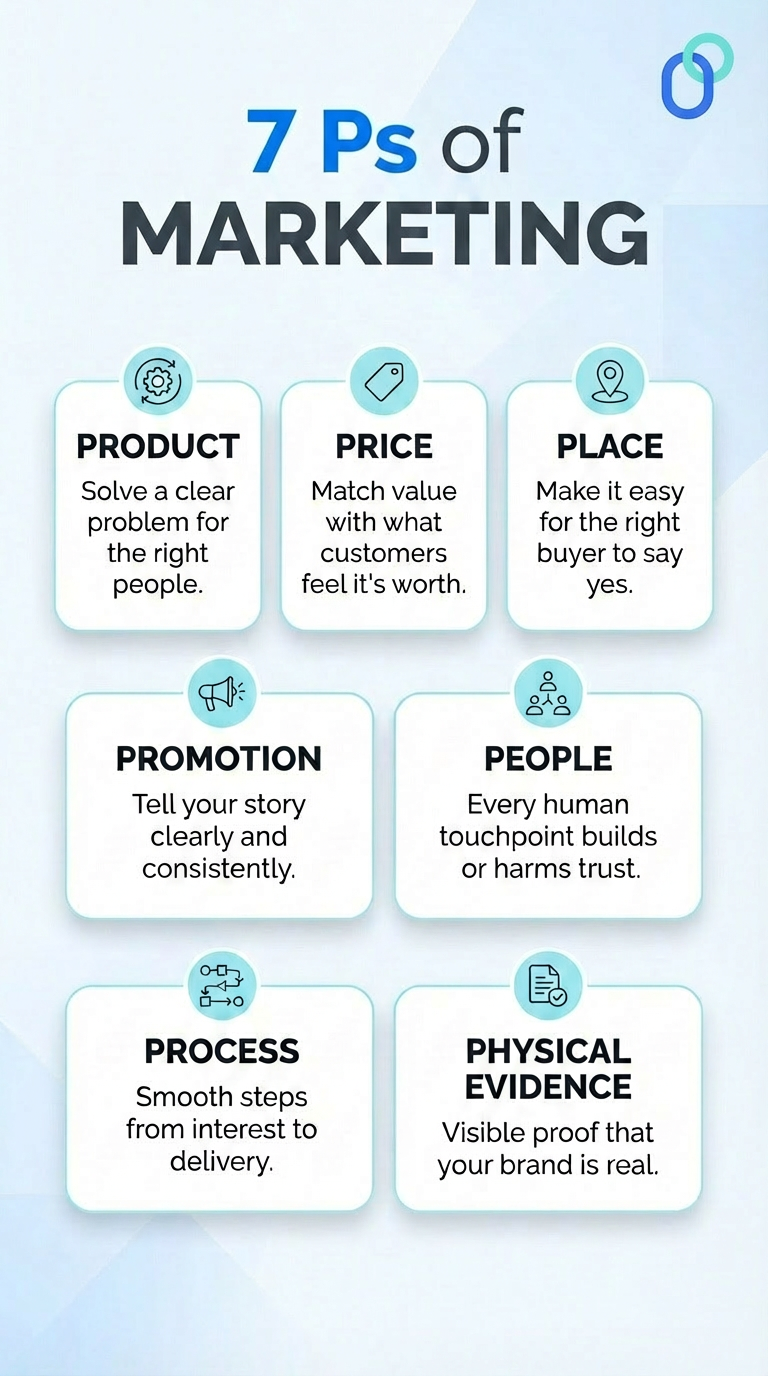
These key marketing principles cover what you sell, how you price it, where people find it, how you promote it, who delivers it, the steps that support it, and the proof that your brand is real.
Here is a quick view of the 7 Ps.
| P of marketing | What it covers |
|---|---|
| Product | What you sell and why it stands out |
| Price | How you charge, and the value people see |
| Place | Where and how customers get access |
| Promotion | How you share your message with the market |
| People | Everyone who shapes the customer experience |
| Process | The steps that move buyers from interest to delivery |
| Physical evidence | The visible signs of your brand such as site and packaging |
Skipping any of these basics makes it harder to use marketing fundamentals well, because gaps in one area limit results in every other area.
What the 7 Ps of marketing actually cover
Read how each P works, and use them as a lever. Pull the right one at the right time, and your whole campaign shifts.
Product
Product is the offer you bring to market. It should solve a clear problem for a clear group of people. When the product fit is weak, no amount of ad spend can save the campaign.
As you shape your product, keep asking:
What problem does this solve?
Who cares deeply about that problem?
How is this different from the next best option?
A clear answer to those questions makes every later decision easier.
Price
Price signals both value and position. A very low price may bring fast sales yet harm perceived quality, while a higher price can support a premium image.
The key is to match the price with what the customer feels the offer is worth.
Think about:
What people already pay for similar offers
How sensitive are your buyers to price changes
Whether offers such as bundles, subscriptions, or payment plans fit your model
Pricing is not only about covering costs; it shapes how people see your brand.
Place
Place covers where people discover and buy your offer. For an e‑commerce store, this might be your site plus marketplaces. For a service, it might be sales calls booked through landing pages.
If the right buyers cannot reach you easily, growth stalls.
Ask yourself:
Where do target customers already shop, search, or hang out?
Do you need salespeople, self‑serve checkout, or both?
How does your buying path compare with your main competitors?
Make it as simple as possible for the right person to say “yes.”
Promotion
Promotion is how you tell the story of your offer. It covers ads, email, content, social media, and more. Strong promotion is clear, consistent, and aligned with the product, price, and place that you have already set.
Rather than trying every tactic, focus on:
A simple core message that explains your value
A few channels where your audience already pays attention
Repeating and refining what works instead of chasing every trend
Consistency often beats creativity that changes every week.
People
People include your team, partners, and support staff. The best message fails if a rude agent answers the chat or a slow response kills trust.
Training, culture, and scripts all matter here.
Think through:
Who interacts with customers at each stage?
What skills and tools do they need to do their best work?
How do you hire and train people to match your brand promise?
Every human touchpoint either builds or harms trust.
Process
Process is the set of steps that turn interest into delivery. Think sign‑up flow, checkout, onboarding, and follow‑up. Simple, smooth steps support higher conversion and lower churn.
You can map processes by:
Listing each step a buyer takes from first contact to repeat purchase
Spotting friction points, such as long forms or confusing emails
Removing steps that do not add value or clarity
A clean process makes it easier for buyers to move forward without needing extra help.
Physical evidence
Physical evidence is the visible proof that your brand is real. It includes your website, logo, packaging, social profiles, and even the style of your emails.
Consistent visuals and tone help people feel safe choosing you.
Examples of physical evidence include:
Professional, on‑brand landing pages and product pages
Clear contact details and policies
Case studies, reviews, and testimonials with real names or companies
This visible proof often makes the difference when buyers compare similar offers.
What are the core digital marketing channels every marketer should know?
Basic digital marketing channels fall into inbound and outbound groups.
According to 23 key market research statistics, understanding your audience drives smarter channel selection across both categories.
Inbound methods pull people in with helpful content, strong search presence, and social proof. Outbound methods push messages out through ads, direct outreach, and mass media.
Most brands use a blend, though the balance shifts based on budget and timing.
Here are key channels that form the foundations of digital marketing:
Search engine optimization (SEO)
It focuses on free traffic from search engines. You research keywords, improve site structure, and build content that answers real questions.
Over time, this channel can drive steady traffic that supports many other content marketing fundamentals. It takes patience, but the compounding effect is powerful.
Content marketing
It turns your know‑how into articles, videos, podcasts, or guides.
The goal is to help before you sell, so that buyers see you as a trusted voice. When done with clear marketing fundamentals, content marketing feeds SEO, social, and email all at once.
A single strong piece can be repurposed into many smaller assets.
Email marketing
Email marketing builds direct lines to leads and customers. You can send welcome series, product education, or promo campaigns without relying on changing algorithms.
Because results are easy to track, email is one of the best channels for testing digital marketing principles such as personalization, timing, and offers. Make sure you follow the best email marketing practices for effective results.
Social media marketing
It lets you meet people where they already spend time.
Short posts, stories, and live streams can build community and awareness very fast. When combined with strong links and tracking, social platforms also feed traffic into your site and funnels or through social media retargeting.
Focus on the platforms where your audience is active instead of trying to be everywhere.
Affiliate marketing
It relies on partners who promote your offer for a commission. This channel can grow reach without large upfront spend because you pay for results.
Clear rules and good tracking keep things fair for both sides, and regular communication keeps partners motivated.
More traditional channels, such as print, radio, and TV, still matter in some markets. They can reach local or older groups that do not spend much time online.
For many brands, the best move is to combine online reach with a few focused offline bets.
Keep in mind that B2B programs usually have longer sales cycles and more decision makers, so they lean on education and trust. B2C efforts often need fast, clear offers that tap into emotion.
In both cases, solid marketing fundamentals guide which channels you pick and how you use them.
Also read: 7 effective digital marketing strategies to increase online sales
How to build a customer-centric marketing strategy
Every strong plan starts with one simple question: What does the customer actually need?
When you answer that with honesty and data, you can apply marketing strategy fundamentals in a clear way instead of chasing random tactics.
A customer‑first plan gives direction to channels, content, and offers. It also makes it easier to explain your choices to clients or internal teams.
The steps below give a simple path you can repeat for new products, markets, or campaigns.
Step 1: Know your audience
Use surveys, interviews, and on‑site polls to hear real language from buyers.
Add data from analytics tools to see what pages people visit and what content they share. From there, build personas that show segments such as B2B buyers, B2C shoppers, or repeat customers, along with their goals and pain points.
Try to capture:
What triggers them to look for a product like yours
What holds them back from buying
Which channels do they trust for information
Step 2: Analyze your environment
A SWOT view shows internal strengths and weaknesses along with external opportunities and threats. A PESTEL view focuses on wider forces such as laws, tech shifts, and social trends.
You can think of SWOT as inward and near-term, while PESTEL looks outward and long-term.
| View type | Stands for | Main focus |
|---|---|---|
| SWOT | Strengths, weaknesses, opportunities, threats | Inside the business and direct market factors |
| PESTEL | Political, economic, social, technological, environmental, and legal | External macro-environment factors |
Running both views once or twice a year keeps you aware of new risks and new openings before they surprise you.
Step 3: Set SMART objectives
Clear goals are specific, measurable, achievable, relevant, and time-bound (SMART).
| Letter | Stands for | What it means |
|---|---|---|
| S | Specific | Clear and well-defined goals |
| M | Measurable | Goals trackable with numbers |
| A | Achievable | Realistic goals given your resources |
| R | Relevant | Goals tied to your business objectives |
| T | Time-bound | Goals that have a clear deadline |
For example, you might aim to raise organic traffic by twenty percent in one quarter by publishing eight focused blog posts that target core marketing principles.
Try to define three to five main goals for the year and then break them into monthly actions so they turn into real work, not wishful thinking.
Step 4: Choose your channels
Not every channel suits every audience.
Pick two or three channels where your target customers already spend time and focus your effort there. For instance:
A B2B brand may lean on LinkedIn and email
A D2C brand may do better on Instagram and search.
Spreading thin across every platform dilutes impact.
Step 5: Build your messaging
Your message should speak directly to your customer’s problem and show clearly why your offer is the right fix.
Keep the core message consistent across every channel, even when the format changes. One clear value proposition, repeated well, outperforms five clever lines that say different things.
Step 6: Plan and execute your content
Turn your goals and messaging into a content calendar. Assign topics, formats, deadlines, and owners.
Consistency matters more than volume. A realistic plan that your team can stick to will always outperform an ambitious one that collapses in week two.
Step 7: Track, measure, and adjust
Set up tracking before anything goes live.
Define the metrics that match your SMART objectives, whether that is traffic, conversions, or retention. Review performance monthly and adjust what is not working. Strategy without measurement is just a plan on paper.
How to execute, measure, and improve your marketing strategy with Replug
A clear plan means nothing without execution.
Follow one simple cycle:
Plan
Execute
Analyze
Improve
Repeat it across every channel. That is how strategy turns into results.
Which is why Replug becomes a helpful execution partner.
Instead of guessing which links work or which calls to action should stay, you can manage, track, and improve all of them from one place.
Low conversion rates are normal on first touch. Replug lets you add retargeting pixels to your links so you can reach lost visitors again on Facebook, Google, LinkedIn, and TikTok, turning missed clicks into second chances.
Weak calls to action drain campaigns even with strong traffic. Replug’s CTA generator lets you build buttons, forms, and pop-ups and test wording, color, and layout without writing a single line of code.
A lack of brand trust often comes down to messy links. Replug fixes this with branded short links, custom domains, and clean affiliate links that look safe and on-brand every time.
Poor campaign visibility makes it hard to scale winners. Replug’s analytics dashboard tracks clicks, conversions, devices, locations, and referrers, with UTM tracking and A/B testing built in.
By combining this kind of link‑level insight with your broader strategy, you reduce guesswork and make each campaign easier to repeat and improve.
Good marketing starts with the right foundation
Understanding the marketing fundamentals is less about memorizing jargon and more about using a clear, simple frame for every decision. The 7 Ps keep your offer, price, place, promotion, people, process, and proof in sync. A customer‑first strategy, thoughtful channel mix, and data‑driven execution turn that frame into steady growth.
The next step is to pick one product or campaign and apply what you just read.
Map the 7 Ps for your offer
Define a few SMART goals
Choose one or two channels to focus on first
Track every important link and action
If you want help with link management, CTAs, retargeting, and analytics, explore how Replug can support your next campaign and make each click count more.
Frequently asked questions
What is the 3 3 3 rule in marketing?
The 3-3-3 rule in marketing is a strategic framework designed to simplify campaigns, prevent resource depletion, and boost effectiveness by focusing on three core pillars: three key messages, three target audience segments, and three primary marketing channels. This approach reduces clutter, increases brand consistency, and improves focus for better engagement.
What is the golden rule of marketing?
The golden rule of marketing is: know your customer better than they know themselves.
Every effective campaign starts with a deep understanding of your target audience, their problems, desires, and decision-making patterns. When you market to the right person, with the right message, at the right time, everything else falls into place.
What is inbound marketing?
Inbound marketing is a strategy that attracts customers to you by creating valuable content and experiences tailored to their needs.
Instead of interrupting people, inbound marketing earns attention through:
– Blog posts and SEO content
– Social media engagement
– Email nurture sequences
– Free tools, guides, and resources
What is outbound marketing?
Outbound marketing is a strategy where you initiate the conversation with potential customers, often interrupting their day to deliver a message.
Common outbound tactics include:
– Paid ads (search, display, social)
– Cold email and cold calling
– TV, radio, and print advertising
– Direct mail
What is B2B marketing?
B2B (Business-to-Business) marketing refers to strategies used by companies that sell products or services to other businesses.
Key characteristics:
– Longer sales cycles with multiple decision-makers
– Logic- and ROI-driven messaging
– Channels like LinkedIn, email, webinars, and case studies
– Emphasis on trust, credibility, and relationship-building
What is B2C marketing?
B2C (Business-to-Consumer) marketing refers to strategies used by companies that sell directly to individual customers.
Key characteristics:
– Shorter, emotion-driven buying decisions
– Broader audience targeting
– Channels like social media, influencer campaigns, and paid search
– Emphasis on brand experience and instant value
What are the core principles of effective product promotion?
Based on marketing fundamentals, effective product promotion rests on these core principles:
– Clarity — Your core message must clearly explain the value you offer
– Consistency — Repeat what works across channels rather than constantly reinventing
– Channel fit — Focus on platforms where your audience already pays attention
– Alignment — Promotion must match your Product, Price, and Place (the other Ps)
– Tracking — Measure what drives results so you can optimize, not guess
Which fundamentals of marketing are essential for launching a new product successfully?
A successful product launch requires getting these 6 fundamentals right before going live:
– Market fit product: Confirm your offer solves a real problem for a specific audience
– Pricing strategy: Price based on perceived value, not just cost
– Distribution (Place): Remove friction from the path to purchase
– Promotion plan: Pick 2–3 channels; build one clear, repeatable message
– People & process: Train your team and smooth out onboarding before driving traffic
– Tracking setup: Use tools like Replug to measure results from day one