Category: White label guides

Explore blogs on white label solutions, including branding, customization, integrations, and proven strategies to scale your agency or SaaS business.

  • White label products: A beginner’s guide to building your brand

    White label products: A beginner’s guide to building your brand

    Picture this: A customer picks up a “store brand” product, never thinking about who actually made it. In the U.S., store and house brands now account for roughly one out of every five items in grocery carts, and that share keeps climbing. Research shows that 72% of consumers are buying private-label products without even realizing it.

    Behind many of those items are white label products. One company handles production, another adds branding, pricing, and marketing, and then sells it under its brand. The same pattern now powers everything from cosmetics and supplements to SaaS dashboards and link management tools.

    For agencies, ecommerce brands, SaaS companies, and even offline retailers, white label products offer a low-risk way to add new revenue.

    Keep reading to learn what white-label products mean, how the model works, which products sell well in 2026, and how platforms like Replug help you build a strong, scalable brand.

    What are white label products?

    White label products are goods or services made by one company and sold under another company’s name.

    In plain terms:

    • One company (the manufacturer or software provider) creates and maintains the product.
    • Another company (the reseller) puts its brand on that product and sells it as if it were its own.

    This model works because:

    • White label products let a specialist handle manufacturing or software development while the reseller focuses on brand, pricing, and customer relationships. This split gives each side clear responsibilities. In practice, that makes growth easier and less stressful.
    • They help brands launch faster than building from scratch. There is no need to design formulas, engineer software, or set up factories. This saves time and cash while still giving room for strong branding and smart white label marketing.
    • They matter because they lower the risk. Smaller businesses can compete with larger brands, test ideas, and expand a white label products list without betting everything on one product or huge upfront costs.

    White label deals differ from franchises or licensing. You control your own brand, pricing, and customer experience, even though the underlying product comes from a partner.

    How does a white label product work?
    How does a white label product work

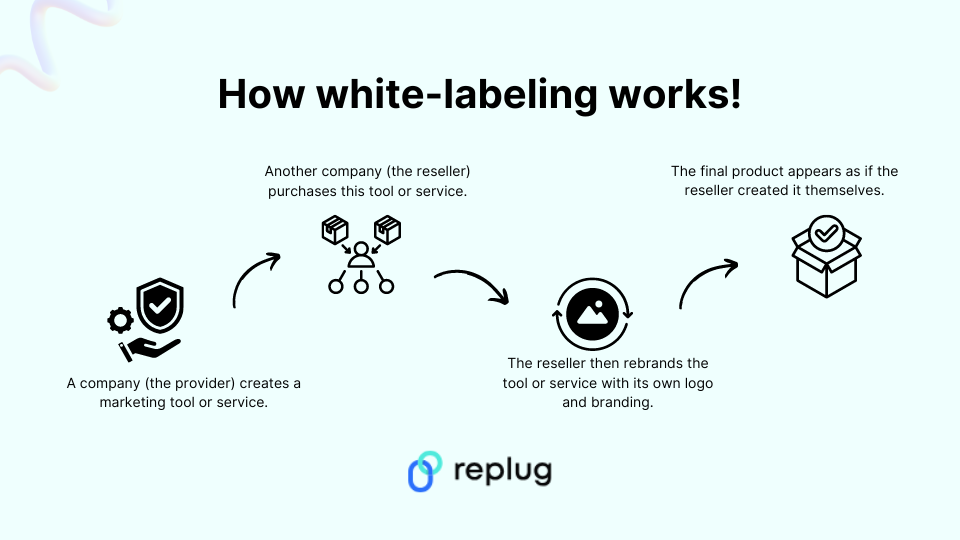
    The white label model is pretty simple once broken into stages. A white label products manufacturer builds the product. Another business “rents” that product, adds its own brand and offer, then sells it to customers. Here is how that flow usually looks.

    1. Manufacturing

    A specialist company produces a generic product or service at scale. That might be collagen powder, face cream, or a SaaS tool such as playout software, link management, or a white label website builder. Their focus is quality, safety, and reliable output, not branding.

    2. Purchase

    A reseller decides to add this item to its catalog. It buys units in bulk, signs a license, or pays a monthly fee for digital white label products. Sometimes this happens through wholesale deals, sometimes through a simple online dashboard.

    3. Customization

    Next comes the branding step. The reseller adds its unique logo, brand colors, and packaging. With software that can include a custom domain, white-label products website, emails, and client reports that look fully “in-house.”

    4. Sale

    Now the reseller markets and sells the product under its own name. It sets pricing, manages customer support, and runs campaigns. In some cases, a dropshipping or white label products dropship model means the manufacturer ships directly to the buyer while staying invisible.

    Step-by-step guide to create white label products

    Launching a white label line is less about luck and more about clear steps. Whether it is a supplement, a hoodie, or a SaaS dashboard, the setup path is almost similar.

    1. Identify a niche and research demand

    Start with a clear niche. Look at search data, marketplaces, and social trends to see what shoppers already buy and where gaps exist. Aim for products people buy more than once, like skincare or marketing tools.

    Useful data sources include:

    • Search volumes and keyword trends
    • Marketplace best-seller lists and reviews
    • Social media comments and community discussions in your niche

    2. Find a white label manufacturer

    Search for a white label products manufacturer that already makes what you want to sell. Compare quality standards, certifications, and minimum order sizes. For software, check the product’s maturity and whether it includes embedded integration options or APIs that fit your tech stack.

    3. Request and test samples

    Never skip samples. Order several units from your shortlist and test them the way a real customer would. For digital tools, this means running campaigns, checking analytics, and seeing how the platform holds up under daily use. Take notes on packaging, instructions, and any support you receive.

    4. Negotiate terms

    Once you pick a partner, talk through pricing, order sizes, support, and exclusivity. Ask how costs change at higher volumes and what happens if you pause or scale down. With SaaS, ask about user limits, white label support, and roadmap plans, so you know the product will keep improving.

    5. Customize branding and packaging

    Now make the product feel like part of your brand. Define your name, logo usage, colors, and tone of voice across labels, inserts, and your white label products website. For software, match the dashboard to your existing website design and development style so the experience feels seamless.

    6. Handle legalities

    Check that your partner follows local rules and regulations for that category, especially for food, supplements, cosmetics, CBD, or health tools like white label telemedicine platforms. Make sure the contracts cover data privacy, returns, and ownership of content. If needed, involve a lawyer to review key documents.

    7. Set up logistics and fulfillment

    Plan how products move from the warehouse to the customer. Decide between in-house shipping, third-party logistics, or dropship from the factory. For SaaS, map out onboarding, billing, and how clients get support under your brand, including clear reporting paths to the underlying provider if something fails.

    8. Launch and market the product

    Create launch campaigns, content, and ads that speak to your target buyer. Use email, social, and paid search to send traffic to your product pages. Track results so you can double down on winners and quietly drop poor performers. Simple dashboards that monitor sales, returns, and reviews are especially helpful here.

    Best white label products to sell online in 2026

    Best white label products to sell online in 2026

    Health, beauty, sustainability, and remote work still drive a lot of spending in 2026. Think of this section as a focused white label products list built around those trends.

    Collagen powders

    Collagen supports skin and joint health, and many shoppers now mix it into coffee or smoothies. White label collagen powders are a perfect fit for beauty, fitness, and wellness brands. However, make sure your supplier can provide clean sourcing and lab test results.

    Supplements & vitamins

    From multivitamins to magnesium, supplements stay in demand year-round. A strong label design and clear dosing guide help your bottles stand out on crowded shelves. Seek partners that follow good manufacturing practices and provide certificates of analysis.

    Functional beverages

    Think energy drinks with clean ingredients, focus shots, or sleep-support drinks. These fit well as white label products wholesale for gyms, studios, and online shops. Taste, sugar content, and branding all matter a lot here.

    Skincare serums

    Serums for hydration, brightening, or anti-aging are high-margin and gift-friendly, and the broader white label cosmetics market is projected to expand significantly through 2030, making this a well-timed category to enter. Customers care about ingredients, so list key actives and benefits in simple language. Great photos and honest claims can move plenty of units.

    Face creams

    Daily moisturizers and night creams keep buyers coming back after a short span. Offer formulas for dry, oily, and sensitive skin so people can pick their ideal match. Matching scent, texture, and packaging gives the line a polished feel.

    Eco-friendly packaged cosmetics

    Shoppers notice packaging almost as much as the original formula. Try refillable cases, glass jars, or recycled cardboard for outer boxes. Position your brand around minimal waste rather than only low prices.

    Branded t-shirts & hoodies

    Tees and hoodies are classics for creators, brands, and agencies. With print-on-demand, you can test designs without holding inventory. Strong, simple designs often sell better than loud graphics.

    Reusable water bottles

    Steel and BPA-free plastic bottles fit wellness, sports, and corporate gifting. Add your logo and maybe a small message or graphic. White label bottles also pair well with fitness apps or wellness SaaS as merch.

    Sustainable cleaning products

    Plant-based sprays, soaps, and concentrates attract eco-conscious families. Concentrates ship lighter, which cuts shipping costs and waste. Clear labels and safe-for-home messaging work well in this space.

    Custom apparel

    Beyond basics, think leggings, sports bras, caps, or workwear. Custom cuts and fabrics can set your brand apart, even if you start from a white label base. Offer limited drops to test styles before going deep on stock.

    Tote bags

    Totes work as both products and walking ads. They fit bookstores, coffee shops, agencies, and SaaS companies that attend events. Look for sturdy stitching and comfortable straps so people actually use them daily.

    Air purifiers

    People care very much about indoor air quality in homes and offices. Compact, sound-free (quiet) purifiers are easier to ship and store. Good filters, safety marks, and a clean design all help with trust.

    Organic pet food

    Pet owners treat pets like family and spend accordingly. Organic or limited-ingredient recipes speak to that concern. Be sure the labels match local pet food rules to avoid regulatory trouble.

    Massage guns

    Nowadays, massage guns have moved from pro athletes’ training rooms to living rooms. A simple set of speeds and heads usually beats complex menus. Strong safety testing and quiet motors are key talking points.

    Phone accessories

    Cases, grips, and chargers often need to be replaced as you buy a new smartphone. Slim, protective cases with simple designs keep selling year after year. Bundles, such as a case plus a screen protector, can further increase order value.

    Blue-light glasses

    People still spend long hours in front of screens. Affordable blue-light glasses pair well with productivity brands and coworking spaces. Offer a few frame shapes and sizes instead of dozens of options.

    AI-powered tools

    White-label AI products, like chatbots, content helpers, or analytics copilots, are perfect for tech and marketing agencies. You resell the tool while branding the dashboard as your own. Clear onboarding and use cases matter more than fancy names.

    Web & e-commerce builders

    A white label website builder lets agencies sell full sites without writing a single line of code. Clients log in to a portal that looks like their personal product. Add website design and development services on top for higher retainers.

    Agency & operational tools

    Think project management, reporting dashboards, or playout software for media teams. Agencies can bundle these into retainers as “their” platform. Check that the vendor offers stable uptime and responsive support.

    Marketing & CRM

    White label marketing tools and CRM tools or platforms help agencies centralize campaigns, contacts, and reports. You keep full brand control while the vendor maintains the tech. Replug, for example, lets agencies resell branded link management as if it were their own tool.

    Popular white label products examples

    Seeing white label products in the wild makes the model feel real. Here are simple examples across physical goods and software.

    Organic white label products example

    A regional grocery chain offers its own line of organic pasta and sauces. Shoppers see the store logo and trust the price and quality. Behind the scenes, a specialist food producer creates the recipes and fills every jar.

    Digital white label products example

    A marketing agency wants to add analytics dashboards without building software. It signs up with a platform that allows full rebranding, custom domains, and branded reports. Clients log in and believe they are using the agency’s own tool.

    CBD white label products example

    A wellness brand sells CBD oils and gummies under its name. A certified CBD manufacturer handles extraction, testing, and bottling. The brand designs labels, creates educational content, and speaks directly with customers.

    Software (SaaS) white label products example

    A social media agency wants link tracking, retargeting, and bio pages. Instead of hiring a development team, it uses a platform like Replug, applies its logo and domain, and sells access as part of its monthly package. The end client never sees the original provider.

    Barber white label products example

    A barbershop offers “house” pomade, beard oil, and shampoo on the counter, whereas a cosmetic lab formulates, bottles, and conducts safety tests. The shop chooses scents, label design, and pricing that match its style.

    Businesses that use white label products: Common white label product categories

    White label products are not just for big-box stores. Many types of companies, from tiny ecommerce brands to global SaaS firms, use them to round out their offers.

    Retailers

    Old-fashioned stores and online retailers use white label products wholesale to boost margins. Store-brand basics like paper goods, snacks, or cables can be cheaper to source and more profitable to sell. Retailers control placement and promotion, which makes house brands hard to miss.

    Skincare & cosmetics brands

    New beauty brands often start with white label serums, creams, and masks, a trend supported by the Private Label & Brand global outlook from NIQ. It highlights rising consumer acceptance of private labels across personal care categories. They focus on brand story, social proof, and clear ingredient lists instead of building labs. Spas and salons also create house lines so clients take the brand home.

    Supplements & vitamins (health/wellness brands)

    Gyms, coaches, and health influencers sell private label or white label supplements. They rely on certified partners for safe formulas and testing. A strong brand voice and educational content help buyers trust what they are ingesting.

    Food & beverage brands

    From coffee beans to brewed beverages, many food brands start with an experienced co-packer. That partner handles recipes, bottling, and shelf-life testing. The brand wraps the product in its own identity and packaging.

    Home goods & tech accessories brands

    Home decor shops and gadget brands often source white label blankets, lamps, or phone chargers. They pick styles and finishes that fit their targeted audience. This keeps catalogs fresh without constant product design work.

    Clothing & apparel brands

    Streetwear labels, creators, and corporate merch teams use blanks from apparel factories. They add prints, embroidery, and custom neck labels. This model keeps design flexible while production stays consistent.

    SaaS companies & brands

    Tech firms resell white label products such as link management, chat, or billing tools instead of building every feature. They might even act as a nearshore outsourcing service company for clients while using white label SaaS behind the scenes. This lets them move faster and stay focused on their main product.

    Service companies & brands

    Agencies, consultants, and IT firms add white label services like SEO, PPC management, or app maintenance. They may work with a custom software development company or MVP development company behind the curtain. Clients have one main point of contact while several partners handle the work.

    Key benefits of white label products

    White label products offer much more than a new logo on a box. They can change how fast a company grows and how wide its catalog becomes.

    Faster time-to-market

    In actuality, product development often takes months or years. However, white label products let you launch in weeks because the base product already exists. This speed helps you catch trends before they fade.

    Lower costs

    Starting with white label items cuts research, development, and tooling expenses. You usually pay for finished goods or access to a live platform. That frees up a budget for marketing, content, and support.

    Expanded product lines

    You can quickly add new SKUs or even full categories around a theme. For example, a wellness brand might add teas, supplements, and functional drinks from the same network of white label partners. More offers mean more chances to cross-sell.

    Focus on core competencies

    Instead of juggling factories or dev teams, you focus on selling and serving customers. Your energy goes into offers, funnels, and content, not lab tests or server tuning. This helps small teams produce outsized results.

    Increased revenue potential

    Each extra product line creates a new way to earn. Bundles, upsells, and subscriptions become easier when you control more of the catalog. The same audience can buy from you many times a year.

    High-quality products

    Experienced white label manufacturers live or die by quality. They already have processes, audits, and compliance checks in place. By picking the right partners, even a young brand can offer products that feel premium.

    Common drawbacks of white label products

    White label products are powerful, but they aren’t magic. There are real risks to plan around before you go all in.

    Copycatting

    If many brands use the same base product, packaging can start to look very similar. That makes it challenging to stand out and may cause legal trouble if designs are too close to a major brand. Aim for clear, original branding and honest messaging, and avoid imitating famous labels.

    Monopsony

    In some categories, one giant buyer controls most orders from a factory. Smaller brands might get worse pricing or lower priority. It is wise to avoid suppliers that depend too heavily on a single massive client and to ask directly how they handle smaller accounts.

    Barriers to entry

    Certain products need high minimum orders or strict licenses. That can keep newer entrepreneurs out or tie up too much cash in stock. Software can have barriers too, like steep monthly minimums for white label access. Start with categories that match your budget and experience.

    Quality control

    You trust another company with your reputation every time a product ships. Without regular checks, quality can be compromised over time. Ask for updated certificates, monitor reviews, and order sample runs now and then so you catch problems early.

    Market saturation

    If everyone jumps into the same hot niche, margins shrink fast. Think of fidget spinners or certain trendy supplements. Data and real research help you look past short-term trends and toward steady, long-term demand.

    Dependence on suppliers

    Relying on one partner for key products is risky. Factory shutdowns, price hikes, or policy changes can hurt your brand overnight. Having backup suppliers or backup software options adds safety.

    Common use cases of white label products

    Because the model is so flexible, there are many ways to apply it. Here are common white label use cases across industries.

    SaaS & software

    Agencies, B2B platforms, and resellers use white label SaaS to add features without coding them individually. Think link management, analytics, chat, or billing tools. The interface carries your logo while the vendor runs the code.

    App development

    Some firms resell app builders or template-based app systems under their brand. Instead of coding from scratch, they configure modules and publish on app stores. This works well for local businesses that want simple apps fast.

    Marketing & services

    Agencies expand offers by partnering with white label SEO, ads, or content teams. The client sees one agency brand and one invoice. Behind the scenes, several specialists share the workload.

    Retail & e-commerce

    Online stores and marketplaces bundle white label products into themed collections. Dropship options keep inventory risk low while you test demand. If a product proves strong, you can move to deeper wholesale deals.

    Finance & payments

    Banks, fintechs, and retailers use white label card issuing, wallets, and payment gateways. A large financial partner handles risk checks and processing. The brand focuses on rewards, app design, and support.

    Beauty & skincare

    Salons, spas, and influencers sell branded skincare that starts as white label stock. They may adjust the scent, packaging, or a few ingredients. Educational content and routines help these lines feel trusted.

    Health & wellness

    White label telemedicine platforms, coaching apps, and wearables allow clinics and coaches to offer digital care. Supplements and devices can be included alongside services in packages. This blend of physical and digital products can drive higher lifetime value.

    Food & beverage

    Cafes might sell their own beans, while bars sell house mixers. In many cases, a roaster or beverage co-packer produces the goods. The venue adds the story and experience around each item.

    White label vs. private label products: What’s the difference?

    White label and private label products sound similar, but they serve slightly different goals. Knowing the difference helps you choose the right path for your brand.

    PointWhite label productsPrivate label products
    DefinitionStandard product or software sold to many brands that rebrand it as their own.Product made for a single brand with custom specs or recipes.
    ProsFast launch, lower cost, less product development work, and easy to test markets.Stronger product control, harder for rivals to copy, deep brand fit.
    ConsLess control over formula or features, more direct competitors, and harder to stand out.Higher setup costs, longer timelines, and deeper commitment to a single product.
    ExampleA link management platform like Replug, offered as a white label service to agencies.A supermarket’s house coffee line, roasted only for that chain.
    When to chooseYou want speed, lower risk, and a broad catalog that can change often.You want strong product control and plan to back one line for years.
    Best forAgencies, SaaS resellers, and e-commerce brands testing new categories.Larger retailers and brands with clear long-term product plans.

    Related: White label vs Private label: Which to choose?

    How to choose the perfect white-label product: Common mistakes to avoid!

    Picking the right product matters more than picking a fancy logo. Here is how to make a smart choice and avoid painful surprises.

    Validate demand

    Look for real proof that people already buy similar items. Check search data, marketplace rankings, and reviews instead of guessing. Talk with existing customers to see what they wish they could buy from you.

    You can:

    • Review current customer emails and support tickets for product ideas
    • Compare price points and review counts of competing products
    • Check seasonality so you know when demand rises or dips

    Order samples

    Never rely on photos or spec sheets alone. Order and use samples the way your customers would. Share them with a few trusted people and gather honest feedback.

    Check supplier reliability

    Research your supplier’s track record for on-time shipping and handling issues. Ask about backup factories, support channels, and how they deal with recalls. For SaaS, review uptime history and support response times.

    Identify niche gaps

    Instead of copying top sellers exactly, look for small gaps or angles. That might be flavor, size, bundle, or a slightly different audience. A clear reason to exist helps a new product get traction.

    Focus on branding

    Even with the same base formula, branding makes a huge difference. Invest in names, visuals, and copy that speak clearly to your market. Think about how the product fits your wider brand story.

    Now, checkout the common mistakes to avoid when picking white label products:

    Price-driven selection

    Choosing the cheapest offer often leads to thin margins and poor quality. Buyers notice fragile items and will not return. Aim for solid value, not the lowest quote.

    Ignoring compliance

    Skipping safety and legal checks can trigger fines or bans. This risk is high with supplements, CBD, kids’ items, and anything health-related. Work only with partners who understand and follow local rules.

    Neglecting hidden costs

    Look past the base unit price. Add shipping, packaging, storage, payment fees, and returns. Only then can you see your true margin and decide whether a product makes sense.

    Product complexity

    Extremely complex devices or multi-part kits can cause support headaches. Returns and broken parts eat profit quickly. Starting with simpler products keeps operations smoother.

    Poor packaging design

    Even great products can sit unsold in dull or confusing packaging. Use clear names, readable fonts, and honest claims. Match packaging to the price point so buyers feel confident.

    Get the perfect white label solution for your business or agency with Replug!

    For agencies, SaaS resellers, and brands that live online, links are everywhere. Every ad, social post, and email depends on them. This is where a strong white label solution for link management can quietly support your whole business.

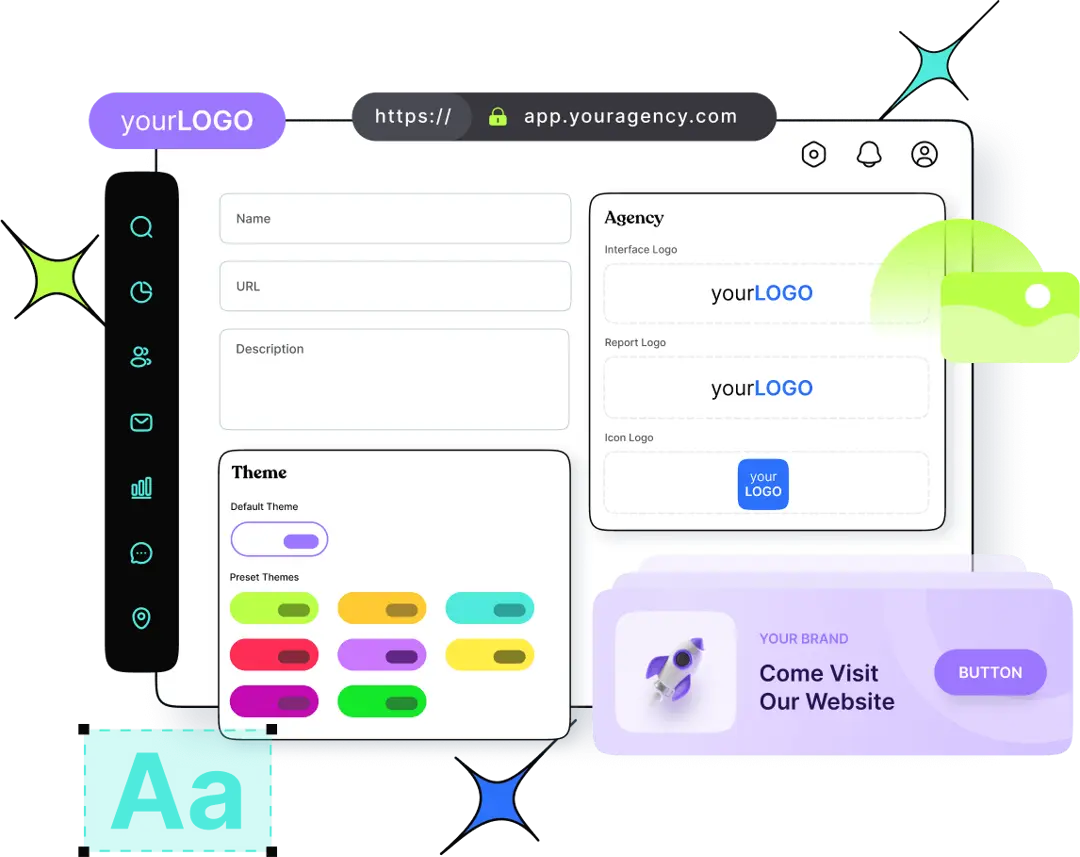
    Replug.io is an all-in-one link management and tracking platform that you can fully brand as your own. You can use your own custom domain, colors, logo, and wording so clients feel they are logging into your product, not a third-party tool.


    Replug Branded Short Links CTA
    A complete link management solution
    for marketing professionals & agencies.
    Try Replug for free

    Inside, you get features such as branded short links, bio-link pages, QR codes, and detailed analytics. Agencies can create campaign reports with their own branding and send them straight to clients.

    Because Replug is already built and battle-tested, you avoid the cost and delay of hiring a custom software development company just to track clicks. You focus on selling and running campaigns, while Replug powers the white label engine behind the scenes.

    Wrapping up

    White label products turn finished goods and mature software into building blocks for brands of any size. Instead of starting from a blank page, you stand on top of tested formulas, code, and supply chains.

    When you pick the right niche, vet suppliers, and build clear branding, white label items can widen your catalog, raise margins, and deepen customer loyalty. The model works across supplements, skincare, apparel, pet products, SaaS, and more.

    Add in a strong white label tech stack, such as Replug for link management, and you can offer pro-grade tools under your name without long development cycles. Start small, measure carefully, and grow into the categories and channels that prove themselves.

    Frequently asked questions

    How do you white label a product?

    To white label a product, you partner with a manufacturer or provider that offers white label access. Then, you agree on pricing, branding options, and terms, and apply your logo, domain, and packaging. After that, you market and sell the product as part of your own catalog.

    What is an example of a white label product?

    A simple example is a store-brand shampoo made by a third-party factory. Another example is a marketing agency that resells a white label link management platform like Replug under its own brand. In both cases, the buyer sees only the reseller’s name.

    How to find white label products online in 2026?

    Use trusted B2B marketplaces, trade sites, and industry directories to search by category. Look for “white label products manufacturer” or “white label products wholesale” plus your niche. For software, search for white label SaaS in areas like CRM, analytics, and link management.

    How can I find white label product suppliers?

    Start with online directories, trade shows, and referrals from other business owners. Join industry groups where people share supplier experiences. Always shortlist a few partners, then check reviews, request documents, and order samples before you sign anything.

    How to tell if a product is white labeled or not?

    It is not always obvious from the outside. Many store and house brands are white labeled, especially when the packaging looks simple and generic. Inside software, clues include “powered by” notes, shared layouts across different brands, or the option to add custom domains.

    What are the costs involved in white labeling products?

    Costs usually include product or license fees, packaging, shipping, and any setup charges. For physical goods, add storage, returns, and product photos. For SaaS, factor in user seats, branding fees, and any add-ons you want to resell.

    How to start your own white label products brand or business?

    Choose a clear niche, research demand, and list possible products. Find and vet suppliers, test samples, and decide on pricing and terms. Then build your white label products website, set up payment and shipping, launch your first offers, and refine based on data.

    What is white labeling in e-commerce?

    In e-commerce, white labeling means selling products made by another company under your own brand in your online store. You focus on storefront design, customer support, and marketing. The manufacturer stays mostly invisible to shoppers.

    Is white labeling legal or illegal?

    White labeling is legal as long as you obey all relevant laws. That means honest labeling, no trademark or copyright violations, and proper safety and compliance steps for your category. Problems arise only when brands copy designs or hide important information.

    Is white labeling profitable?

    White labeling can be very profitable when you pick strong products, manage costs, and build a trusted brand. Margins often beat simple reselling because you control pricing and branding. Like any business model, profit depends on research, execution, and ongoing optimization.
  • What is white label software: Meaning, benefits, examples, & how to pick the right one!

    What is white label software: Meaning, benefits, examples, & how to pick the right one!

    Building software from scratch is expensive, time-consuming, and, honestly, unnecessary for most businesses at present. That’s why so many companies are skipping the long development cycles and going straight to white label software instead.

    And the numbers back this up!

    73% of businesses now incorporate white label solutions into their workflow, and it’s easy to see why. The global software market is projected to hit $1,789.67 billion by 2034, growing at a CAGR of 11.8%, and white labeling is a huge part of that story.

    Whether you’re a startup trying to launch fast or an agency looking to expand your service offerings, white label software might just be your smartest shortcut.

    But wait, what exactly does white label software mean? Let’s break it down.

    What is white label software?

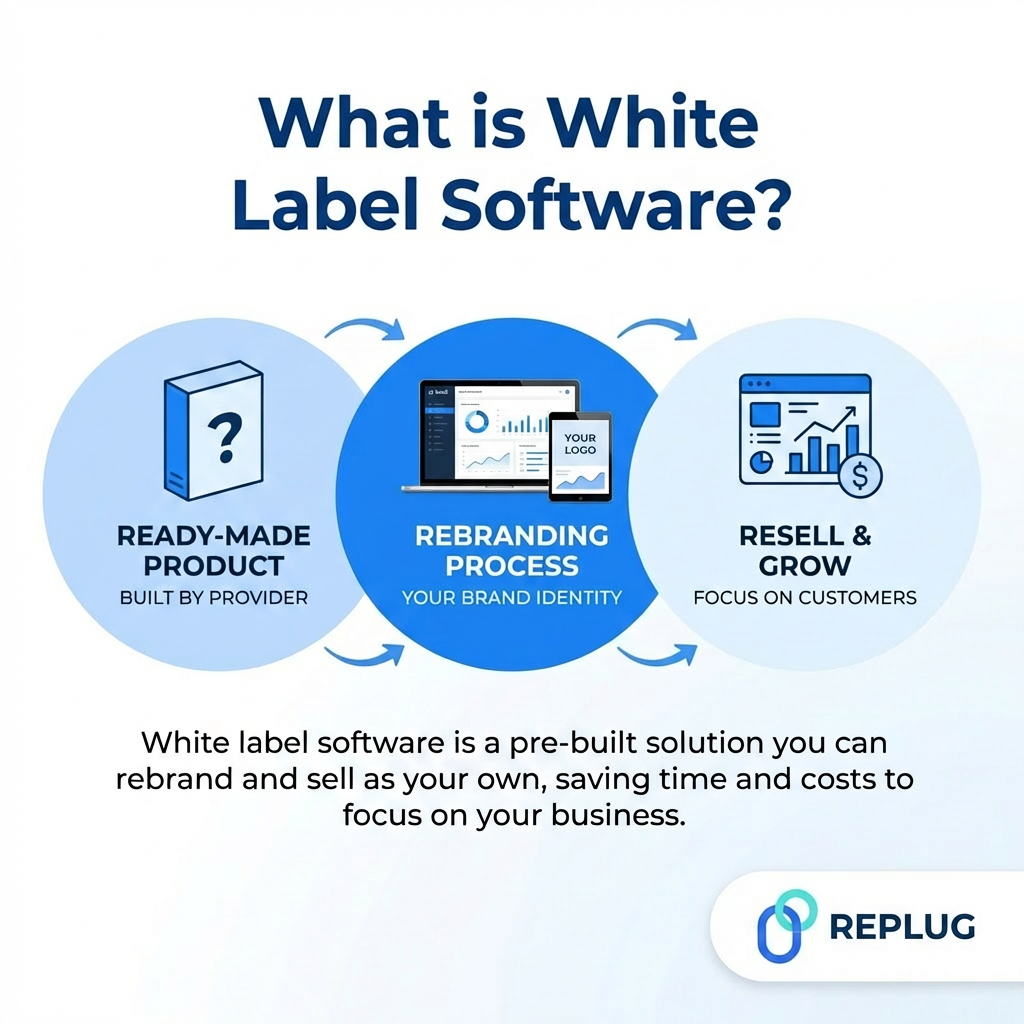
    White label software is a ready-made product built by one company that other businesses can purchase, rebrand, and resell as their own.

    Think of it like buying a plain t-shirt from a manufacturer and sewing your own label on it. The product is the same, but it carries your brand’s identity.

    What is white label software

    The primary objective is simple: Let businesses skip the costly, time-heavy process of building software from the ground up, and instead focus on what they do best, i.e., selling, growing, and serving their customers.

    Key aspects of a white label software

    Mentioned are the core elements of a white label software:

    • Custom branding & rebranding

    One of the biggest draws of white label software is that you can make it look and feel completely like your own product. 

    You can apply your logo on it, match it to your brand colors, and even give it a custom domain name. Your customers won’t have any idea someone else built it, and that’s exactly the point.

    • No-code/fast deployment

    You don’t need a dedicated team of developers to get white label software up and running. Most solutions are built for quick setup, meaning you can go from purchase to launch in days rather than months. 

    This is a massive win for businesses that need to move fast and can’t afford to wait on lengthy development cycles.

    • Reliable maintenance & support

    When something breaks or needs an update, that’s the original vendor’s job (not yours). The software provider handles all the technical maintenance, bug fixes, and platform updates in the background. You get a smooth-running product without having to manage the messy technical side of things.

    • Scalability & performance

    As your business grows, your software should keep up optimally. Good white label solutions are built to scale, meaning they can handle more users, more data, and more demand without falling apart. You won’t need to rebuild or switch platforms every time your customer base doubles.

    • Cost-effectiveness

    Building software from scratch can cost anywhere from tens of thousands to millions of dollars. White label software cuts that down drastically. 

    You’re essentially splitting the development cost with every other business using the same platform, which means you get a polished, fully functional product at a fraction of the price.

    • Built-in security & compliance

    Reputable white label providers invest heavily in keeping their platforms secure and compliant with industry standards like GDPR, SOC 2, or HIPAA (depending on the industry). 

    This means you’re not starting from zero on security. You’re actually inheriting a system that’s already been tested and solidified.

    • Integration capabilities

    White label software doesn’t have to live in a silo. Most modern solutions are built to connect with the tools you’re already using, no matter if that’s a CRM, payment gateway, analytics platform, or anything else. Good integration support means your tech stack stays connected and your workflows stay smooth.

    How does a white label software work?

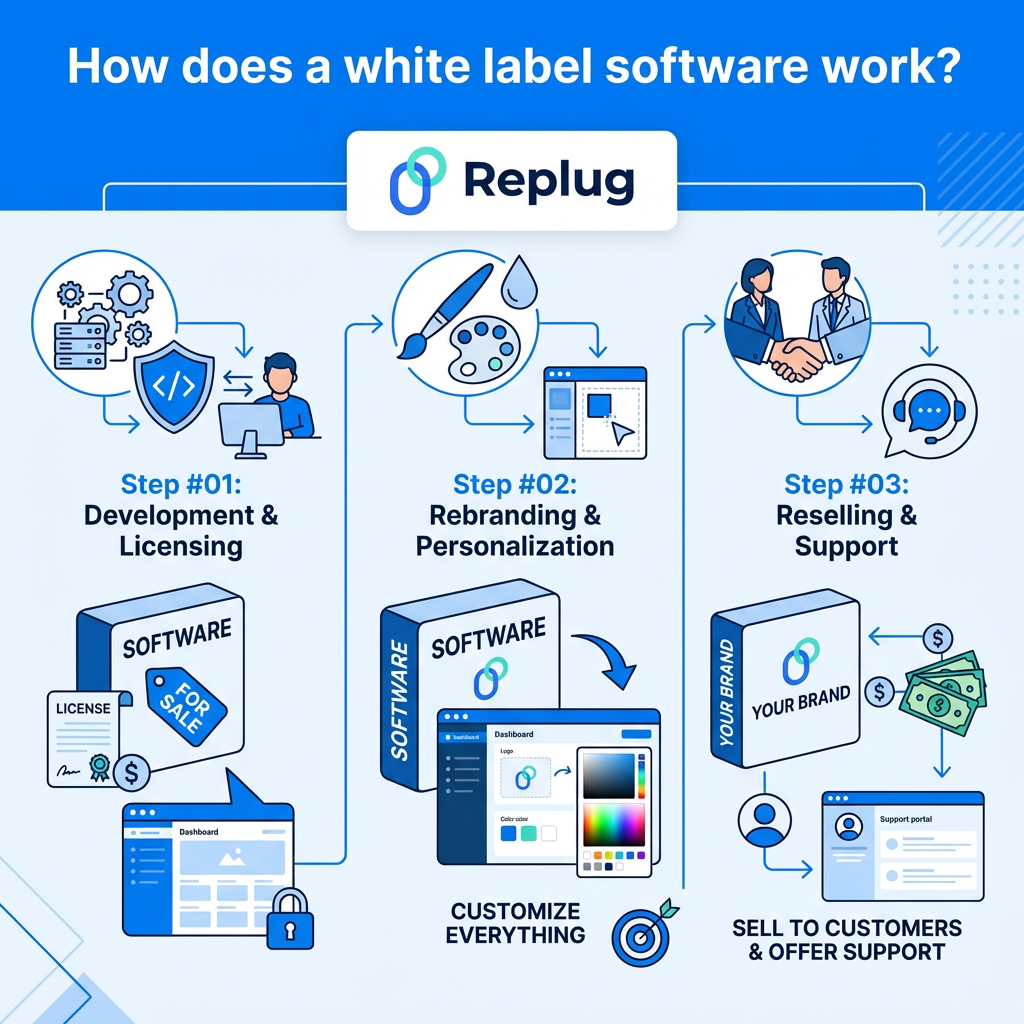
    White label software follows a pretty straightforward process. One company builds it, another company brands it, and the end customer uses it without ever knowing who originally developed it. It’s a three-way relationship that benefits everyone involved. 

    Here’s how the whole thing plays out, step by step!

    How does a white label software work

    Step #01: Development & licensing

    It all starts with a software development company that builds a fully functional product, whether that’s a project management tool, a marketing platform, a chatbot, or anything else. Instead of selling it directly to end users under their own brand, they license it out to other businesses.

    This licensing model is what makes the whole thing tick. 

    The original developer gets a steady stream of revenue without having to do any marketing or sales themselves. And the businesses buying the license get a ready-to-go product without spending a single dollar on development. It’s a win-win right from the start.

    Step #02: Rebranding & personalization

    Once a business licenses the software, the next step is making it their own. This is where the actual “white label” magic happens. 

    The purchasing company can add its unique logo, apply its brand colors, set up a custom domain, and sometimes even customize certain features to better fit their specific audience.

    The goal here is to make the software feel like something the business built in-house. By the time it reaches the end customer, there’s no trace of the original developer; just a clean, branded product that looks like it belongs to the company selling it.

    Step #03: Reselling & support

    With the software rebranded and ready to go, the business can now sell it to its own customers, either as a standalone product or bundled into a larger service offering. This is where the real money-making potential kicks in.

    As for support, responsibilities are typically split.

    The original vendor handles the backend stuff, like server maintenance, security updates, bug fixes, and platform upgrades. Whereas the reselling business, on the other hand, takes care of customer-facing support, ie.e, answering questions, onboarding new users, and managing relationships. It’s a clean division that keeps things running smoothly on both ends.

    Different types of white label software

    White label software isn’t a one-size-fits-all kind of thing; it spans almost every industry you can think of. 

    No matter if you’re running a marketing agency, a startup, or an e-commerce store, there’s likely a white label solution built for exactly what you need.

    Here’s a breakdown of the most common types!

    Different types of white label software

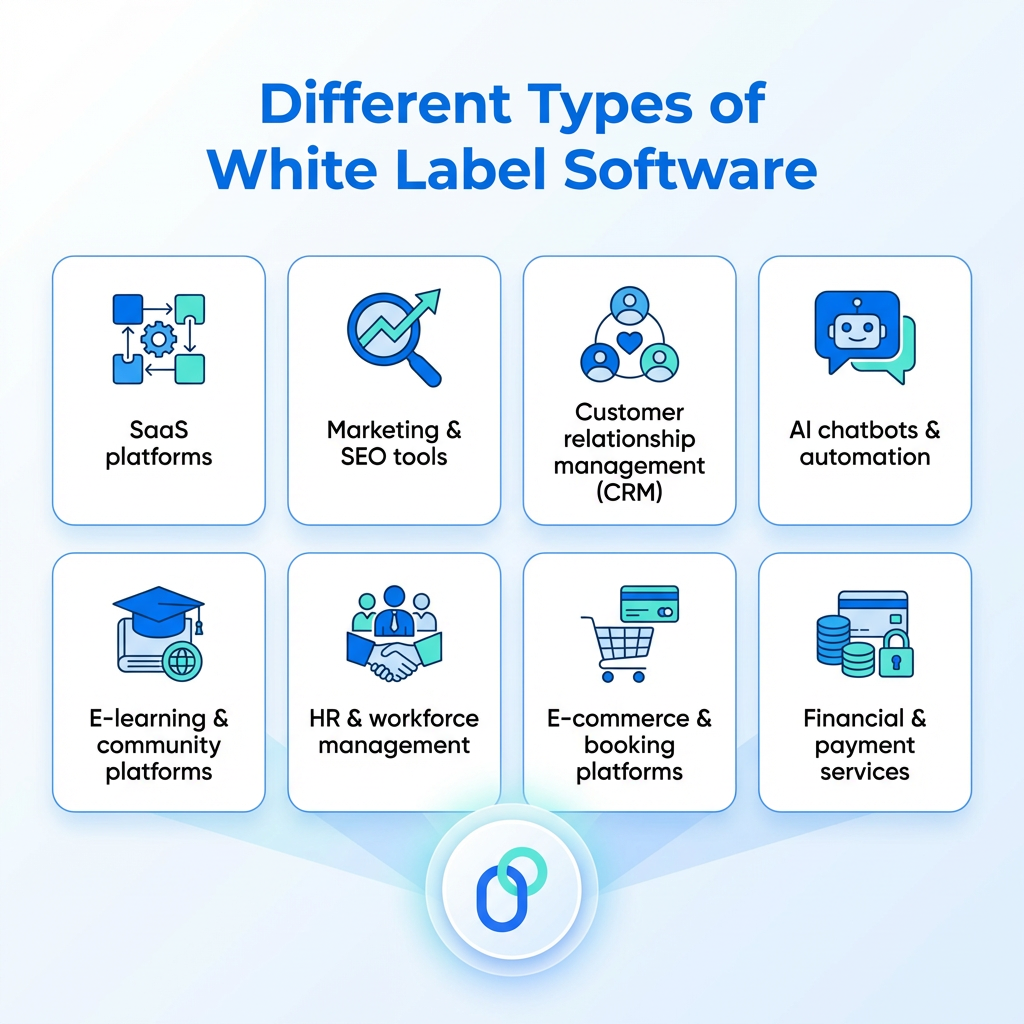
    SaaS platforms

    White label SaaS platforms are cloud-based tools that businesses can rebrand and resell under their own name. These are incredibly popular because they require zero infrastructure setup. You simply license the platform, brand it, and start offering it to your customers right away.

    Marketing & SEO tools

    From social media schedulers to SEO audit tools and email marketing platforms, white label marketing software lets agencies offer powerful tools to their clients on the go. It’s a great way for agencies to expand their service offerings and create an additional revenue stream.

    Customer relationship management (CRM)

    White label CRM software lets businesses manage leads, track customer interactions, and handle sales pipelines, all under their own personalized brand. Instead of pointing clients toward a third-party tool, companies can offer a fully branded CRM experience that feels native to their ecosystem.

    AI chatbots & automation

    This is one of the fastest-growing categories right now. White label AI chatbot platforms allow businesses to deploy smart, conversational bots on their websites or apps without any AI development expertise. You get all the functionality of a powerful automation tool, branded entirely as your own, without any hassle.

    E-learning & community platforms

    Businesses in the education, coaching, or community space can use white label e-learning platforms to host courses, manage memberships, and build engaged communities. It saves months of development time and lets creators focus on content rather than tech.

    HR & workforce management

    White label HR tools cover everything from employee onboarding and payroll management to performance tracking and leave management. HR consultancies and staffing agencies especially love these because they can offer clients a complete branded HR solution without the overhead of building one.

    E-commerce & booking platforms

    Whether it’s an online store or an appointment booking system, white label e-commerce and booking platforms are a go-to for businesses that want to get up and running fast. Agencies building solutions for retail or service-based clients can deliver polished, fully functional platforms in a fraction of the usual time.

    Financial & payment services

    White label fintech solutions include payment gateways, digital wallets, invoicing tools, and even banking platforms. These are particularly popular among startups and businesses in the financial space that want to offer seamless payment experiences without dealing with the complexities of building financial infrastructure from scratch.

    Major benefits of white label software

    White label software isn’t just a shortcut; it’s a genuinely smart business move. It opens up opportunities that would otherwise take years and significant investment to build. 

    Here are the biggest advantages that make it such an attractive option for businesses of all sizes.

    Major benefits of white label software

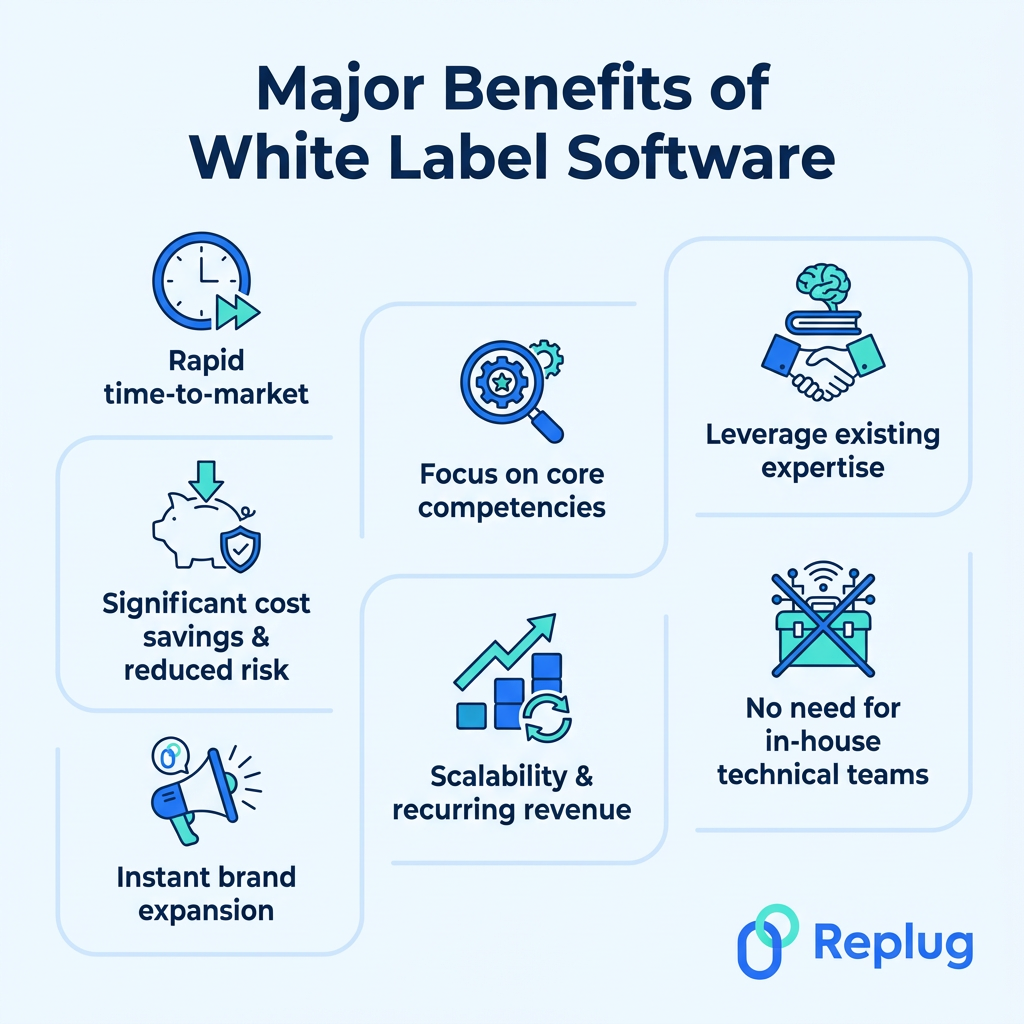
    Rapid time-to-market

    With white label software, you’re not starting from zero. The product is already built, tested, and ready to go. This means you can launch in days or weeks instead of months or years. In competitive markets, that kind of speed can make all the difference.

    Significant cost savings & reduced risk

    Building software in-house comes with a heavy price tag. Developer salaries, infrastructure costs, testing, maintenance, and the very real risk that the product might not work out. White label software eliminates most of that financial risk upfront, letting you invest your budget where it actually matters.

    Instant brand expansion

    White label software lets you add new products and services to your portfolio almost overnight. Instead of spending years developing a new offering, you can license a ready-made solution, put your brand on it, and start selling right away. This lets you expand what your business offers without the usual growing pains.

    Focus on core competencies

    Your team’s time and energy are best spent on what your business does best. White label software takes the technical heavy lifting off your plate. This allows you to stay focused on sales, customer relationships, strategy, and growth, rather than getting buried in development and maintenance tasks.

    Scalability & recurring revenue

    Most white label software operates on a subscription model, which means predictable, recurring revenue as your customer base grows. And because the underlying infrastructure is already built to scale, you don’t have to worry about the platform struggling to keep up as your business expands.

    Leverage existing expertise

    The vendor who built the software has already spent years refining it, fixing bugs, and improving performance based on real user feedback. When you white label their product, you’re essentially inheriting all of that expertise and experience, without having to go through the same trial and error yourself. Seriously, a huge relief!

    No need for in-house technical teams

    Hiring and managing a full technical team is pretty expensive and time-consuming. With white label software, the vendor handles all the backend technical work (updates, security patches, server management, and more). You get a fully functioning product without needing a single developer on your payroll.

    Top 10 white label software for sales agencies & resellers in 2026

    If you’re a sales agency or reseller looking for the best white label software examples & solutions on the market, you’re in the right place. 

    No matter if you need help with outreach, reporting, social media, or CRM, there’s a white label marketing tool out there built exactly for your use case.

    Here are 10 of the best ones worth your attention in 2026!

    1. Replug (Link management platform)

    Replug (Link management platform)

    Replug is essentially a complete link optimization and tracking platform that you can present to clients as entirely your own. Marketers rate Replug ⭐⭐⭐⭐⭐ for its simplicity, reliability, and powerful link management features.

    This makes it a solid pick for agencies that want to offer branded short links, retargeting pixels, bio links, and deep analytics without building anything from scratch.

    Replug’s “Agency” plan offers agencies full white label access to custom domains, logos, dashboards, reports, and emails, all under their own identity.

    2. GoHighLevel (CRM & funnels)

    GoHighLevel (CRM & funnels)

    GoHighLevel is one of the most popular all-in-one platforms for marketing agencies, and its white label capabilities are a big reason why. 

    Agencies can fully rebrand the platform with their own custom logos, domains, and dashboards, then resell it as their own funnel software. This helps create recurring revenue without building from scratch.

    It includes CRM, sales funnels, marketing automation, booking, a drag-and-drop website builder, AI appointment bots, lead nurturing, and analytics, all in one platform, ready for your agency’s branding.

    3. Vendasta (Marketing suite)

    Vendasta (Marketing suite)

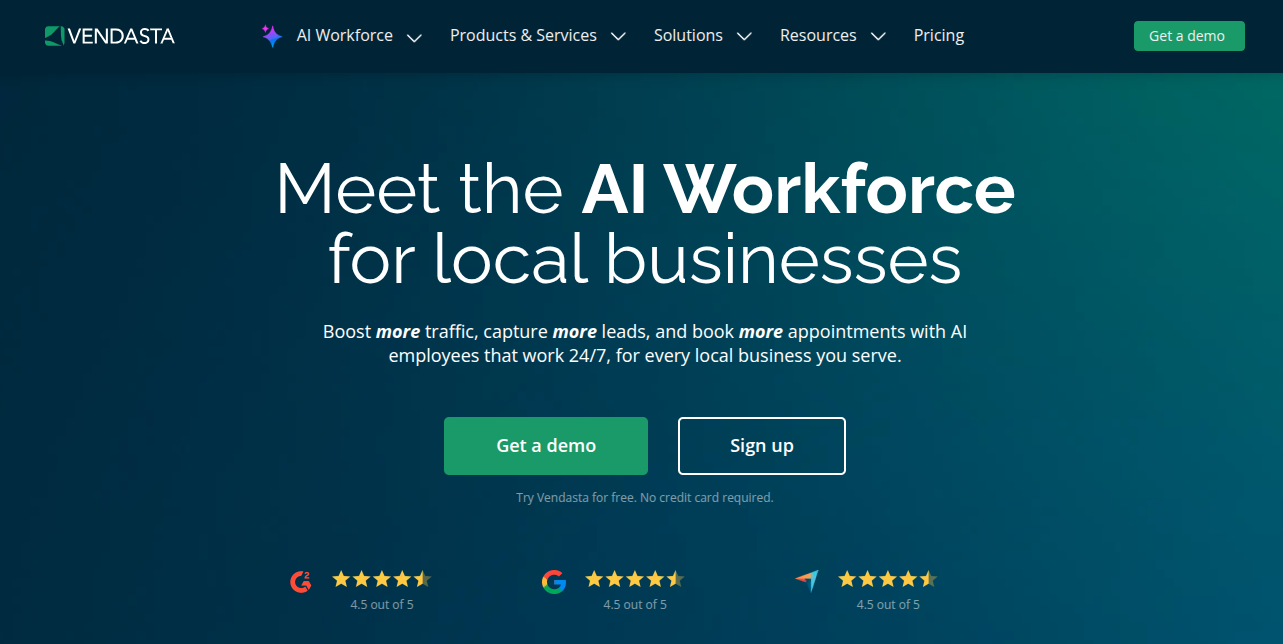
    Vendasta is a powerhouse for agencies looking to expand their digital service offerings fast. It gives you access to a massive marketplace of 250+ rebrandable SaaS products and services.

    From email marketing to PPC management, along with a white label CRM and client portal where customers can manage their marketing, view reports, and request services, hassle-free.

    If you want to become a one-stop shop for your clients without hiring a huge team, Vendasta makes it surprisingly straightforward.

    4. DashClicks (Fulfillment platform)

    DashClicks (Fulfillment platform)

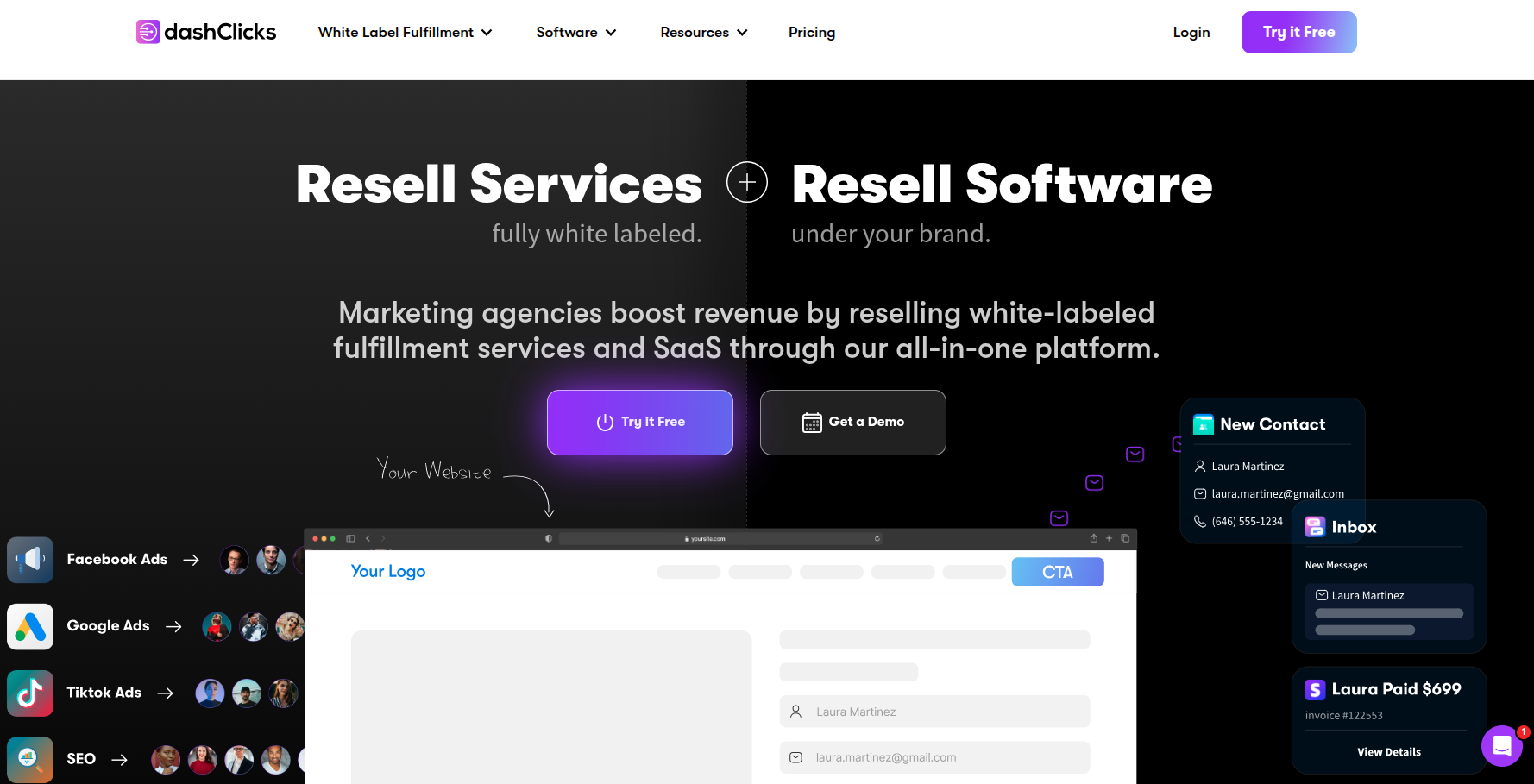
    DashClicks is built with agencies in mind, combining a slick client-facing dashboard with a suite of white label fulfillment services. 

    It includes built-in marketing tools for SEO audits, Facebook ad reporting, lead management, and reputation tracking. In addition, you can add your personalized logo, your domain, and your unique colors so it looks like you built the entire platform from scratch.

    It’s especially popular among newer agencies that want a polished, all-in-one client experience without the operational overhead.

    5. AgencyAnalytics (Reporting)

    AgencyAnalytics (Reporting)

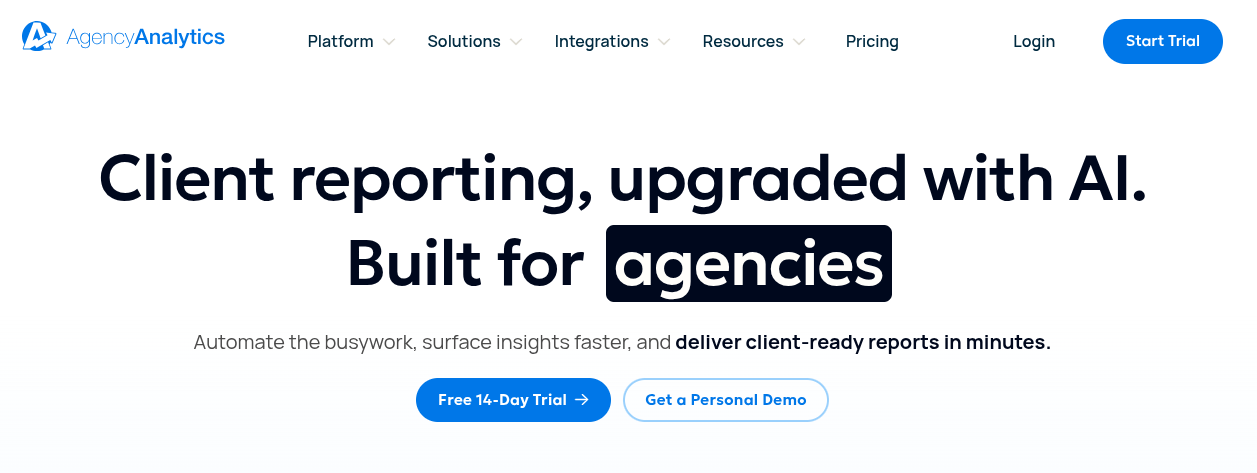
    If client reporting is a pain point for your agency, AgencyAnalytics is the ultimate fix. It pulls data from Meta Ads, Google Ads, Google Analytics, SEO tools, and 80+ other platforms into one fully white-labeled dashboard. 

    This data is complete with your custom domain, branding, and client portals under your agency name. You can even set up automated reports on a schedule, so your clients always feel informed and your team spends less time building decks manually.

    6. Infraforge (Cold email)

    Infraforge (Cold email)

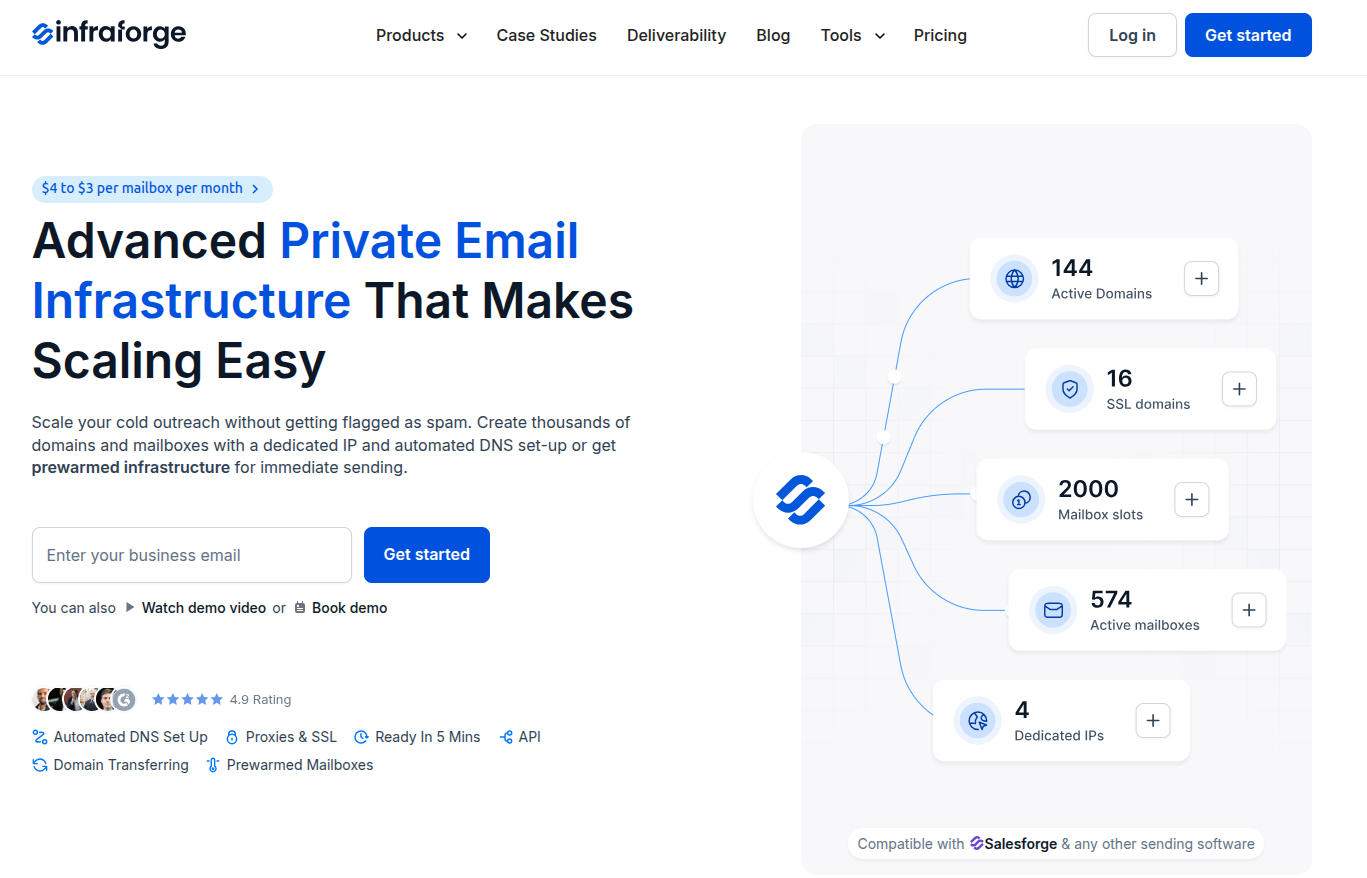
    Infraforge/Salesforge are two complementary tools from the same ecosystem, and together they make a formidable white label cold email stack.

    Salesforge Whitelabel lets agencies rebrand the full outreach platform, including email automation, AI personalization, and client workspace management. 

    On the other hand, Infraforge lets you resell the actual email infrastructure, including dedicated IPs, domain setup, and automated DNS configuration. 

    It’s a great option for agencies that want to own the entire cold outreach experience under their own brand.

    7. ContentStudio (Social media)

    ContentStudio (Social media)

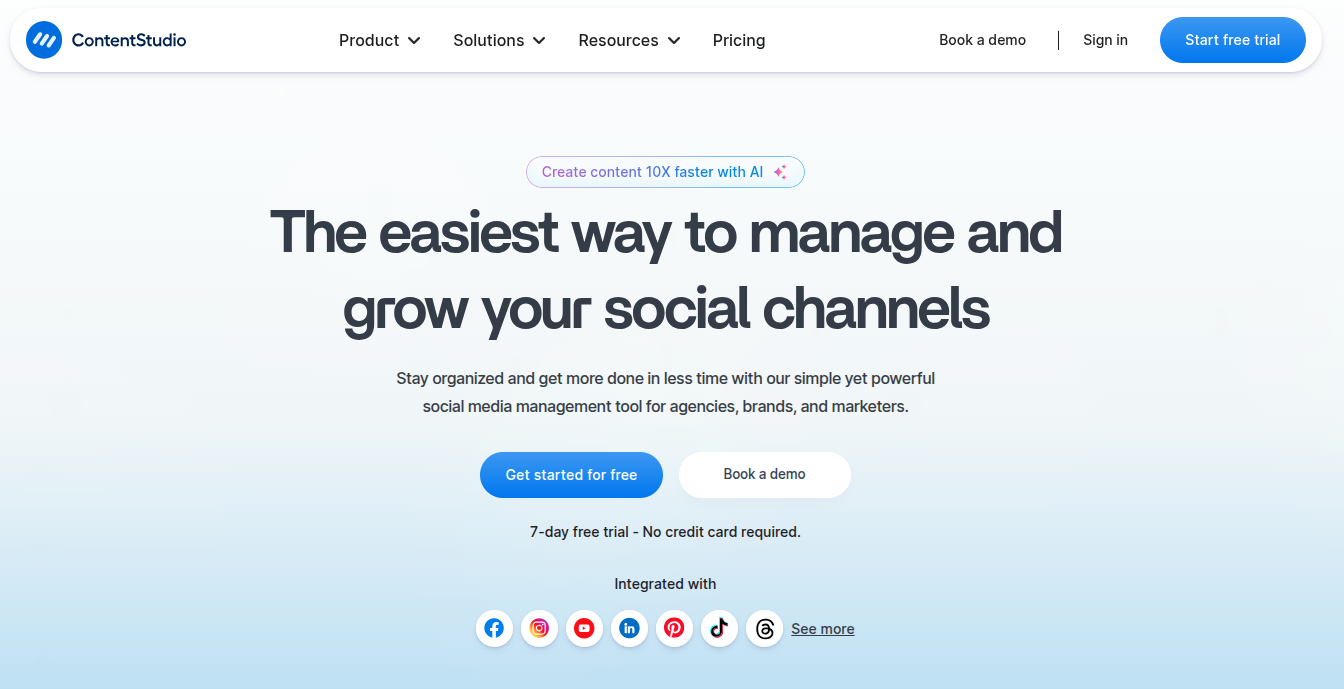
    ContentStudio is a go-to choice for agencies managing social media across multiple clients. It includes a white label dashboard and branded reports, letting you replace the provider’s branding with your own.

    It offers key features like bulk scheduling, multi-account management, a unified social inbox, and analytics designed for agency workflows.

    What’s the best part? 

    It’s budget-friendly, easy to use, and built with the kind of multi-client setup that agencies actually need day-to-day.

    8. BotPenguin (AI automation)

    BotPenguin (AI automation)

    BotPenguin is a strong pick for agencies looking to ride the AI wave and offer chatbot automation under their own brand. 

    The platform lets you deploy intelligent AI agents on WhatsApp, Instagram, Facebook, and websites. Plus, it provides the ability to set up custom pricing plans, manage client subscriptions, and track agent usage, all from one branded dashboard.

    You can power your agents using leading AI models and train them on client-specific data for smarter, more contextual conversations.

    9. Duda (Web design)

    Duda (Web design)

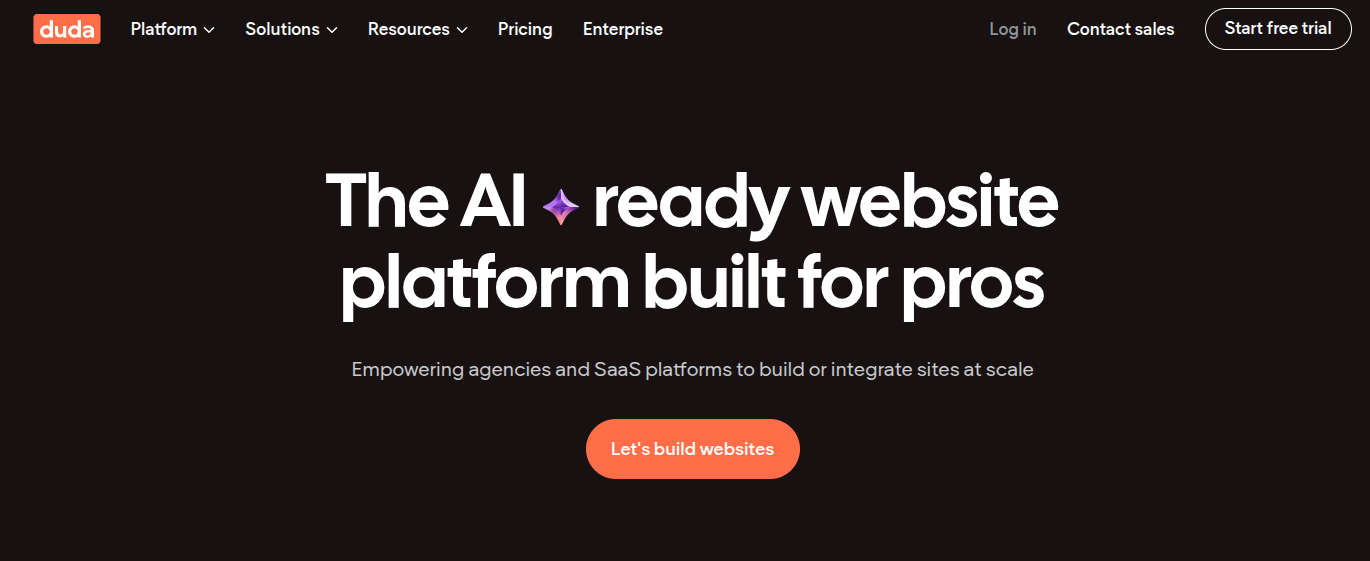
    Duda is a website builder purpose-built for agencies and SaaS providers, and its white label offering is genuinely impressive. 

    It includes branded editors, custom domains for client logins, white-labeled notifications, and branded support portals. This is so that agencies can present Duda as their own website platform rather than a third-party builder. 

    It’s particularly well-suited for web design agencies that want to launch multiple client websites quickly while keeping everything under their own brand.

    10. ConnectPOS (POS system)

    ConnectPOS (POS system)

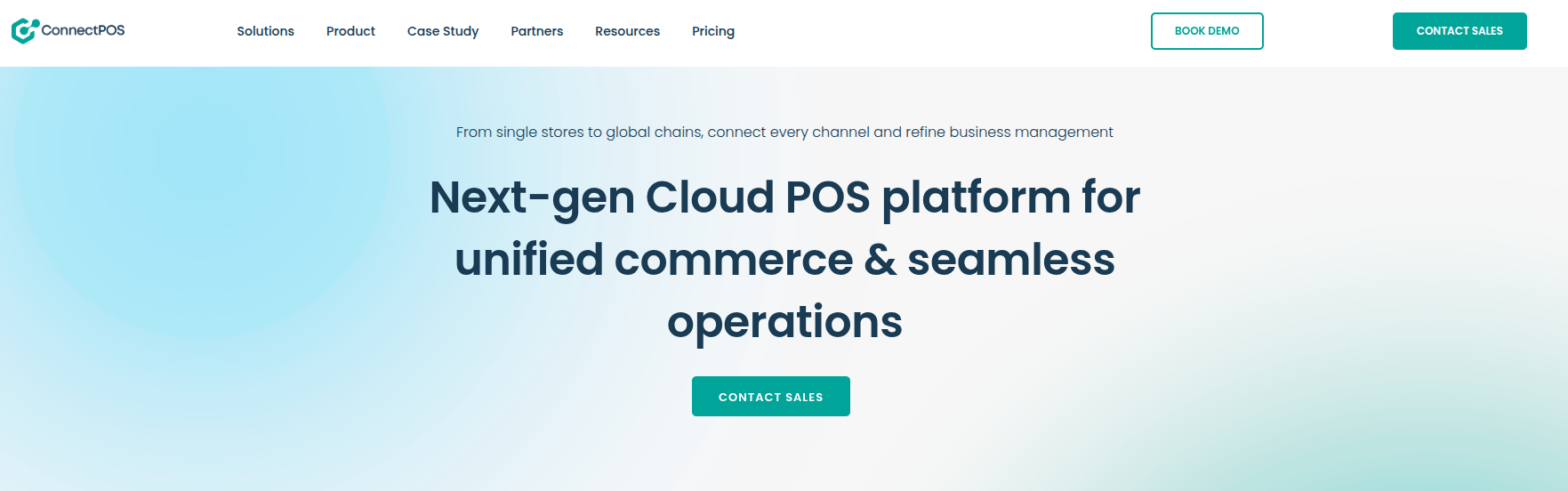
    ConnectPOS is the go-to option for agencies and resellers targeting the retail space. It integrates online and offline transactions seamlessly.

    This amazing platform ensures businesses can provide a unified shopping experience with real-time synchronization between online and offline stores. 

    Moreover, integrations with major e-commerce platforms like Shopify, WooCommerce, Magento, etc. are even more effortless.

    Resellers can fully rebrand the platform and offer it to retail clients as their own POS solution, all while ConnectPOS handles the backend maintenance and updates.

    Related:14 Best white label marketing tools for agencies in 2026

    How to sell a white label software?

    Selling white label software isn’t just about placing your logo on a product and hoping for the best. There’s a proper process behind it, and when done right, it can become a seriously profitable revenue stream for your business.

    Here are the steps to successfully sell white label software:

    How to sell a white label software

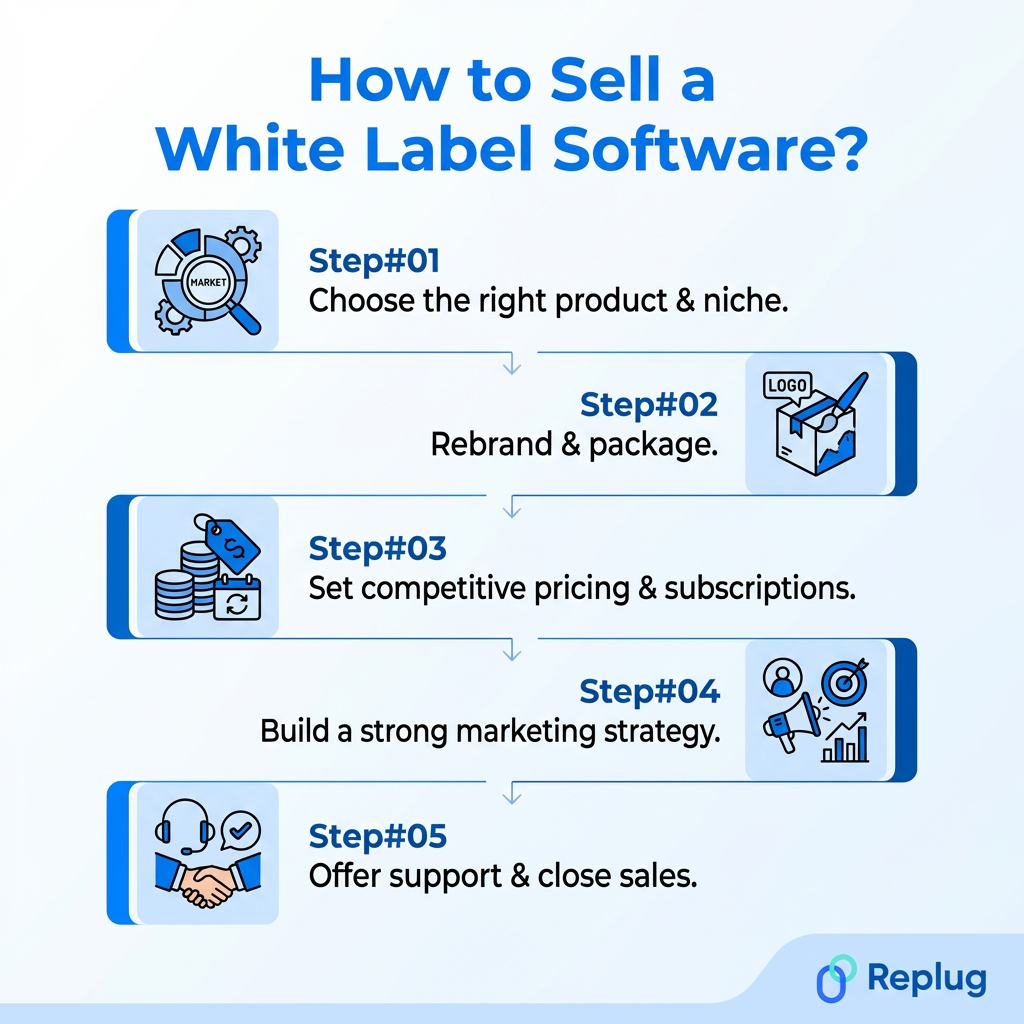
    Step#01: Choose the right product & niche

    Before anything else, you need to figure out what you’re selling and who you’re selling it to. The biggest mistake most resellers make is picking a product that’s too broad or doesn’t solve a clear, specific problem. 

    Take your time and think about your target audience. Are they marketing agencies, small retailers, HR teams, or e-commerce businesses?

    Once you know your niche, find a white label product that directly addresses their biggest pain points. Always remember, a focused niche always outperforms a generic one!

    Step#02: Rebrand & package

    Once you’ve picked your product, it’s time to make it yours. Add your logo, set up a custom domain, align the color scheme with your brand identity, and craft messaging that speaks directly to your audience. 

    But don’t stop at just visuals; packaging matters too. Think about how you want to bundle the product. Will you offer different tiers? Include onboarding support? Pair it with additional services? 

    Note: The way you present and package the software can be just as important as the product itself.

    Step#03: Set competitive pricing & subscriptions

    This is the most important step, as pricing can make or break your sales. You want to charge enough to make a healthy margin, but not so much that potential customers bounce straight to a competitor. 

    Research what similar tools in your niche are charging and position yourself accordingly. Subscription-based pricing tends to work best for software because it creates predictable, recurring revenue and lowers the barrier to entry for new customers. 

    Helpful tip: Offering a free trial or a starter plan can also help get people through the door faster.

    Step#04: Build a strong marketing strategy

    A great product with no visibility won’t sell itself. You need a clear plan to get in front of the right people. 

    This could include content marketing, SEO, paid ads, LinkedIn outreach, email campaigns, or even partnerships with complementary service providers. 

    Focus on communicating the value your software delivers (not just its features). Case studies, testimonials, and demo videos are especially effective for software sales because they show real outcomes rather than just making promises.

    Step#05: Offer support & close sales

    Here’s where a lot of resellers make a mistake. They invest all their energy in getting leads but forget about the experience after the sale. 

    Offering solid onboarding, responsive customer support, and regular check-ins builds trust and dramatically improves retention. 

    On the sales side, don’t be afraid to take on calls, offer live demos, and address objections head-on. People buy software from businesses they trust, so the more confidence and support you project, the easier the close becomes.

    How to choose the right white label software (selection criteria)

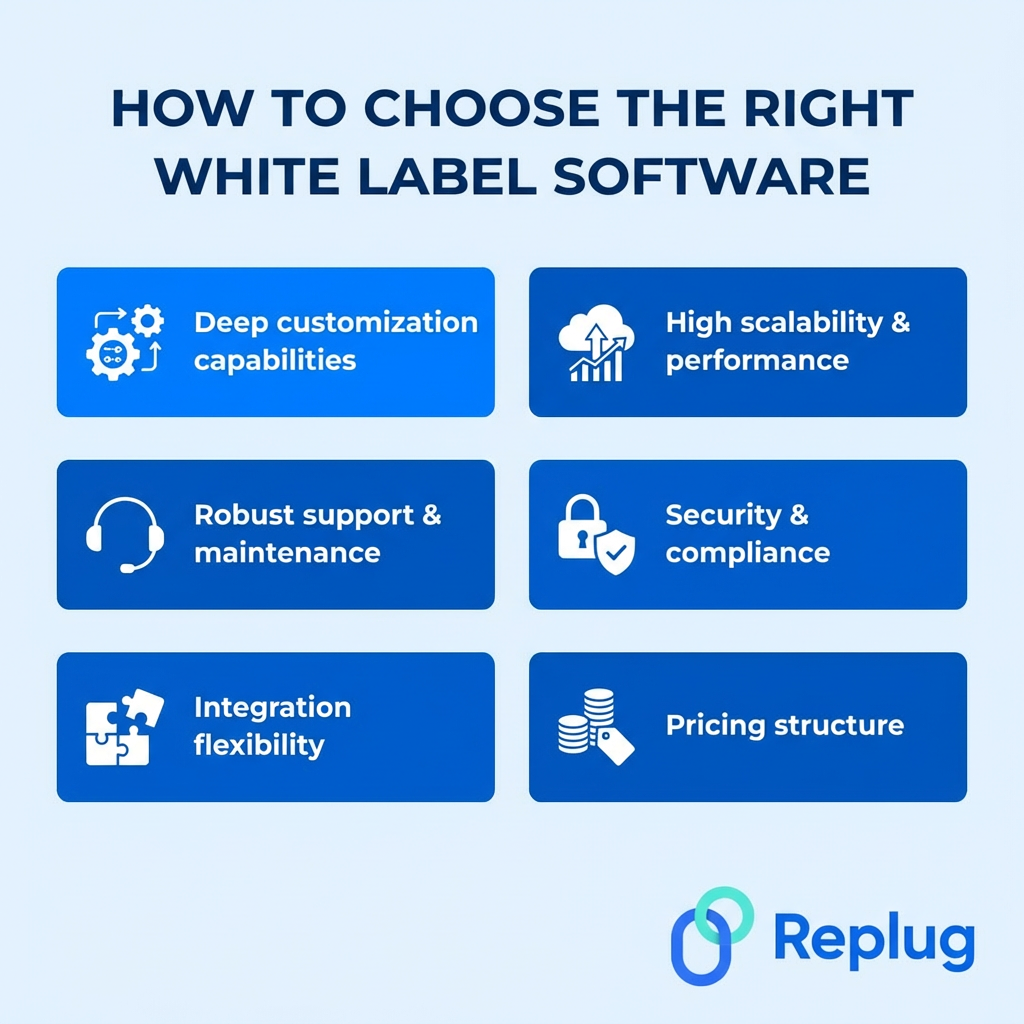
    Not all white label softwares are created equal, and picking the wrong one can cost you clients, reputation, and money in the long run. Before you commit to any platform, here are the key factors you should be evaluating:

    How to choose the right white label software

    Deep customization capabilities

    The whole point of white label software is to make it look and feel like your own personal product. So if a platform only lets you swap out a logo, that’s a red flag.

    Look for solutions that offer custom domains, branded dashboards, personalized client portals, and flexible UI adjustments. The offerings must be at least enough to make it genuinely unrecognizable from the original vendor’s product.

    High scalability & performance

    Your software needs to grow with you, not against you. Make sure the platform can comfortably handle an increasing number of users, higher data loads, and growing client demand without slowing down or crashing. 

    Ask vendors directly about their uptime guarantees and how the platform performs under heavy usage. These are questions worth asking before you sign anything.

    Robust support & maintenance

    When something goes wrong (and at some point, it will), you need a vendor who actually shows up. Look for platforms that offer 24/7 reliable, responsive support through multiple channels like live chat, email, or a dedicated account manager.

    Regular product updates and a clear maintenance schedule are also good signs that the vendor is actively invested in keeping the platform running smoothly.

    Security & compliance

    If your clients are trusting you with their data, you need to trust your vendor with it too. Make sure the platform meets the relevant security and compliance standards for your industry, whether that’s GDPR, SOC 2, HIPAA, or something else. 

    Don’t just take their word for it; ask for documentation and certifications to back it up.

    Integration flexibility

    The software you pick shouldn’t exist in isolation. It needs to play nicely with the other tools your clients are already using (CRMs, payment gateways, analytics platforms, email tools, and so on).

    Prioritize platforms that offer strong API access and pre-built integrations, because the more connected your stack is, the smoother everything runs.

    Pricing structure

    Make sure the pricing actually makes sense for your business model before committing. Some vendors charge a flat monthly fee, others take a revenue share, and some charge per user or per client.

    Critically evaluate the numbers and make sure there’s enough margin left for you to price competitively and still turn a healthy profit. 

    Also, watch out for hidden fees around onboarding, extra features, or scaling. Those can quietly eat into your margins fast.

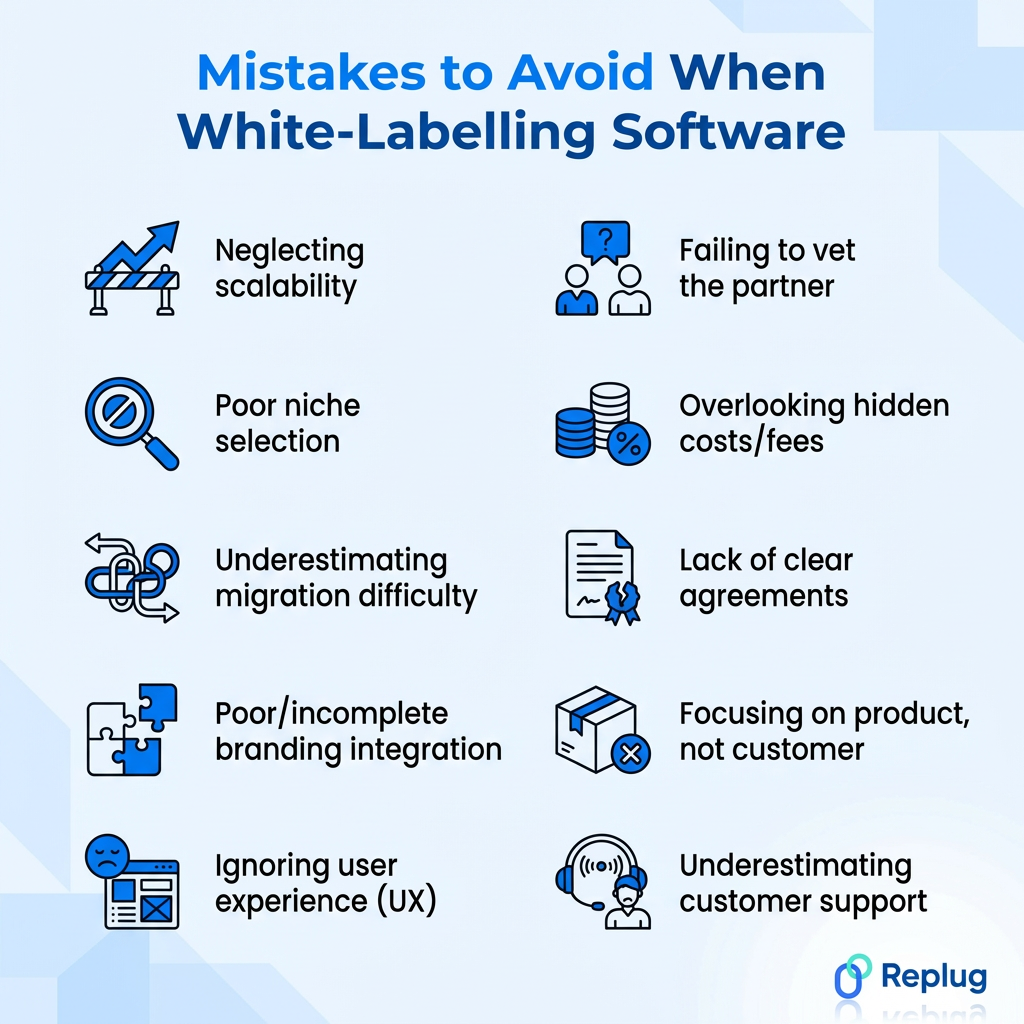
    Mistakes to avoid when white-labelling software

    White labelling software can be incredibly rewarding, but only if you go in with your eyes open. There are some pretty common pitfalls that trip up even experienced resellers, and knowing them upfront can save you a lot of headaches down the road.

    Mistakes to avoid when white-labelling software

    Neglecting scalability

    A platform that works fine with 10 clients can completely fall apart at 100. Always think ahead and make sure the software you choose is built to handle growth before you actually need it to.

    Failing to vet the partner

    Your vendor’s reliability directly reflects on your brand. Before signing anything, step into their track record, read reviews, check their uptime history, and make sure they’re a company you can actually trust for the long haul.

    Poor niche selection

    Trying to sell to everyone usually means selling to no one. Picking a niche that’s too broad, too saturated, or simply not the right fit for the product you’re reselling is one of the fastest ways to struggle with sales from day one.

    Overlooking hidden costs/fees

    The base license price is rarely the full picture. Watch out for extra charges tied to additional users, premium features, onboarding, API access, or scaling. These can quietly stack up and seriously squeeze your profit margins.

    Lack of clear agreements

    Handshake deals aren’t the ideal choice in white labelling. Make sure your contract with the vendor clearly outlines ownership rights, data handling, SLAs, termination clauses, and what happens if they decide to discontinue the product.

    Poor/incomplete branding integration

    Half-baked branding kills credibility fast. If your logo sits next to the original vendor’s name somewhere in the UI, or the color scheme doesn’t quite match, clients will notice. This will instantly undermine the trust you’re trying to build.

    Focusing on product, not customer

    Getting too caught up in the software’s features and forgetting about the actual problems your customers need solved is a common trap. At the end of the day, people don’t buy software; they buy outcomes, so always lead with value, not specs.

    Ignoring user experience (UX)

    A messy, confusing interface will frustrate your clients and drive them straight to a competitor. Before committing to any platform, test the UX thoroughly. If it’s not intuitive and smooth for you, it won’t be for your customers either.

    Underestimating customer support

    Even the best software comes with questions, issues, and annoyed users. If you haven’t planned for how you’ll handle response times, knowledge bases, and escalation paths, you’ll quickly find yourself overburdened. You’ll end up losing clients over problems that could have been easily managed.

    White label vs private label: Key differences explained!

    People often use these two terms interchangeably, but they’re actually quite different, and picking the wrong model for your business can cost you. 

    Here’s a clear breakdown of how they stack up against each other.

    Comparison pointWhite labelPrivate label
    ExclusivityNon-exclusive — the same product is sold to multiple businessesExclusive — the product is made solely for one brand
    CustomizationLimited to branding (logo, colors, domain)Deep customization — product specs, features, and design can all be tailored
    Startup costLow — you’re sharing development costs with other resellersHigher — you’re funding a more custom, dedicated build
    Time to marketVery fast — product is already built and ready to deploySlower — requires more development and setup time
    ControlLimited — vendor controls the core product and updatesHigh — you have significantly more say over the product roadmap
    ExampleA marketing agency reselling a branded version of a social media scheduling toolA retailer commissioning a manufacturer to build a product sold exclusively under their brand
    Best forAgencies, resellers, and startups looking to launch fast with minimal investmentEstablished businesses that want a unique, exclusive product under full brand ownership
    When to useWhen speed, cost-efficiency, and quick revenue matter mostWhen differentiation, exclusivity, and long-term brand ownership are the priority

    The bottom line: If you need to move fast and keep costs low, white label is your friend. But, if you’re after something truly unique that no competitor can replicate, private label is worth the extra investment.

    For more info: White label vs Private label: Which to choose?

    Get a top-notch white label solution that looks and feels like your own with Replug!

    If you’re serious about brand marketing and want a white label solution that actually delivers, Replug is worth a close look. 

    It’s a reliable URL shortener and an all-in-one link management platform packed with features like branded short links, bio links, retargeting pixels, and deep analytics, etc.

    But what really sets it apart for agencies and resellers is its white label offering. Custom domains, branded dashboards, personalized reports, and client-facing portals that carry your identity from top to bottom.

    Replug Branded Short Links CTA
    Add your custom domain, logo, & interface branding, getting a white label solution that looks and feels like your own.
    Try Replug for free

    Your clients will never know Replug exists. They’ll just know your brand. Clean, professional, and completely yours!

    Wrapping up

    White label software is one of the smartest ways to grow your business without burning through your budget or your team’s bandwidth. 

    Whether you’re an agency looking to expand your service offerings, a startup trying to launch fast, or a reseller building a recurring revenue stream, there’s a white label solution out there that fits your needs perfectly. 

    The key is choosing the right product, partnering with a reliable vendor, and presenting it in a way that genuinely reflects your brand.

    Do that well, and white label software stops being just a shortcut. It becomes a real, scalable business advantage that keeps paying off long after launch.

    Frequently asked questions

    Is white label software legal?

    Yes, absolutely! White label software is a completely legitimate and widely accepted business model. 

    The original developer licenses their product to resellers through a formal agreement, giving them the legal right to rebrand and resell it. As long as there’s a proper licensing contract in place between both parties, everything is above board. Thousands of businesses worldwide operate this way every single day.

    Are white label products and white label software the same?

    Not exactly! The concept is the same, i.e., buying something pre-made and selling it under your own brand, but the nature of the product differs. 

    White label products are typically physical goods, like cosmetics or packaged food. White label software, on the other hand, is digital. Think SaaS tools, apps, and platforms. Same business model, very different execution.

    What advantages do white label software offer compared to traditional software solutions?

    The biggest advantages come down to speed, cost, and simplicity. With white label software, you skip the lengthy development process entirely and get a market-ready product almost immediately. 

    You also avoid the massive upfront investment that building traditional software requires. On top of that, maintenance, updates, and security are handled by the vendor. This way, you get all the benefits of owning a software product without most of the operational headaches.

    What are the common use cases for white label software?

    Here are the common use cases for white label software:

    Marketing agency tools: Agencies use white label platforms for SEO, social media management, and email marketing so they can offer branded services without building tools themselves.
    Lead generation & CRM: Businesses rebrand CRM systems and lead capture tools to manage customer data, automate sales pipelines, and offer client-facing solutions under their own name.
    Client portals & reporting: White label dashboards and portals allow companies to share analytics, reports, and project updates with clients while maintaining their own personalized branding.
    E-commerce & web solutions: Companies use ready-made website builders and e-commerce platforms to launch online stores or services quickly without custom development.
    HR & payroll services: Businesses adopt white label HR tools for employee management, payroll processing, and compliance, offering these services as part of their own solutions.
    AI chatbots & analytics: Many firms use white label AI tools like chatbots, customer support systems, and analytics dashboards to enhance customer experience and insights.
    Mobile applications: Pre-built mobile apps (e.g., fitness, delivery, or service apps) are rebranded and launched quickly, saving time and development costs.
    Financial technology (FinTech): Startups and businesses use white label payment gateways, banking apps, and financial tools to offer branded financial services without building infrastructure from scratch.

    These use cases show how white label software helps businesses expand services, reduce costs, and launch faster without heavy technical investment.

    What are the technical requirements for white labeling software?

    The technical requirements are generally pretty minimal on the reseller’s end. You’ll typically need a custom domain, basic DNS configuration to point the domain to the platform, and access to a branding dashboard to upload your logo and adjust the UI.

    Some platforms may also require API integration if you’re connecting the software to other tools. The vendor handles all the heavy backend infrastructure, so you don’t need a technical team to get started.

    How to efficiently market your white labeled software to attract clients?

    Start by getting crystal clear on who your ideal client is and what problem your software solves for them. 

    From there, build your marketing around that specific pain point, not the product’s feature list. Content marketing, SEO, LinkedIn outreach, and targeted paid ads all work well for software.

    Case studies and live demos are especially powerful because they show real results. Offering a free trial or a low-barrier starter plan also helps reduce the hesitation that often comes with software purchases.

    What are the most common challenges in white labeling software?

    The most common ones include:

    – getting stuck with a vendor that has poor support or unreliable uptime, 
    – underestimating hidden costs that eat into your margins, and 
    – struggling to differentiate your offering in a crowded market.

    Branding inconsistencies, limited customization options, and customer churn due to poor UX are also frequent pain points. 

    Most of these challenges can be avoided up front by thoroughly vetting your vendor and setting clear expectations before signing any agreement.

    Which one is the best white label software to resell in 2026?

    It really depends on your niche and target audience. That said:

    GoHighLevel remains one of the top picks for marketing agencies. Thanks to its all-in-one CRM and funnel capabilities. 
    Replug is a standout for link management and branded short links. 
    Vendasta is excellent if you want a full marketplace of resellable services. 

    The “best” option is the one that fits your specific audience, offers strong white label customization, and has a pricing structure that leaves you a healthy margin.

    Which one is the best AI white label software?

    BotPenguin is one of the strongest options in the AI white label space right now, offering fully branded AI chatbots deployable across WhatsApp, Instagram, websites, and more. 
    GoHighLevel also has solid AI features built in, including AI appointment bots and automation. 
    – If your focus is on AI-powered cold outreach, Salesforge is worth a serious look.

    The best choice depends on whether you need conversational AI, sales automation, or something else entirely.

    What’s the difference between OEM and white label?

    OEM (Original Equipment Manufacturer) and white label are similar but not identical. 

    – With white label, a reseller buys a finished product, rebrands it, and sells it as their own, with little to no modification to the core product.
    OEM arrangements typically involve more customization and integration, where the buyer incorporates the original manufacturer’s component or technology into their own product.

    In short, white label is more plug-and-play, while OEM usually involves a deeper, more technical partnership between the two parties.