Author: Manahil

  • Exit intent popups: examples & tips that convert

    Exit intent popups: examples & tips that convert

    Stop losing leads! Create exit-intent popups that convert. 

    Unsure what they are?

    These are pop-ups triggered when a user is about to leave your website. Like 

    “Wait! Don’t Miss Out on This Exclusive Offer!”

    “Leaving So Soon? Get 20% Off Your Next Purchase!”

    The last-minute deal or incentive can encourage users to take action, whether it’s making a purchase, signing up for a newsletter, or downloading a resource. 

    That’s what exit intent pop-ups do. 

    Wanna know more? Let’s explore this detailed guide together:

    What are exit popups & how do they work?

    Exit-intent

    Exit popups, also known as exit-intent popups, are website overlays displayed right before a user appears to be leaving the page. 

    They use advanced technology to track user behavior and trigger the popup when someone moves their cursor toward the “X” to close the tab or scroll up to the browser bar.

    Boost ROI with branded URLs - Replug dashboard showing performance metrics and branded URL creation
    Boost your conversion rates with irresistable CTAs with

    for your marketing campaigns.

    Check

    Higher clicks

    Check

    More leads

    Check

    Better ROI

    Generate free CTAs

    Are exit popups effective?

    Exit popups can be highly effective when used strategically. Studies show they can:

    • Cut down bounce rates: By offering a last-minute incentive or addressing potential concerns, exit popups can convince visitors to stay and explore further.
    • Quick conversion boost: Regain the attention of indecisive shoppers and nudge them towards completing a purchase.
    • Upsell or cross-sell opportunities: Based on a visitor’s browsing behavior, exit-intent popups can suggest complementary products or services. This can increase your average order value and boost overall revenue.

    However, poorly designed pop-ups can be intrusive and backfire. The key is to use them thoughtfully and provide a genuine benefit to the user.

    Must-do practices for successful exit-intent popups

    • Headline: Create an attention-grabbing headline that addresses a specific pain point or offers a compelling incentive.
    • Copy: Keep your message short and sweet, highlighting the benefit or value of your offer.
    • CTA: Make your call-to-action (CTA) button clear and enticing so visitors know exactly what to do next.
    • Catchy visuals: Use appealing visuals, like a shopping cart picture and a discount badge, to make your popup more attractive.
    • Brand-specific colors:  Stick to your brand colors but use a bold color for the CTA button to make it pop.
    • Set duration: Trigger the popup to appear just as the user is about to leave to catch their attention at the perfect moment.

    If you’re looking to simplify your pop-up creation process, opt for a no-code pop-up maker. With no-code tools, you can effortlessly design, customize, and launch pop-ups — no developers or designers needed.

    Some exit-intent pop-up examples that caught our eye

    Here are some of the most engaging pop-ups that caught our eye so far;

    1. ContentStudio

    At the forefront is ContentStudio, a premium social media management tool packed with advanced features. In a thoughtful move, the brand offers its users an exclusive AI powered marketing tool. Highlighting the key points in bold catches user attention. Given that the audience largely consists of social media professionals and content creators, this strategy is likely to attract significant interest and engagement.

    Best exit Intent Popup Example - ContentStudio

    2. Scarlettos

    We came across a fantastic exit intent example from Scarlettos, a shoe store. They remind shoppers about the items still in their cart and offer a 20% discount on their exit popup, but only for first-time buyers.

    Exit Intent popup example of Scarlettos

    3. Yesplshealth

    Yesplshealth uses a vibrant and eye-catching exit-intent pop-up that offers 10% off on the first purchase for users who provide their email addresses.

    Exit Intent popup- Yesplshealth

    4. Stylerunner 

    Here’s another thoughtful touch: users love freebies. So, alongside offering 10% off in exchange for an email address, you’re giving them a gift they can’t resist.

    Stylerunner - Exit Intent popup

    5. Zendesk

    Zendesk’s exit-intent pop-up combines a sleek design with a compelling message. By offering a free trial or demo of its customer service software, Zendesk appeals to the immediate needs of its audience.

    Exit Intent popup example of Zendesk

    6. Le Creuset   

    Free shipping is another excellent tactic most e-commerce businesses use to capture users’ attention. By offering free shipping, you remove a common barrier to purchase, making it easier for customers to complete their orders and increasing overall conversion rates.

    Exit Intent popup example of Le Creuset   

    Related: 100+ call-to-action phrases you NEED to use [+ best examples]

    Replug Branded Short Links CTA
    A complete link management solution
    for marketing professionals & agencies.
    Try Replug for free

    05 common benefits of exit-intent popups

    Exit-intent popups can be a game-changer for your website.

    Here’s a look at how they can help you keep visitors engaged and boost your conversions.

    1. Grow your email list

    Capture valuable leads by offering something of value (e.g., discount code, free guide) in exchange for an email address.

    Email list

    This can significantly increase your email sign-ups, giving you a larger audience to nurture and convert over time.

    2. Promote special offers & events

    Got a special promotion or a new product launch? Use exit-intent popups to make sure visitors don’t miss it. 

    Highlighting special offers or important updates in a popup can drive more engagement and conversions, especially if the offer is time-sensitive.

    3. Save abandoned carts

    If you run an e-commerce site, abandoned carts are a big deal.

    Abandoned carts

    Exit-intent popups can help you recover lost sales by offering a discount or reminding customers of the items they’ve left behind. This gentle reminder can be just what they need to complete their purchase.

    Related: Abandoned Cart Email Examples & Tips

    4. Get valuable feedback

    Ever wonder why people are leaving your site? Exit-intent popups can ask visitors for feedback just before they go. 

    A simple question like, “Why are you leaving today?” can provide you with insights into what’s not working on your site and what you can improve.

    5. Better user experience

    When done right, exit-intent popups can actually improve the user experience.

    They provide timely and relevant information just when the visitor is about to leave, making their interaction with your site more engaging and valuable.

    Replug Branded Short Links CTA
    A complete link management solution
    for marketing professionals & agencies.
    Try Replug for free

    Some secret exit intent hacks no one told you about

    1. Speed up your pop-ups for instant impact

    Boost the effectiveness of your pop-ups by ensuring they load quickly and seamlessly. Fast-loading pop-ups grab attention before visitors get distracted, leading to higher engagement and more conversions.

    2. Send personalized messages to different user groups

    url-tracking- analytics

    Segment your audience based on the analytics of your pop-up. Then send personalized content that speaks directly to users’ interests and needs, enhancing engagement and fostering stronger connections.

    3. Respect visitor preferences with easy opt-outs

    Show your visitors you value their choices by providing simple opt-out options for pop-ups and notifications. Easy opt-outs build trust and create a more positive user experience, which can lead to greater loyalty.

    4. Prioritize mobile-friendly experiences

    Ensure your pop-ups are as effective on mobile devices as they are on desktops. Mobile-friendly designs cater to the growing number of smartphone users, providing a seamless and engaging experience on all screens.

    5. Add a strong call to action (CTA)

    obvi-example

    Guide your visitors toward the desired action with a compelling call to action. A strong exit intent pop-up can drive more sign-ups, downloads, or purchases, enhancing your conversion rates.

    6. Match your website’s design

    Keep your branding consistent by aligning your pop-ups with your website’s design. Matching fonts, colors, and styles creates a cohesive user experience, making your pop-ups feel like a natural part of your site.

    7. Test and learn with A/B testing

    A/B testing different pop-up designs, messages, and triggers allows you to determine what works best for your audience. By continuously experimenting and analyzing results, you can optimize your pop-ups for maximum impact and improve overall site performance.

    Boost ROI with branded URLs - Replug dashboard showing performance metrics and branded URL creation
    Boost your conversion rates with irresistable CTAs with

    for your marketing campaigns.

    Check

    Higher clicks

    Check

    More leads

    Check

    Better ROI

    Generate free CTAs

    How do i make an exit-intent pop-up?

    If you run marketing campaigns using links, ads or personalized webpages then one of the best options out there is Replug. It’s a versatile tool that does more than just exit intent pop-ups. It offers multiple types of CTA’s e.g. banner CTA, form CTA etc.

    With Replug, you can easily adjust colors, images, and layouts to create visually appealing and highly effective pop-ups. 

    The platform also provides advanced targeting options, so you can set your pop-ups to appear at the precise moment a user is about to leave your site.

    Here’s how you can create an exit-intent pop-up with Replug. 

    Step 1: Sign up and login to Replug

    Sign Up to Replug

    Step 2: Create a new brand

    Create a Brand

    Step 3: Create a CTA campaign

    Enter the campaign name and choose the CTA campaign.

    Select Call to action campaign

    Note: You can also add your domain instead of using Replug’s shortened domain.

    Step 4: Select CTA Type

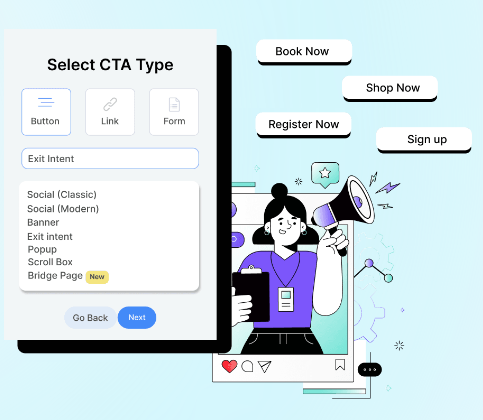
    Add a button, link, or form to your CTA campaign. We have selected the “button CTA” and “exit intent popup” CTA type.

    Select CTA type

    Once you have selected the exit intent popup CTA, then add your CTA image that you wish to display on your CTA link.

    Step 5: Add your CTA message

    Then add a headline, body, and actual CTA of your exit intent pop-up.

    Exit intent popup - Call to Action Message

    Helpful tip: UTM tracking

    Add UTM parameters to your pop-up to track the effectiveness of your campaigns. By including specific UTM tags like source, medium, and campaign in your popup URLs, you can easily identify which channels and messages are driving the most conversions. This data allows you to refine your marketing strategies and optimize future campaigns for better results.

    Step 6: Customize your exit Intent popup template

    The next step is to add background colors to your text and button. Also, add a background image, ensuring your CTA image and text is clearly visible.

    CTA customization

    Step 7: Select “On Exit-intent”

    In the next step, choose when your CTA should appear. We are creating an exit intent CTA so we will select “On Exit-intent”.

    Step: Preview & publish the exit intent popup

    Lastly, preview your exit intent pop-up CTA and “Save campaign” to publish your CTA on the live link.

    Check this exit intent popup yourself. Move the cursor on the address bar, and it will appear.

    Replug is a complete link management tool

    Apart from CTA’s, the core function of the tool is to optimize and personalize your URLs with the help of its top-notch URL shortener. With Replug, you can add retargeting pixels to your CTA links and generate QR codes for them.

    Set various filters to route & rotate traffic on your CTA shortened links based on time, date, region, etc. Moreover, enhance the user experience using deep linking for your CTA links for seamless navigation. Lastly, track clicks and conversions for each CTA campaign you create.

    Wait! there’s more you can do with Replug.

    • Create custom bio links
    • Add your custom domain replacing Replug domain
    • White label your dashboard
    • Create temperory links
    • Add password to your links
    • Add UTMs
    • And more…

    Other tools you can use to create exit-intent popups

    • OptinMonster: Known for its user-friendly interface and powerful features, OptinMonster allows you to create and customize exit-intent pop-ups with ease. It also offers advanced targeting options and A/B testing.
    • Sumo: Sumo provides a range of tools for creating exit-intent pop-ups, including customizable templates and detailed analytics to track your pop-up’s performance.
    • Privy: Privy offers a simple setup process and robust customization options. It’s particularly popular among e-commerce businesses for its ability to reduce cart abandonment and boost sales.
    Boost ROI with branded URLs - Replug dashboard showing performance metrics and branded URL creation
    Boost your conversion rates with irresistable CTAs with

    for your marketing campaigns.

    Check

    Higher clicks

    Check

    More leads

    Check

    Better ROI

    Generate free CTAs

    Conclusion:

    Continuously monitor the performance of your pop-ups and be ready to make adjustments based on what works best for your audience. 

    All in all, by using these tools and following these best practices, you can create effective exit-intent pop-ups that help reduce bounce rates and convert visitors into customers or subscribers.

    FAQs

    Are exit popups good?

    Yes, exit popups can be effective in capturing the attention of users about to leave, potentially converting them into leads or customers with timely offers or messages.

    What is the exit-intent form?

    An exit-intent form is a pop-up that encourages users to add their email in exchange for an offer, discount, or other relevant content to retain their interest.

    What is a pop-up strategy?

    A pop-up strategy involves the planned use of pop-ups on a website to engage visitors, capture leads, and drive conversions through targeted and timely messages.

    Do exit popups work on mobile?

    Yes, exit popups can work on mobile devices by detecting user behaviors, such as swiping away or tapping the back button, to trigger the pop-up.

    Do pop-ups affect SEO?

    Excessive or intrusive pop-ups can negatively affect SEO by impacting user experience and page load times, potentially leading to lower search engine rankings.

    When not to use a popup?

    Avoid using pop-ups when they disrupt the user experience, such as during critical navigation moments or on pages where users are highly engaged with content.

  • 25+ best affiliate programs to earn money in 2026

    25+ best affiliate programs to earn money in 2026

    Affiliate marketing has a bright future ahead. It’s a great opportunity for agencies to expand their revenue streams and provide valuable services to clients.

    By teaming up with the right programs, you can use your skills to generate leads, boost sales, and earn hefty commissions.

    But with so many options out there, it can be tough to choose the best affiliate programs. This list highlights the top 25+ affiliate programs, including SAAS tools, crypto tools, and more. Let’s kick things off!

    What is affiliate marketing?

    Affiliate marketing is a performance-based advertising strategy where you (the affiliate) earn commissions for promoting another company’s (the merchant’s) products or services.

    And SaaS (Software as a Service) affiliate marketing is the same.

    Here’s the breakdown:

    The merchant: A company selling a subscription-based software service.
    The affiliate: You! You’ll promote the merchant’s SaaS product to your audience.
    The customer: Someone who signs up for the SaaS product through your unique affiliate link.

    So when a customer clicks your affiliate link and signs up for the SaaS product, you earn a commission.

    It’s a win-win-win! 

    The merchant gets a new customer, you get paid for the referral, and the customer hopefully discovers a valuable tool.

    Factors to consider when choosing an affiliate program

    Factors to consider for Affiliate programs
    1. Commission rate
    2. Cookie duration
    3. Payment methods
    4. Minimum payout threshold
    5. Reputation of the merchant
    6. Product or service relevance to your audience
    7. Support and resources provided by the affiliate program
    8. Frequency of payoutsTracking and reporting tools
    9. Program restrictions and requirements
    10. Marketing materials and promotional support
    11. Refund and return policies

    Top affiliate programs

    Sr.ToolCommission Rate
    1.ReplugUp to 30% recurring commission
    2.Linkly30% recurring commission
    3.ContentStudio30% recurring commission
    4.OneUp20% commission on the first year’s payments
    5.Usermaven20% recurring commission
    6.SemrushOffers multiple affiliate tiers
    7.ConvertKit30% recurring commission
    8.DripMultiple commission rates (15 %, 20%, 25%)
    9.Amazon associateEarn up to 10% commission
    10.ShopifyVariable based on merchant location
    11.BigCommerce200% of the customer’s first monthly payment or $1,500 per enterprise customer
    12.WriterSonic30% recurring commission
    13.Grammarly$0.20 per free sign-up and $20 per paid subscription
    14.BybitUp to 1025 USD
    15.Kraken20% commission (lifetime)
    16.Augusta Precious Metals$200 per qualified lead
    17.GoldcoDetails not specified, high potential earnings
    18.Foreclosure.com25% commission on website subscriptions
    19.DealCheck30% of every subscription payment
    20.Life Line ScreeningDetails not specified, good commission
    21.NutriProfitsDetails not specified, good commission
    22.Ted’s Woodworking75% per sale
    23.Whirlpool2% commission per sale, 30-day cookie duration
    24.BarkBox$18 per subscription
    25.PetcoDetails not specified
    26.Viator8% per sale
    27.GetYourGuide8% base commission, negotiable up to 12%

    You may also like: 11 Best Affiliate Marketing Tools of 2026 – Features, Reviews, Pricing, and More

    Best SAAS affiliate programs

    Here’s a detailed rundown of the best affiliate programs.

    Top Link management tools

    1. Replug

    Replug Affiliate marketing program

    It all starts with a link! That’s why on top of the list we have Replug, an all-in-one solution that allows you to shorten, track, and optimize your links with ease. 

    By joining our affiliate program, you can earn up to 30% recurring commission while helping others manage their links more effectively.

    Here’s a quick overview of Replug’s features:

    • Custom-branded URLs: Create custom short links that reflect your brand identity.
    • Retargeting pixels: Track visitors and target them with ads across the web.
    • Bio-link pages: Combine multiple links into a single, customizable landing page.
    • Link analytics: Monitor and analyze the performance and traffic of your links.
    • Link rotator: Rotate multiple URLs under a single short link for split testing or traffic distribution.
    • White-label solution: Customize the tool with your branding for a seamless user experience.
    • A/B testing: Test different versions of links to determine the most effective option.
    • QR codes: Generate scannable QR codes that direct users to your links effortlessly.
    • Customizable links: Make your links look sharp and build trust with your audience.
    • Click magnet: Test different links and landing pages to get the most clicks (more clicks = more $$).
    • All the extras: Add passwords, UTM links, preview links and manage links in bulk.

    Become a Replug Affiliate

    Once you sign up, you can access your affiliate dashboard to find your unique referral link. This link is essential for tracking conversions and earning your rewards and commissions.

    Your affiliate dashboard provides all the tools you need to succeed. Here’s what you can expect:

    • Real-time analytics: Monitor the performance of your referral links with up-to-date analytics.
    • Promotional materials: Access banners, logos, and other promotional materials to enhance your marketing efforts.
    • Support and resources: Get access to comprehensive support and resources to help you make the most of your affiliate journey.

    Sign up today, grab your unique referral link, and start raking in the dough!

    2. Linkly

    Linkly Affiliate marketing program

    Linkly is your go-to for link tracking and analytics. Features like link cloaking, tracking pixels, A/B testing, and QR code generation take your marketing to the next level.

    Promote Linkly and enjoy a 30% recurring commission, making it a win-win for you and your audience.

    Top social media management tools

    3. ContentStudio

    ContentStudio  Affiliate marketing program


    ContentStudio is your all-in-one solution for managing content and social media effectively. Discover trending content to stay ahead of the curve, schedule posts across various platforms to save time, and curate engaging content from different sources.

    With features like AI-powered caption suggestions and social media analytics, ContentStudio helps you not only craft compelling content but also measure its impact and optimize your strategy for better results.

    The platform affiliate program offers a 30% recurring commission, perfect for social media users.

    4. OneUp

    OneUp  Affiliate marketing program

    OneUp simplifies social media management by allowing you to schedule and recycle posts efficiently. With bulk uploading and automation, it saves you tons of time.

    Join OneUp’s affiliate program and receive a 20% commission on all payments from customers you refer to OneUp for the first year.

    You may also like: Pinterest affiliate marketing for beginners

    Top digital analytics & SEO tools

    5. Usermaven

     Usermaven Affiliate marketing program

    Usermaven is a lightweight, feature-rich, and user-friendly product and web analytics tool, which helps you turn user behavior into actionable insights to help you increase product adoption and reduce churn.

    Here are some of the most prominent features of Usermaven:

    • Maven AI
    • Segmentation
    • Funnel insights
    • User journey analysis
    • Product engagement
    • Acquisition channels
    • Marketing attribution
    • User retention

    Earn 20% recurring commissions for referring to Usermaven’s amazing website and product analytics tool.

    6. Semrush

    Semrush is an all-in-one SEO tool that helps with keyword research, competitor analysis, and site audits. It’s a must-have for improving online visibility.

    Here’s a quick rundown of Semrush’s affiliate tiers.

    Semrush  Affiliate marketing program

    You may also like: Affiliate Link Tracking To Optimize Your Earnings

    Top email marketing tools

    7. ConvertKit

    convertkit- Affiliate marketing program

    ConvertKit is ideal for creators looking to build and manage email marketing campaigns. With automation, segmentation, and landing pages, it helps you grow and engage your audience.

    Affiliates earn a 30% recurring commission, making ConvertKit a lucrative choice for email marketers.

    8. Drip

    Drip offers personalized email marketing automation, perfect for e-commerce platforms. It helps drive sales with tailored messages.

    Join their affiliate program. Select from the following;

    Drip Affiliate marketing program

    Top e-commerce tools

    9. Amazon Associates

    Amazon associates Affiliate marketing program

    The Amazon Associates program, also known as Amazon Affiliate Marketing, allows content creators and website owners to earn commissions by promoting Amazon products.

    You can sign up for free and gain access to millions of products to advertise. Once approved, you’ll create special links that track clicks from your audience. If someone clicks your link and completes a purchase on Amazon (within a specific timeframe), you earn up to 10% commission on that sale.

    10. Shopify

    Shopify Affiliate marketing program

    Shopify is a leading platform for creating and managing online stores. It offers everything you need to sell products and manage your business. Your earnings as a Shopify Affiliate vary based on the location of the merchants you refer. Additionally, your earnings may be subject to taxes depending on your local tax regulations and your location.

    Related: How to increase sales on Shopify: 25 winning strategies

    11. BigCommerce

    BigCommerce Affiliate Marketing

    BigCommerce provides powerful e-commerce solutions with multiple sales channels and extensive integrations. It’s perfect for enhancing online businesses.

    Promote BigCommerce and earn 200% of the customer’s first monthly payment, or up to $1,500 per enterprise customer, making it highly rewarding.

    Related:

    Best AI affiliate programs

    12. Writersonic

    WriterSonic Affiliate marketing program

    WriterSonic uses AI to generate top-notch content, helping you write faster and more efficiently. It’s a great tool for content creators.

    WriterSonic’s affiliate program offers a 30% recurring commission, making it a valuable option for promotion.

    13. Grammarly

    Grammarly Affiliate marketing program

    Grammarly is an AI-powered writing assistant that helps improve your grammar, spelling, and style across various platforms.

    Their affiliate program offers $0.20 per free sign-up and $20 per paid subscription, making it a lucrative choice for affiliates.

    Best crypto affiliate programs

    14. Bybit

    Bybit is a cryptocurrency trading platform known for its advanced trading features and high liquidity. It offers a secure and user-friendly experience for trading digital assets.

    Additionally, Bybit provides a seamless referral program, allowing you to invite friends to access all its products using a single referral code. For a detailed Bybit review, you can explore its features and benefits in-depth.

    Bybit Affiliate marketing program

    15. Kraken

    Kraken Affiliate marketing program

    Kraken is a popular cryptocurrency exchange known for its wide range of digital currencies and advanced trading features. It’s secure and reliable.

    The Kraken affiliate program rewards its partners with a 20% commission for the lifetime of the referral, surpassing the typical 90-day period offered by most other exchanges.

    Best gold affiliate programs

    16. Augusta Precious Metals

    Augusta Precious Metals Affiliate marketing program

    Augusta Precious Metals enables you to secure your retirement through gold and silver IRAs.

    With the Augusta Precious Metals affiliate plan, you can earn $200 for each qualified lead. Additionally, the platform offers virtual conferences for all qualified leads, designed by our Harvard-trained economic analyst.

    17. Goldco

    Goldco Affiliate marketing program

    Goldco offers precious metal IRAs to diversify your retirement portfolio, providing guidance and support for investing in gold and silver.

    There is currently no limit to the earnings potential with the Goldco Affiliate program. The platform pays out millions every month to its affiliate partners and is prepared to double or even triple that amount!

    Best real estate affiliate programs

    18. Foreclosure

    Foreclosure- Affiliate marketing program

    Foreclosure.com is a dedicated property search engine focusing on foreclosure listings. Subscribers gain early access to detailed property information before it hits the general market.

    Affiliate partners can earn a 25% commission by promoting website subscriptions. A key benefit of this affiliate program is that high-volume affiliates may qualify for upgraded partnership agreements.

    19. DealCheck Affiliate

    DealCheck Affiliate marketing program

    DealCheck is the premier property analysis platform for real estate investors, wholesalers, and agents, utilized by over 350,000 professionals globally.

    As an affiliate partner of Dealcheck, you’ll earn 30% of every subscription payment made by users you refer, providing a steady stream of recurring income.

    Best health affiliate programs

    20. Life Line Screening

    Life Line Screening Affiliate marketing program

    Life Line Screening offers preventive health screenings to detect potential health issues early, promoting proactive healthcare. It’s essential for maintaining good health.

    Check their affiliate page to get more details. 

    21. NutriProfits

    NurtiProfits

    NutriProfits offers a variety of health and wellness products, including dietary supplements and skincare items. It’s a go-to for health enthusiasts.

    The affiliate program of NutriProfits offers good commission per sale, providing substantial earning potential.

    Best affiliate programs for home decor

    22. Ted’s Woodworking

    Ted’s Woodworking provides a massive collection of woodworking plans, perfect for DIY enthusiasts. It’s all about creating beautiful home decor projects.

    Ted’s Woodworking affiliate program offers:

    Ted's Woordworking

    23. Whirlpool

    Whirlpool offers a high-quality affiliate program with a 2% commission rate per sale, which is competitive within the industry. Additionally, their 30-day cookie duration provides ample time to earn commissions.

    Best pet affiliate programs

    24. BarkBox

    BarkBox delivers monthly subscription boxes filled with toys, treats, and accessories for dogs. It’s a joy for pets and their owners.

    BarkBox affiliate program offers:

    Barkbox

    25. Petco

    Petco

    Petco offers a wide variety of pet supplies and services, including food, toys, grooming, and veterinary services. It’s a one-stop shop for pet owners.

    For more details regarding the program we suggest you visit their affiliate plan.

    Best travel affiliate programs

    26. Viator

    Viator offers an extensive selection of tours and activities worldwide, allowing travelers to book unique experiences and skip-the-line tickets. It enhances travel adventures. Their affiliate program offers an 8% commission per sale, making it a profitable option.

    Viator

    27. GetYourGuide

    GetYourGuide provides easy booking for tours, activities, and sightseeing around the world. It simplifies travel planning and offers unforgettable experiences. GetYourGuide offers an 8% base commission rate through their direct program, though successful affiliates can negotiate for rates as high as 10 and 12%.

    06 reasons why you should join a marketing affiliate program

    1. Low barrier to entry 

    Affiliate programs typically don’t require a big investment to get started. 

    There are minimal upfront costs, and you can often begin promoting products or services right away.

    2. Performance-based commission

    You only get paid when you generate a sale or lead, which means you can focus your efforts on what converts and avoid wasting time on marketing strategies that don’t yield results.

    3. Reach a wider audience

    By partnering with a company that has a well-established brand, you can tap into their audience and potentially reach a much larger customer base than you could on your own.

    4. Promote products you believe in

    Many affiliate programs allow you to choose which products or services to promote. 

    This means you can focus on items that you believe in and that align with your own brand or niche.

    5. Build trust with customers

    People are more likely to trust recommendations from people they know or follow. 

    By promoting products you use and endorse, you can build trust with your audience and increase the likelihood of conversions.

    6. Flexibility

    Affiliate marketing allows you to work from anywhere and set your hours. 

    This makes it a great option for people who want to be their own boss or who are looking for a way to supplement their income.

    Conclusion 

    Affiliate marketing is a fantastic way for agencies to expand their revenue streams and offer even more value to clients. With so many options out there, it can feel overwhelming to pick the right programs. That’s why we’ve put together this list of 25+ top affiliate programs tailored for agencies in 2026.

    By partnering with the right affiliate programs, you can use your expertise to generate leads, drive sales, and earn solid commissions. Whether you’re looking to promote SaaS products, real estate tools, or health and wellness services, there’s something here for everyone.

    Remember, the key is to choose programs that align with your agency’s strengths and audience. With the right approach, affiliate marketing can become a highly profitable part of your business.

    Thanks for taking the time to read through our guide. We hope it helps you find the perfect affiliate programs to boost your agency’s success in 2026 and beyond!

    FAQs related to affiliate marketing

    What is affiliate marketing?

    Affiliate marketing is like earning a referral fee for recommending products or services online. You promote a product through a unique link, and when someone buys it, you earn a commission.

    How do I choose the right affiliate programs?

    Look for programs that match your expertise and appeal to your audience. Consider factors like commission rates, cookie duration, and the reputation of the company.

    What are the benefits of affiliate programs?

    They provide additional income without the need to create products. Recommend useful products to clients and earn commissions.

    How can I effectively promote affiliate products?

    Create genuine, informative content that resonates with your audience. Use SEO, social media, email marketing, and advertising to reach potential customers and drive conversions.

  • How to increase sales on Amazon: Understanding A10 [Updated]

    How to increase sales on Amazon: Understanding A10 [Updated]

    In 2024, Amazon witnessed a record-breaking $575 billion in sales, proving its power as a selling platform.

    But with such a massive opportunity comes intense competition!

    Increasing sales on Amazon demands more than just listing your products; it requires a strategic approach. And to help you out we created this guide.

    This guide isn’t just another “how-to” – it’s the only roadmap you’ll ever need to master top sales tips and tricks in Amazon’s vast market.

    So let’s get started:

    The A10 Algorithm: What Amazon wants from sellers

    According to Maacro Trends, Amazon invested $85.6 billion in research and development from March 31, 2023, to March 31, 2024, marking an 8.6% increase from the previous year. Before we get to the tips and tricks, let us give you a quick overview of Amazon’s algorithm. Amazon’s algorithm, currently called A10 (though some sources still reference A9), focuses on delivering the most relevant products to users based on their search queries.

    Here’s what you need to know:

    • The A10 algorithm favors products with positive customer reviews, high ratings, and low return rates.
    • Boost your listings by using Amazon links across your website, blog, social media, and other platforms. This external engagement shows Amazon that your product has a broader appeal.
    • Sponsored links and PPC campaigns are less effective under A10 compared to A9. Instead, prioritize organic traffic and authentic customer engagement for better results.
    • Products with a strong sales history are given priority. Consistent sales signal to Amazon that the product is popular and reliable.
    Amazon logo

    Related: 9 ways to multiply your sales with eCommerce retargeting

    Insider tips and tricks for ranking and on Amazon

    Here’s a detailed breakdown of some of the best strategies:

    1. Optimizing your listings for maximum visibility

    On Amazon, where millions of products compete in order to stay on the top. Standing out requires strategic optimization of product titles, descriptions, and keywords to align with customer search behaviors.

    Manually researching and selecting the perfect product category can be a tedious task. The Product Classifier automates this process, saving you valuable time and effort.  It uses the most up-to-date information to specify your product type, add your brand name, and compelling selling points directly into the title.

    The best part is that it automatically updates its suggestions based on trends so your listings stay relevant and discoverable even as Amazon’s catalog grows and adapts.

    2. Use customer-centric keywords 

    Put yourself in your customer’s shoes. What terms would they use to search for your product? Understanding your customer’s perspective is key to optimizing your product listings on Amazon.

    • Research is Key: Use Amazon scraping and keyword research tools like Smartminded’s free Amazon Keyword Tool or conduct manual searches on Amazon to identify high-traffic, low-competition keywords relevant to your product.
    We have short-listed top keyword research tools, so you don’t have to: Helium 10 Jungle Scout  SellerApp  AMZScout
    • Long-tail advantage: Don’t just focus on broad, generic keywords. Target long-tail keywords – more specific phrases that shoppers will likely use later in their buying journey. For example, instead of just “blender,” consider “high-performance countertop blender.”
    • Strategic Integration: Weave your target keywords naturally throughout your listing. Include them in your title, description, backend search terms, and even in product variations (e.g., color options).

    It’s important to have relevant keywords that closely relate to what the person is searching for.

    Amazon wants your title to be short, descriptive and to the point, they do allow for between 150-250 characters

    3. Visual appeal: Why high-quality content matters

    Great images and videos grab attention in a flash. They make your content pop, not just look pretty. Cool charts and clear pictures can explain things way faster than words alone. This keeps people hooked, turning them from scrollers into viewers who get your message.

    Here are some of the factors you should know:

    • The main image should have a white background, 85% product fill, and no text/logos/watermarks.
    • Images should be clear, and free from blurriness, pixelation, or jagged edges.
    • Number of Images: 7 recommended, avoid overwhelming with too many.
    • For videos, amazon suggests a minimum resolution of 1280 x 720 pixels (HD).

    An easy way is to use the Amazon A+ Content tool which allows you to enhance your product detail pages with videos, customized text placements, shoppable product-comparison charts, and more, effectively showcasing your products and telling your brand’s story.

    Important note: Make sure that all visuals are optimized for mobile viewing. With a significant number of consumers shopping on mobile devices, your images and videos should be responsive and load quickly on smaller screens without compromising quality.

    Related: Content Marketing Best Practices

    4. Mask your affiliate links

    If you’re an affiliate marketer this is the most important tip for you. Rather than using raw Amazon affiliate links, opt for a branded link shortener.
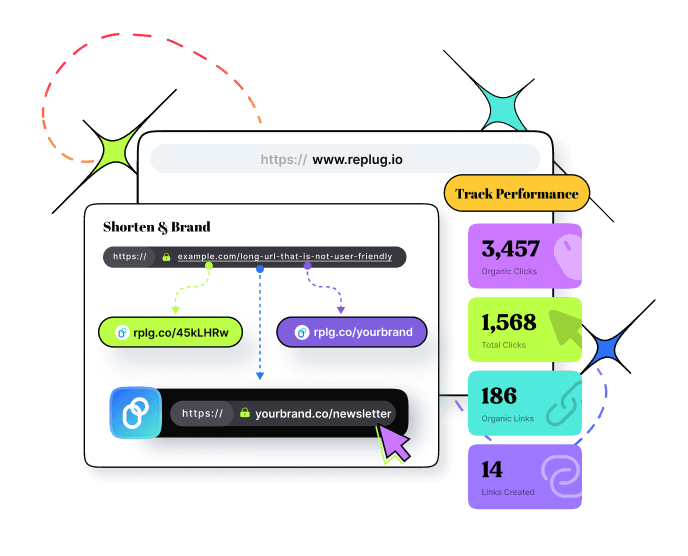
    Affiliate links

    One popular link shortener is Replug.io, which not only makes your links appear more professional and trustworthy but also provides valuable analytics and tracking capabilities.

    Here are some other major advantages of using an Amazon link shortener;

    • Cross-platform consistency: Branded link shorteners allow you to maintain consistent branding across different platforms and channels.
    • Aesthetic appeal: Shortened and branded links are often more appealing to users, leading to higher click-through rates compared to long, complex URLs. This can result in increased Amazon sales and traffic to your affiliate products.
    • Easy management: Using a branded link shortener centralizes the management of your affiliate links. You can easily edit, update, or redirect links as needed without having to change the URLs embedded in your content, saving time and effort.
    • Commission protection: Masking your affiliate links helps protect your commissions from link manipulation or hijacking.

    Also Read: A Quick Guide on Affiliate Decloaking 

    5. Win back customers with multi-channel retargeting

    While Amazon offers a massive audience, relying solely on it can limit your earning potential. To expand your reach effectively, strategically place advertisements on social media, search engines, email newsletters, and other platforms where your target demographic is active.
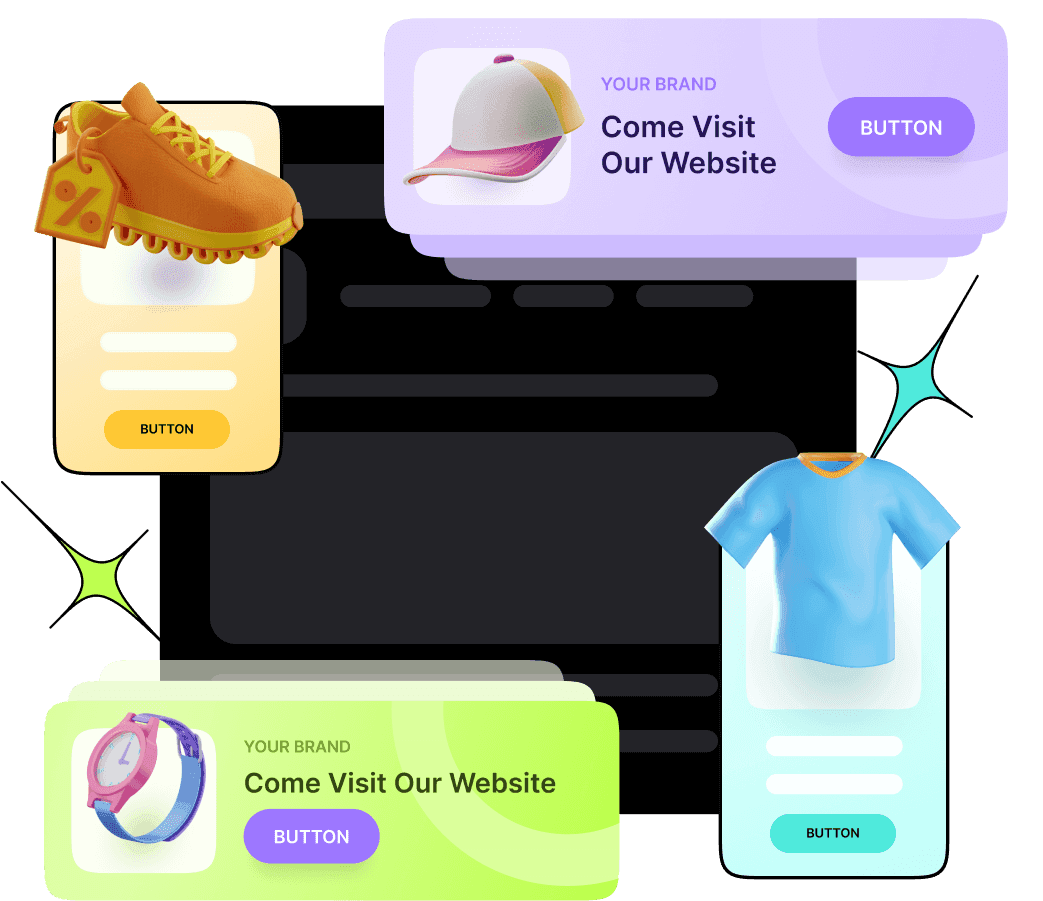
    multi-channel retargeting

    A highly effective approach involves incorporating retargeting pixels. Retargeting is a significant move for the retailers to bring the customers towards your website repeatedly. Use retargeting ads on platforms like Facebook and Instagram to re-engage potential customers who have shown interest in your products.

    Pro tip: Sellers! Don’t let valuable audience data slip through your fingers. Go beyond basic retargeting by utilizing demographic and interest-based targeting options.

    6. Get more positive reviews

    Did you know that over 95% of online shoppers read reviews before deciding to buy something? On Amazon, having lots of positive reviews not only boosts your product’s search visibility with their A10 algorithm but also enhances its perceived quality.

    Customers are often willing to pay more for products that have received good reviews. After your product has been delivered and they’ve had a chance to use it, sending a follow-up email asking for a review can be really effective.

    If they haven’t left a review after your first request, a friendly reminder a week or two later can often nudge them to share their thoughts. It’s a great way to build trust and attract more buyers to your listing.

    7. Win the Buy Box

    The Buy Box is prime real estate on Amazon, and securing it translates to increased Amazon sales and brand visibility.  To become the top contender, optimize your product listings with high-quality images, detailed descriptions, and relevant keywords.

    Additionally, prioritize account health by maintaining a competitive price, exceptional fulfillment speed, and a stellar customer service record.

    8. Provide excellent customer service

    Excellent customer service

    Prioritize providing prompt, helpful, and friendly customer service to build trust and loyalty.  Respond to inquiries quickly and efficiently, address issues with empathy and understanding, and go the extra mile to exceed expectations.

    Positive customer experiences translate to positive reviews, which can further strengthen your Buy Box position.

    9. Make sure you have a competitive pricing strategy.

    Start by analyzing the prices of similar products, identifying your main competitors, and understanding the average price range in the market.

    Setting your price too low might make customers question the quality, while pricing too high could discourage potential buyers. Set competitive yet profitable prices that attract buyers while considering factors like shipping costs and Amazon fees.

    You can use tools like Amazon’s pricing analytics or third-party options such as Helium 10’s Market Tracker and Insights Dashboard.

    Another option is to automate your pricing strategy with tools like RepricerExpress or Feedvisor, which can help you stay competitive and save time.

    10. Outsource your tasks

    Start by identifying tasks that can be outsourced. Common tasks for Amazon sellers to outsource include

    • Customer service
    • Product photography
    • Order processing
    • Product Listing
    • Inventory management
    • Marketing campaigns
    • Complete store management

    Choose reliable partners or freelancers with expertise in Amazon operations to streamline processes, improve efficiency, and maintain a high level of service and productivity.

    11. Test campaigns, ads, images, etc.

    Testing campaigns, advertisements, product images, and descriptions on Amazon allows you to optimize performance and identify what resonates best with your target audience.
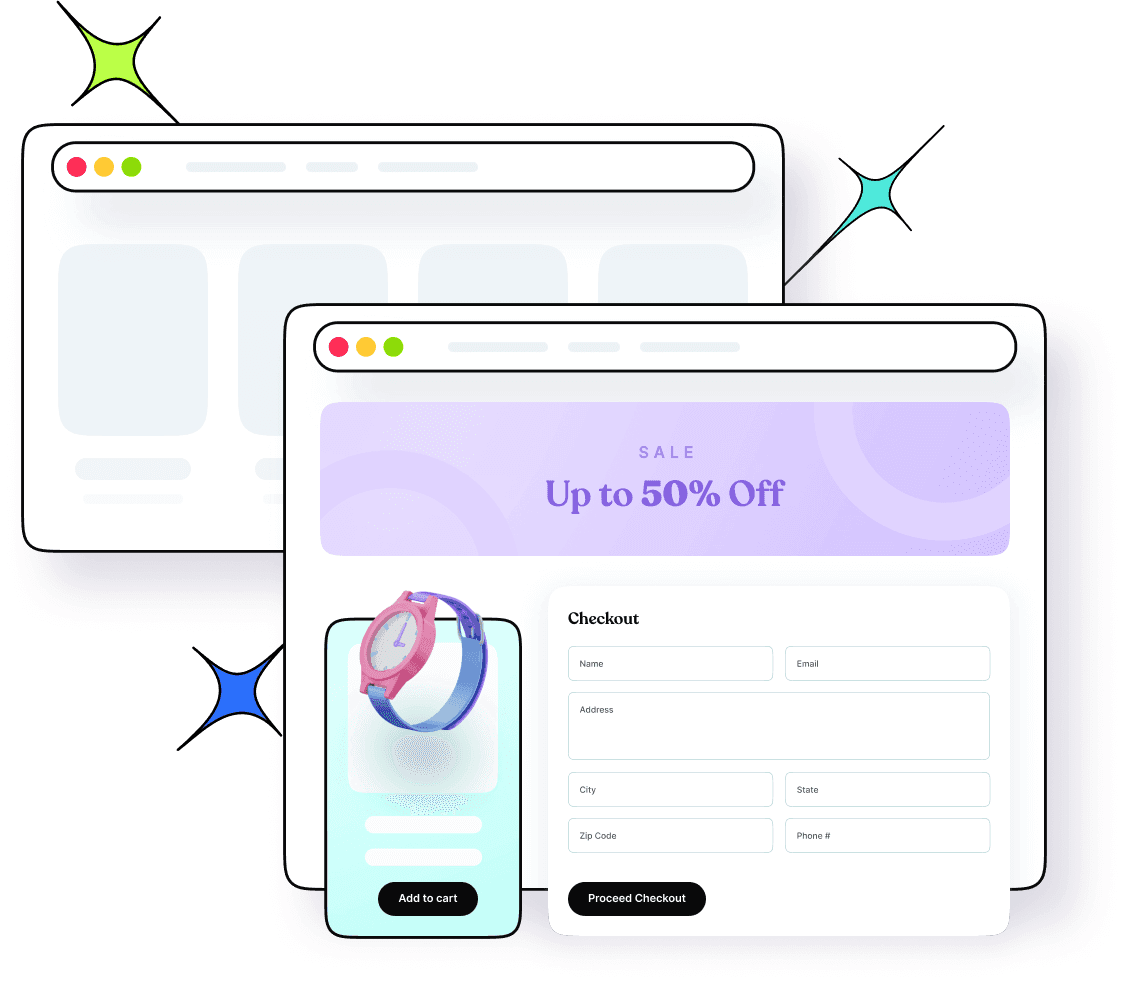
    A/B test product pages, images and more

    Conduct A/B testing to compare different elements and strategies, such as ad copy variations, image styles, and campaign settings, to improve engagement, click-through rates, and ultimately, conversion rates.

    12. Offer multiple payment methods

    By catering to a wider range of payment preferences, you remove potential barriers to purchase and encourage more customers to complete transactions.

    Accept all major credit and debit cards like Visa (including the Amazon Rewards Visa Signature Card), Mastercard/EuroCard, Discover Network, American Express, JCB, and China UnionPay (credit card only).

    Also Read: How to increase online sales: 17 Proven tips & hacks

    13. Track your performance and analyze data

    Regularly monitor your Amazon Seller Central account to track your sales performance, identify top-selling products, and analyze amazon customer reviews. Utilize the data to identify areas for improvement and optimize your strategies for better results.
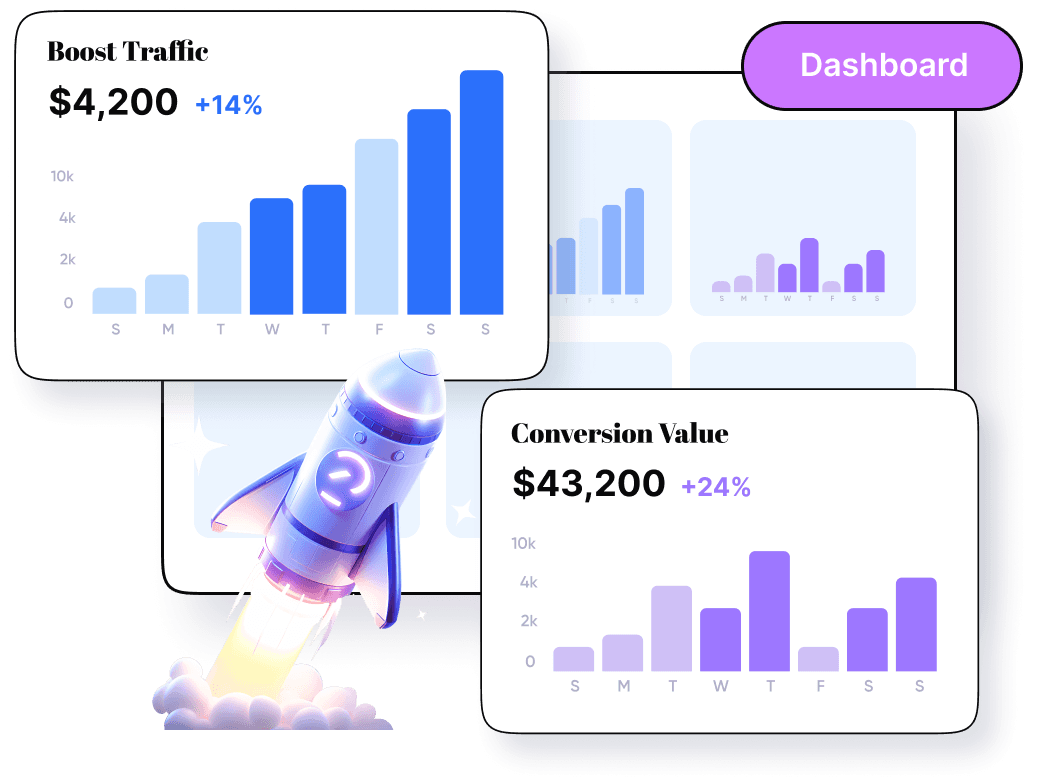
    Analytics

    Key customer metrics to track:

    MetricsDescription
    Sales performanceTotal revenue generated over specific periods (daily, weekly, monthly) to assess growth trends.
    Conversion ratePercentage of visitors who make a purchase, indicating listing effectiveness and customer interest.
    Customer lifetime value (CLV)Projected revenue from a customer over their entire relationship with your business.
    Average order value (AOV)The average amount spent per customer order, guiding pricing, and promotion strategies.
    Conversion ratePercentage of visitors who make a purchase, indicating listing effectiveness and customer interest.
    Advertising performanceMetrics like CTR, CPC, and ROAS to evaluate ad effectiveness and return on investment.
    Buy Box percentagePercentage of time your product wins the Buy Box, impacting visibility and sales.
    Return ratePercentage of orders returned, indicating product quality and customer satisfaction.
    Inventory levelsMonitoring stock levels and avoiding stock-outs to maintain sales continuity.

    You may also likeAffiliate Link Tracking To Optimize Your Earnings

    14. Engaging with Amazon live

    Show off your products in real time, answer customer questions live, and build a connection with viewers.

    Demonstrate your products in action, offer exclusive deals during your live stream, and run fun polls or quizzes to keep people engaged. Limited-time offers or free gifts with purchases can create a sense of urgency and encourage customers to take action.

    Besides that, this is a fantastic way to put a face to your brand and connect with potential customers on a personal level. You can even partner with relevant Amazon Live personalities to reach a wider audience.

    Also Read: How to Create Affiliate Links and Keep Track of Affiliate Results?

    • Offer discounts: If you want to increase sales, then offering discounts is a very effective strategy to draw customers into your stores.
    • Competitor analysis: It’s imperative to analyze your competitors. Before offering a product or service to the target market, you need to find the gaps in the competitor’s marketing strategies and try to fill up.
    • Stay up-to-date with Amazon policy changes: Amazon’s policies and procedures can change frequently. Stay informed by regularly reviewing Amazon Seller Central announcements and updates to ensure you’re adhering to the latest guidelines.
    • Boost Amazon sales by incorporating bio links: Increase Amazon sales using bio links in your social media profiles, directing traffic to your product listings. Leverage platforms like Instagram and TikTok to engage followers with compelling content and seamless access to purchase options through these links.

    Conclusion:

    Remember, success on Amazon is not a one-time achievement but an ongoing journey of adaptation and optimization.

    Stay tuned in to policy updates, keep an eye on how you’re doing, and always be ready to tweak your approach based on what the data tells you.

    With each step, you’ll navigate Amazon’s ever-changing terrain with a sense of assurance and purpose.

    FAQs on increasing sales on Amazon

    How can I improve my product’s visibility on Amazon?

    To improve product visibility on Amazon, focus on keyword optimization, high-quality images, compelling product descriptions, and utilizing Amazon advertising options.

    What strategies can I use to win the Buy Box?

    Winning the Amazon buy box requires competitive pricing, positive seller feedback, fast shipping, and maintaining stock availability.

    How do I effectively manage pricing to stay competitive on Amazon?

    Manage pricing effectively by utilizing repricing tools, monitoring competitors’ prices, offering competitive pricing, and adjusting prices strategically based on demand and market trends.

    What are the benefits of using Fulfillment by Amazon (FBA)?

    Fulfillment by Amazon (FBA) streamlines order fulfillment, storage, shipping, and customer service, thus saving time.
  • White label vs Private label: Which to choose?

    White label vs Private label: Which to choose?

    Ready to launch your own brand, But short on time? 

    We’ve got you covered with two great options: white labeling and private labeling. Both can help your brand grow in unique ways, but which one is the right fit for you?

    In this blog, we’ll break down everything you need to know about white label vs. private label. We’ll explore their similarities, drawbacks, benefits, and real-world examples. 

    By the end, you’ll have a clear understanding of which strategy will help your brand thrive. Let’s get started!

    What is white labeling?

    White labeling means rebranding products or services developed by another company and selling them under your company’s name.

    You’ve probably come across many white-labeled products without even knowing it because they were rebranded so smoothly. This makes it hard for most people to tell the difference.

    White labeling is common in many industries, like food and beverages, electronics, and software. It helps businesses expand their product lines without needing to invest in research, development, or manufacturing.

    Here are a few examples:

    White-label example no.1: Replug – A SaaS white-label solution

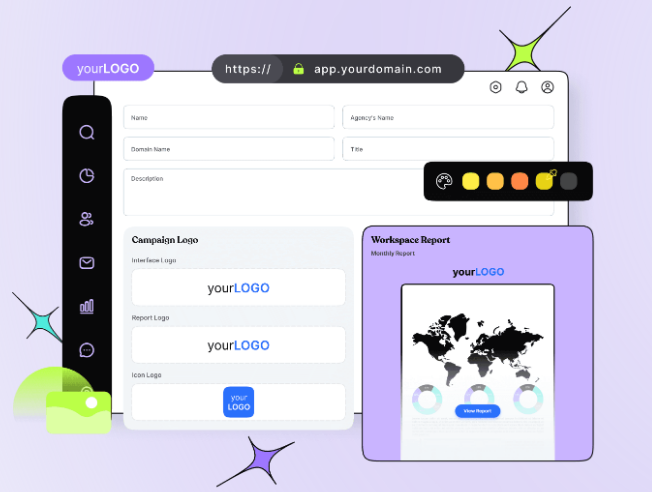
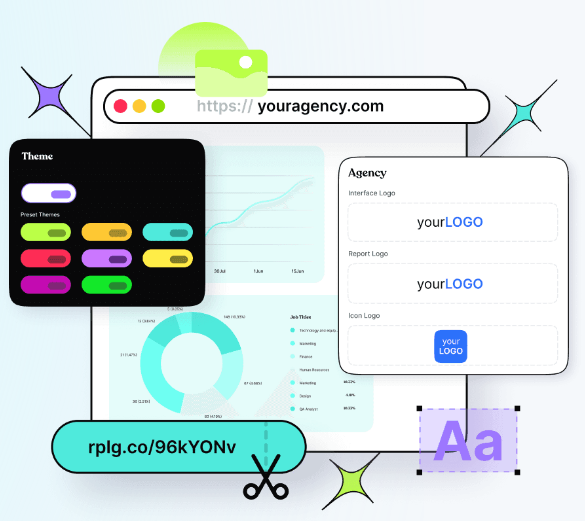
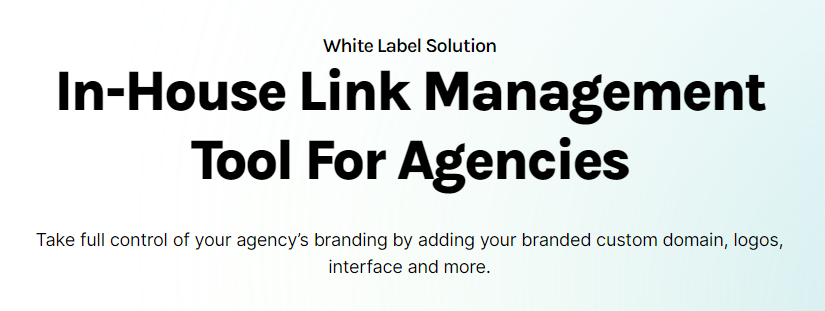
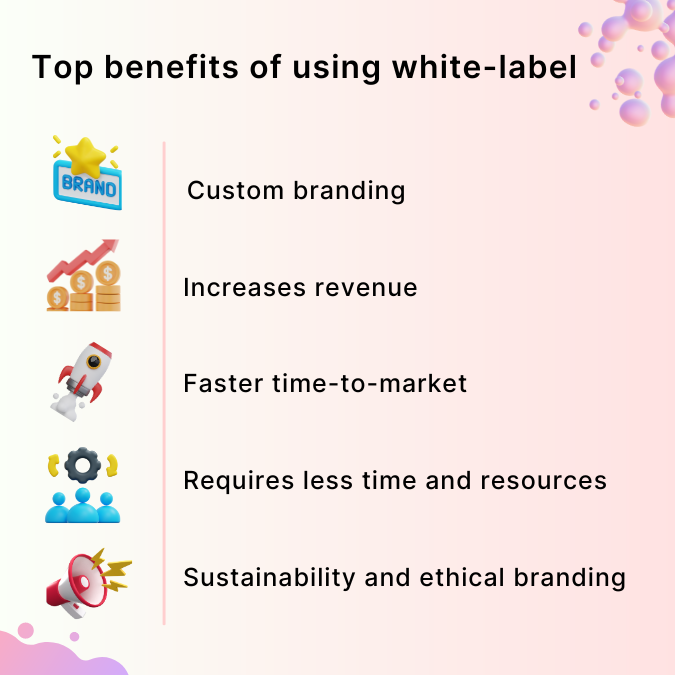
    One perfect example of white-label solution is Replug. It’s a powerful link management tool packed with advanced features. With Replug.io, you can fully customize the dashboard with your brand’s colors, favicons, and logos, making it feel like your own.

    White label solution: Replug

    Replug is an efficient link shortener that offers fantastic link management features, like retargeting pixels, bio-links, deep links, and the ability to create custom CTAs. This is a classic example of white labeling, ideal for businesses looking to boost their marketing while keeping everything aligned with their brand.

    Replug Branded Short Links CTA
    A complete link management solution
    for marketing professionals & agencies.
    Try Replug for free

    White-label example no. 02: Printful

    White label example: Printful

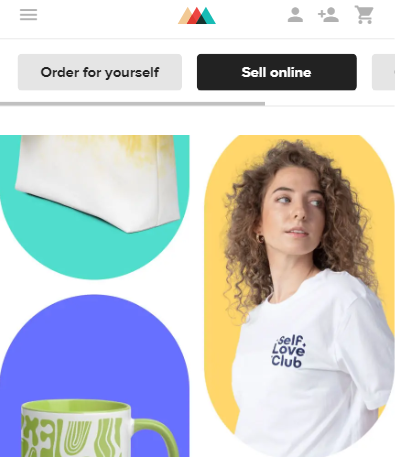
    Printful is a print-on-demand company that lets businesses create and sell custom products like t-shirts, posters, and accessories without dealing with inventory or production. Companies can design their own graphics and logos, which Printful prints and ships under the company’s brand. This allows businesses to offer customized products easily and quickly without needing their own manufacturing facilities.

    White-Label example no.03: Printify

    Printify is a print-on-demand platform. It allows users to design and sell custom products online without needing to maintain an inventory. Printify connects its users with a vast network of print providers worldwide, offering a wide range of custom-printed products. Printify plays a significant role in the white-label market, particularly in the print-on-demand (POD) space. Through Printify, businesses can create white-label products like custom apparel, accessories, home goods, and more. Users can integrate Printify with major e-commerce platforms like Shopify, Etsy, WooCommerce, and others, making it easy to automate the sales and fulfillment process.

    Top benefits of white labeling

    Until now, you must have understood that white-label products are pre-manufactured items for you that are completely ready to be shipped with your brand logo. Here are some of the most prominent benefits of white-labeling. 

    • Lower initial investment: White label products are often cheaper than private label because you’re not customizing them from scratch.
    • Faster turnaround time: Since the product already exists, you can get it to market quickly.
    • Less risk: You don’t have to worry about the product failing to meet quality standards or market demands.
    • Scalability: Easy to scale up or down production based on demand.

    Read more: 14 Best white label marketing tools for agencies in 2026

    Drawbacks of white labeling

    Now that you have gone through the similarities, it’s time to go through the drawbacks.

    • No customization: The product itself is typically not customized for each purchaser; it remains the same for all buyers.
    • Brand differentiation: Your product might be similar to offerings from other brands.
    • Profit margins: Profit margins can be lower due to competition from other white-labeled versions.

    What is private labeling?

    Private labeling is a business strategy where a retailer or company contracts with a manufacturer to produce a product under their own brand name. The retailer essentially “outsources” the manufacturing process while controlling the branding and marketing of the final product.

    Private label example no 01: Heyday

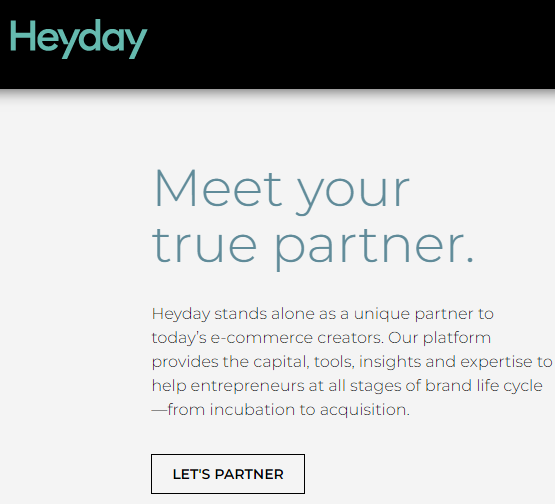
    Private label example Heyday

    Heyday, a brand specializing in consumer electronics, follows this model. Although they don’t handle manufacturing directly, they supervise the process and affix their label to top-quality electronics manufactured by partnering companies. This allows them to offer customers products that reflect their brand identity.

    Private label example no. 02: Stone & Beam

    Private label example Stone & Beam

    It’s one of the most successful private-label brands. Stone & Beam, known for its furniture line, utilizes private labeling. They partner with manufacturers to produce furniture items under their brand name. By overseeing manufacturing standards and design elements, they ensure that the products meet their quality standards and resonate with their customers.

    Benefits of private labeling

    White label vs Private label
    • Be your own brand boss:  From product to packaging, make it all your own. Partner with a trusted packaging labels manufacturer to give your customers a brand experience they’ll remember!
    • More profit for you: Private labeling often allows for more control over production costs. By bypassing some middlemen, you can potentially increase your profit margins compared to selling established brands.
    • Customer loyalty: Create products people love under your brand. Watch them come back for more! Use a product roadmap tool to plan future releases and improvements, keeping your customers engaged and excited.
    • Solve specific needs: See a gap in the market? Private labeling lets you create the perfect product to fill it!

    Drawbacks of private labeling

    • Higher costs: Development and minimum order quantities can be expensive.

    Helpful tip

    “We would advise you to get quotes from multiple manufacturers and negotiate for the best price based on volume and order frequency.”

    • Longer lead time: Customization takes time, delaying product launch.
    • Minimum order quantities: Manufacturers often have minimum order quantities (MOQs) for private-label products. This can be a barrier for smaller businesses starting out.
    • Risk of failure: If the product doesn’t resonate with consumers, you’re stuck with it.

    However, keep in mind that just because a product has your label doesn’t mean customers will automatically recognize it. You’ll still need to invest in marketing and building brand awareness for your private-label line.

    Similarities between white label vs private label

    SimiliarityDescription
    Product originBoth utilize a product manufactured by a third party.
    Branding controlThe retailer or company has complete control over the branding, including logo, packaging, and marketing materials.
    Sales and distributionThe retailer or company is responsible for selling and distributing the final product through their own channels.
    Replug Branded Short Links CTA
    A complete link management solution
    for marketing professionals & agencies.
    Try Replug for free

    Difference between white label vs private label

    DifferencesWhite-labelPrivate-label 
    Level of customizationLower Higher 
    Branding focusGeneric (may have minimal branding options)Strong focus on creating a unique brand identity
    Product developmentLittle to no control over product developmentMore involvement in product development, potentially including formula tweaks or feature adjustments
    Minimum order quantities (MOQs)Typically lowerMay have higher minimum order quantities due to the potential for more customization
    Cost Generally lowerGenerally higher

    When to choose the white label or private label?

    In white label vs private label, the best option for you depends on your business goals and resources. Here’s a quick guide:

    • Choose white label if: You need a product quickly, like a custom hat, have limited resources, and want to test the market before investing heavily in branding.
    • Choose a private label if: You have a clear brand vision, want a unique product offering, and are willing to invest time and money upfront.

    Ultimately, both white-label vs private-label strategies can be successful. You can choose the path that propels your business forward by carefully considering your needs and limitations.

    FAQs on white-label

    What is white label vs private label?

    Both white-label and private label involve customizing a pre-made product, but white-label offers less customization (think generic packaging with your logo)  while private label gives you more control over design and features (like a store-brand cereal with a unique recipe).

    Is private labels cheaper than national brands? 

    Private-label products can be cheaper for retailers to purchase, which can translate to lower prices for consumers. However, only sometimes.

    What are some examples of white-label products?

    White-label products can be anything from clothing and electronics to software and supplements.

    Is private labeling a good business strategy? 

    Private labeling can be a good strategy for businesses looking to build brand loyalty and higher profit margins. However, it requires careful planning and execution.

  • 14 Best white label marketing tools for agencies in 2026

    14 Best white label marketing tools for agencies in 2026

    White-label marketing tools cover a wide range of needs, each with its own specialty—whether it’s custom branding, social media management, SEO, or CMS services. 

    That’s why we’ve put together this guide to simplify your selection process. 

    Stick with us as we break down the options and help you find the perfect fit for your needs.

    What is a white-label tool?

    A white-label tool is a pre-built software application or service that can be customized with your own branding elements.

    Here’s a breakdown of the concept:

    The core product: A developer creates a software tool with all the essential features but without any specific branding.

    Customization: You, the business owner, purchase this tool and personalize it with your brand identity. This could include:

    • Adding your logo and color scheme.
    • Modifying the user interface (UI) elements to match your brand style.
    • Customizing the content and messaging within the tool.
    • And much more…

    The final product: You then offer the white-labeled tool to your customers or clients under your own brand name. This way they got a branded experience as if the tool was built specifically by your company.

    Related: All about white label & why it can be a game changer for you!

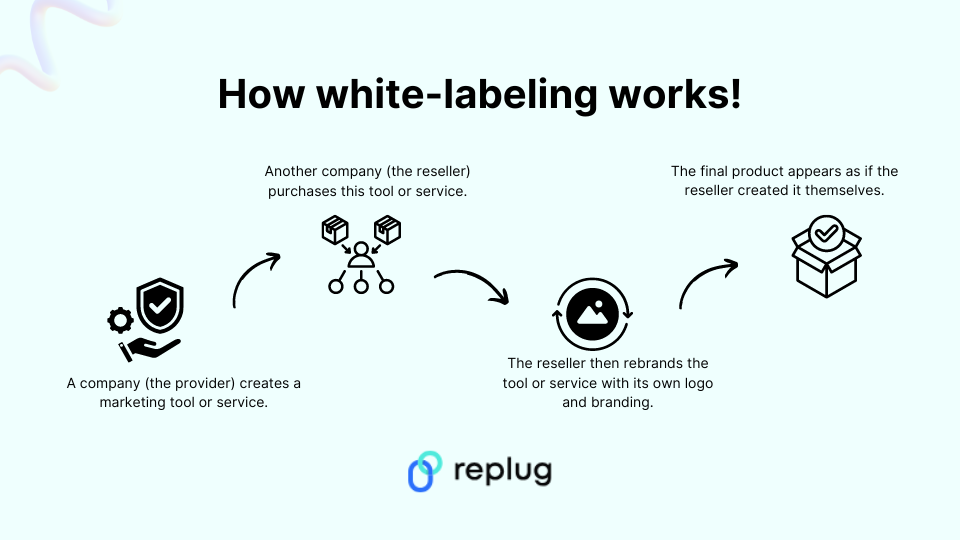
    How does white-labeling work in business?

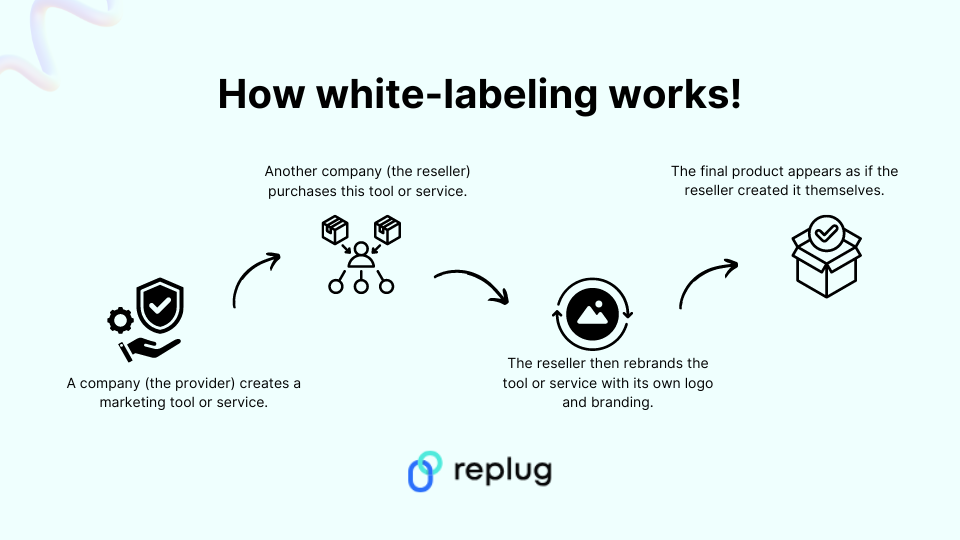
    How white labeling works

    White labeling can be applied to various aspects of a business. Some of the common include the following:

    CategoryDescription
    SoftwareSoftware companies can white-label software applications and resell them as their own. This allows them to offer branded solutions without the cost and time investment of developing software from scratch.
    Marketing toolsMarketing and other types of agencies can white-label email marketing platforms, link management tools, or social media management tools to offer these services to their clients under their own brand.
    WebsitesWebsite builders can provide white-label solutions, allowing clients to create custom websites without any branding from the builder.

    14 best SAAS white-label tools for agencies

    1. Replug – White-label link management tool

    At the top of our list is Replug, an all-in-one link management tool packed with advanced branding features. With Replug’s white-labeling, you can customize everything to match your brand—from logos and favicons to titles, meta images, descriptions, agency names, domains, branded reports, and emails.

    Replug - Custom branding tool

    Replug makes it easy to generate optimized short URLs and unique slugs that represent your brand perfectly. You can also track click-through and conversion rates to see how well your links are performing.

    Need to shorten a lot of links at once? No problem—Replug lets you import files for bulk link shortening. Plus, you can turn visitors into customers by adding retargeting pixels to your links or creating branded microsites for your clients using the bio link feature.

    White-label

    Safety is a top priority for Replug. The platform scans and checks links in real time, blocks malicious URLs and uses phishing detection algorithms to keep everything secure. The best part? Replug offers affordable and scalable pricing, so it can grow with your brand or agency’s needs.

    Here’s what you get with the Replug white-label solution:

    • URL shortening 
    • White-label dashboards
    • Link rotator
    • QR codes
    • SMS links
    • Custom CTA’s
    • Deep links 
    • Bio-links
    • Link analytics
    • Retargeting pixels

    Pricing of Replug

    Replug’s pricing is both affordable and flexible, allowing you to scale your plan as your brand or agency grows. The white-label pricing plans start at $79 per month (with a free trial) and include a host of advanced features. 

    Replug Branded Short Links CTA
    Maximize marketing ROI
    by transforming ordinary URLs into
    branded short links that convert.
    Try Replug for free

    2. Short.io – White-label domain

    Short.io is a user-friendly tool that helps you create branded short links, making long URLs shorter and easier to share. It’s perfect for social media, emails, and text messages.

    While it doesn’t offer a white-label dashboard like Replug, you can still white-label your links with your custom domain. Additionally, you can track clicks and user behavior on your links, providing valuable insights for your marketing campaigns and website optimization efforts.

    Pricing of ShortIo

    Regarding its pricing, there’s no specific mention of white-label links, although the platform does reference this on the homepage. Most of the tool’s advanced features are included in the enterprise plan, which costs $148 per month.

    3. ContentStudio – White-label social media software

    ContentStudio is your go-to solution for managing social media effectively. It helps you discover trending topics and curate engaging content to keep your audience glued.

    ContentStudio- Social media white label tool

    Besides that measure metrics such as total engagement, audience growth, top-performing posts, and many more.

    One of its standout features is the ability to white-label files or reports. This white-labeling feature is beneficial because it allows you to present your content as if it were created entirely by your own team, strengthening brand recognition and creating a smooth user experience.

    These white-label reports are like tailor-made suits, perfectly fitting the needs and preferences of every client.

    Other popular features:

    • Content planning
    • Content curation
    • Influencer search
    • Content discovery
    • AI caption generator
    • Content automation
    • RSS feed reader
    • Content calendar

    Pricing of ContentStudio

    The tool offers three different pricing plans. The mid-tier plan starts at $49 per month and includes white-label reports along with many other advanced features.

    Related: How to Measure Social Media Engagement: 12 Crucial Metrics

    4. SE Ranking – White-label SEO tool

    SE Ranking offers a self-hosted, white-label, cloud-based tool, along with a customized, performance-based invoicing platform that easily integrates into your service offerings.

    SE Ranking - SEO tool

    With SE Ranking, you can automate reporting, create comprehensive marketing plans, check keyword rankings, monitor backlinks, and much more. The platform is user-friendly and serves as your ultimate support for excelling in search engine results pages (SERPs).

    The white-label services allow you to make the platform uniquely yours by configuring your personalized domain name and removing any references to SE Ranking. Impress your clients with professional, branded SEO reports that can be automatically sent from your corporate email or manually dispatched as needed.

    Pricing of SE Ranking

    The platform currently offers three pricing plans, with white-label services available starting from the Pro plan at $109.00 per month.

    You may also like: How to create an SEO-friendly URL: Ultimate tips

    5. HubSpot – White-label email marketing software

    Say goodbye to generic email marketing campaigns and hello to personalized, engaging content that drives results. HubSpot marketing automation platform puts the power of automation and analytics at your fingertips, allowing you to deliver the right message to the right person at the right time.
    Hubspot

    The platform allows you to fully white-label their product, replacing their branding with your own or your client’s logo across the platform, including the interface, email campaigns, notifications, and reports.

    With automated white-label email campaigns featuring personalized messaging, you can guide prospects toward conversion, nurturing them through the purchasing process until they’re ready to buy. This is particularly advantageous for B2B businesses with extended sales cycles.

    Pricing of Hubspot

    Starts from $45/user/month if billed annually for small to medium-sized businesses. 

    Related: How to track emails using UTM parameters?

    6. DashThis- White-label project management software

    DashThis is a marketing reporting tool designed to simplify creating data visualizations and reports. It excels at combining data from various sources like SEO, social media, and analytics platforms into a single, informative dashboard.

    The white-label feature allows you to remove all references to DashThis and customize your analytics dashboards to reflect your own branding effortlessly. Additionally, you can start with preset report templates that include all the essential KPIs.

    Pricing of DashThis

    Dash offers up to four pricing plans, starting at just $149/month for the complete white-label dashboard. You can upgrade your plan as needed.

    You may also like: A Complete Guide to Building a Brand Marketing Strategy

    7. Domo – White-label reporting tool

    Domo’s advanced analytics and visualization capabilities give you the tools you need to uncover insights, spot trends, and make smarter decisions.

    Domo

    Besides that domo ensures your client’s data remains secure within their environment while still allowing for comprehensive analysis. With its white label, you can completely customize the look and feel of the analytics reports platform to match your brand.

    Pricing of Domo

    To obtain pricing information, please contact the platform’s sales team.

    8. WordPress – White-label CMS Tool

    WordPress offers a white-label option ideal for agencies and web developers who build websites for clients. Building a professional website doesn’t have to be complicated. With WordPress, you can create a stunning online presence that reflects your brand identity and engages your audience.

    Remove all WordPress branding from the admin panel and public-facing website. This make sure your client’s brand takes center stage, fostering a professional image.

    Pricing of WordPress

    The platform offers various pricing plans and provides custom quotes for large enterprises. For more details, we recommend visiting the website.

    You may also like: How to Create Highly Shareable Content?

    9. Drupal – White-label CMS Tool

    Need a CMS service that can handle complex websites and digital experiences? Look no further than Drupal. Drupal is a free and open-source content management system (CMS) used by millions to build and manage websites.

    Drupal- White label CMS

    It allows users to personalize their profiles with their logo and preferred color scheme. It then automatically adds a white-label token to all outgoing URLs, ensuring email links and other links direct recipients to the user’s custom-branded website.

    Pricing of Drupal

    The basic Drupal modules are free, but there are no pricing details on the Drupal website. We recommend contacting the customer support team for specific information about your needs.

    You may also like: Online Branding: The Roadmap to Stand Out and Succeed Online

    10. Asana – White-label project management software

    Create dedicated workspaces for each client, allowing you to organize projects, tasks, and communication under a specific client brand. While full white labeling isn’t available, you can utilize custom fields and integrations to incorporate your agency’s branding within the Asana interface. Or provide clients with a streamlined view of their projects without exposing them to the full Asana platform. This can be achieved through custom integrations or dedicated dashboards.

    Pricing of Asana

    The platform offers pricing plans for individuals, small teams, and large teams. Custom branding features are available starting from the advanced pricing plan at $24.99.

    Related: Abandoned Cart Email Examples & Tips That Actually Convert

    11. Invoice Ninja- White-label payment platform

    Invoice Ninja is a free invoicing and expense management software ideal for freelancers and small businesses.  It simplifies sending professional invoices, tracking time and projects, and managing client communication.  With its user-friendly interface, you can create branded invoices, accept online payments, and automate recurring bills.  

     Plus, for a professional touch, Invoice Ninja offers a white-label option that removes their branding, allowing you to completely customize the software with your own logo and colors.

    Pricing of Invoice Ninja

    Invoice Ninja doesn’t list the white-label pricing on their main pricing page, but the enterprise plan allows you to remove platform branding for $16 per month.

    12. DashClicks – CRM

    Scale your business and automate your marketing efforts with DashClicks. Its white-label CRM and marketing automation solutions help you to manage leads, strengthen relationships, and track ROI – all from one intuitive platform.

    Pricing of DashClicks 

    There are no such details mentioned about pricing on the website.

    You may also like: Replug click analytics: Turn clicks into conversions

    13. Simvoly – Website building tool

    Create stunning websites and online stores without writing a single line of code with Simvoly. Its drag-and-drop builder and white-label options make it easy to bring your vision to life and showcase your brand to the world. 

    Whether you’re a freelancer, agency, or entrepreneur, Simvoly gives you the tools you need to succeed online.

    Pricing of Simvoly 

    Starts from $59/month and goes up to $199/month

    14. BlockSurvey – White-label survey tool

    BlockSurvey is a privacy-focused survey tool that offers full white-label capabilities, making it ideal for businesses and agencies that prioritize data security. BlockSurvey ensures that your surveys are completely anonymous and encrypted, providing an additional layer of trust for your clients.

    Pricing of BlockSurvey

    BlockSurvey’s pricing is flexible, with a white-label option available with a team plan starting at $55 per month. It’s an affordable solution for agencies looking to provide branded, secure surveys to their clients without sacrificing data privacy.

    10 Things to look for in your white label tool 

    Replug Branded Short Links CTA
    A complete link management solution
    for marketing professionals & agencies.
    Try Replug for free

    When choosing a SaaS white-label tool, it’s important to consider some of the following factors:

    1. Branding

    Can you easily add your logo, color scheme, and fonts throughout the tool? Does it allow customization of login screens, email templates, and other branding elements?

    2. Custom functionalities 

    Does the tool offer the level of control you need to tailor features and functionalities specific to your client’s needs? Can you disable unused features or create custom user roles?

    3. Existing systems

    Does the white-label tool integrate with your existing CRM, marketing automation platform, or other software you use?

    4. Data security

    How does the white-label provider ensure the security of your client data? Look for features like data encryption, access controls, and compliance with relevant security standards.

    5. Uptime and reliability

    Is the white-label tool hosted on a reliable platform with a high uptime guarantee? Ensure minimal downtime to avoid disruptions for your clients.

    6. Scalability

    Can the tool handle your growing client base and data volume? Choose a solution that scales with your business needs.

    7. Support

    Does the white-label provider offer adequate technical support to address any issues you or your clients encounter? Consider the availability and response times of their support team.

    8. Pricing

    Review the pricing structure of the white-label tool. Does it offer a model that aligns with your budget and client pricing strategies (e.g., per-user, tiered pricing)?

    9. Ease of use

    Is the white-labeled tool user-friendly for both you and your clients? Look for intuitive interfaces and available training resources.

    10. Free trial or demo

    Many white-label tool providers offer free trials or demos. Take advantage of these to assess the tool’s functionality and user experience before committing.

    By carefully considering these factors, you can select a white-label SaaS tool that empowers your business to offer exceptional branded solutions to your clients while streamlining your operations and ensuring a positive user experience.

    Related: Top 29 personal branding tools to upscale your marketing efforts

    Conclusion

    Remember, the ideal white-label tool allows you to deliver exceptional branded solutions to clients, streamline operations, and ensure a positive user experience. By carefully considering the factors outlined in this guide, you can make an informed decision that propels your agency’s success.

    FAQs on White-label tools

    I’m concerned about data security with white-label tools. What should I look for?

    Data security is crucial. When choosing a white-label tool, ensure they offer features like data encryption, access controls, and compliance with relevant security standards. Don’t hesitate to inquire about their data security protocols to ensure your clients’ information remains protected.

    What are some popular white-label marketing tools for social media management?

    The guide highlights two excellent options: PromoRepublic and ContentStudio. Both offer advanced collaboration features and customizable white-labeling, allowing you to seamlessly manage social media for your clients under your own brand.

    Can I use white-label tools for email marketing as well?

    Absolutely! The guide explores two popular choices – HubSpot and Brevo. While HubSpot offers full white-labeling, Brevo focuses on user-friendly campaign creation and tracking with white-labeling capabilities. Consider your specific needs and budget when choosing an email marketing tool.

  • How to incruse a link retargeting tool like Replug – it allows you to creease online sales: 17 Proven tips & hacks

    How to incruse a link retargeting tool like Replug – it allows you to creease online sales: 17 Proven tips & hacks

    Ever wondered why everybody wants to increase online sales fast?

    Obviously, more sales means more revenue, and more revenue means you become richer.


    Platforms like Meta, Amazon, Google Ads and Shopify, to name a few, provide a variety of tools and features designed to increase online sales. These platforms have massively contributed to the growth and success of businesses by enhancing customer engagement, streamlining operations, and optimizing marketing strategies.

    This not only shows how boosting online sales have gradually, but surely, become the backbone of almost all businesses. This surge in online sales has a huge impact on global online sales as well. Statista reports that global eCommerce sales revenue is expected to grow at a CAGR rate of 9.47% (2024-2029).

    If you are struggling to turn those website visits into actual sales?

    Fear not, fellow marketers! This guide is your cheat sheet to increase your online sales game. Let’s keep going.

    17 amazing tips to increase online sales

    We have compiled 17 tips with pro hacks that can help multiply your sales and some can even save the costs for your business as well.

    1. Target the right audience

    The first and most important tip is to target the right audience. You can conduct thorough market research to identify your ideal customer’s demographics, preferences, and pain points. Tailor your marketing efforts to resonate with their needs and interests, increasing the likelihood of conversion.

    2. Stay ahead with advanced SEO strategies

    Organic traffic is gold. Stay ahead of the curve with advanced SEO strategies to ensure your website ranks high in search engine results pages (SERPs). Focus on keyword research, on-page optimization, and high-quality content creation to improve your website’s visibility.

    Good SEO Increase online sales

    With the majority of online traffic coming from mobile devices, optimizing your website or app for mobile responsiveness is non-negotiable. Make sure your website has fast loading times and intuitive user interfaces across all devices. A mobile-friendly experience enhances user satisfaction and encourages mobile shoppers to complete their purchases.

    Pro hack: Optimize website navigation for easy access to products and information, allowing a smooth and intuitive browsing experience that keeps customers engaged.

    3. Utilize user-generated content more often

    Encourage satisfied customers to share their experiences through reviews, testimonials, and social media posts. UGC serves as authentic endorsements of your products or services, influencing potential buyers’ purchasing decisions to increase online sales.

    4. Use high-quality visuals and themes

    appealing themes to boost online sales

    Invest in high-quality imagery, videos, and graphics that showcase your products or services in the best light. Make the best of tools for seamless AI video generation to create engaging, professional-quality videos quickly and efficiently. Ensure your website design and branding elements align with your target audience’s preferences, creating a visually appealing and cohesive online presence.

    5. Run online ads

    If you are not running ads in this digital era, then don’t expect to increase online sales.

    Online ads are like direct bridges to reach potential customers, instantly enhancing brand visibility. Compared to many other marketing methods, running online ads is remarkably faster. Through precise targeting based on demographics and online behavior, ads ensure reaching the most relevant audience.

    Moreover, you can simply use these statistics to tailor your next campaign to target them. Since the data you receive is in real-time, there’s a higher probability of achieving high social media engagement.

    6. Set up killer social media campaigns

    Map out, design, and set up visually appealing posts tailored for specific platforms and suggested posting times. To simplify this process, use automation tools to schedule posts, monitor their effectiveness, and optimize your social media workflow for greater efficiency.

    ContentStudio social media management platform

    We would suggest you consider ContentStudio, a comprehensive social media tool designed for agencies, brands, and marketers. With its user-friendly interface and powerful features agencies, brands, and marketers can stay organized and accomplish more in less time, streamlining social media management tasks.

    7. Deliver exceptional customer support every time

    Providing exceptional customer support is essential for long-term relationships and driving repeat business. Positive experiences lead to satisfied customers who are more likely to become loyal advocates for your brand.

    Tip: Implement live chat and consider investing in the best business phone systems or an AI chatbot like Crisp (a leading Freshdesk alternative) to provide immediate assistance and support, address concerns, and facilitate the buying process in real time.

    Replug Branded Short Links CTA
    A complete link management solution
    for marketing professionals & agencies.
    Try Replug for free

    8. Giveaways or discounts

    speacal offers- increase online sales

    Everyone loves a good deal, so consider running giveaways or offering discounts to incentivize purchases and attract new customers. Promote exclusive offers through email marketing, social media, and website banners to create excitement and urgency. More importantly, it helps to increase online sales.

    Pro hack: Offer complimentary items or samples with purchases to catch customers’ attention and boost sales.

    9. Team up for a win-win 

    Collaboration is key! Partner with complementary brands or influencers to reach new audiences, leverage each other’s networks, and boost your online sales.

    Explore opportunities for cross-promotion through co-branded campaigns, guest blogging, or social media takeovers.

    10. Make your checkout process smooth

    guest check out

    Don’t let a clunky checkout process affect your sales. Simplify the steps to purchase, minimize form fields, and offer multiple secure payment options to cater to diverse customer preferences. 

    Guest checkout and clear shipping/return policies further enhance the user experience and build trust.

    Lower the risk of purchasing with money-back guarantees or hassle-free returns to alleviate customer concerns and boost confidence in making a purchase.

    Disable account registration requirements at checkout and simplify the checkout process. Reduce friction and abandonment rates, while still offering the option for customers to create an account for future purchases.

    Pro hack: Recommend complementary or upgraded products during the checkout process, maximizing the value of each transaction and increasing overall revenue.

    11. Retarget your visitors

    Not everyone buys right away. Retargeting pixels allow you to re-engage visitors who have previously interacted with your website or products. Install retargeting pixels on your links to track user behavior and serve targeted ads to visitors across various online platforms.

    By staying top-of-mind with potential customers, you can encourage them to revisit your site and complete their purchase. Thus, retargeting your visitors with more personalized ad experiences can increase online sales for you.

    Repug- Link management solution to increase online sales

    The best way is to use a link retargeting tool like Replug. It is an all-in-one link management platform that allows you to create and manage retargeting campaigns across various platforms and channels, helping you reach potential customers who have previously interacted with your brand.

    Moreover, with this top-notch URL shortener you can add CTAs, track audience, route traffic, A/B test your campaigns and much more.

    12. Put what’s popular in the spotlight

    Boost ROI with branded URLs - Replug dashboard showing performance metrics and branded URL creation
    Boost your conversion rates with irresistable CTAs with

    for your marketing campaigns.

    Check

    Higher clicks

    Check

    More leads

    Check

    Better ROI

    Generate free CTAs

    The next tip in our list for increasing online sales is to capture visitor attention.

    Let me explain..

    A compelling offer presented with a call to action pop-up, encourages visitors to subscribe or make a purchase.

    Use your CTAs to display customer reviews and testimonials to build credibility and reassure hesitant buyers of the value and quality of your products. Furthermore, showcasing best-selling products prominently to leverage social proof and inspire trust in potential buyers.

    All of the above can potentially help you to increase online sales.

    13. Craft personalized email campaigns for impact

    Email remarketing remains one of the most effective tools for nurturing leads and driving conversions. Segment your email list based on user preferences, behavior, and purchase history to deliver personalized content and offers. Tailor your email campaigns to address specific customer needs and pain points, increasing engagement and driving online sales.

    Pro hack: Run abandoned cart email campaigns to remind customers of items left in their cart, prompting them to complete their purchase.

    14. Map your customer’s journey

    Understanding the customer journey is essential for providing seamless online experiences and guiding users towards conversion. Map out the various touchpoints and interactions users have with your brand, from initial discovery to post-purchase support.

    Mapping customer journey increases online sales

    Identify potential pain points or friction areas and optimize each stage of the user journey to enhance satisfaction and drive online sales.

    15. Refine strategies through A/B testing

    Don’t just guess what works – test and refine your approach to find what converts best. A/B testing lets you compare different versions of your website, emails, and product offerings to see what clicks with your audience. By constantly iterating based on data, you’ll ensure your sales strategy is firing on all cylinders.

    16. Data is your friend

    Numbers don’t lie! Learn how to use analytics tools to track website traffic, user engagement, and sales. Analyze these key metrics to identify trends, find areas for improvement, and make data-driven decisions that fuel growth and profitability.

    Make use of data to increase online sales

    For this, you can any advanced yet affordable analytics tool such as Usermaven. By tracking metrics such as page views, time spent on the site, and click-through rates, you can gain valuable insights into what resonates with your audience and what doesn’t.

    Besides that, automating data collection and analysis processes help you streamline your operations and free up valuable time and resources.

    17. Limiting choices

    Carefully curate a selected range of products, reducing decision fatigue, and guiding customers towards quicker purchasing decisions.

    Mistakes to avoid when trying to increase online sales:

    Here’s a table outlining common mistakes to avoid when trying to increase online sales:

    #MistakeDescriptionSolution
    1Poor Website NavigationComplicated navigation can frustrate customers.Simplify site structure and ensure intuitive, user-friendly navigation.
    2Lack of Mobile OptimizationA website not optimized for mobile can lead to lost sales.Ensure your site is fully responsive and functions well on all mobile devices.
    3Ignoring SEOLow search engine visibility can decrease traffic.Invest in SEO strategies to improve your site’s ranking on search engines.
    4Unclear Value PropositionCustomers may not understand why they should buy from you.Clearly communicate the unique benefits and value of your products or services.
    5Complicated Checkout ProcessA lengthy or complex checkout can cause cart abandonment.Streamline the checkout process with fewer steps and multiple payment options.
    6Lack of Trust SignalsCustomers may hesitate to buy without trust indicators.Include customer reviews, security badges, and clear return policies to build trust.
    7Inadequate Customer ServicePoor customer support can lead to negative reviews and lost sales.Provide excellent customer service through various channels like chat, email, and phone.
    8Ignoring Customer FeedbackNot addressing customer complaints can harm your reputation.Actively seek and respond to customer feedback to improve your offerings and service.
    9Poor Product DescriptionsVague or generic descriptions can fail to engage customers.Write detailed, compelling product descriptions highlighting key features and benefits.
    10Neglecting Email MarketingMissing out on this channel can reduce repeat business.Implement targeted email marketing campaigns to engage customers and drive repeat purchases.
    11Slow Website Load TimesSlow pages can lead to high bounce rates.Optimize website speed by compressing images, using a CDN, and minimizing code.
    12Ineffective Social Media UseNot leveraging social media can limit your reach.Use social media strategically to engage with your audience and promote your products.
    13Lack of PersonalizationGeneric experiences can reduce customer engagement.Use data and analytics to personalize the shopping experience for each customer.
    14Ignoring Market TrendsFailing to adapt to new trends can make your offerings outdated.Stay informed about industry trends and adapt your products and marketing strategies accordingly.
    15Overcomplicating Product PagesToo much information or clutter can overwhelm customers.Keep product pages clean and focus on key information with clear, high-quality images.
    16Ignoring Cart AbandonmentNot addressing cart abandonment can lead to lost sales.Implement abandoned cart recovery strategies like email reminders and exit-intent pop-ups.
    17Neglecting Local SEOFailing to optimize for local search can miss out on nearby customers.Use local SEO tactics such as Google My Business and localized keywords.
    18Underutilizing Video ContentNot using videos can miss an opportunity to engage customers.Create product videos, tutorials, and customer testimonials to increase engagement.
    19Inconsistent BrandingInconsistent branding can confuse customers and dilute your message.Maintain a consistent brand voice, design, and messaging across all platforms.
    20Poor Quality ImagesLow-quality images can deter customers from making a purchase.Use high-resolution images that accurately represent your products from multiple angles.
    21Ignoring Seasonal TrendsNot capitalizing on seasonal trends can result in missed sales opportunities.Plan promotions and stock inventory based on seasonal trends and holidays.
    22Lack of Social ProofNot showcasing social proof can reduce trust and credibility.Display customer reviews, ratings, and user-generated content prominently on your site.
    23Complex Return PoliciesComplicated return policies can deter potential buyers.Offer clear, simple, and fair return policies to increase customer confidence.
    24Insufficient Payment OptionsLimited payment options can lead to cart abandonment.Provide multiple payment methods, including credit cards, PayPal, and digital wallets.
    25Overlooking Site SecurityInadequate security measures can compromise customer trust and data.Implement strong security protocols, including SSL certificates and secure payment gateways.
    26Lack of A/B TestingNot testing different strategies can lead to missed optimization opportunities.Regularly conduct A/B tests on various site elements to find what works best for your audience.
    27Ignoring Customer JourneyNot understanding the customer journey can lead to missed engagement points.Map out the customer journey and tailor your marketing efforts to each stage of the buying process.
    28Underestimating Shipping CostsUnexpected high shipping costs can lead to cart abandonment.Offer clear shipping options and consider free or discounted shipping to reduce cart abandonment.

    Conclusion

    Social media has upgraded e-commerce many a fold over the past few decades. In order to survive in the competitive market, you need to come up with cautious strategies.

    For your business to soar, you need customers to invest in you. I have discussed a few practices for you to elevate your sales game.

    The first and the foremost step is to gain your clients’ trust. Deal with your clients honestly and do not wreck your credibility by making the promises you can’t keep.

    Devotedly serve your targeted audience and make the best of your time and resources.

    Reciprocate with your customers and incline them towards loyalty.

    Work with the latest technologies and make them believe that they’re in best hands.

    Use scroll maps and heat maps to improve your awebsite thereby improving the quality of business with your customers.

    Engage with your customers via Live Chats, Emails and other social platforms.

    The most crucial thing to worry about is consistency. Consistently working towards betterment will improve you in every field of life.

    FAQs on how to increase online sales

    What are the benefits of selling online?

    Selling online brands can boost conversions, lower overheads, 24/7 store availability, convenience for customers, and much more…

    How do i write effective product descriptions?

    You can write effective product descriptions by highlighting the features & benefits of your brand or product etc. Try using related keywords based on search queries. 

    What payment methods should i offer?

    You should offer credit cards or other secure payment gateways.

    What are the challenges of selling online? 

    One has to face market competition, challenges in online marketing, managing inventory, etc.

    How do i run effective online sales campaigns?

    You can offer discounts, and promotions, or run customized email marketing campaigns for this.

  • All about white label & why it can be a game changer for you!

    All about white label & why it can be a game changer for you!

    Looking to broaden your services without blowing your budget? White-label branding is the solution you’ve been searching for!

    It saves you from costly and time-consuming development hassles by allowing you to customize a ready-made SaaS solution and more in no time. 
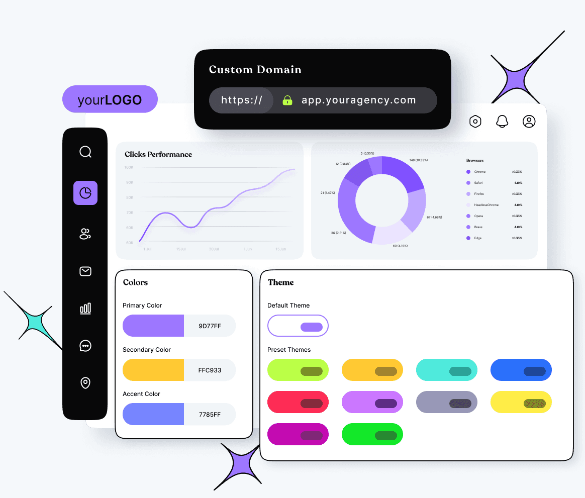
    Whether you need automation tools, customer management platforms, or sleek reporting tools for your client’s website data, white-label has got you covered. 

    This guide will walk you through how white-label branding can be a game-changer for your business!

    What is white-label marketing?

    How white label works

    White-label marketing or white-label branding refers to using marketing products or services developed by one company and then rebranding them under your company’s name. 
    Let us simplify for you:

    How white-labeling works!

    A company (the provider) creates a marketing tool or service. Another company (the reseller) purchases this tool or service.The reseller then rebrands the tool or service with its logo and branding.The final product appears as if the reseller created it themselves.
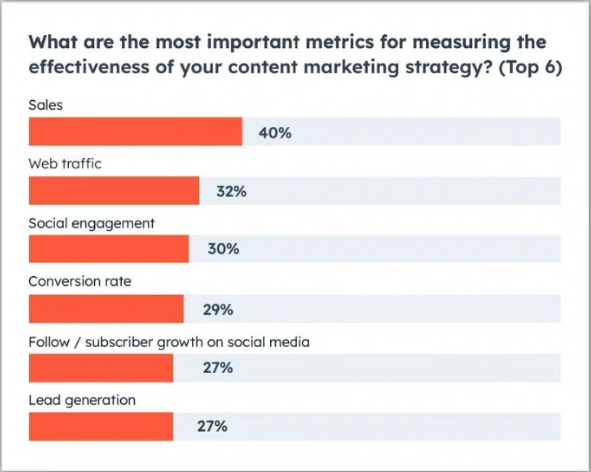
    Related: A Complete Guide to Building a Brand Marketing Strategy

    What is white-label software?

    White-label software is known as software developed by an MVP development company which is then remarketed and resold by another. Here are some common types of white-label software:

    White-label marketing softwares

    • Social media marketing
    • Branded link management tools
    • SEO tools
    • Email marketing tools
    • Analytics and reporting tools

    Design, programming, or management products

    • Landing page builders
    • UI/UX design kits
    • Content management systems (CMS)
    • Project management tools
    • Customer relationship management (CRM)
    • Embedded integration solutions

    What features does a white-labeling tool offer for branding customization?

    An advanced custom link branding white-label tool allows you to take a pre-built software and rebrand it as your own. But it’s not just about looks – it’s about boosting your click-through rates and supercharging your marketing, e-commerce, or affiliate strategies.

    Consider Replug for branding & customization

    Beyond just customizing the logo, color scheme, fonts, domain name, and login screen, the platform offers: a top-notch and reliable URL shortener, bio-link pages, retargeting pixels, deep links, custom CTAs, link rotator, QR codes, link analytics and branded reports. With these powerful features, a white-label tool becomes your go-to for not just rebranding, but for making the most out of your brand.

    Replug Branded Short Links CTA
    A complete link management solution
    for marketing professionals & agencies.
    Try Replug for free

    What are the core benefits of using a white-label tool?

    Benefits Of White Labelling

    White-label solutions are tried and tested, eliminating the risks of any errors or security concerns while developing new in-house software. Besides that, you get so many other benefits including the following.

    1. Faster time-to-market

    In business, timing is everything. You can’t afford to wait months or even years for a custom-built solution. White-labeling tools let you hit the ground running. It’s like skipping the line at the theme park – you enjoy the ride while others are still waiting in line to build theirs.

    2. Add your custom branding

    Just because it’s not custom-built doesn’t mean it can’t feel like it’s yours. White-labeling tools are like blank canvases waiting for your artistic touch. You can customize them to fit your brand and make them feel like they were tailor-made just for you.

    3. Save money

    Building software from the ground up is like constructing a house – it’s expensive! With a white-label tool, it’s like buying a house that’s already built. Sure, you might need to do some decorating to make it your own, but it’s way cheaper than starting from scratch. Working with a nearshore outsourcing service company can help you tailor these solutions efficiently while keeping development costs manageable.

    4. Focus on core business

    Utilizing white-label tools allows you to free up your team’s time and resources to focus on your core business activities. Besides that, you’re good at what you do, whether it’s selling widgets or providing services. You don’t need to become a software developer overnight. With white-label tools, you can focus on what you do best while leaving the tech stuff to the tools. For more complex or unique needs, partnering with a custom software development company can offer tailored solutions that align perfectly with your business objectives.

    These are just some of the core benefits. In the next section, we can explore some specific examples of how white-label tools can be used in different industries.

    Who can benefit from white-label marketing tools?

    The beauty of white-label marketing tools lies in their versatility. Here’s a breakdown of who can leverage their power:

    Marketing agencies and freelancers

    • Expand service offerings: Offer a wider range of services to clients without the need for in-house development.
    • Increased revenue: Generate additional income by bundling white-labeled solutions with your existing services.
    • Client satisfaction: Deliver more comprehensive marketing solutions, leading to happier clients.

    Small and medium businesses (SMBs)

    Rebrand your business
    • Cost-effective marketing solutions: Access powerful marketing tools at a fraction of the cost of custom development.
    • Improved brand consistency: Maintain a consistent brand image across all marketing channels.

    Enterprises or e-commerce businesses 

    • Faster market entry: Launch new marketing initiatives quickly by utilizing pre-built white-labeled solutions.
    • Scalability: Easily scale your marketing efforts as your business grows.
    • Targeted promotions: Personalize the customer journey and offer targeted promotions. 
    • Standardization: Consistency across various departments and geographical locations with a centralized white-labeled platform.

    Are URL shorteners useful for eCommerce sites?

    White-label URL shorteners for eCommerce streamline link sharing by creating custom, branded short links that reflect the eCommerce site’s domain name. These shortened URLs enhance brand recognition, trust, and credibility, improving user engagement and click-through rates.

    Additionally, they offer analytics and tracking features to optimize marketing campaigns and monitor link performance, ultimately contributing to increased conversions and sales.

    Replug Branded Short Links CTA
    Maximize marketing ROI
    by transforming ordinary URLs into
    branded short links that convert.
    Try Replug for free

    Software-as-a-service (SaaS) companies

    • Offer additional revenue streams: Expand your product portfolio with white-labeled versions of your core SaaS offering.
    • Partner with other businesses: Develop strategic partnerships by offering white-labeled solutions to complementary businesses.
    • Reach new markets: Enter new markets by white-labeling your SaaS product for regional or niche markets.

    Web design and development firms

    • Provide a detailed solution to clients, including website design and development, and much more.This allows web design firms to become one-stop shops for their clients’ digital needs.

    Quick rundown: Best white-label tools to try in 2026

    Sr.White-label tools for agencies
    1.Replug
    2.ContentStudio
    3.SE Ranking
    4.AllClients
    5.Brevo
    6.Weblium
    7.ClickUp
    8.WordPress 
    9.Ecwid
    10.Convrrt

    Key factors to consider when choosing your white-label tool:

    Add custom domain, logo, fonts and much more with the help of Replug.

    Below are some important factors one needs to consider when choosing a white-labeling tool:

    • The range of features offered: Check if the given features align with your client’s needs and marketing goals.
    • Customization options: Look for providers that allow you to fully brand the tools according to your preferences.
    • Pricing and scalability: Choose a plan that fits your budget and allows you to grow as your business expands.
    • Ease of use: The tools should be user-friendly for both you and your clients.
    • Customer support: Make sure the provider offers reliable support to ensure a smooth user experience.

    Overall, white-label marketing can be a game-changer for businesses and agencies looking to expand their services, improve client satisfaction, and gain a competitive edge.

    6 Steps to implement in white-label branding

    Steps to implement in white-label branding

    Successfully implementing white-label branding requires careful planning and execution. Here are some essential steps to get started:

    • Research and identify opportunities: Analyze market trends and consumer preferences to identify potential white-label opportunities, such as playout software for media companies.
    • Find reliable white-label partners: Select reputable manufacturers or service providers with a proven track record of quality and reliability.
    • Customize products or services: Work closely with partners to tailor products or services to meet your brand’s specifications and target audience preferences.
    • Establish brand guidelines: Clearly define brand guidelines and quality standards to ensure consistency and alignment with your brand identity.
    • Launch your product: Consider a soft launch to gather initial feedback and make necessary adjustments. After the soft launch plan a full-scale launch with promotional events and marketing campaigns to create buzz around the new product.
    • Monitor performance: Regularly track sales and customer feedback to understand the product’s performance and market acceptance. Be prepared to tweak marketing strategies based on customer feedback and sales data.

    Is white-labeling right for you?

    While white-labeling offers numerous benefits, it’s essential to consider whether it aligns with your business goals and objectives. Before investing in a white-label solution, ask yourself the following questions:

    • What are my business’s unique needs and challenges?
    • How will white-label marketing software help me address these needs and challenges?
    • What are the potential risks and drawbacks of adopting a white-label solution?
    • Am I prepared to invest the time and resources required to effectively implement and manage white-label software?

    By carefully evaluating these factors, you can determine whether white-label marketing software is the right choice for your business.

    FAQs on white-label

    What is the difference between private-label and white-label branding?

    Private-label branding involves products manufactured exclusively for a specific retailer, while white-label branding allows multiple retailers to sell the same product under their brand names.

    Can any business benefit from white-label branding?

    While white-label branding can benefit many businesses, it’s essential to assess your specific market, industry, and brand positioning to determine its suitability for your business model.

    How can I find trustworthy white-label partners?

    Researching and vetting potential white-label partners is crucial. Look for partners with a solid reputation, proven track record, and compatible values and objectives.

    Is white-labeling suitable for startups?

    Yes, white-label branding can be particularly beneficial for startups looking to enter competitive markets quickly.

  • Conversion tracking: Best tools, tips, and tricks

    Conversion tracking: Best tools, tips, and tricks

    What good is all the effort you put into creating engaging content and driving traffic to your website if it doesn’t result in meaningful actions?

    Therefore, having a powerful tool at your disposal can help you not only boost your conversion rates but also understand exactly how and why your audience is taking action.

    And if you’re not using those advanced conversion tracking tools or not following the smart tips you’re probably missing out on a lot of revenue.

    That’s why we are here with a quick guide just for you guys. So you can get your hands on some of the top-notch conversion tracking tools, tips, and much more… 

    Conversion tracking tools at a glance

    ToolDescriptionPricing
    Branded link management & analytics
    ReplugAll in one branded link management solution, from custom short links to conversion tracking to link retargeting to A/B testing and more.Pricing starts from $19 / month
    LinklyLinkly simplifies link tracking, allowing users to monitor click activity on specific links. Utilize your own domain to generate custom branded short-links and promote your business with every click, making it an ideal tool for conversion tracking and marketing.Pricing starts from $29 / month
    SniplySniply is a powerful marketing tool that allows users to add custom CTAs to any link they share. With Sniply, you can drive traffic back to your own website or landing pages.Pricing plan of Sniply starts from $9 / month
    Website & product analytics
    UsermavenBest for detailed link analytics and capture UTM parameters, setting up conversion goals, analyzing user journeys, UTM attributions etc. It gives you 100% data ownership, ensuring full control over your analytics data.Pricing plan starts from $14 / month
    MixpanelMixpanel provides powerful conversion tracking tools for businesses, enabling better decision-making and growth monitoring. With Mixpanel, you can track user engagement and compare current trends to past performance, helping you optimize conversions and drive business success.Pricing starts from $20 / month
    KissmetricsKissmetrics provides powerful conversion tracking tools for businesses. With its advanced analytics platform, businesses can track customer behavior across their websites and campaigns, allowing for targeted optimization and increased conversions.Pricing starts from $25.99 / month
    MatomoMatomo is a comprehensive conversion tracking tool that offers detailed insights into user behavior and website performance.Pricing starts from 22EUR / month
    Social media analytics
    ContentStudioMonitor and analyze performance of your social media channels with multi-channel social analysis.Pricing starts at $25 /month
    SprinklrSprinklr offers advanced conversion tracking featuires to optimize your social media presence. Monitor and enhance performance across platforms for improved engagement and increased conversions.Pricing starts at $249 per seat / month

    Let’s get going. So if you’re new and don’t know

    What is conversion tracking?

    Conversion tracking is the process of monitoring specific actions users take on your website, app, or elsewhere, signifying that they’ve interacted with your brand in a way that’s valuable to your business.

    But conversions go beyond just sales. They bring in a variety of valuable actions, such as:

    • Purchases (of course!)
    • Email signups
    • Phone call initiates
    • Live chat engagements
    • Social media engagements
    • Form submissions (e.g., contact forms, download requests)
    • App downloads (if you have an app)
    • And much more…

    Importance of conversion tracking

    By tracking conversions, you gain valuable insights into how well your marketing campaigns are performing and where you can optimize for better results.

    Today, conversion tracking is not just a luxury but a necessity for any business looking to thrive in the competitive online landscape.

    According to a study, conversion rate is the 4th most important metric for marketers. These numbers highlight the pivotal role that conversion tracking plays in modern marketing strategies. It’s not just about tracking sales; it’s about understanding customer behavior, optimizing campaigns, and maximizing ROI.

    What are the benefits of conversion tracking?

    url-tracking- analytics

    When you start keeping track of your conversions, you open up a world of benefits. Here are some of the best ones:

    1. Improved return on investment (ROI) – By understanding what’s working and what’s not, you can allocate your resources more effectively and maximize your return on investment (ROI).
    2. Making smarter choices with data – Conversion tracking provides you with valuable data that you can use to make data-driven decisions about your marketing strategy. This data can help you identify trends, understand your target audience better, and create more effective marketing campaigns.
    3. Fine-tuning your website and landing pages – Identify areas on your website or landing pages that are hindering conversions.
    4. List out top content – You can use conversion tracking data to see which pieces of content are most effective at driving conversions. This information can be used to create more content that is likely to convert visitors into leads or customers.
    5. Seeing which campaigns do the most – See which campaigns (paid ads, social media posts, email marketing) are driving the most conversions, allowing you to focus your budget and efforts on the most successful ones.
    6. Gain customer insights – Conversion tracking data can reveal valuable insights into your customer behavior, helping you tailor your marketing messages and offerings to better meet their needs.
    7. Smarter budget allocation – With conversion data in hand, you can allocate your marketing budget more effectively. You can invest more in the channels that are driving the most conversions and less in the channels that are not performing well.

    Best conversion tracking tools

    1. Replug

    Replug Branded Short Links CTA
    A complete link management solution
    for marketing professionals & agencies.
    Try Replug for free

    Replug is a complete link management platform that allows brands to track a multitude of URL parameters such as clicks, conversions, and unique visitors to make informed decisions on doubling down on profitable streams.

    With this conversion rate optimization tool, you can set goals for your campaigns to track and analyze how many conversions you have achieved for certain campaigns. Examine traffic parameters such as device type, browser, country, and IP to create targeted campaigns.

    Real-time Analytics

    In easier words, Replug’s click analytics help you track where users click on your website or within links you’ve shortened. This provides insights into user behavior, such as which buttons or CTAs (calls to action) are most effective and where users navigate after clicking a link.

    Pricing starts from $19 / month

    2. Linkly

    Linkly conversion analytics tool

    Linkly is another link management tool for marketers, as the platform provides shortened and branded links. With features like A/B testing and retargeting, it also helps one to optimize link performance. Besides that Linkly does help in conversion tracking. It provides insights into how many clicks on your links lead to desired actions, such as purchases or sign-ups. Depending on your needs, Linkly’s pricing might not be the most competitive. It’s always best to compare pricing plans of different tools before making a decision.

    Pricing starts from $29 / month

    3. Sniply

    Sniply stands out for its unparalleled ability to track and analyze user behavior, empowering marketers to refine their content curation strategies based on genuine audience engagement.

    Sniply conversion tracking

    While monitoring click-through rates on your call-to-action (CTA) provides valuable insights into the effectiveness of your content curation efforts, Sniply goes further.

    Sniply CTA conversion tracking tool

    It’s essential to recognize that while Sniply offers robust analytics features, its primary function remains centered around content marketing and enhancing engagement through strategically placed CTAs.

    Pricing plan of Sniply starts from $9 / month

    4. Usermaven

    An affordable yet advanced alternative to Google Analytics. It automatically captures most user actions on your website or app without any developer dependency. 

    Some of the key metrics you will see on the web analytics dashboard include total visitors, page views, covered events, bounce rate, scroll depth, time spent on the page, top traffic channels/sources, devices, locations, and top-performing keywords, etc.

    Besides that with the multi-touch attribution feature, one can even capture UTM parameters (tags used to track campaign performance) and backfill data even if a user signs up later.

    Or segment users based on various criteria like demographics or behavior. This lets you analyze conversion rates for specific user groups. You can also visualize conversion funnels to pinpoint drop-off points where users abandon the conversion process. 

    Pricing plan starts from $14 / month

    5. Mixpanel

    Now let’s get back to our traditional analytics tools. Just like Usermaven, this powerful analytics platform allows you to track user behavior across platforms and devices. 

    conversion analytics tool

    Mixpanel excels at creating custom funnels and reports, enabling you to analyze the entire conversion journey and identify bottlenecks. By understanding user behavior, you can identify areas for improvement and optimize your product or website to drive engagement and conversions. Other than that the platform offers clear visualizations and insightful reports, which allows you to make data-driven decisions to achieve your marketing goals.

    However, keep in mind that setting up and configuring Mixpanel can require some technical knowledge, especially for complex tracking needs. 

    Pricing starts from $20 / month

    6. Kissmetrics

    Another user behavior analytics platform with a focus on customer journey analysis, Kissmetrics helps you understand the “why” behind user actions. By analyzing user behavior patterns, you can identify drop-off points to personalize the experience and improve conversion rates. 

    conversion analytics tool

    However, there are some drawbacks to using kissmetrics as well. Take for example the platform lacks a free tier and has a starting price point that might be steep for small businesses or startups.

    Besides that when compared to some competitors, the conversion tracking platform platform might have fewer out-of-the-box integrations with other platforms. This might require additional development work for certain setups. 

    Pricing starts from $25.99 / month

    7. Matomo

    Matomo prioritizes privacy and data ownership. Unlike some analytics tools, it keeps your website visitor data on your own server, giving you complete control. You can customize what data is collected and avoid relying on third-party servers. 

    Matomo analytics

    However, this self-hosted approach requires some technical setup compared to hosted solutions. Additionally, the user interface might feel less intuitive for beginners, and some advanced features require paid plans. Despite these drawbacks, Matomo’s focus on privacy and data security makes it a strong choice for businesses prioritizing user data control.

    Pricing starts from 22EUR / month

    8. ContentStudio

    ContentStudio-Scheduling

    ContentStudio helps you manage your social media campaigns all in one place. This lets you see how different pieces of content are performing within a campaign, which can help you identify what types of content are most effective at bringing in conversions.

    social media analytics

    Overall, this all-in-one content marketing platform offers built-in conversion tracking functionalities. For example, you might create a campaign to promote a new product launch. By tracking the performance of different social media posts within that campaign in CS you can see which posts are generating the most interest and conversions.

    social analytics

    Pricing starts at $25 /month

    9. Sprinklr

    Sprinklr

    Sprinklr is a comprehensive social media management platform used by businesses worldwide. It offers tools for scheduling posts, engaging with audiences, and analyzing performance across various social media channels. Its advanced analytics provide valuable insights into audience behavior and campaign effectiveness, conversion tracking helping brands make data-driven decisions.

    Pricing starts at $249 per seat / month

    Best conversion tracking tool

    Our top pick as the best conversion tracking tool is a high-end analytics tool known as Usermaven.

    Brands can gain a deeper understanding of user behavior throughout the conversion funnel by utilizing Usermaven. 

    Key features of Usermaven

    • UTM campaign and event tracking
    • User journey insights
    • Advanced segmentation
    • AI assistant
    • Pixel white-label
    • Session recording 
    • Actionable insights
    • Activity heatmaps 
    • Data retention
    • Funnel analysis

    While if you require a tool that can do more than analytics then Replug should be your first choice.

    Key features of Replug

    • Link analytics 
    • Retargeting pixels 
    • A/B testing
    • Custom CTA
    • Trackable shortened links
    • Deep links 
    • Bio links

    Top tips for effective conversion tracking

    Replug Branded Short Links CTA
    A complete link management solution
    for marketing professionals & agencies.
    Try Replug for free
    • Define clear conversion goals: What actions do you want users to take on your website or app? Be specific and measurable.
    • Set up conversion tracking correctly: Ensure your tracking code is implemented accurately to capture all conversion data.
    • Track multiple conversion points: Don’t just focus on sales; track other valuable actions like sign-ups, downloads, or video views.
    • Segment your data: Analyze your conversion data by different segments (e.g., traffic source, device type) to gain deeper insights.
    • Regularly review and optimize: Monitor your conversion data and make adjustments to your marketing campaigns and website based on your findings.

    As we wrap up, it’s clear that conversion tracking isn’t just a trend—it’s a necessity for businesses aiming to thrive in the digital age. By utilizing the right tools and following smart tips, businesses can gain valuable insights, optimize their marketing efforts, and ultimately drive more revenue.

    FAQs about conversion tracking

    Why do I need conversion tracking?

    Conversion tracking shows how well your marketing efforts drive sales or desired actions (sign-ups, downloads). Optimize campaigns to get more results for your investment.

    How do you track customer conversion?

    Use website tags, and UTM codes, or track specific actions like purchases or form submissions to see how customers convert.

    What is the goal of conversion tracking?

    To understand which channels (social media, email) bring in the most valuable customers by tracking conversions.

    What is conversion rate tracking?

    Conversion rate tracking calculates the percentage of visitors who take a desired action (e.g., buy something).

    What is conversion tracking protocol?

    Conversion tracking protocols ensure consistent and accurate data collection across different platforms.

    How do you keep track of the conversion rate?

    Divide the number of conversions by total visitors and multiply by 100% to find your conversion rate.

    What is the recommended way to track conversions?

    Use conversion tracking tools like Replug for simplified setup, tracking, and analysis of your conversion data.

    What is the difference between a micro conversion and a macro conversion?

    Micro: Smaller actions like adding items to a cart.

    Macro: Bigger goals like completing a purchase or signing up for a service.

    Are tracking pixels illegal?

    Tracking pixels is not illegal, but respecting user privacy and getting consent for data collection is crucial.

    Who uses pixel tracking?

    Marketers or product owners use pixel tracking to understand ad performance and website visitor behavior.

    What is the difference between tracking pixels and cookies?

    Pixel: Tiny image that sends data when loaded, works even with cookie blocking.

    Cookie: Small data file stored on the user’s device, privacy concerns exist.

  • How to track emails using UTM parameters?

    How to track emails using UTM parameters?

    You’re sending hundreds of emails on a daily basis, getting good open rates, still the conversion rate is less than your expectations. What could be the problem?

    The problem is that you don’t know 

    • Which email campaigns are doing the most for your brand?
    • How do different audience segments respond to your emails?
    • What is the bounce rate of your email campaigns?
    • Which emails are getting the highest click-through rate?
    • Which specific ad or link on a webpage is driving traffic?
    • Which marketing campaigns are working and which ones aren’t?

    But don’t worry, we’ve got your back. The solution? 

    Add email UTM parameters to your links. They help you keep track of who’s clicking, where they’re coming from, and what’s working best.

    If you don’t know “What’s a UTM parameter?” They are special codes you can add to the end of URLs to track visitors.

    So, if you’re serious about fine-tuning your email game and getting better results, it’s time to get along with UTMs. 

    What is a UTM in email?                                                 

    In simple terms, a UTM parameter in email is a unique tag added to the links within your email marketing campaigns. These tags are added to the end of URLs, providing valuable information to brands about the source, medium, campaign, and more.

    Why do i need to use UTM parameters in email campaigns?

    email utm parameters

    The use of email UTM parameters in email campaigns is really important if you want to get in-depth insights. Any email marketing platform will allow you to add UTM parameters since it is simply a change to the URL of each link you are adding in the email content. Take for example, if you add such parameters to your email links, you can accurately track metrics such as

    • Open rates
    • Total impressions
    • Click-through rates
    • Conversion rates
    • And overall engagement
    • And much more…

    What are the benefits of UTM tracking?

    UTM tracking offers several key benefits for email marketers as well as digital marketers.

    1. Identify top-performing content
    Blog UTM

    Let’s say you include a blog post link within your email campaign. UTM parameters can tell you which blog posts generate the most website traffic from your email blasts. This helps you understand what content resonates with your audience and prioritize future content creation efforts.

    1. A/B testing optimization

    UTM parameters are instrumental in A/B testing different elements of your email campaigns. You can create multiple email versions with different subject lines, calls to action, or content and use UTM tags to track which version performs better. This allows for data-driven decisions to improve your email marketing strategy.

    1. Measure long-term impact 

    Know that email UTM tracking allows you to measure the long-term impact of your marketing campaigns. By analyzing UTM data over time, you can see how campaigns influence website traffic and conversions even after the initial email is sent. This helps you understand the full customer lifecycle and optimize campaigns for long-term success.

    1. Measure ROI (Return on investment) 
    ROI

    UTM parameters help you track the effectiveness of paid advertising campaigns. You can see which keywords or ad variations drive the most valuable traffic, allowing you to optimize your ad spend for maximum return.

    1. Cross-channel measurement 

    Email UTM tracking is valuable for campaigns spanning multiple channels. You can track how users interact with your brand across different platforms, like clicking a social media ad and then subscribing to your email list.

    Types of UTM parameters for email campaigns

    There are so many email UTM parameters you can use to track your email campaigns, but some of them are particularly common:

    utm_sourceIt showcases the exact source within the marketing channel. So, for an email campaign, you might use “newsletter” or a specific campaign name like “welcome-series.”
    utm_mediumThis one identifies the marketing channel that brought the visitor to your site. In the case of emails, this would always be “email.”
    utm_campaignThis is where you can get specific about the exact campaign you’re running. You could use a name for a particular promotion “summer-sale” or a more general term for an ongoing campaign “customer-retention”.
    utm_contentUsed to differentiate between different versions of the same email, such as A/B testing variations.
    utm_termThis parameter is typically used for tracking keywords in paid search campaigns but can also be repurposed for email campaigns to track specific elements like links or calls to action.

    How do I set UTM parameters?

    One can set up UTM parameters by using any free UTM builder tool. Replug is an all-in-one tool that offers a user-friendly interface where you can easily input your URL and customize the UTM parameters according to your campaign goals. 

    Fill in the details for the UTM parameters you want to use for a specific link:

    • Campaign name: Assign a unique name for this particular marketing campaign.
    • Medium: Specify the marketing channel (always “email” for emails in this case).
    • Source: Add in the exact source within the channel (e.g., “newsletter,” “welcome-series”).
    • Content (Optional): Use this to differentiate clicks between different versions of the same link within your email (e.g., button text or a unique identifier).
    • Term (Optional): Less common for emails, but useful for tracking paid search ads within emails.
    • Campaign ID: It could be a unique identifier or code associated with the campaign.

    Once you’ve entered the desired information, click “Create” to generate your link with the UTM parameters embedded. 

    Replug – A complete link management solution

    Replug Branded Short Links CTA
    A complete link management solution
    for marketing professionals & agencies.
    Try Replug for free

    If you want more than just email UTM parameters, you can test out the Replug free trial to check out the complete range of advanced features including retargeting pixels, bio-links, link rotator, A/B testing, link analytics, QR codes, link shortening,  and much more…

    Here’s how you customize your UTM links with Replug.

    • After signing up to your Replug account go to the Dashboard.
    • In the “Create Quick Replug Link” section, Select your campaign 
    • Afterward, add the link to which you want to customize.
    UTM link
    • In the same block, you’ll see an option labeled “+Add UTM” next to the URL field. Click on it.
    • A pop-up window will appear, allowing you to either choose a pre-saved UTM parameter set or create a new one.
    email utm parameters
    • If creating new UTM parameters, provide the necessary information such as source, medium, campaign, term, and content. Click “Apply” once completed.
    • Click the “Create” button, and Replug will automatically generate a shortened URL with the added UTM parameters.
    • Next, if you want to customize the UTM URL, you can do so by clicking the edit icon.
    email utm parameters shortened
    • After any edits, simply copy the URL with the UTM parameters and click the “Update” button to save your changes.
    update settings

    And you’re done.

    Also, check out our free link shortener to easily shorten and track your links with just a few clicks!

    UTM tracking with Usermaven

    Usermaven is a fantastic alternative to Google Analytics, providing detailed analytics for your website and app. It relies on UTM parameters to track important data like where your visitors are coming from, which pages they’re entering and exiting, and even their location down to the city level.

    Sign up today and get a hold of the top 

    • Channels / Sources
    • Mediums
    • Campaigns
    • Terms
    • Contents
    Usermaven-track-email-utm

    In the top pages section, monitor both the entry and exit pages to understand your audience’s behavior effectively. Besides that, explore your customer base’s geographical distribution through detailed maps, countries, and city breakdowns. You can also see what devices and browsers most of your audience prefers.

    Usermaven-UTM

    Identify high-performing keywords effortlessly with Usermaven’s keyword tracking feature, displaying total clicks and impressions. Utilize this data to optimize email campaigns and content strategies for maximum traffic.

    In easier words, by analyzing such parameters, you can make the most of Usermaven’s features to improve your campaigns and get better results.

    Conclusion 

    Email UTM parameters are super useful for email marketers. They help you track how well your emails are doing, so you can make them even better.

    But! Are you using UTMs in your email campaigns?

    If you’re not using UTMs yet, it’s a great idea to start now. They’ll help you understand what’s working and what’s not, so you can get awesome results from your campaigns.

    Frequently asked questions

    What is the difference between UTM and GTM?

    UTM tags are codes added to URLs for traffic source tracking, while GTM is a platform to manage various tracking codes on your website.

    Is it illegal to track emails?

    Tracking emails isn’t illegal, but regulations like GDPR limit data collection methods.

    Which method is used to track emails?

    UTM tracking is one of the most common ways to track email clicks and conversions.

    What is email trace?

    An email trace shows the path an email takes from sender to recipient, helping diagnose delivery issues.

  • Why is Replug the best Ow.ly alternative?

    Why is Replug the best Ow.ly alternative?

    Ow.ly, a link-shortening tool from the popular platform Hootsuite, has won over many users, but it’s not without its downsides. One big issue is that it’s tied exclusively to Hootsuite. So, if you’re not using Hootsuite for your social media or other tasks, Ow.ly won’t work for you.

    That’s why it’s worth exploring ow.ly alternatives that offer more advanced link management features to meet the needs of today’s marketers and businesses.

    One top alternative is Replug. 

    Replug-Owly Alternative

    While Ow.ly covers the basics, Replug goes above and beyond with features like detailed analytics, customizable call-to-actions, white-label solutions, bio-links, retargeting pixels, and more.

    Let’s take the next step and introduce you to Replug, where you can discover a whole new level of link management capabilities.

    Replug.io
    Replug.io is a comprehensive link management platform offering advanced features like detailed analytics, customizable call-to-actions, and white-label solutions, empowering marketers to optimize their campaigns effectively.
    Ow.ly
    Ow.ly is a link-shortening tool developed by Hootsuite, a popular social media management platform. It allows users to condense URLs into shorter, more manageable links, primarily for sharing on social media platforms. However, Ow.ly is exclusively tied to Hootsuite and lacks advanced features and flexibility compared to standalone link management alternatives.

    Replug vs Ow.ly

    Replug Branded Short Links CTA
    A complete link management solution
    for marketing professionals & agencies.
    Try Replug for free

    In this comparison, we’ll explore the key differences between Replug and Ow.ly to help you make an informed decision. While both platforms offer link-shortening capabilities, they differ in terms of features, integrations, and flexibility. 

    Link management capabilities

    Let’s start with some of the most important link management feature comparisons to see what works best for your brand.

    1. Advanced link shortening

    First, we have link shortening. With Replug, users can enjoy advanced link-shortening features that not only condense URLs but also provide detailed analytics and customization options for each shortened link.

    Whereas, Ow.ly offers standard link-shortening capabilities without the advanced analytics and customization features found in Replug.

    If you’re looking to go beyond basic URL trimming, Replug’s advanced features make it the smarter way to shorten link
    while tracking and customizing every click.

    2. Bio-links

    Next, we have bio-links where Replug enables users to create bio-links, which serve as a centralized hub for multiple links, making it easier to share content across various platforms from a single location.

    Ow.ly lacks the functionality to create bio-links, limiting users to sharing individual shortened links.

    Replug- best ow.ly alternative

    3. QR codes

    Ow.ly does not offer QR code generation as part of its feature set. But in the case of  Replug, users can generate QR codes for shortened links with Replug, making it convenient to share links offline or in print materials.

    4. Deep links

    Same as the QR codes, deep linking capabilities are not available within Ow.ly. Whereas with Replug marketers can create deep links, which enables direct access to specific sections or content within mobile apps, and enhance user experience and engagement.

    deep linking- Replug

    5. Custom CTAs (call-to-actions)

    When it comes to Replug, brands can use the free CTA generator to create custom call-to-actions associated with their shortened links, allowing for greater control over user interaction and conversion optimization.

    Whereas, Hootsuite does offer AI content creation capabilities but still both the platforms lack advanced customization options for call-to-actions.

    6. Retargeting pixels

    Lastly, we have one of the most amazing features which is retargeting links. Here Ow.ly does not support retargeting pixel integration. However, users can integrate retargeting pixels with Replug’s shortened links, enabling targeted advertising campaigns and audience remarketing efforts.

    White-label solution

    White-Label_ Ow.ly alternative

    Neither Ow.ly nor Hootsuite offers white-label boards. However, unlike these platforms, Replug provides an extensive range of branding options, including white-label boards. This feature allows you to create your personalized link management tool, allowing you to…

    • Replace Replug’s domain with your own for shortened links.
    • Customize the overall user interface to match your brand aesthetic.
    • Add your brand name, logo, favicon, title, meta image, description, and domain.
    • Design reports and emails sent to users with your branding.
    • Promote your brand with advanced characteristics such as retargeting links, catchy call-to-actions, traffic routing, and more.

    Overall white-label service can help you scale up and meet the demands of launching new services without incurring additional costs. 

    Detailed link analytics comparison

    Replug - Link analytics

    Ow.ly

    Being a more well-known service, Ow.ly likely offers a range of features, but in-depth link analytics might not be the main focus. Research-specific analytics offered by the platform include:

    • Total clicks on the link
    • Where the clicks came from (e.g., Facebook, Twitter, email)

    Overall, keep in mind that Hootsuite is more focused on social media analytics. However, if you’re using Hootsuite, you can add tracking parameters to your Ow.ly links so that you can track them in an analytics tool like Usermaven.

    Besides that the platform also allows you to filter your analytics to analyze data for specific brands you’re promoting. Or track the performance of individual marketing campaigns.

    So my friends as you can see Replug is the clear winner.

    Replug Branded Short Links CTA
    A complete link management solution
    for marketing professionals & agencies.
    Try Replug for free

    Integrations offered

    Replug

    Replug offers direct integrations with various social platforms, email marketing tools, social media management tools, and much more. 

    Whether it’s connecting with popular social media channels like Facebook, Twitter, or LinkedIn, or integrating with leading email marketing tools such as Mailchimp or Constant Contact, Replug allows users to optimize their outreach efforts and drive engagement effectively. 

    Additionally, Replug’s integrations with social media management tools like ContentStudio, and Social Bee streamline the process of content scheduling, creation, and publishing, as well as social media analytics tracking and much more.. 

    With its comprehensive range of integrations, Replug excels as a solution for link management and marketing optimization.

    Ow.ly

    Ow.ly, being an integral part of the Hootsuite platform doesn’t have standalone integration capabilities. Instead, to integrate with other tools, users need to connect to Hootsuite itself. 

    Here are some of the Replug reviews

    “Handy Link Management Tool with URL shortener and more”

    Says Alan N.

    “Very convenient platform to create Branded Links with Marketing & Reporting”

    Says Karen S.

    Pricing comparison

    Now, let’s talk about pricing. When choosing a link management tool, go for the one that meets your needs best. Here’s a quick pricing table for you:

    Replug Ow.ly
    Basic = $19 /monthProfessional plan = $99 per month
    Professional = $49 /monthTeam plan = $249 per month
    Agency = $79 /monthCustom enterprise plan

    Compare Replug’s features, functionality, and pricing against Ow.ly, and you’ll quickly see why it’s the clear winner. 

    With flexible pricing plans to suit every budget and requirement, Replug ensures that you get the most bang for your buck without compromising on quality or performance.

    Conclusion

    Considering the limitations of Ow.ly tied exclusively to Hootsuite, this article clearly explains why Replug is the best Ow.ly alternative. Enjoy advanced link management features, affordable pricing, top-notch customer support, and much more…

    Faqs

    What are social media management tools, and how do they differ from link management tools?

    Social media management tools are platforms that help businesses schedule, publish, monitor, and analyze their social media content across various platforms like Facebook, Twitter, Instagram, and LinkedIn. While link management tools focus specifically on managing URLs and tracking link performance.

    What are some key features to look for in link analytics tools?

    When selecting a link analytics tool, consider features such as total clicks, click-through rate (CTR), demographics, referring sources, UTM parameters for campaign tracking, time series data, and customizable reports.

    What’s the difference between Replug and Ow.ly? 

    Both Replug and Ow.ly offer link management solutions. Replug focuses on detailed link analytics and integrations with analytics tools, while Ow.ly emphasizes social media scheduling and team collaboration features.

    Why is link management important?

    Effective link management helps you:

    – Improve SEO (Search Engine Optimization) ranking
    – Track the performance of your marketing campaigns
    – Analyze user behavior and content engagement
    – Maintain brand consistency
    – Shorten long URLs for better aesthetics and sharing