How many times have you heard the buzzword “deep links” and thought about googling it?
Deep linking has been around for a while, and if you’re a developer working in the tech industry or you have been doing affiliate marketing to make money, then you may know about this.
However, the rest of the readers might not be exactly sure what deep linking is and why they need to learn about it.
Replug users and blog readers are online marketers, affiliate bloggers, digital marketing gurus, web developers, and social media experts.
So, we need to discuss a vital topic in the link management industry to make sure that you don’t miss out on any user engagement opportunities.
Well, this article is going to help you explain what deep linking is and your brand can benefit from deep linking.
So buckle up because you might want to pick a few nuggets from the sections below.
Drive more clicks, conversions, and app installations by deep linking
to your favorite platforms.
Try deep links for free
What is deep linking?
A deep link is a pathway that drives users directly to a specific page or section of the website or mobile app without having to launch the app or open the website from the home page.
In simple words, deep links are administered by marketers or app developers to direct the users to a specific in-app location or website URL before the user decides to take off.
A brief history of deep linking
The concept of deep linking has been around since the early days of the web, but it wasn’t until the widespread adoption of smartphones and apps that deep linking really took off.
Deep linking went mainstream when social media platforms took over the internet marketing realm. In a nutshell, the convenience of linking to specific content or section within an app, rather than just launching the app from the home screen turned things around for this marketing tactic.
Imagine opening an app and going across different sections to reach a specific section within the app. It would surely take a while to do that. Therefore, deep linking is immediately adopted by digital marketers and app developers to improve engagement and conversion.
Importance of deep links
Brands now understand the power of quick user engagement. Therefore, they try to squeeze every marketing channel to attract, engage, and convert the audience.
No doubt, such engagement tactics do wonders for social media marketing along the way. Not only does a deep link improve user engagement, but it also positively impacts the conversion rate.
In 2026, deep links are specifically linked to mobile apps and social media platforms. However, deep linking has been around for a long time.
Pro-bloggers and veteran affiliate marketing would know that many affiliate networks offer a deep linking tool for affiliate marketers to generate deep links to advertisers’/brands’ product pages.
So affiliate marketers copy and paste the landing pages or specific product pages of brands/advertisers into the deep link tools to generate their custom affiliate URLs for their campaign.
Several affiliate networks offer the facility to create a deep link for the specific page of the advertiser’s website. Usually, it’s the landing page or a product page that affiliate marketers want to promote.
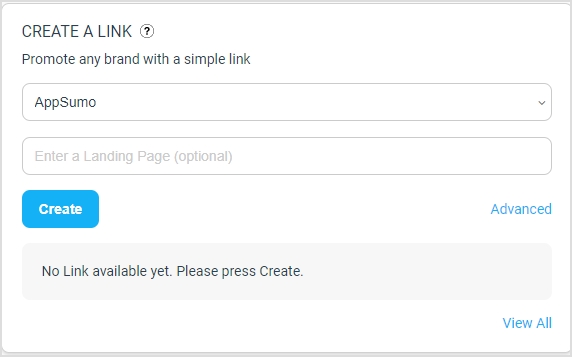
Impact Radius is a popular affiliate network that provides a deep linking tool for affiliate marketers. Take a look at the screenshot below:
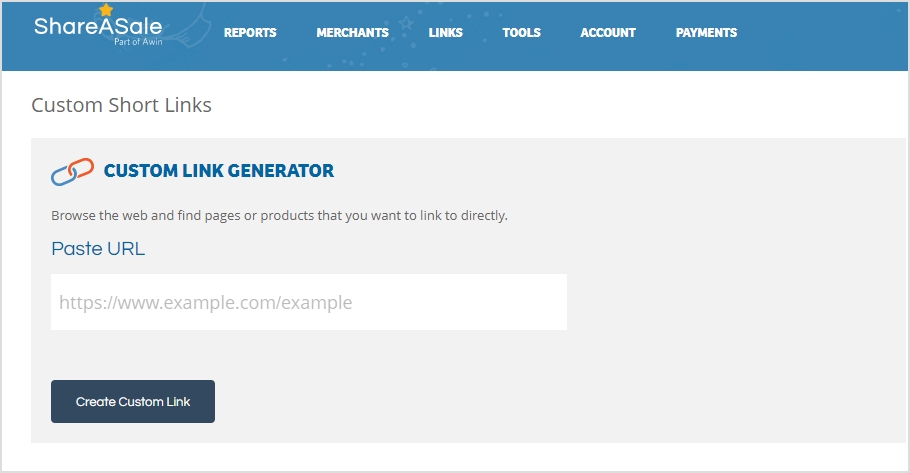
Similarly, ShareASale is another well-known affiliate network that offers a custom link generator, which does the same thing. Here’s the screenshot:
How Does a Deep Link Work?
The way deep links work is that such links are created using a specific URL format that includes the full path to the specific page or content within the website or app.
Suppose a website that has a page with information about a particular product. The URL for the homepage of this website might be “http://www.examplewebsite123.com”, while the URL for the product page might be “http://www.examplewebsite123.com/products/product-name”.
In this case, when the deep link to the product page would be created, the web browser or app will open and navigate visitors directly to the specific product page using the deep link system.
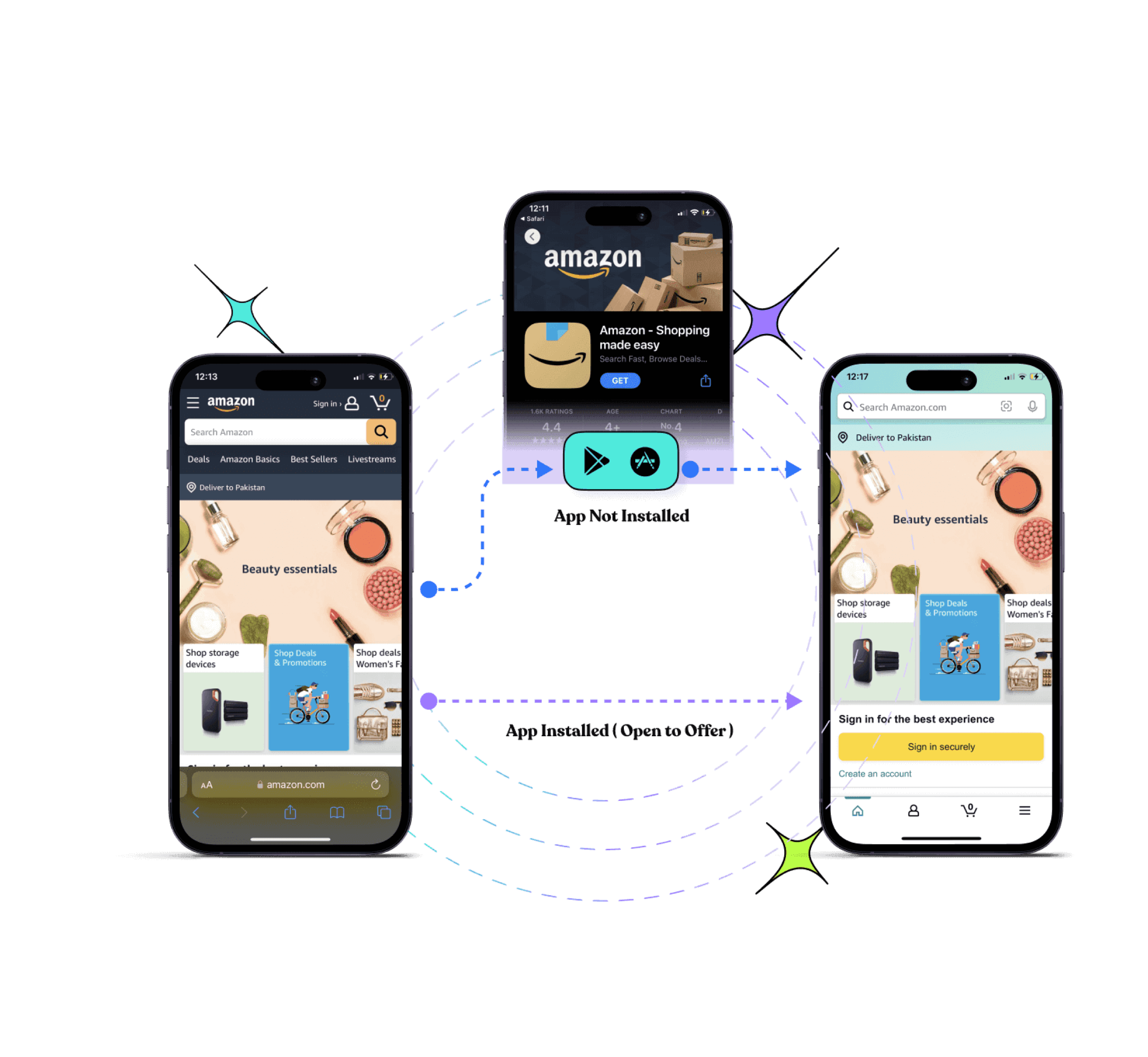
Moreover, in the case of a mobile app, the app may need to be installed on the user’s device in order for the deep link to work properly.
Deep links can be created and used in a variety of contexts, including in emails, social media posts, advertising campaigns, and more. However, they’re widely used in the social media industry mostly by top-tier social media and communication apps.
Why deep linking is so critical in building great mobile journeys?
Deep linking helps brands and influencers create a seo friendly and effective engagement experience that facilities the overall user experience of the prospects and customers.
A great mobile journey is a term that describes how easy and quick the accessibility of a tool or app is for the target audience.
It’s the era of smart devices and mobile communication, so brands might not want to comprise the mobile-first user experience. No wonder companies pay close attention to building responsive websites these days.
Since deep linking assists businesses in providing customers with quick access to resources, it directly influences the conversion rate.
To understand why deep linking is crucial to building a great mobile journey for the audience, it’s important to dive deep into the key reasons to use deep linking for better mobile journeys:
Seamless integration
Deep linking allows for more seamless integration of mobile apps into the overall user experience, as it enables developers to create links that take users directly to specific pages or features within an app, rather than just the home screen. This can help to improve the overall flow and continuity of the user journey.
Intuitive user experience
By allowing developers to link directly to specific content or features within an app, deep linking can help to create a more intuitive user experience, as it makes it easier for users to find and access the information or functionality that they are looking for.
Conversion optimization
Deep linking can be used to optimize the conversion process by allowing developers to create links that take users directly to the pages or features within an app that are most relevant to their needs or interests. This can help to increase the chances of a successful conversion by making it easier for users to find and engage with the content or functionality that they are looking for.
Fast communication
Deep linking can help to facilitate fast communication between apps and websites, as it allows developers to create links that can be used to quickly open specific pages or features within an app. This can help to improve the overall speed and efficiency of the user journey.
User engagement
Deep linking can be used to drive user engagement by allowing developers to create links that take users directly to specific sections or features within an app that are likely to be of interest to them. This can help to increase the amount of time that users spend within an app, and can help to improve the overall user experience.
Customer retention
Deep linking can be used to improve customer retention by allowing developers to create links that take users directly to the features or content within an app that are most relevant to their needs or interests. This can help to keep users engaged with an app and can help to increase the likelihood of them returning to the app in the future.
Benefits of Deep Linking in Mobile Apps
Deep linking has essentially become more useful to social media platforms and mobile applications after the vast adoption of mobile devices globally. The concept seems more like an engagement strategy for mobile users, let’s dive deep into the benefits of deep linking in mobile apps:
Access to location-based content
Deep linking allows you to link directly to a specific location-based page within an app, which can be useful if you want to direct users to content that is relevant to their current location.
Often companies have different versions of the apps or websites, so deep linking helps them navigate the users to the appropriate app or website version based on their country or city.
Personalized user experience
It can be used to provide a more personalized user experience by linking users directly to the content that is most relevant to them or the app version designed for them.
This can be especially useful for e-commerce websites where deep linking can be used to direct users to a specific homepage based on their IP address or other location-detecting parameters.
Target a specific audience segment
Brands and entrepreneurs try to segment their audience whether they’re doing email marketing or social media advertising. Once they successfully do that, it makes it easier for them to reach out to a specific segment of the audience.
This is where deep linking comes in handy when companies and experts can generate specialized deep links based on the credentials of the specific segment.
Speed up the communication
No doubt that deep linking can speed up the communication process by allowing users to access specific content within an app quickly and easily. This can be especially useful in situations where users need to access information quickly, such as when they are trying to make a purchase decision.
Improve conversion rate
By providing a more personalized and relevant user experience, deep linking can help to improve the conversion rate for an app or website. This can be especially important for e-commerce apps, where deep linking can be used to direct users to specific product pages and increase the likelihood of a sale.
You must have noticed that sometimes when you visit a rather big e-commerce store, it automatically detects your country or sometimes directs you to your country-specific online store version.
Improves search engine discoverability
One of the key benefits of deep linking is that it also allows search engines to easily index and rank specific pages or content within a website or app, which can lead to better search engine optimization (SEO) and improved discoverability.
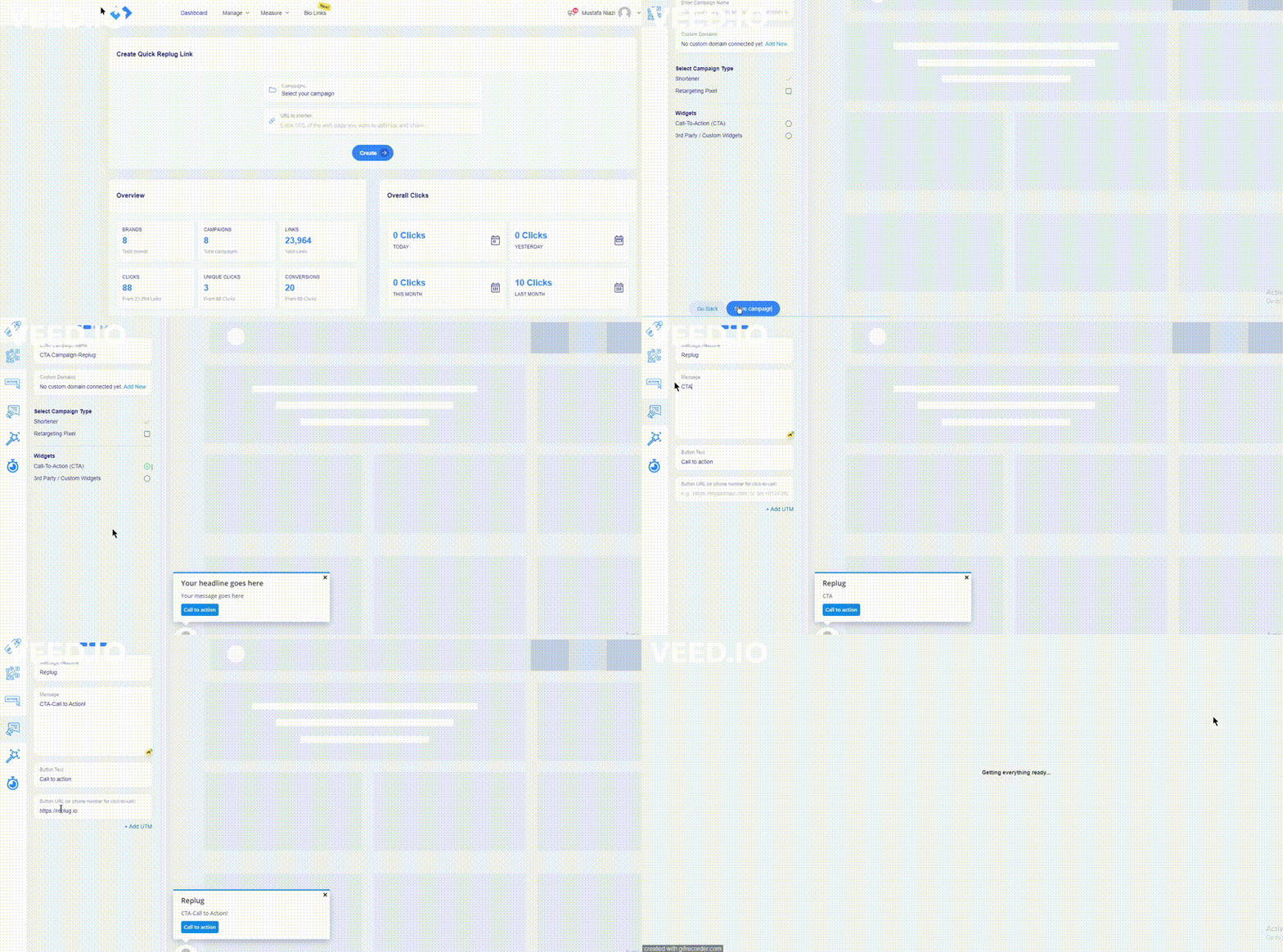
One of the features of Replug is deep linking. I’ll use the TikTok example, meaning I’ll create a deep link for a TikTok video just to showcase how it’s done.
If everything goes perfectly, the short URL will be created as a deep link and it would open the same TikTok video in the TikTok app on clicking on that short link.
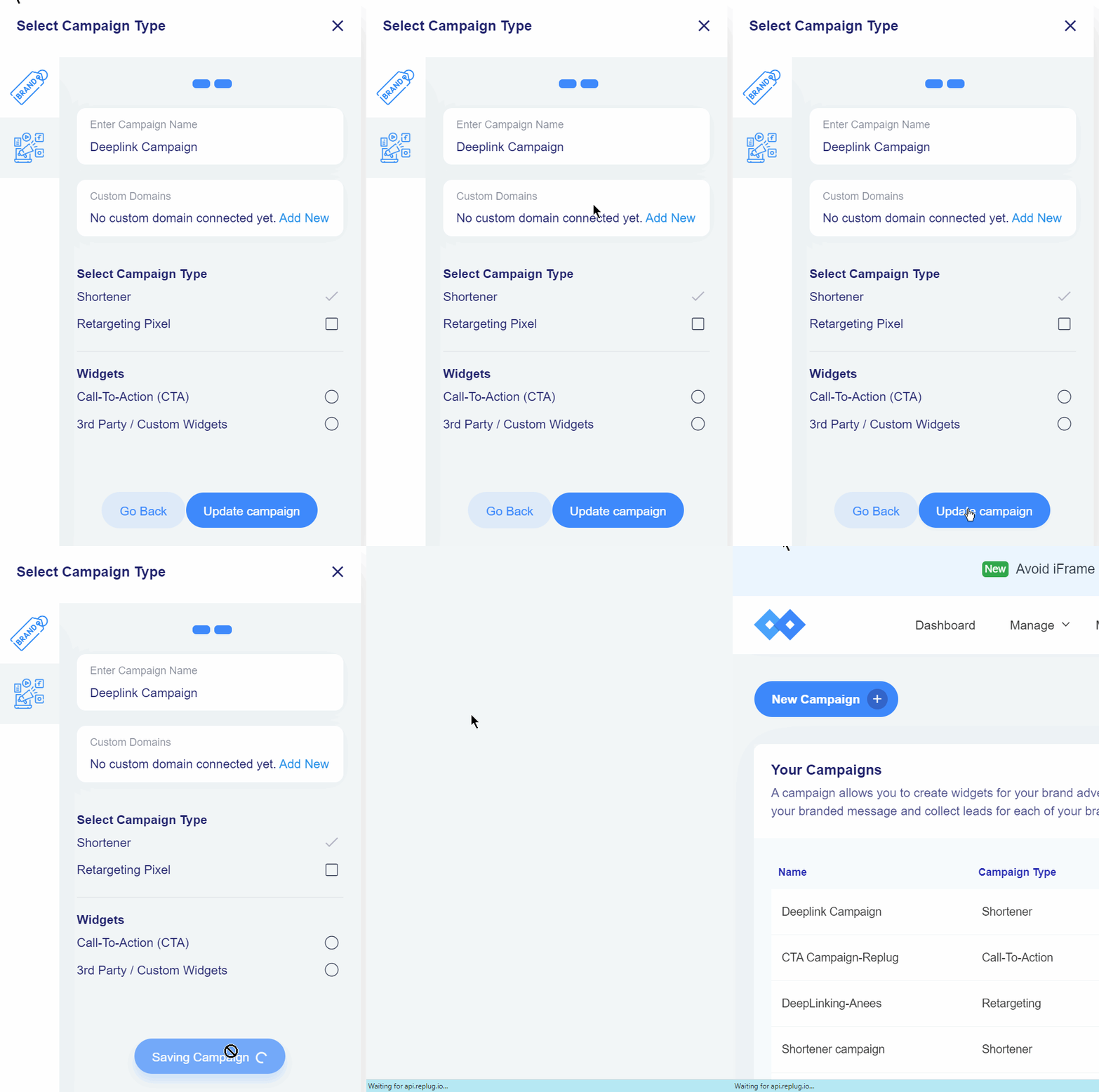
Once you successfully create your campaign in the Replug account, go to the deep links area.
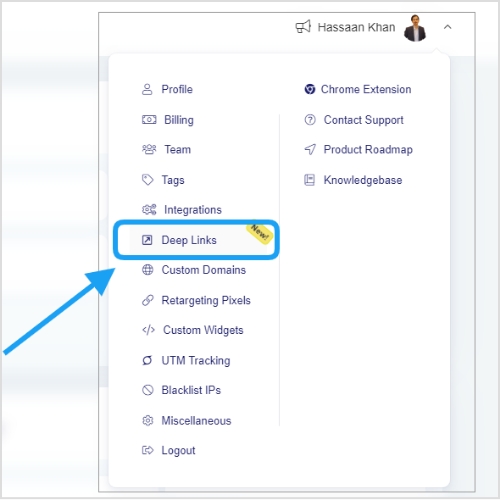
To access the deep links section, click on the profile icon from the top left of the dashboard and then click on the “deep links” option.
Step 4: Choose the platform
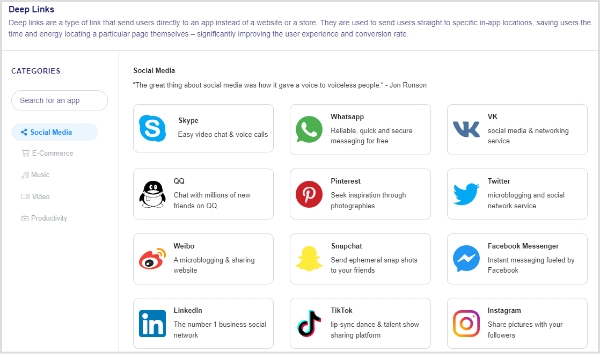
This is the step where you’d have to choose the platform for the deep link campaign. After landing on the deep links section page, there will be dozens of options across different categories.
Click on the icon of the platform you want to create your deep link for, for instance, TikTok or Pinterest. Once you click on the platform icon, a popup window would appear.
Step 5: Adjust the formatting
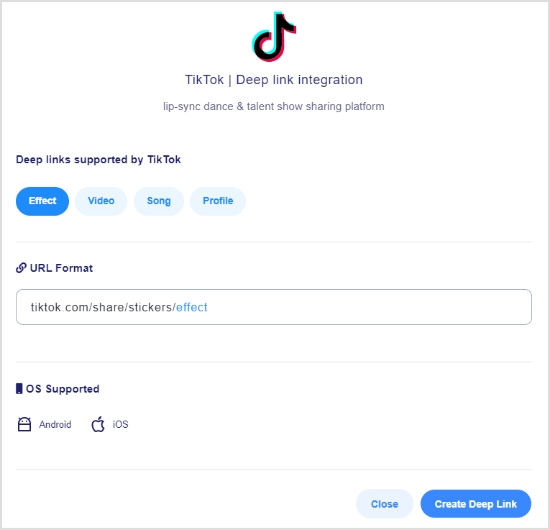
The popup window as shown in the above image would be a deep link integration area where you get a chance to adjust the formatting of the deep link.
Moreover, this integration area would also showcase different available deep link formats/options for each platform.
Once everything looks okay, just click on the “create deep link” button to go ahead.
Step 6: Create a deep link-enabled short URL
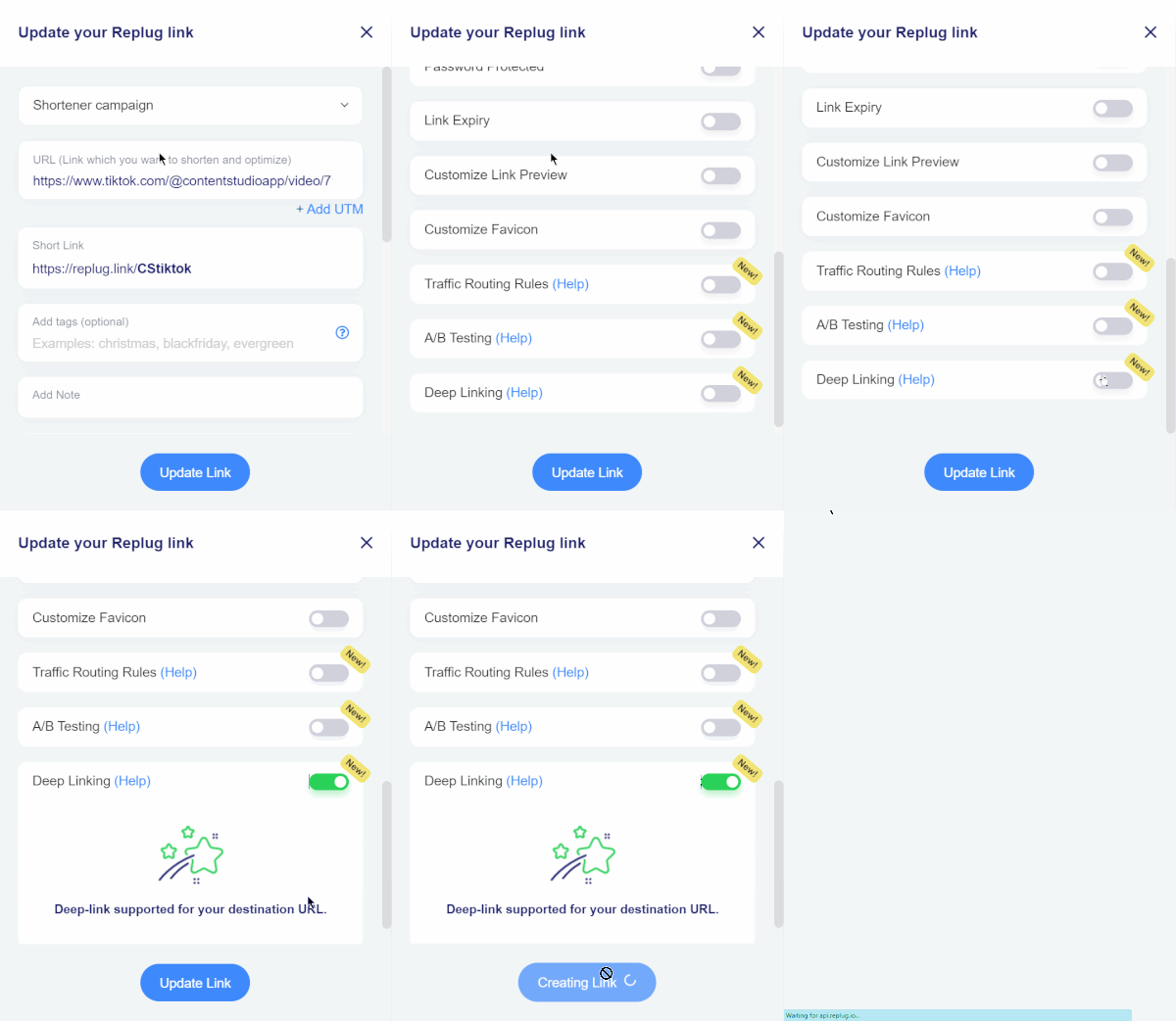
The last step is also crucial to the whole deep link creation process. It’s the section where you input the associated URL as well as choose the appropriate campaign.
When everything goes smoothly, there shouldn’t be a problem. Turn on the deep link option for the link using the toggle, just in case.
Also, makes sure that the deep link is supported for the URL. Fix the URL formatting if the deep link is displaying an error.
Once everything seems okay, go ahead and save the link. Now you have created a deep link for your favorite social media platform.
As I said earlier that if everything works out fine, the short link would be used as a deep link and it would open the TikTok video in the TikTok app. I tested this short URL and it did open the TikTok video in the TikTok app.
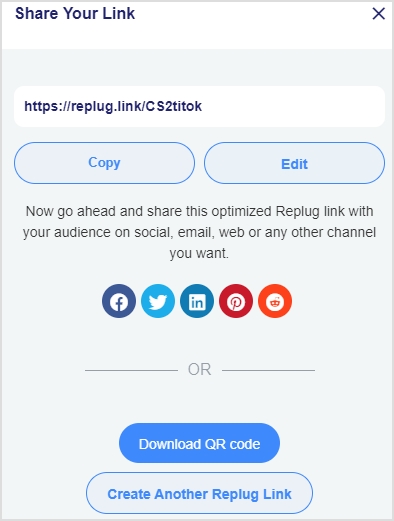
Try it yourself: https://replug.link/CS2titok
FAQs about deep links
What happens when the user is deep linked into an app they don’t have installed?
When a user clicks on a deep link but doesn’t have the relevant app installed, then there are two possibilities that could happen depending on the platform or app. The deep linking system would either open the web version of the app or take you to the relevant app store to install the specific app.
Deep link vs. hyperlink – what is the difference?
A deep link is a mobile link that directs the user toward the relevant app instead of the website. Whereas the hyperlink is a link that sends the website visitor to the specific page or website it’s linking to using a web browser regardless of the device.
What is the biggest benefit of deep linking?
The most important one is that it provides end-users with quick access to the content within the app or website.
Marketers use link rotation tools to understand the website visitors or audience response towards the provided URL links, so to speak. So if you share your website or actively share content on social media then use short URLs on social media to drive traffic to your website pages, blog posts or fan pages. Adding link rotation to your marketing repertoire can be a good way to convert more audience.
URL shortening is a popular link management tactic. However, the story doesn’t end withutilizing short links on social media. This is why we decided to shed some light on the concept of link rotation .
For those who are curiously waiting to find out where exactly we could use link rotators, this section is written for them. There are several occasions when you could use link rotators. Let’s find out:
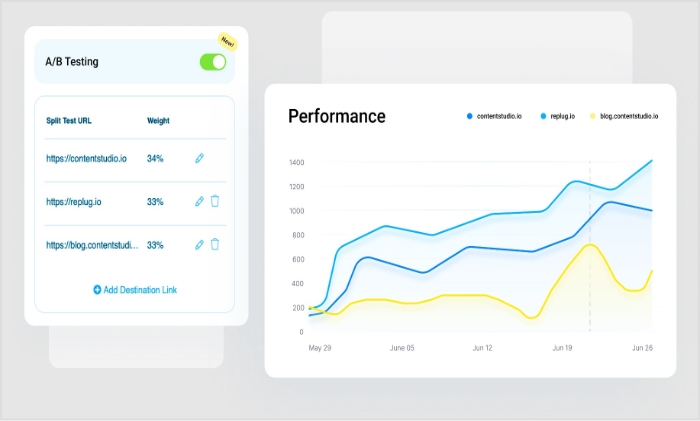
Link rotators could come in handy when you want to run A/B split testing campaigns with your links. Digital marketing may have a million ways to market your product or content, but the end goal of every strategy ortactic is to attract the audience to take action. Therefore, embrace the link management strategies.
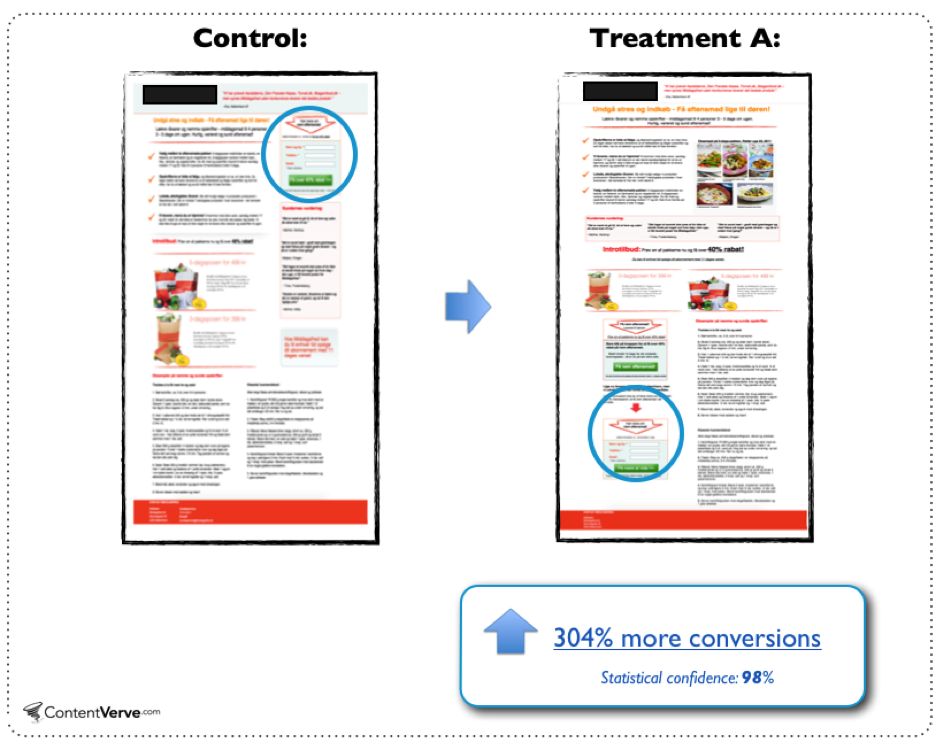
Most top-notch URL shorteners have a link rotator feature for A/B testing. A/B testing is a testing strategy of creating two options for comparison. Usually, marketers test out two ad designs or ad headlines to do a comparison between them.
Since link rotators allow users to split the traffic to two different destinations, it helps them understand which one performed better. It could be two sales pages or separate websites.
2. Promoting products in affiliate marketing
Affiliate marketing is a monetization model that allows marketers to earn commissions on sales. Affiliate marketers – whether they’re bloggers, YouTubers, or Instagram influencers – the majority of themuse short links for their affiliate links.
Plus, short URLs are used for almost all the outbound links that they need to track. There are short URL WordPress plugins that most of them use for shortening their URLs.
Link rotation could be used in affiliate marketing by setting up two different links to see which drives more visitors or which one attracts more eyeballs. It could quite be an experiment, because affiliate marketing depends on link clickability. One can’t earn a living with affiliate marketing if links aren’t being clicked.
59%of companies use A/B testing on their email marketing campaigns.
(QY Research)
Email marketing is a digital marketing strategy that allows brands, businesses, and marketers to reach out to their subscribers via email. The subscribers must opt-in to receive the email newsletters.
Email marketers use their email content to convey their message and insert links to drive traffic to their websites or landing pages.
Link rotators could be infused into anemail marketing campaign by adding two or more links with different anchor texts across multiple emails to see which one works best. However, one has to make sure that all the links are pointing to the same page.
Social media is a powerful source of website traffic. Marketers heavily rely on social media platforms such as Pinterest, YouTube, Quora, andFacebook to get website traffic. A small portion of that social media website traffic couldconvert into paying customers.
Link rotation could be used on social media when driving website traffic. Since link rotation helps you understand how theaudience behavestowards your links, it gets easier to understand the acceptability of a specific URL or website page.
5. Running ad campaigns
Online ad campaignsare incomplete without providing the destination URLs. Advertisers usuallydrive traffic through their online ads to the landing/sales pages or product pages on the website.
Link rotation could help advertisers with creating multiple links for their pages to analyze how those users receive those links.
So these were a few of the use cases of link rotators in digital marketing, but I’m sure there are plenty of other areas where link rotators could help marketers.
6. Link Rotators and SEO
“We find that content marketing is by far one of the highest performing channels over the long-term. On average, our clients see that people who subscribe to their blog are 50% more likely to become paying customers than non-subscribers. That’s a big difference,”
Jenna Alburger, Digital Marketing Strategist @ Outlier Creative (Data Box)
Link management is a vast domain and doesn’t only cover URL shortening. You must have learned so far that link rotation is a vital feature of URL-shortening tools.
Link rotators could come in handy in SEO for many reasons. One of those reasons is that link rotators go hand-in-hand with A/B testing and SEO experts split tests with landing pages, CTAs, navigation, content, and other stuff all the time .
Link rotators assist marketers and conversion specialists with driving traffic to specific pages or rotating some visitors for testing purposes. The reason behind pivoting some of the website visitors could be bringing some attention to the specific offer or landing page.
Similarly, the clickability on the CTAs or banners could also be analyzed by using the link rotation technology.
7. Rotate multiple links
One of the reasons why you should be trying out the link rotating feature is to rotate multiple links for testing purposes. You might want to see which one works best for you. For instance, if you have a dedicated domain registered for your short URLs, you could test out the link shortening with the custom domain and the regular domain to see the difference.
8. Alter destination URLs
Altering or rotating destination URLs is one of the features that most URL rotators offer . It allows marketers and bloggers to test the outcome if they switched the destination URLs, meaning if the traffic lands on a different destination page.
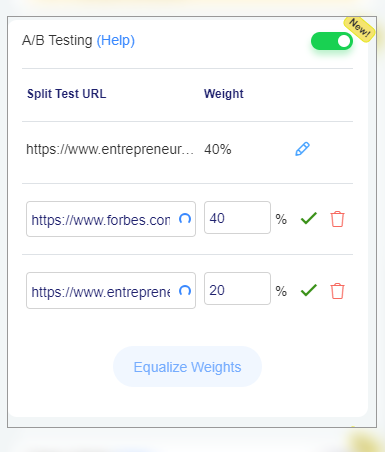
9. Add a link weight
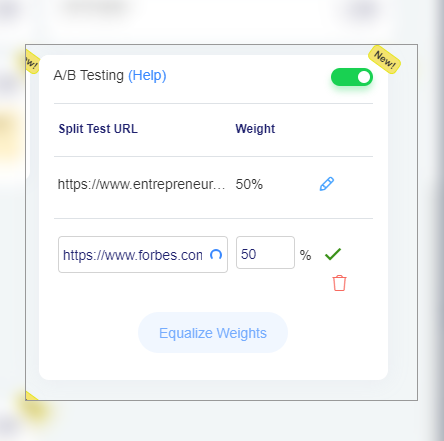
Adding a link weight is the ability to tell the link rotator about the importance of two or more links by setting a certain percentage for each link. Replug allows users to set the weight while A/B tests the URLs.
In conclusion, link rotators provide a number of benefits for online marketers and businesses. They allow for easy tracking and analysis of traffic, enabling users to see which links are performing well and which are not. They also offer the ability to rotate multiple links, providing a way to test different campaigns and marketing strategies. Overall, link rotators offer a powerful tool for optimizing online marketing efforts and are an essential part of any online business strategy.
To further enhance and uplift your marketing campaigns, consider using Replug’s top-notch URL shortener with custom name to create branded, trackable links that complement your link rotator strategy.
A call to action for social media is an untold success secret that top brands and influencers use it every day.The majority of the top-performing social media content usually has a strong call-to-action phrase.
No wonder the audience reacts to it quickly. I’ve got social media call-to-action examples to share with you. But, before I get to those examples, it’s essential to discuss the basics around call-to-actions that will come in handy.
Why do CTAs matter in social media marketing?
Social media marketing becomes dull if there is no activity whatsoever. The purpose of social media call-to-actions is to entice the audience to react to the message.
Social media success lies in the engagement process regardless of the social media platform. The reason CTAs matter in social media marketing is that they encourage the audience to respond to social media posts no matter what.
What elements should you include in your CTA strategy?
Here are the seven key elements that should be added to a CTA strategy:
Wittiness: A little bit of fun or excitement goes a long way
Appeal: An appealing message that attracts the audience right away
Shortness: A short and sweet copy that is understandable and catchy
Relevance: It should be related to the target audience in order to work
Clarity: It must help clarify the context of the story or event
Enticement: It must be enticing the audience to reply
FOMO: Sometimes, a fear of missing out also helps in conversion. Try using the urgency-factor in the CTAs.
Call to actions for social media
There is plenty to learn from the experts on social media in every area – CTAs are no exception. A call-to action (CTA) button can be added to any social media post. Take a look at some of the examples of call-to-actions for social media:
LinkedIn CTAs
LinkedIn is a top-tier social media platform, and ignoring this lead-generation machine would be a big mistake. When it comes to LinkedIn posting ideas, CTAs should be part of every social marketer’s LinkedIn content strategy.
Below are some good examples of call-to-actions found on LinkedIn.
1. Amazon Web Services
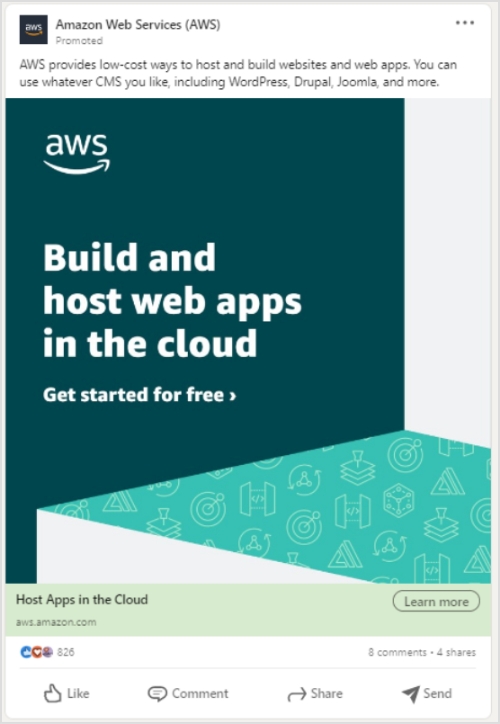
Amazon Web Services (AWS) is a popular cloud hosting service that allows users to host websites and apps.
Let’s check their LinkedIn ad:
Why it works
The main copy of the ad states the message with clarity. It simply hits the bullseye by targeting web and app developers.
A plus point in this LinkedIn ad is that it tells the audience about getting started for free – the CTAs like “sign up for free” and “free trial” in the copy always bring attention.
The ad has a “learn more” call-to-action that drives visitors to the AWS sign-up page. Moreover, such CTAs push prospective customers one step further, especially if they’re on the fence.
If you are looking to track or disguise links that appear much friendlier to the online user, then Amazon link shortener is just the tool for you. It helps you optimize product URLs and turn them into trackable and easy to share short branded links.
Enrolling in an AWS courses can help you better understand these tools and features, enabling you to make the most of AWS for website optimization and performance.
Tip: Make most of your CTAs by using it with deep links to amplify marketing efforts by sending users directly to the in app content and trigger app installations to the users that have not installed the app on their smartphone devices.
2. Microsoft
Microsoft is a tech giant that sells software, operating systems, and gadgets.
Here’s Microsoft’s recent LinkedIn ad about financial institution’s guide to the public cloud:
Why it works
The crux of the message is clearly written in the white bold text on the ad. No fluff or detailed text.
The “download now” CTA on the ad banner symbolizes that there is an ad for a downloadable item. It hints to the target audience to look into it.
Microsoft’s marketing team smartly used the “download” call-to-action button on the ad to make it easier for the audience to decide and take action about downloading the public cloud guide.
3. LinkedIn Talent Solutions
LinkedIn Talent Solutions is a powerful recruitment tool available on the LinkedIn platform.
Here’s their LinkedIn ad:
Why it works
A brief yet meaningful introductory text on the ad steals attention immediately.
Short link at the end of the introductory text gives the audience a chance to explore it further.
A downloadable CTA tells the target audience to get their hands on the downloadable item.
Tip: Audience-matched targeting can help you reach more prospects you already know.
4. Reliance Infosystems
Reliance Infosystems is a tech powerhouse that offers cloud hosting, network management, and IT security management services.
Take a look at their LinkedIn ad:
Why it works
The text on the ad image easily becomes overwhelming for the viewers unless it’s short and precise. Reliance Infosystems seems to be pulling this off quite well.
The dashboard picture of their software solution balances the whole thing. Pictures and vectors mostly help retain the target audience’s attention.
The sign-up call-to-action pushes the audience to take a leap.
5. LinkedIn Learning
LinkedIn Learning is an educational platform from LinkedIn. It provides users access to the platform through their LinkedIn accounts. Check out their LinkedIn ad:
Why it works
The most attractive part of this ad is the copy of the ad. It has a short yet catchy statement on the ad banner. Along with a strong CTA phrase, the “Learn more” CTA button persuades users to click and get more information.
A number or percentage on the ad copy immediately grasps the attention of the viewers.
The ad design is quite simple which shifts the focus toward the copy.
Twitter CTAs
Twitter may seem simple, but it has a lot to offer. All you need is to know how to capitalize on the attention. Here are some of the tweets from brands and influencers that are crushing it with their call-to-actions on Twitter:
Tweets allow to use a limited amount of characters. So link shorteners for Twitter help create short URLs that can fit into your tweets.
6. Canva
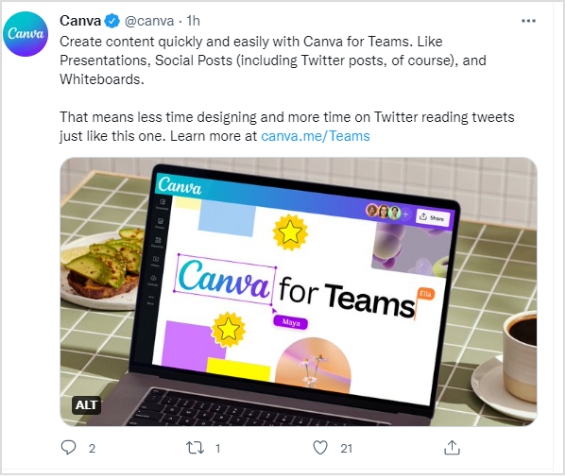
Canva is a popular online graphics designing tool for creating social media images, banners, and ads. Check out their tweet:
Why it works
The tweet from Canva vividly targets the organizations or companies with team members for their “Canva for teams” plan.
The simplicity of the tweet language ensures that readers keep on reading the two-paragraph tweet from them.
A call-to-action text at the end of the tweet makes it easier for the prospective audience to click through and land on the respective plan page.
7. Guy Kawasaki
Guy Kawasaki is an entrepreneur, investor, and adviser to startups.
I stumbled upon one of his recent tweets, and it’s worth mentioning here:
Why it works
A one-line tweet and the text body includes “7 lessons” – it surely rings the bell. People would like to take a sneak peek at the list of seven lessons even for a second. A good move, indeed.
A short URL is used very smartly – the tweet stays in just one line, which makes the short link more prominent and clickable.
A picture is added to the tweet just to weigh in on the organic reach. Pictures and images usually get more attention and organic viewership as compared to text-only social media posts.
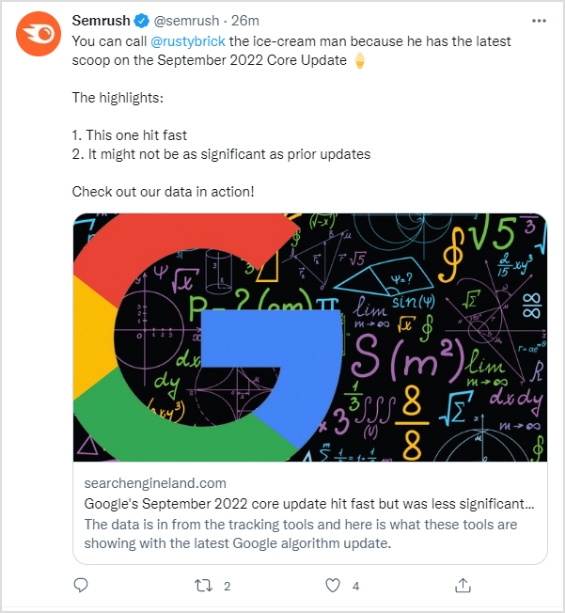
8. Semrush
Semrush is a powerful SEO analysis and rank tracking software used by professional digital marketers around the globe.
Here’s one of their tweets mentioning SEO expert Barry Schwartz.
Why it works
The tweet from Semrush cashed in on the hot trend in the online marketing and SEO fields, which is the September core update 2022.
Semrush mentioned Barry Schwartz in the tweet, which is a fantastic engagement strategy and gets the attention of the audience.
A short and brief call-to-action directs visitors to the article, which makes it a perfect tweet from a social media engagement standpoint.
9. TV Guide
TV Guide is an entertainment portal that discusses TV shows and movies.
Take a look at one of their recent tweets:
Why it works
The tweet has a news update for Netflix fans. It announces the availability of the Witcher: Blood Origin TV series on Netflix.
The tweet is short and sweet with no fluff. Such social media posts get more attention as compared to hefty social media posts.
TV Guide wrote a simple yet attractive call-to-action for driving Twitter followers to the article.
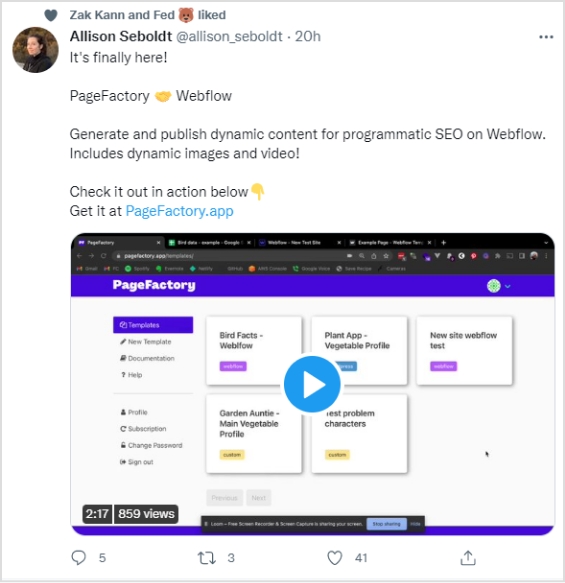
10. PageFactory
Allison Seboldt is the developer of PageFactory – an online content publishing app for content management systems.
Check out her tweet:
Why it works
Allison’s tweet has an attractive text body. She kept it simple yet meaningful. Her tweet was about the announcement of PageFactory’s integration with the Webflow platform.
The second thing that fascinated me was the two-line explanation that summed up the whole tweet.
The call-to-action was clear, concise, and catchy – it pushes the audience to click and check out the website.
The video in the tweet took the announcement to the next level.
Tip: Along with CTA’s, use retargeting ads to retarget people who haven’t visited your website and win back your online customers.
YouTube CTAs
YouTube is the second most popular search engine on the internet. When it comes to call-to-action for social media, YouTube has an excellent real estate to offer for CTAs.
Shorten links and add CTAs to your Youtube links using a Youtube URL shortener.
Let’s take a look at a couple of YouTube influencers who are capitalizing on the call-to-actions on YouTube:
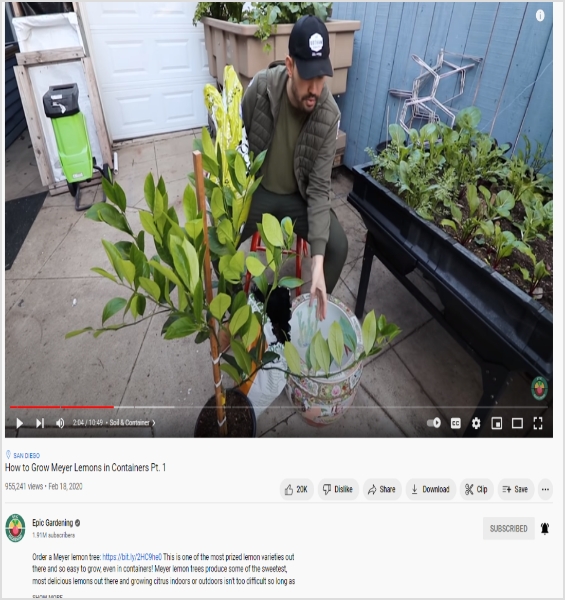
11. Epic Gardening
Epic Gardening is a well-known gardening brand that has a YouTube channel and a website. Let’s see how this gardening brand is using the call-to-actions on social media:
Why it works
Epic Gardening is using the video description for sharing the link. Since the video description is a place to find the detail about the video, the channel has a product link in the video description.
The channel is promoting the lemon plant through the link in the description – the video is also about the same plant. Therefore, relevancy is the key to generating sales.
The product link is in the first line of the video description, which makes the link more prominent.
12. Creative Explained
Creative Explained is a YouTube channel around gardening and life hacks made by Armen Adamjan. He is promoting an ebooks bundle deal and using his YouTube video descriptions to sell the bundle deal.
Take a look at the description of one of the recent videos on this channel:
Why it works
Armen mentioned his website address in the very first line to drive people to check out the deal next to the call-to-action.
This YouTube influencer used the naked URL of the bundle deal right below the call-to-action.
13. Meta for Creators
Meta for Creators is a platform built by Facebook with creators in mind so that they could meet, collaborate, and earn money online.
Check out their Facebook ad:
Why it works
The ad has a short and sweet introductory text, which catches the attention in a split second.
Meta for Creators used the “follow” in the introductory text and mentioned their Facebook page to grow followers.
They used the video to attract, engage, and convert the audience.
The ad also has a “Follow” CTA phrased button at the bottom to ensure that more people follow their Facebook page.
Tip: Use bio links tools for your Instagram, Facebook, TikTok and Twitter to drive more followers and conversions.
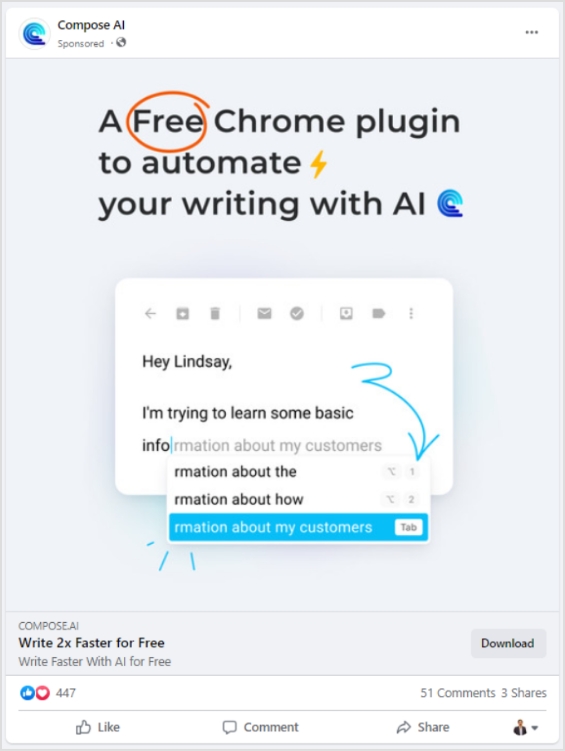
14. Compose AI
Compose AI is a browser extension that has powerful AI features to write speedy emails and messages. It works across multiple sites but is commonly used for Gmail.
Here’s the Facebook ad for Compose AI:
Why it works
The first and foremost is the circled “free” text in the ad copy, which immediately steals the attention.
The ad image showcases a snippet of how this tool works – it’s an excellent way of enticing the audience to try out the product.
The headline of this Facebook ad says, “Write 2X Faster for Free” – it’s a fantastic one-liner along with the download CTA at the bottom.
Tip: Automate your content publishing using social media management platforms and grow your reach.
15. Circle
Circle is a financial technology company that helps in financial transactions at a fast-paced using the power of USDC and Euro Coin.
Let’s take a look at their Facebook ad:
Why it works
Circle is cashing in on their ability to deal with USDC cryptocurrency in their Facebook ad.
The copy of the ad emphasizes the trustworthiness of the coin.
They also have a “learn more” CTA at the bottom to drive people to their website for more details.
Replug: How do CTAs work?
Replug is an all-in-one link management tool that creates branded short URLs with the ability to track link performance.You can make your links even more effective by using its short URL generator to create customized, trackable links that enhance your branding and boost click-through rates.
Moreover, the additional features include deep links, custom domains, integrations, bio links, UTM codes, retargeting, and call-to-actions.
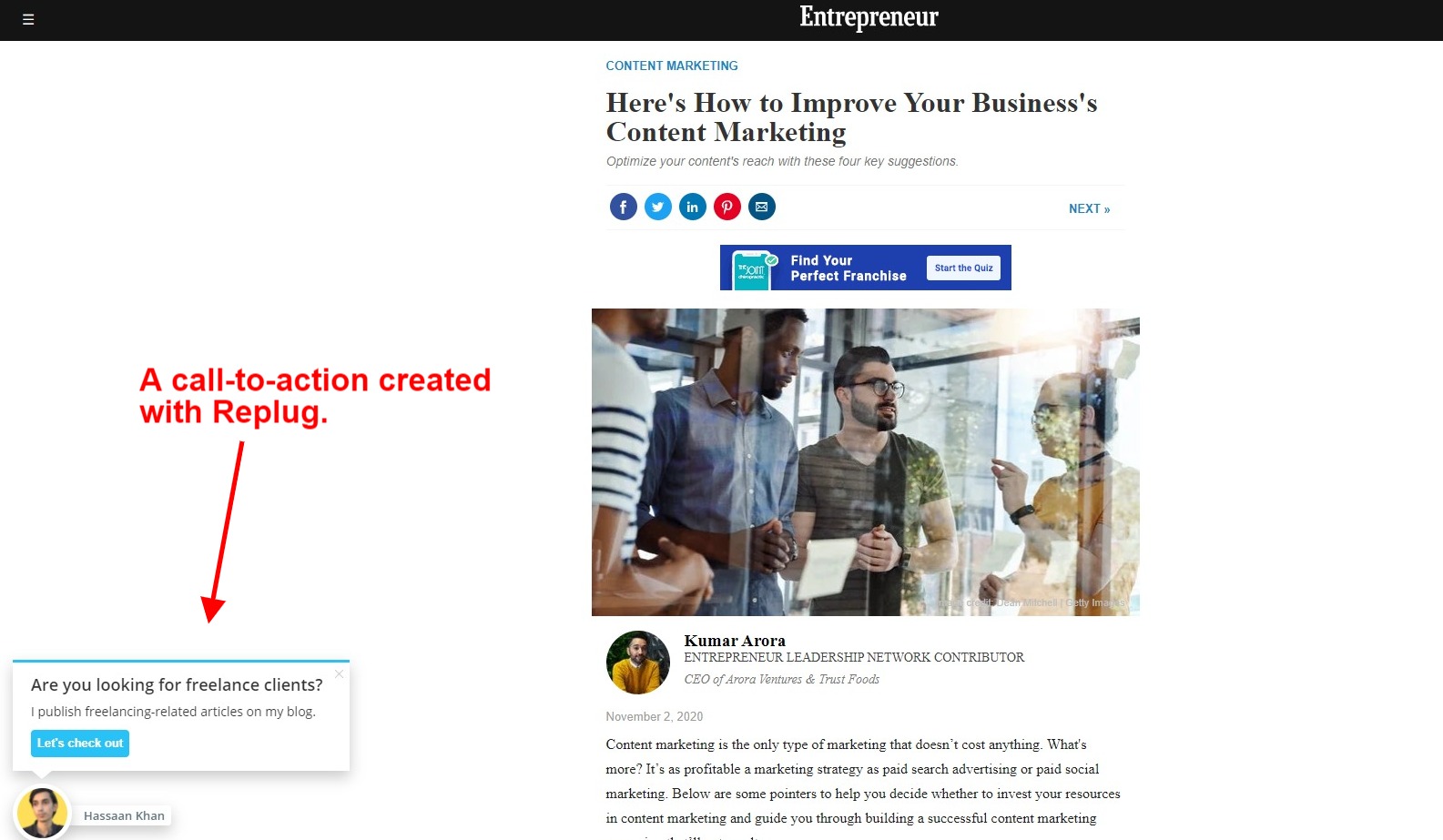
Here are the steps of creating a CTA using Replug.
Step #1: Create a campaign in Replug
Log in to your Replug account and go to the campaign section. Click on the “New Campaign” button to get started with creating a new campaign.
Step #2: Select your brand
The second step is to select the appropriate brand or create a new one just in case. Once you’re done with this, click the “next” button to proceed.
Step #3: Choose the CTA widget
The next up is the selection of the CTA widget. Since you’re creating a call-to-action with Replug, choose the “call-to-action” option from the widgets section.
Step #4: Opt for the CTA type
After selecting the CTA widget, choose the CTA type. You’ll see three options, such as a button, link, and form. Choose the required CTA type to proceed.
Step #5: Add a CTA message
Add a CTA message afterwards. If you opt for the CTA button option in step #4, you’ll have to input the message headline, message body, and button text.
Step #6: Customize the CTA
You can customize the CTA to match your company’s branding if you will.
Step #7: Adjust the appearance
Adjust the popup timing in the appearance settings to make sure that the CTA snippet appears the way you want it to appear.
Final thoughts on call-to-action for social media
Most people think of call-to-action buttons as green or yellow rectangular buttons that say “sign up” or “download” on the websites.
However, a call-to-action doesn’t necessarily mean a button. In fact, it could be a text, image, or emoji that navigates the audience or influences the visitors to take an action.
Since there is cut-throat competition on social media, it’s essential to use every tool available at your disposal to attract, engage, and convert the audience.
The call-to-actions for social media is surely something that could increase post visibility, clickability, and engagement across all social media platforms.
Don’t hesitate to alter your social media strategy by including tailored-made call-to-actions for social media to see how they turned out for you.
Reach out to us on social media and tell us how this tactic worked out for you because if it works, then you could always rinse and repeat.
Frequently asked questions
Here are some burning questions about social media CTAs that need to be answered:
Does every social media post need a call to action?
Social media posts with call-to-actions tend to perform better from an engagement standpoint. However, it’s not absolutely important to infuse a CTA every time you post on social media.
Some social media post types such as useful tips, personal stories, and case studies don’t require call-to-actions. Instead, they have to be authentic, helpful, and engaging.
What is a call to action on TikTok?
The commonly used call-to-action on TikTok is “link in bio” – it’s similar to Instagram. However, it’s a completely different story in the TikTok ads.
What is a call to action on Facebook?
Facebook allows URLs in the caption/introductory text on a post. Most social media users utilize short links on Facebook to drive the audience to their website or a different social media profile. It’s a popular social media tactic to capitalize on the attention.
What is a good call to action on Instagram?
A good call-to-action on Instagram means a CTA that grasps the attention right away. To make such a CTA, make sure that you’re reaching out to the right audience, sharing something relevant with powerful call-to-action such as free, get access, download now, grab it today, avail discount, early access, etc. Instagram link shorteners like Replug help create tracking CTAs and bridge pages that can redirect traffic to any webpage with a shortened URL that helps convert more.
What is a call-to-action hashtag?
It’s a type of hashtag that brands and organizations create that emphasizes taking action or encouraging the followers to perform a specific job. Sometimes, brands start a Twitter trend with a specific hashtag and pay influencers to use that hashtag for promotion.
A tracking URL is a link that contains one or more URL parameters to track, identify, and analyze user activity or behavior on a website.
URL tracking is an engagement strategy used in digital marketing that allows marketers to track the clickability, conversion rate, and call-to-action buttons on the websites.
Have you seen a call-to-action button in an email newsletter or cloaked Amazon affiliate links?
The reason behind it is that e-commerce marketers utilize tracking tools that allow them to add parameters that help track user behavior and also to win back customers through retargeting.
Why is URL tracking important?
URL tracking is an essential process in online marketing that helps marketers in analyzing the overall performance of the URLs. It includes factors such as number of clicks and conversions.
The reason why the URL tracking process is important for bloggers, affiliate marketers, and digital marketers is that it assists users in determining the link performance in an article or on a website page.
It’s nearly impossible to track affiliate sales without URL tracking. Almost every affiliate network or affiliate marketing software uses URL parameters in the product links to track the clicks and conversions.
Digital marketing experts use UTM parameters to track their website visitors and understand the source of the traffic. They set separate UTM parameters for Google ads, Facebook ads, social media, landing pages, etc.
To sum it up, the reason why URL tracking is important in the digital marketing world is that it provides users with insights into link performance, click activity, and conversion rate.
URL tracking is an online marketing strategy that monitors the impact of the marketing campaigns through link performance. Following are the activities that can be tracked with URL tracking:
Clicks
Conversion
Affiliate commissions
Click-through rate
Traffic sources
Leads generated
URL tracking process
Define the purpose of URL tracking:
Bloggers and marketers don’t vaguely start tracking random URLs. Instead, there is always an agenda behind the tracking.
URL selection:
Pinpoint the URLs that you can track over the next few weeks or months.It’s almost impossible to manually track hundreds of thousands of URLs.
Opt for the most suitable UTM parameters:
Opt for the most suitable UTM parameters to insert in the URL to track. A UTM parameter is a tiny code that goes into the URL address to track the sources of website page traffic.
Tracking the UTM parameters:
The last and most important part of the URL tracking process is tracking the UTM parameters. Track UTM parameters through Replug or also can use Google Analytics.
When should I use a tracking URL?
There are several use cases for tracking URLs. Once you have figured out what tracking a URL means, it gets easier to apply the tactics.
Here are different scenarios when you should use a tracking URL:
Record the clicks on the links:
Whenever you want to know how many clicks a link has gotten, the easiest way to track the clicks is by using a tracking URL.
Track sales and conversions:
E-commerce stores and online businesses track sales and conversion through a tracking URL. It usually comes in handy when businesses want to know where the sale or conversion has come from on their website.
Identify the top-performing pages:
When there are multiple sales pages with unique UTM parameters, it’s easier to identify the top-performing sales page.
Study the performance of the links on a site:
There are site-wide links available on every blog or website. Tracking URLs help admins understand the overall link performance on the website.
Allot the affiliate commissions appropriately:
Tracking URLs are imperative in affiliate marketing. No wonder the affiliate product links are long and clunky. The affiliate networks use URL parameters to identify and allot the affiliate sales to the appropriate affiliate account.
Find the traffic sources for a landing page:
When marketers create a new landing page for a new product, they share the landing page link across all channels, such as social media, email newsletter, blog sidebar, etc. Therefore, the source of the website visitor is easily traceable with a tracking URL.
Trace the footprints of the generated leads:
Lead generation means when a visitor signs up for a trial account or downloads a freebie. Marketers insert a UTM parameter that explains where the lead came from.
Types of URL tracking
There are three types of URL tracks that are being used:
1. Auto-tagging
The auto-tagging URL tracking is a URL tracking system that automatically adds relevant slugs to the URL that helps in tracking the data. There is no need to manually add a tag to every URL.
2.Manual tagging for backend systems
Manual tagging for backend systems relies on the ValueTrack parameters. These parameters track information about the ad clicks. Adding these parameters to your ad campaign, the user can track or identify the details such as device, location, and other information about the audience.
3.Manual-tagging
In a manual-tagging system, the user needs to put in the UTM parameters using a URL builder. Usually, the UTM tracking generators have a form and the users need to fill in the blanks using the parameters to generate the tracking URL.
How to track URLs with UTM parameters?
Are you wondering about tracking URLs with UTM parameters?
Here are four steps to follow:
#1. Select the URLs to track
The URL tracking process begins with selecting the URLs to track. Most experts start with choosing the UTM parameters and bypassing step no. 1, which doesn’t make sense. So start with the URL selection and then get to the UTM parameters afterward. Usually, digital marketing experts use UTM parameters on the call-to-action buttons in email newsletters, landing pages, discount offer pages, and Facebook or Google ads.
#2. Choose appropriate UTM parameters
The next up is to choose the suitable UTM parameters to add to your URL. Digital marketers who run Google ads or Facebook ad campaigns know the effectiveness of these UTM parameters. Moreover, a campaign’s URL could have multiple UTM parameters doing their specific jobs. The most common UTM parameters are mentioned below:
utm_source:
To identify the traffic platform sending traffic to a website
utm_medium:
To understand the type of link where it’s being used
utm_campaign:
To specify a certain campaign or promotion
utm_term:
To recognize the search term the brand is targeting
utm_content:
To explain the type of content used to drive website visitors such as an article text or a sidebar banner.
#3. Place the UTM parameter tracking
UTM parameters placement does seem a difficult task, especially for online marketers who have zero experience with HTML or website code editing. However, the manual insertion of the UTM parameter isn’t the only way to do it. There are several UTM tracking code generators available on the market that lets you insert the UTM parameters into a URL. Not only are these UTM generators spot on, but they also make the process faster.
#4. Analyze the results
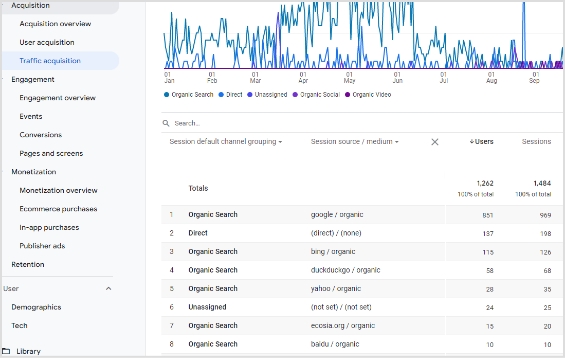
It’s necessary to keep an eye on the campaign results to navigate along the way. To get started with tracking your UTM campaign results, follow these steps: Go to your Google Analytics account for further steps Head over to the Acquisition. Then go to the Traffic Acquisition.
You’ll see all the traffic acquisition channels.
The UTM campaign would reflect under the source/medium section, so look out for that.
How to get a tracking URL?
The UTM parameters are extremely helpful when tracking user behavior during an online campaign. A tracking URL with complete tracking anecdotes could come in handy in social media marketing, online advertising, and email marketing.
Have you ever hovered over a link in an email that includes various terms such as source or medium? The reason is that these are types of UTM parameters that facilitate to track the performance of the email marketing campaigns.
You might wonder, how do I get a tracking URL? Well, you can opt for a decent UTM tracking tool that allows you to add UTM tags to your URLs without making a big deal out of it.
Add UTMs with Replug
Replug is an all-in-one link management platform for creating, managing and tracking vanity URLs for social media, online advertising, or email newsletters. Its custom URL shortener free tool allows users to shorten the long URLs so that they appear clean anywhere you share them.
Moreover, the additional Replug features include UTM, retargeting, bio links, QR generation, mobile deep linking, and more.
Here are four simple steps to get a tracking URL using Replug:
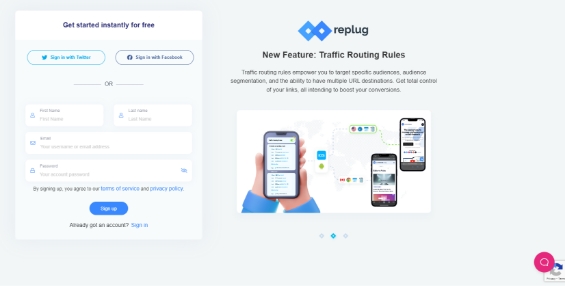
Step 1: Log in to your Replug account Go to the Replug app and log in to your account.
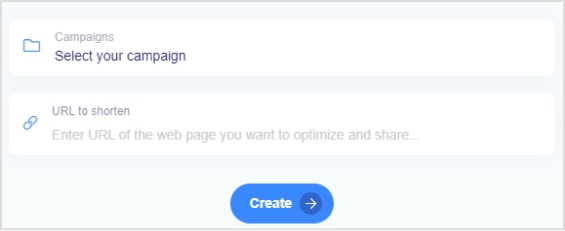
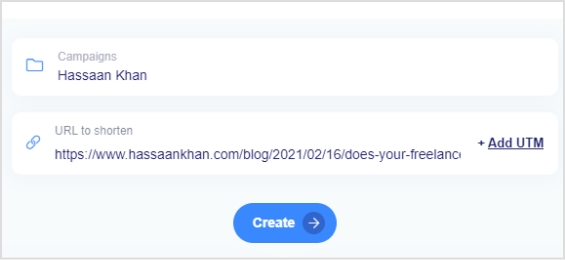
Step 2: Enter the URL to shorten After the login, you’ll see a URL shortening snippet right on the dashboard. Select the Replug campaign and paste the long URL you want to shorten and add UTM parameters to the campaign. If you haven’t created a campaign, you’ll be better off creating one.
The moment you paste the URL to shorten it, an “Add UTM” CTA button will appear next to the URL.
Step 3: Add UTM parameters
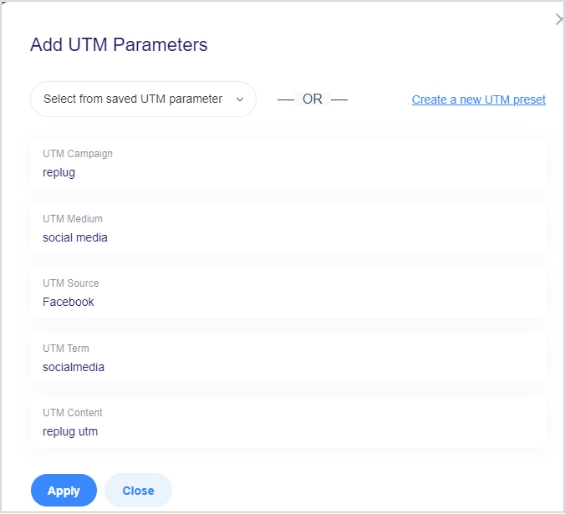
Click on the “Add UTM” CTA button to include the UTM parameters to add the ability to track the URL using Replug.
Once you click that CTA, you’ll be prompted with a UTM screen – you’d have to select an already created UTM or add a new one.
If you choose to create a new UTM code, a form will pop up to fill out.
Go through this step as it’s crucial to add the URL tracking. Once you’re done with adding all required parameters, proceed to the next step.
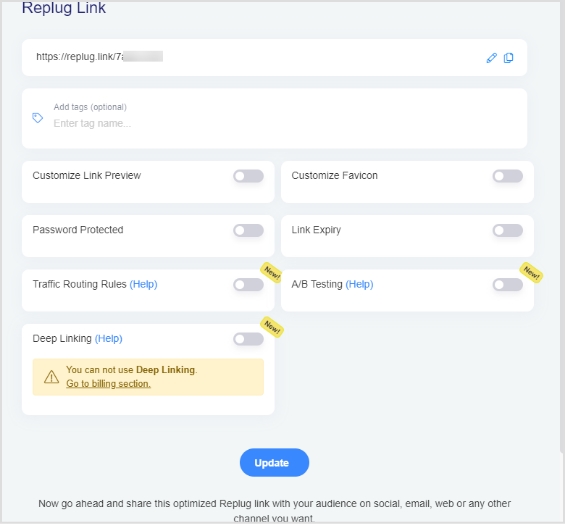
Step 4: Generate the short URL After you add the parameters, they will appear along with your URL. Proceed further to generate that short URL along with UTM parameters to track link performance.
Start Tracking
Generating a tracking URL is a great tool for online marketers to push sales growth. The fundamentals of a tracking URL will remain the same whether you use Google Analytics or a URL shortener tool. However, the benefits of URL shorteners are still yet to be explored to its maximum potential. Brands and entrepreneurs use URL tracking for branding, building a custom audience, and generating more sales.
Frequently asked questions
Can URL be tracked?
Any URL that contains the tracking parameters can be tracked. The ideal method is to include UTM parameters to track the URL performance.
What is URL tagging?
URL tagging is the process of infusing identifiers to the URLs to attribute the traffic to a specific campaign or event.
Affiliate Link Cloaking is a process of replacing the long and clunky affiliate product links with short links that trackable links and point visitors to the same URL destination, but are trustworthy and brandable.
Expert affiliate marketers use affiliate link cloaking to make their affiliate product links look more trustable. You might be wondering how to get your hands on those short links. So let me briefly explain affiliate link cloaking, and then we will touch on more relevant topics you should know about.
Shall we?
Bloggers and marketers use affiliate link cloaking because visitors are hesitant toward longs and clunky product URLs. Most experts try to simplify the URLs, CTAs, and navigation so that readers feel safe.
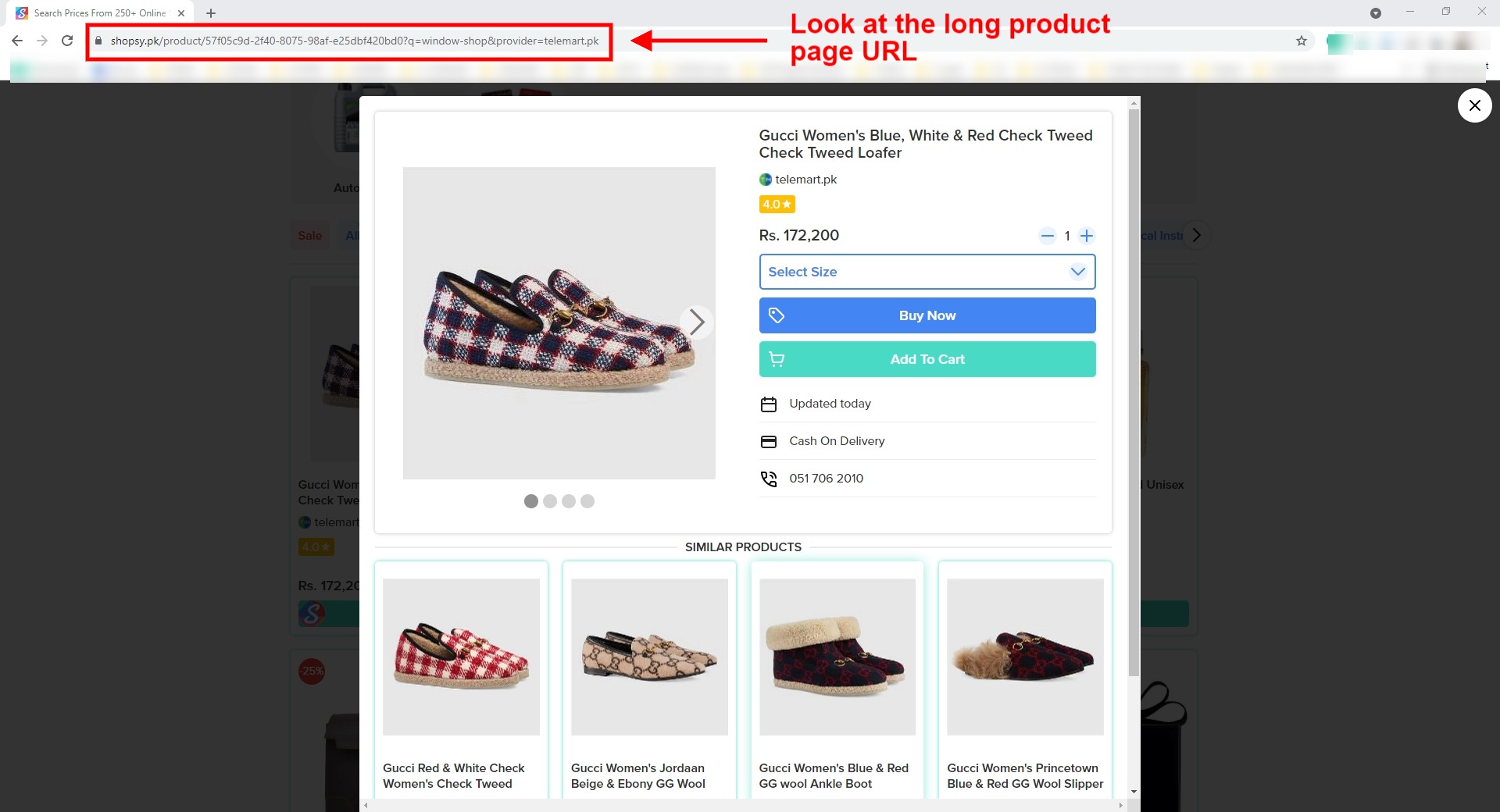
Perhaps, people are skeptical about long URLs because scammers use several protocols in the URLs or page contents that lead to data theft or privacy issues.
Most website owners want to track the clickability on their site pages to analyze their on-page SEO strategies and understand the content performance through user behavior.
Anyway, affiliate link cloaking allows affiliate marketers and bloggers to minimize the complexity in the website navigation and provide a better user experience.
Should You Cloak Your Affiliate Links?
If you have ever thought about whether or not you should cloak your affiliate links, then this section might convince you to start paying close attention to affiliate link cloaking.
I like cloaking affiliate links because I don’t want to scare off readers – some visitors hover over the links and when they see the long, clunky URLs, they avoid clicking on those links.
Cloaking affiliate links doesn’t mean you want to hide your association with the brands. But instead, it makes readers feel safe when the links seem short and sweet.
Below is a video that will make you understand the importance and benefits of affiliate links.
Can You Make a Living Off of Affiliate Marketing?
The answer is yes; you can make a living off of affiliate marketing. Affiliate marketing is a lucrative business model if done right. The only caveat is that you must understand how it works.
Even though most affiliate marketers fail to make a significant amount of money with affiliate marketing, it’s still one of the most popular ways to earn money online.
When content creators put out valuable content to solve the audiences’ problems and mention the links to the products or services they have been using, the audience trusts them with their recommendations.
The best part is that bloggers, YouTubers, and TikTokers make money off of affiliate marketing the same way – they build a fan base, provide value to earn trust, and make money by recommending products.
Since you have some idea of how link cloaking works, it’s important to discuss the fundamental steps of link cloaking.
i. Figure Out the Purpose of URL Shortening
Before you jump on cloaking random links on your blog just because you have seen influencers do this, it’s important to understand why you need to do this. A lot of bloggers blindly follow what experts are doing without having a plan in mind.
Most influencers and pro-bloggers cloak links because they don’t want messy links on their blogs. However, there are other reasons for cloaking links. For instance, short URLs or cloaked links also help in tracking clicks on those links. So figure out why you need to cloak links first.
ii. Identify the Website URLs to Trim Down
It’d be unfair if you start shortening the random URLs on your blog or website. Affiliate marketers and bloggers usually cloak affiliate product links to make them look decent. The reason is that affiliate product links are long and clunky, so cloaking them with a URL shortening tool makes them look nice.
You might not want to shorten the post or page URLs on your blog. Just stick to the affiliate product links when trimming the long URLs.
iii. Choose the Best URL Shortener
Cloaking links isn’t possible without an excellent URL shortener. Even though the core purpose of a link cloaking tool is to make links shorter and cleaner, it’ll be a bonus if any URL shortener provides additional features.
The value-added feature that you may want to look out for in a URL shortener or cloaking tool is click tracking. It’s vital to find out where visitors are clicking on your blog when it comes to affiliate marketing.
iv. Replace the Long URLs with Short Ones
Once you have shortened the long and clunky URLs on your blog using an external URL shortener or a WordPress plugin, the next up is the replacement of the long URLs with shorter ones.
It shouldn’t take so long if you’re using a tool like Lasso. However, you can always replace the links manually.
How to Cloak Links Using URL Shorteners?
If you’re curious about how to cloak affiliate or e-commerce products on your blog or website, then there are several tools to cloak links that might come in handy.
One of the methods to cloak links on a blog or a website is by using a link cloaking WordPress plugin.
However, it’s only possible when you’re using the WordPress open-source program.
I use Replug for creating short links. It’s a top-notch URL shortener that could connect with custom domains for creating branded short URLs. Plus, it has some of the best features, such as click tracking, integrations, bio link, UTM codes, retargeting, and more.
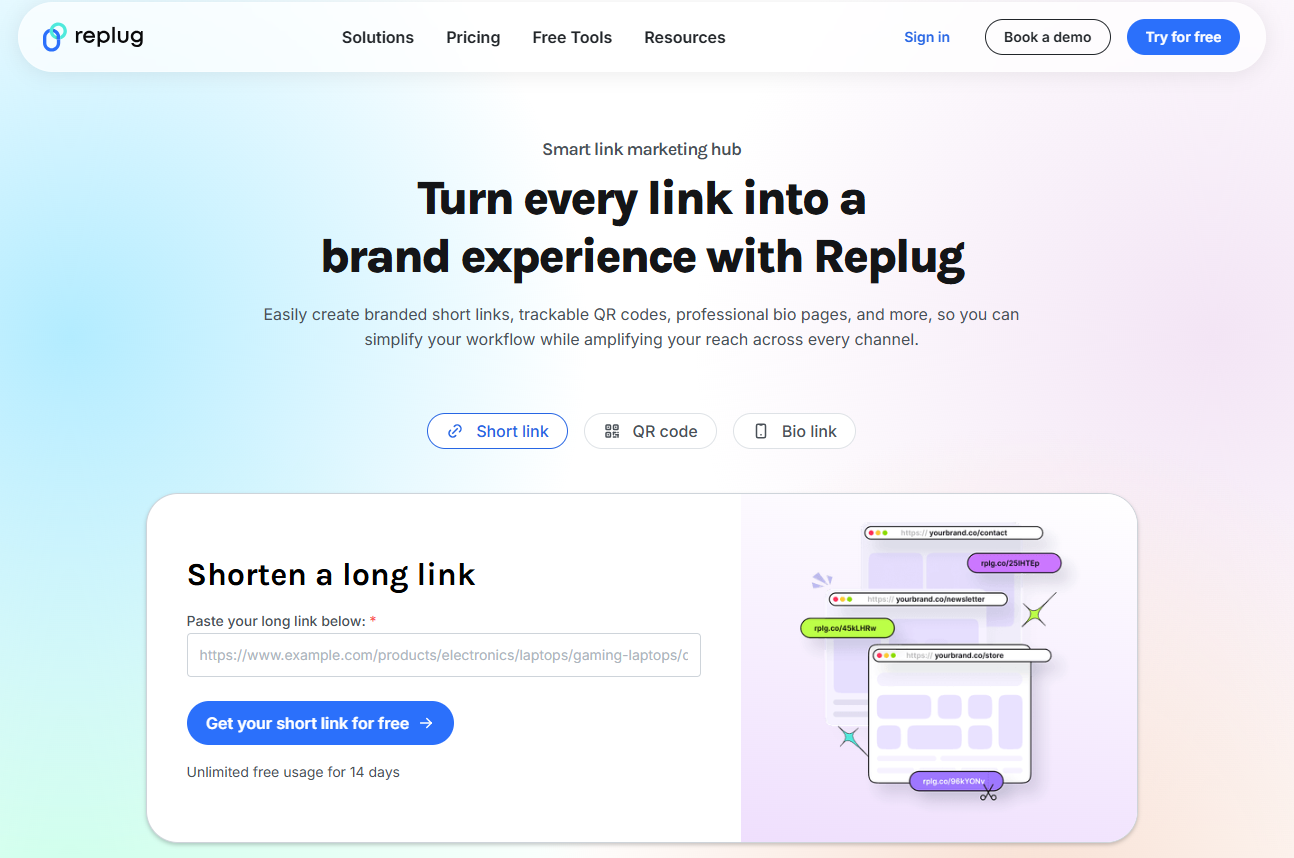
Go to the Replug website and log in to your account.
Once you’re in the dashboard, you’ll see the option called “Create Quick Replug Link” – this is where you could shorten the URLs.
However, I’d highly recommend checking out a few of our articles on how to use branded URLs or the benefits of using the short branded URLs, etc.
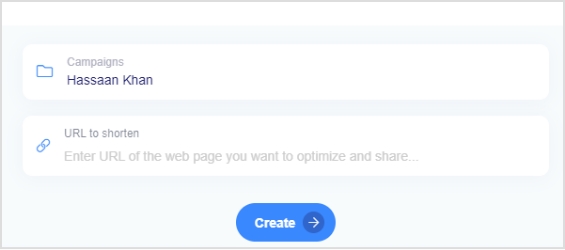
Once you’re logged in to your Replug account, you’ll see the URL shortening section right at the top of the dashboard. All you need is to choose a campaign name and insert the URL you want to shorten.
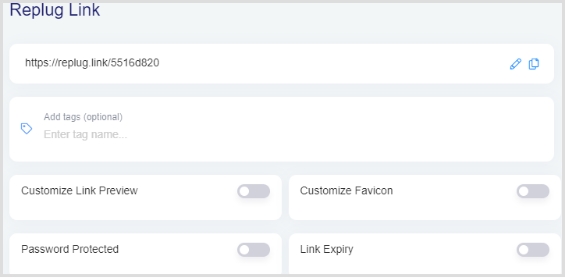
Once you select the campaign name and paste the long URL to shorten it and proceed with it by clicking on the “create” button, a popup will be prompted with a form to fill out about the short URL.
Fill out the form and you’re all set.
Now you have generated a short URL using Replug URL shortener.
You could later check out the Analytics section to analyze the clickability of the short URLs.
Related: How to Setup Your Branded Short URL in Replug
5 Reasons Why You Should Cloak Affiliate Links
There are several reasons why you should cloak affiliate links, so allow me to share them with you.
Let’s take a look:
i. Clean Link Structure
Let’s admit that when you have short URLs instead of long ones, they look better. One of the aspects of URLs most people ignore is the link structure. If your affiliate link has a bunch of UTM codes, tracking codes, and serial numbers, people won’t trust your links, and rightly so.
So one of the biggest perks of cloaking affiliate links is that you clean up the link structure, which plays a vital role in improving the conversion rate.
ii. Clicks Tracking
You may or may not be properly tracking the affiliate conversion. Most bloggers and affiliate marketers rely on the merchants’ tracking – whatever the seller is using for affiliate sales tracking, and you have to rely on that.
However, when you’re using cloaked affiliate links, you have some control over click tracking. You know how many clicks have been recorded in your URL tracking system and you could match the number with your affiliate statistics. It’d help you figure out how accurate your affiliate dashboard is or enable you to find any discrepancies in the affiliate dashboard tool.
iii. Nofollow Affiliate Links
Most beginner affiliate marketers don’t even know that they should nofollow every affiliate link and most of them let the link juice pass to the merchant sites. When you let the link juice pass to the external sources, you’re letting the search engine bots slip to other sites.
There are WordPress plugins or nofollow scripts (for manual insertion) available for bloggers and affiliate marketers. Plus, you could always use a top-notch link management tool to have more control over your links, even when you’re shortening them.
iv. Increase Clickability
The experts in the SEO industry believe that visitors are likely to click more on short links rather than long links. You may have noticed that professional SEOs and bloggers keep their page URL slugs as short as possible. The same goes for other links, such as affiliate links.
Pro-bloggers and SEO experts think that shorter links get more clickability and add more relevance to the destination URL.
v. Ease of Management
When you’re using a URL shortener to track clicks or conversion, you don’t just have control over data and statistics, but you also have ease of link management. Using a tool like Replug would enable you to track clicks on the short links as well as help you retarget the audiences who have clicked on the links.
So these were some of the main reasons why you should cloak affiliate links and make this process a part of your affiliate marketing regime.
Two Reasons Why Most Affiliate Marketers Fail At Affiliate Marketing
1. Zero Understanding
The no. 1 reason why most affiliate marketers fail is that they don’t figure it out. They think that just because they’ve put out a link to an affiliate product, people will click and buy the product.
It doesn’t work that way – you have to convince people that this product is worth buying. In some cases, the affiliate marketer purchases the product themselves to test out and share the results with the audience. It earns them the trust and loyalty of the audience. Be ready to go above and beyond to earn trust online.
2. Get Quick Rich Scheme
Affiliate marketing isn’t a quick money-making scheme. You’re most likely to fail at affiliate marketing if you don’t have the patience. It ain’t work too fast. Most bloggers who successfully monetize their blogs with affiliate marketing have had loads of failures, and they always learn from their mistakes.
If you want quick money out of it, you’re destined to fail at affiliate marketing. It doesn’t matter if you start with bloggers, YouTube, Instagram, or TikTok – it makes no difference unless you understand the game.
So you’ll be better off if you learn how to make money from affiliate marketing before jumping on the bandwagon of affiliate marketing.
Do Affiliate Links Affect SEO?
Affiliate links drive website visitors to the merchant’s website or landing page. It’s not rocket science that driving traffic to a page or website helps the destination page or website because everyone knows this.
But there is a caveat: if a link is pointing the visitor in a specific direction per se, then the destination page would benefit from it unless the link is nofollowed.
Whenever a link is nofollowed, the search engine bots are directed not to follow the link. This way, the bots don’t travel through that link. Thus, the page or website keeps the bots for a little longer.
However, some SEOs believe that even nofollow links add credibility and trustworthiness in the search engines’ eyes, but not in the same way as the dofollow links.
If you’re wondering whether or not the affiliate links affect SEO, then here are a few cases when affiliate links could potentially affect the SEO performance of a site:
i. Dofollow External Links
Since affiliate links are external or outbound links because they’re directing visitors to a merchant’s website, they could harm your site SEO if they’re dofollow. Most bloggers and affiliate marketers keep their affiliate links nofollow to avoid passing the unnecessary juice to the merchant’s website.
It’s safe to say that dofollow external links could affect your site’s SEO unless they aren’t taken care of from an SEO standpoint.
ii. Broken Affiliate Links
When affiliate links are broken, they’re quite damaging for an affiliate marketing website. There are several reasons why a broken link is dangerous; for instance, it doesn’t generate a sale, and it drives visitors away. This can frustrate readers when they don’t land on the intended merchant page.
So no doubt, a broken affiliate link could result in a bad user experience for your website visitors. And you can’t dominate with SEO techniques if you’re providing a bad user experience to the visitors.
Furthermore, there are WordPress plugins and online tools available that scan your site and report all the broken links.
iii. Clunky Product Links
Have you ever seen a long and clunky product link on e-commerce sites or affiliate blogs? When you hover on the products, you see unending URLs that seem scary at times.
One of the disadvantages of those clunky URLs is that they aren’t optimized for SEO. Plus, it scares visitors off due to their scammy appearance. Such affiliate product links are a no-go.
iv. Bunch of Affiliate Banners
A ton of affiliate product banner ads could frustrate visitors that are trying to learn about the product or find an answer to their query. You don’t have to bombard the visitors with several banner ads. Instead, put a couple of banner ads on the side or in the content if you have to put the banner ads.
Moreover, these image-based banner ads often increase the page loading speed, which fails websites at core web vitals. It’s Google’s mechanism to check and analyze the website page loading speed, accuracy, and quality.
So clearly, loads of banner ads could affect your site’s SEO performance.
The key to winning at affiliate marketing is figuring out the balance between several things, such as:
Niche identification
Target audience
Engaging content
Relevant affiliate products
However, there is no guarantee that more affiliates would bring in more money or fewer affiliate programs would earn you less money.
It seems impossible to pull off if you’re doing something wrong in affiliate marketing. On the other hand, it may look very simple to those bloggers who figured this out.
I’ve written a blog post about joining multiple affiliate programs and the gist of the blog post was that you should join multiple affiliate programs as long as they are in line with your content strategy.
A lot of affiliate bloggers say that building a topical authority on your blog or affiliate site is the stepping stone to start generating sales.
The way it works is that you test out different topics by publishing a handful of articles across three to four categories.
Once a cluster of topics starts getting traction from search engines, you could double-down on that and write a bunch of more articles on that topic/category and become an authority in that area. That’s how you build topical authority around a certain topic or category.
So several affiliate links or affiliate programs won’t make a difference unless your content is worth paying attention to from the readers’ standpoint.
However, indeed, placing dozens of the same affiliate links in a brief blog post may annoy the readers, so you need to create a balance in that area.
Make sure that your blog doesn’t look pushy when it comes to affiliate product insertion.
We’ve explained what affiliate links are and how they work on affiliate blogs.
The reason why we discussed this topic is that it’s vital to use link cloaking, especially when you’re monetizing blogs with affiliate marketing.
If you have been paying attention to quality content, link building, site design, page speed, and on-page SEO, then you can’t mess up with long and clunky affiliate links.
Several branded URL shorteners and affiliate link cloaking tools are available on the market. Choose the link cloaking tool that provides in-depth reporting and click-tracking so that you keep track of your clicks on the affiliate links.
TikTok doesn’t need any introduction. It has become the new normal, a buzzing phenomenon or a global trend, whatever you want to call it.
It’s the most downloaded app of all time. So it opens up an opportunity for businesses, brands, and influencers to cash in on this hot, trendy mobile platform.
For a few of those who haven’t had a chance to go through TikTok, I’d say it’s a short-form, vertical video app that has taken the world by storm.
There might be several ways to hop on the TikTok and become successful. However, understanding TikTok trends for individuals and businesses might set a pathway for long-lasting attention on the platform.
If you’re a business or brand and trying to get the hang of this 15-second vertical video trend, then you’re at the right place.
This article encapsulates major TikTok trends to follow and strategies to apply to make the most of this short-form vertical video social media platform.
Without any further ado, let’s jump right into it.
TikTok Trends for Businesses
Everyone knows that TikTok is on the rise, so brands and marketers want to cash in on this opportunity, and rightly so.
However, most companies don’t have TikTok trends for businesses to follow, and most end up frustrated after all. The reason is that they don’t have a plan in place.
One of the underestimated growth tactics is following the social media trends. We sat down to discover some of the hottest TikTok trends that businesses should surely look into. Here are those TikTok trends for businesses:
i. Influencers and Celebs are Joining TikTok
One of the trends businesses need to look at is how influencers and celebs take TikTok seriously. It’s a massive shift in the social media realm. There were celebrities in every part of the world who always avoided social media despite pressure from fans.
However, a lot of celebs have jumped on the bandwagon. Jennifer Aniston joined Instagram in 2019 and reached one million followers in five hours and sixteen minutes.
Similarly, some celebs and influencers are taking TikTok seriously. It seems like nobody wants to miss out on a boat. It’s a sign that there is attention shifting toward TikTok. The reason is that when influencers or celebs start a hashtag or hop on a platform, it means the audience follows it. As a result, the platform or a trend comes under the spotlight.
Millenials are quite popular, but Generation Z has taken over their position. Since we’re discussing TikTok trends, it’s impossible to talk about TikTok and not discuss Generation Z.
The TikTok’s popularity wouldn’t be the same if it weren’t for the Generation Z. The platform became wildly famous among Generation Z. According to Comscore, 32.5% of US-TikTok users are between 10 to 19, 29.5% are 20 to 29, 16.4% are 30 to 39, 13.9% are 40 to 49, and 7.1% are 50+.
The data shows that TikTok is the go-to platform for a younger audience, and brands could use TikTok as a source of engagement and relationship-building with the young audience through TikTok.
iii. Indie Musicians Collaborate with TikTokers
One of the TikTok trends is musical collaboration. Nowadays, indie singers and musicians create music, and besides putting it out on Spotify or SoundCloud, they collaborate with TikTokers to promote their songs.
TikTokers don’t only get the music to put out new videos, but they also get paid money to use that music in their TikTok content. You could easily spot such collaboration with hashtags such as #ad or #paid. Moreover, you could also notice that the TikToker would also mention the singer’s TikTok handle in the description or comment.
Brands should closely look at this TikTok trend, as they might be able to collaborate with the TikTokers in their niche. Check out the creative agency Collab Inc which connects content creators and brands.
iv. Social Commerce is Expected to Grow on TikTok
Social commerce isn’t a mystery anymore – Instagram, Snapchat, and YouTube have already been testing social media management tools. TikTok hasn’t been that far away. You can check out our tutorial on how to make money on TikTok.
It’s expected that the trend of TikTok commerce will go up in the next few years or so and users will be spending more money.While brands will be cashing in on their TikTok attention without leaving the TikTok app.
v. TikTok Challenges are Gaining Popularity
One of the TikTok trends businesses and brands should keep an eye on is the TikTok challenges. It works because an influencer or celebrity makes a TikTok video about a particular challenge, and it’s most likely to go viral if it happens to be fun.
Brands who keep an eye on TikTok trends to follow and take advantage of all the attention must keep an eye on the for you page or discover section on TikTok. Plus, following a bunch of creators would go a long way.
There might be dozens of more TikTok trends out there, and the strange part is that they keep changing every week. So anyway, stick around to keep learning about TikTok for business.
TikTok trends change from time to time, just like top trending hashtags on Twitter. Therefore, it’s difficult to point out a TikTok trend because no one knows how long it will last.
Brands who want to capitalize on TikTok trends shouldn’t overthink making videos on the latest TikTok trends – all they need is to create videos and move on.
When TikToker influencers come across a new trend through the discover page or for your section and find it interesting, they jump on the bandwagon and make a video around that.
Here are three TikTok trends that I spotted recently:
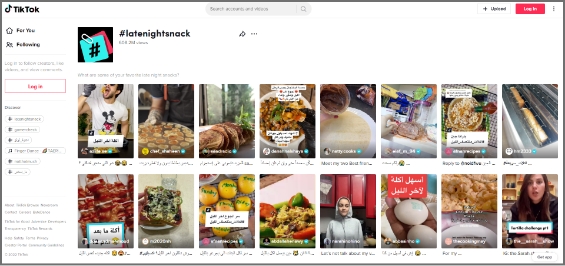
1. Latenightsnack
Latenightsnack trend was recently spotted on TikTok. It was about what people snack on late at night. TikTokers were making short, vertical videos about what they were eating while watching Netflix or working late.
This TikTok trend had gotten over 608 million views. So this is why it was trending on TikTok the other day.
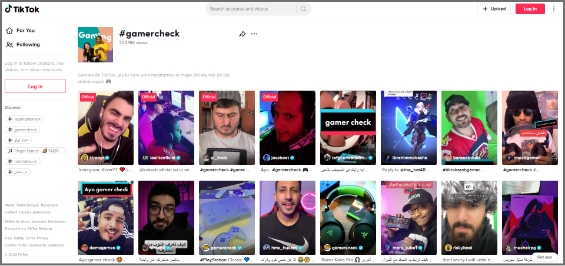
2. Gamercheck
Gamercheck was also a TikTok trend I came across lately. It was the trend about how TikTok users play games, what their gaming rooms look like, what gaming equipment they use, and all things gaming.
The Gamercheck TikTok trend had gotten over 300 million views, and the numbers were growing.
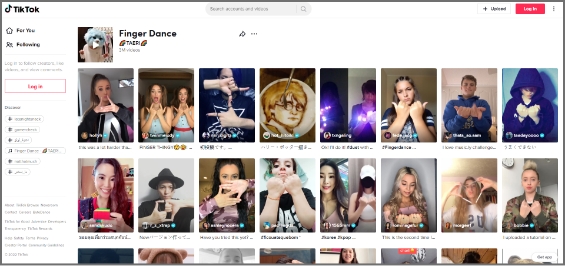
3. Finger Dance
Finger Dance was a relatively newer trend that was seen on Twitter. The TikTok trend was about finger dancing – TikTokers were making their fingers dance to the music. It was fun to watch people doing finger dancing.
This TikTok trend had reached 3 million views, but it looked like it would become a massive TikTok trend in the coming weeks.
Strategies to Apply to Trend on TikTok
Trending on TikTok doesn’t happen on a whim, especially if you’re a business. Usually, influencers and celebs fascinate people to follow the trends on social media.
However, if brands want to trend on TikTok, they must humanize themselves – people like to connect with people rather than bots or faceless social profiles.
Here are some strategies brands can opt for to trend on TikTok:
1.Understand the Market Demand
Trending on any social media platform is no easy game – you have to be an expert at this or know how to make content that immediately goes viral.
For the majority of the brands and individuals, it’s essential to figure out what’s happening in the market. It doesn’t apply to only brands who want to dominate on TikTok. But instead, it’s for everyone who wants to jump on this bandwagon.
Understanding the market demand means figuring out what people like, what they want to consume more, and what type of TikTok accounts are getting more traction.
The easiest way to understand the market demand is to spend a good couple of days on TikTok and analyze the “for you” and “discover” sections on TikTok. This will allow brands to comprehend what people are watching, liking, and enjoying.
2.Use Trending Sounds in the Videos
TikTok is a social media platform that might be new for most of us, but it’s certainly not impossible to pull this off.
One of the best strategies to go viral on TikTok or make trending videos is by simply using the trending sounds available on this short-form video app. If you’re new to TikTok, you’d probably think about where to find trending soundtracks on TikTok.
Well, you don’t need to find those popular sounds. In fact, TikTok allows you to use the TikTok sounds from the trending videos. All you need is to look out for the popular videos on the “discover page” or “for you” section.
The videos that get recommended to the TikTok users are the ones that are trending or gaining some traction.
Since you’re a business and want to trend on TikTok, the easiest way is to start using trending sounds in your TikTok videos. This will allow you to blend in with the TikTok community, and your content will start getting discovered through the trending sounds you have been using.
3. Collaborate with Other TikTokers
One of the easy wins for brands to trend on TikTok is collaborating with TikTokers. These TikTokers could be influencers or up-and-coming content creators. The brands may have to cherry-pick these TikTokers based on their content type, audience demographics, and fan loyalty.
Get paid through collaborations with other Tiktokers, and it doesn’t cost as much as Facebook or Instagram ads. However, the return of these collaborations could be an eye-opener.
If you haven’t had a chance to spot a TikTok collaboration, then you perhaps don’t know why these collaborations happen. Obviously, the content creators want to monetize their social media existence through these paid collaborations, and brands get the attention, eyeballs, and publicity.
If you think a single collaboration with a TikToker would get you to the For you page or the discover section, then you’re mistaken. It doesn’t happen so quickly for most brands, but with time and effort, you never know.
So don’t rule out the possibility of going viral on TikTok just by collaborating with a famous TikToker.
4. Upload Multiple Videos Every Day
One of the strategies that take TikTok influencers to the next level is that they upload multiple videos a day. The influx of continuous videos often helps such TikTokers in getting so much attention on the platform.
Any social media platform will put you on a pedestal if you keep putting out fresh content consistently. So an easy hack for trending on TikTok is to experiment with uploading multiple videos daily.
Sure, it’ll be tough to maintain the quality of every video, but it’s worth the risk. If you follow social media gurus, they put out a ton of content daily on Instagram, Twitter, and TikTok.
Evan Carmichael is a video curator who started on YouTube and now also has a TikTok account. He uploads multiple videos on TikTok every day.
He has got half a million TikTok followers.
5. Use the Relevant Hashtags in the Video Descriptions
Hashtags have a lot of potential if done right. The majority of the users don’t know how to use hashtags across all social media platforms.
As far as the hashtags on TikTok are concerned, they play a vital role in taking any content on the “for you” page or discover section. Since the hashtags are connected to the discoverability of the content, they have the potential to make your videos quite popular.
However, the common mistake people make is going after generic hashtags. For instance, if they’re sharing a picture of rice, they might use hashtags such as #rice, #food, and #tasty.
So instead of using those generic hashtags, they must go after specific hashtags to be more precise, for instance, #chickenrice #bestfoodintown, #bestricerecipe, etc.
The hashtags must be relevant yet specific – opting for broad and short hashtags won’t help the cause.
6. Engage with TikTokers in the Same Niche
The most undervalued TikTok growth strategy that could help a brand or individual trend on TikTok is engaging with TikTokers in the same niche.
Usually, it’s said that you must engage with your audience through comments, replies, and DMs – the same applies to the TikTokers.
When TikTokers communicate with each other on the platform through DMs or comments, it builds a relationship among them, which could lead to collaborations and more opportunities.
Furthermore, the TikTokers openly engage with each other through commenting or duets. This gives a chance for the audience to pay attention to both sides. The audience loves their favorite content creators collaborating or talking publicly.
It opens up a plethora of opportunities for brands to cash in just by building relationships with TikTok content creators or providing a stage for other TikTok influencers to come on board and entertain the audience.
There are countless ways to get the attention on TikTok, which is key to gaining popularity and getting on the trending sections on the vertical videos app.
Best TikTok Examples to Understand TikTok Trending
It would be unfair to discuss TikTok trends and not talk about the TikTok influencers who have been crushing it with their uniqueness, innovation, and strengths.
Interestingly, some high-profile TikTokers don’t always worry about the trends. Sure, some try to cash in on it, but most just go with the flow.
Here are three TikTokers that have their unique style, posture, and genre, but they’re doing quite well on TikTok:
1. GaryVee
Gary Vaynerchuk is an entrepreneur, investor, author, and social media expert. He has over million followers on Instagram, Facebook, Twitter, YouTube, and TikTok.
He always advises people to post multiple times on TikTok and Instagram to pop up.
So it’s a no-brainer that if you start uploading several videos on TikTok daily, your numbers will skyrocket in a month or so. Once you start to get those followers consistently, you could be trending on TikTok.
2. Zach King
Zach King is a popular social media influencer, filmmaker, and illusionist. He became popular from his 6-second magic videos on Vine. Even though Vine shut down, Zack didn’t stop there.
When TikTok popped up, he hopped on this 15-sec vertical video platform and started doing the same. And now, he is among the top TikTok influencers in the world. He has over 68 million followers on TikTok.
3. Charli D’Amelio
Charli D’Amelio is the biggest TikToker in the world. Now she has over 141 million TikTok followers. Not only is she the top TikToker, but she is also among the highest-paid TikTok influencers in the world.
The interesting thing about Charli is that she showcases her passion and talent for dancing in her TikTok videos. It’s a true testament to following your passion and making the most of it.
Why Brands Should Use a URL Shortener
Short URLs have not been this relevant before. It doesn’t matter what social media platform you’re focusing on. A URL shortener tool can come in handy.
Not only does it allow you to shorten the long URLs, but you can also create branded short URLs for newsletters and social media sharing.
Here are some of the main reasons why brands need a URL shortener:
Bio Links on TikTok, Instagram, and Twitter
All major social media platforms allow users to put their website or blog URL in the bio. However, a long URL doesn’t look reasonable. As a result, it affects the overall look and decency of the social media profile.
This is where an efficient short URL shortener comes in handy and solves the problem. It lets users convert long and clunky URLs into short and sweet URLs in no time at all.
Now brands can put their sales pages or discount offer page URLs in the bio section of Instagram or TikTok without any problem.
Placing the short URLs in the bio or story on social media platforms isn’t enough – it’s half the equation unless you could track the clicks.
The reason is that click tracking can help you analyze the conversion from the clicks. You might not want to generate short links that don’t have any performance tracking system in place.
When a brand is on the lookout for a link management tool for URL shortening, they must try to find a URL shortening tool that offers click tracking. Otherwise, it would be impossible for them to identify where the clicks are coming from. Usually, a website gets traffic from several sources.
Long URLs Look Spammy
One of the main reasons why URL shortener tools became popular is that long URLs often look spammy. People generally don’t trust those long URLs as they seem fishy.
Have you ever come across a long URL on social media that look malicious? We often receive such spammy links in the DM, and most receivers hesitate to click on those links.
Branded URLs are Trustworthy
A huge perk of using a branded URL shortener tool is that it could flawlessly integrate with your domain name.
Brands need trust from the audience, especially on social media platforms. So using a short branded domain for sharing social media content could turn things around for any business. Here’s the guide on adding a custom domain.
Drive Website Traffic from Social Media
Brands that develop websites want website visitors, they use different traffic strategies and digital marketing tactics to drive website visitors to their websites.
There are several ways to drive website traffic, such as:
Social media marketing
Social media ads
Search ads
SEO
Sponsored content
Guest posting
Paid collaborations
Most of you might already know about these different ways to drive website traffic. However, Replug.io allows you to drive visitors from sharing content on social media seamlessly.
If you want to test this feature of Replug, all you need is to start a campaign and choose retargeting as your campaign type. Then, opt for the widget as a call-to-action.
Choose the CTA type afterward; you can either go with a button, link, or form. Then, add a personalized headline, message body, CTA text, and the link to drive traffic. That’s it.
No doubt, TikTok has taken the world by storm, and it’s essential to figure out how to use this short-form, vertical video platform with immense attention on it.
We’ve discussed TikTok trends and strategies to make the most of popular TikTok trends. Plus, we also shared some TikTok influencer examples that are using the platform quite impressively.
We’ve previously discussed how to make money on TikTok in detail. If you haven’t seen this detailed guide, we highly recommend checking it out.
Since TikTok has taken the world by storm, everyone wants to know, does TikTok really pay?
To be short and sweet, yes, it does!
Now you must be wondering.
How to make money on TikTok?
Who can make money on TikTok?
TikTok is probably one of the hardest things to resist at the moment. Even though TikTok has become the most popular mobile app, most users still don’t know how to make money on TikTok.
No Worries!
We’ll walk you through how to start and monetize your TikTok account, but you have to put in the work and spend some time reading this piece.
So whether you installed TikTok just to watch funny videos or want to be a TikToker, this article could be an eye-opener for all of you.
Buckle up! It’s a complete guide on TikTok monetization.
Let’s get down to business by answering some highly relevant questions.
How Do I Start Making TikTok Money?
Hit the milestones from the number of followers and monthly views standpoint, then apply for the creator fund program.
Eligibility Factors: TikTok Creator Fund
It’s available to the creators that meet the following criteria:
Creator Age: At least 18 years old
Eligible Countries: US, UK, France, Germany, Spain, and Italy
Minimum Followers: 10,000
Last 30 Days’ Video Views: At least 100,000
Must Comply With: TikTok community guidelines and terms of service
Simply put, anybody can make money from TikTok. Just grow a following on TikTok by creating content around any of this:
Passion
Skill
Day job
Side hustle
Knowledge
Experience
Once your TikTok content starts getting traction on the platform, the followers will pour in, and some money-making opportunities will eventually begin to unfold.
The TikTok Creator Fund is a creator reward program that pays TikTok creators for being creative, inspirational, and consistent on the platform. It’s not a grant or ad revenue-sharing program. Instead, it’s a way of celebrating the uniqueness and talent that creators bring to the platform.
The purpose of the TikTok Creator Fund is to appreciate the creators’ success, commitment, and passion for showcasing their skills, talent, and passion. Since it’s not a monetization method, it may vary from month to month, depending on numerous factors.
How to Apply for TikTok Creator’s Fund?
First achieve the required number of followers and views. Then follow these steps to get your TikTok Creators Fund.
Open your TikTok app and go to the account settings.
Next, open the “Creator tools” and click the “TikTok Creator Fund” to apply for the program.
How Much Does TikTok Pay Per 1000?
It pays 2 to 4 cents per 1000 views.
How Many Views Do You Need to Get Paid by TikTok?
You must have at least 100,000 views in the last 30 days or so.
Keep in mind that a hundred thousand views are a minimum. The more views you get, the higher you could earn. However, other factors determine how much you’d make each month on TikTok.
Following are the elements that determine how much you’d make from TikTok:
Number of views on the videos
The engagement level of the audience
Compliance with terms of service and community guidelines
The authenticity of the views
15 Surefire Ways on How to Make Money on TikTok
Let’s quickly move on to the list of various methods to make money on TikTok:
Selling Direct-to-Consumer Products
If you have a 10 or 15 years old in your house, the kid would know the top TikTokers in the country. Nowadays, kids don’t know the TV stars and film celebs. Instead, they have favorite YouTubers and TikTokers.
Since TikTok is a short video platform that attracts an audience ranging from 12 to 60 years old, it has gotten so much attention lately. The TikTok demographics provide brands with loads of opportunities to sell directly to consumers.
Brands could potentially start their TikTok accounts or opt for either running TikTok ad campaigns to sell directly to the consumers. When a brand uses a platform like TikTok and connects with the potential audience, it widens the brand’s social media reach. This removes the middleman, but it also builds a relationship between the brand and the potential customers.
Reselling Fashion Accessories
You might think of TikTok as a platform to watch entertaining or funny videos, but it has gotten much bigger. Since TikTok has a massive audience, it has created business opportunities for brands, entrepreneurs, and almost everyone.
You may or may not have seen this, but many TikTok users are selling clothes and accessories on TikTok. TikTok may not have the transactional facility to carry out the selling and purchasing of products. Still, things seem to be working out for many.
One of the ways to make money on TikTok could be reselling fashion accessories, such as clothes like men’s leather blazers, jackets, suits, jewelry, makeup, and other relevant products. However, you may have to create a TikTok account dedicated to selling those items. Otherwise, it won’t work out. For example, you can’t use your same TikTok account for cat videos and selling clothes.
Promoting Songs on TikTok
Once you’ve managed to gain a sizeable audience on TikTok, there will be many monetization opportunities waiting for you. One of those opportunities would be promoting songs of indie singers.
Many indie singers who release their singles reach out to TikTok influencers and pay them to use their songs in their videos. Plus, TikTokers often tag them in the video description on TikTok. Thus, they also get promotions along with the song.
I have been noticing song promotion tactics for the last three years or so. It’s a win-win situation for both parties. The TikTok influencer gets paid a good amount for a 15 or 30-second video. The singer gets to promote the songs without spending hundreds of thousands of dollars on traditional marketing channels.
Hiring Micro-Influencers Over Superstars
Do you know celebs get paid millions of dollars to post on Instagram? According to Influencer Marketing Hub, Kendall Jenner is among the top 10 highest-paid celebs for publishing a single Instagram post. The article revealed that she could charge up to half a million for a single post on Instagram.
Most of us don’t have that kind of money to spend on influencer marketing. However, TikTok is a great platform for hiring micro-influencers over TV celebs. These TikTok influencers have an engaged audience, but they are also quite affordable compared to top-tier global celebrities.
Remember that it won’t happen on a whim. You can’t just download TikTok and start finding a TikTok influencer. You must give it time before you jump the gun.
Therefore, if you’re trying to make money on TikTok, you could put yourself in a micro-influencer shoe and try to build an engaged audience to attract sponsors. However, you’ll be better off sticking to a specific niche while creating TikTok videos.
Create Sponsored Content
Have you ever seen a popular tech YouTuber unboxing a cell phone or tech gadget? Well, tech companies pay those YouTube influencers to unbox and review their products.
The same thing could work out for you on TikTok. However, the key to getting paid for your TikTok videos, you must cross a threshold. In other words, you must have a rather large followers base to attract sponsored content deals.
TikTok Creator Marketplace is the official TikTok marketplace for finding TikTok influencers for your sponsored content deals. It’s a complete TikTok influencer discovery network that provides advertisers with the statistics to find the most suitable TikToker for sponsored content.
Accept Video Gifts
One of the TikTok monetization methods is receiving video gifts. Even though it won’t work for every video or creator, it is still a way to make money on TikTok. Before we dig deeper into how it works on the platform, let’s discuss the eligibility criteria for accepting video gifts.
The creator must be 18 years of age and should have 100,000 followers. In addition, the account should be at least 30 days old with at least one public video during that period. Above all, the TikTok account must not be violating the community guidelines.
The TikTok users should join the Creator Next program to access several TikTok monetization tools, including video gifts. The creator must enable this feature from account settings to accept video gifts. Go to the “Creator Tools” to enable this feature and select the “Video gifts.” Then, turn on the video gifts.
If the video gifts feature hasn’t rolled out in your country, you could go to the “Creator Tools” and toggle on the “Video gifts” feature.
Once it’s enabled on your TikTok account, the algorithm would decide the eligibility of the TikTok videos for video gifts. Then, the audience would see a gift button next to the comment section for sending you a video gift that you could redeem later on.
Grow & Sell TikTok Accounts
Most beginners have no idea about social media real estate. Buying and selling of social accounts and channels is a common practice, and TikTok is no exception. The point is that you can grow a TikTok account and flip it for thousands of dollars.
All you need is to figure out how you can scale a TikTok account rather quickly. There is no secret to growing a TikTok account rapidly. All you need is to create a content strategy by keeping the target audience in mind. If you hit the bullseye with your targeting and creating exciting content, your TikTok account would surely take off.
Once you cross a 100,000 followers mark, you could either monetize it with Creators Fund or sell your TikTok account for a heap of money.
Manage Influencer Campaigns
If you are camera shy and don’t want to create videos for TikTok, you can still monetize TikTok. However, you won’t be under the spotlight in this situation. Instead, you’d be offering your expertise to connect creators and brands.
So let me explain how it works: one of the easiest ways to earn money on TikTok is by managing influencer campaigns. All you need is to connect with TikTok influencers in your town, city, or country and build a strong relationship with them.
If you have a solid social media follower base, it’ll be easier for you to pull this off. Influencers usually don’t like to be friends with random people unless they’re formally introduced to them for business.
Once you have TikTok influencers onboard, you could help brands and influencers strike a deal and charge a small fee from both parties for your service.
Management Services
Social media influencers rely on management services to help them find clients to work with and get their merchandise ready for them or even manage their social media profiles.
Therefore, you could offer a management service for TikTokers or TikTok influencers and charge a fee. This way, you get a chance to use any of your soft skills or a passion for earning some side money.
There are various management services you can go for. Like TikTok video editing, music discovery, social media management, merchandise management, community management, etc.
You might not be monetizing your TikTok profile, but you’d be making money from your work for other TikTokers.
Place Affiliate Links
A common yet under-utilized method of making money on TikTok is placing affiliate links in your TikTok bio. You may not be able to make a clickable link in the video description on TikTok, but the bio link works like a charm.
Experts from different walks of life use Instagram and TikTok bios for giving away freebies using short links. Replug is a popular URL shortener for creating short branded links for TikTok or Instagram bio. This amazing link management platform offers branded URLs, custom audience clicks, performance tracking, retargeting, bio links, etc.
As far as placing the affiliate links in TikTok videos is concerned, you could insert the affiliate links in your TikTok bio. Not only does TikTok help you reach newer audiences, but it also creates chances for you to generate more affiliate sales.
Paid Collaborations
One of the ways to make money on TikTok is paid collaboration. Usually, smaller TikTokers pay influencers to collaborate with them and highlight their account in the paid video description.
Have you ever seen two or more TikTokers make videos together and mention each other’s handles in the video description? Well, it could be a paid collaboration.
Brands collaborate with TikTok influencers as well. They pay TikTokers to use their products or showcase their product in the video and cash in on the traction those TikTokers get on the platform.
TikTok Script Writing
You may have seen Fiverr gigs or Upwork projects about YouTube scripts. Well, TikTok scripts writing could be your TikTok monetization strategy. I’m not saying it would immediately work out for everyone, but you got to have a little faith when trying something new.
You need to reach out to the TikTokers in your genre or area of expertise and ask them if you could write their TikTok video scripts. You never know what happens after that. Don’t give up if the first 10 TikTokers turn you down; it won’t happen so quickly, so just keep on trying.
TikTok Video Editing
One of the secrets to winning on TikTok is creating unique, creative, and eye-catching videos. Therefore, your video editing skill can come in handy when trying to make money on TikTok. Several video editing tools can help you create content effectively
Reach out to the TikTokers and ask them if you could edit their videos. However, I’d suggest setting up your TikTok profiles and start uploading fantastically edited videos to showcase. You never know which one of these videos will go viral. All you need is to set up your TikTok profile as a TikTok video editor. Use the video description and account bio to explain what your service is.
Creating Original Music for TikTok
Many services sell original music for YouTube videos and Vlogs. Wouldn’t it be cool if you started offering premium music for TikTok? Of course, you’d need to crush it with your TikTok account to get the attention and drive TikTok creators to your music website.
Moreover, you could run TikTok ads to get the eyeballs around and make an impact. But, anyway, it’s only possible if you have a passion for music and you’re already creating music for selling on the internet.
Running TikTok Ads
Speaking of TikTok ads, it’s not something everyone around here has already explored. Most of you didn’t even know that this ad service exists until now.
The catch is that you could learn how to run TikTok ads by taking an online course and running a couple of test campaigns to brush up your ad running skills.
Once you’ve mastered the art of running TikTok ads, you could run these ad campaigns for TikTokers or brands who want to crush in on TikTok. You would surely make good money doing this.
So these were fifteen ways to make money on TikTok. I promise there are so many more out there that you should explore, but try to pick a few of these and see what happens next.
5 TikTok Influencers to Follow
Let’s take a sneak peek at five TikTok influencers and follow them to understand what separates them from the rest:
1. Charli D’Amelio
Charli D’Amelio is an American TikToker and without a doubt, the biggest TikToker in the world. As of December 2021, she had 136 million followers on TikTok. She is likewise, Charli is among the highest-paid TikTok influencers in the world.
2. Khabby Lame
Khabby Lame, a Senegalese content creator from Italy became famous for his comedic content. He lost his job in the pandemic and continued his passion which has provided him great fame. Now with 134 million followers and growing. he’s among the top TikTokers in the world.
Bella Poarch is one of the top TikTokers in the world. She has 89 million followers on the platform. Besides TikTok, she is a singer and has already released her debut single, “build a bitch” in May 2021.
4. Zach King
Zach King is a famous social media influencer, filmmaker, and illusionist based in LA, California. He started making 6-second magic videos on Vine and became a popular social media personality. Now he is among the top TikTok influencers in the world. He has over 68 million followers on TikTok.
5.Addison Rae
Famous for her dance and choreography, Addison Rae has over 87 million followers on TikTok. Plus, she is making 5 million annually using TikTok which is more than what Charli D’Amelio earns from TikTok.She has also launched her own fragrance brand. Further, she has appeared in the Netflix series and has also signed a film “Fashionista”.
How Would You Make Money on TikTok?
There are several ways to cash in on your TikTok account and get paid for making videos you love to make. However, remember that it doesn’t happen quickly, or maybe it doesn’t happen to every TikToker.
It doesn’t mean you can’t make it happen. If you have been consuming TikTok content for a while, you will notice that anybody could be a star on TikTok. All you need is to put your real self out there and do something you enjoy.
Unfortunately, making TikTok videos starts to look like a job you hate, which is unlikely to happen for you.
We shared many ways to start making money on TikTok, and it’s up to you which ones you’re going to pick and try out.
Let us know how you’d like to make money from TikTok.
How long have you been going back and forth between Google ads and Facebook ads?
I’m no psychic that knows everything; I just stumble upon so many Google and Facebook ads from the brands I’m aware of that use these ad platforms.
Undoubtedly, both are excellent paid ad options in digital marketing, but the point is that these aren’t the only options out there.
There are several other online advertising options that some of you may not have even explored yet. When most advertisers plan to start their paid ads journey, they look out for better ROI without breaking the bank.
This is why I decided to put some light on the Quora ads platform. Before I dig deeper into the nuts and bolts of how to advertise on Quora, I’d like to lay the foundation first.
In case, you aren’t familiar with the Quora platform, here’s what you should know about this social media platform:
Quora is a popular questioning and answering platform that connects people through this social media network. It’s a platform that lets users ask questions from industry-relevant users as well as allows users to reply to the questions they stumble upon on the platform.
It’s similar to Reddit on some level, but I find Quora easy-to-use, effective, and user-friendly. On the contrary, Reddit is more cluttered, difficult-to-get-attention, and hard-to-figure-out.
Besides the questioning and answering concept, the platform has a lot to offer. You could manage your bio, profile, and credentials. Plus, you could build followers base on Quora through your interactions, activities, and responses.
If you’re wondering how you can get the ball rolling on this platform from a building the followers base standpoint, then let me tell you more.
The Quora algorithm detects the relevancy of the questions and puts them in front of the specific users to answer based on their credentials and profile activities.
You don’t necessarily need to be an expert on a subject to answer the questions on Quora. All it needs is that you’re interested and knowledgeable on the topic.
The platform does the rest of the job through the feedback it gets on the answer from the users interested in the subject.
That’s pretty much it.
Now let’s get back to our topic. Shall we?
If you’re curious why you need to advertise on Quora in the first place, then it’s time for you to find that out.
Why Should You Advertise on Quora?
Quora is one of those top-tier social media platforms that are a little bit underrated when it comes to building a followers base and reaching out to the masses.
However, my personal experience on the Quora platform tells a different story altogether. Perhaps, this is why I’m a big advocate of using Quora let alone advertising on this question-and-answer platform.
When I ran the first few campaigns with Google ads, they turned out to be a failure. Then I took an online course about Google ads and it helped me run a few successful Google ad campaigns afterwards.
The point is that there is no shame in learning something that you don’t know. This is why I’m excited to share my expertise and knowledge on Quora with you.
You might wonder why you should advertise on Quora instead of any other platform. I’m a big fan of testing out all the options available at my disposal. However, four key elements that might convince you to give Quora advertising a try:
I. A large User Base
Quora is undoubtedly one of the top-tier social media platforms among Facebook, LinkedIn, Twitter, YouTube, Pinterest, and Instagram. However, the audience size may not be even close to Facebook, Instagram, and YouTube, but it has a sizeable audience.
Ryan Browne, VP of Revenue on Quora revealed in December 2019 that Quora has over 300 million monthly active users. It’s not rocket science to figure out that the number would have gone up over the past couple of years.
Therefore, the Quora ad platform is worth a try if you’re trying to spice up your digital marketing campaign.
II. Retargeting
Quora ads program is embedded with several advertising features that make your online advertising experience a whole lot better. One of those features is the Quora Pixel that helps the ad platform identify the occurrence of specific actions on the consumer end, which influences the ad campaign results.
In simple words, It is a tracking code that is placed in your website code to track traffic and conversions.
Furthermore, the Quora Pixel has two parts; the Base Pixel code and the Event Pixel code. The Base Pixel goes into the header of every page of the website, which enables you to leverage website audience building for remarketing and targeting the Lookalike audience.
Whereas, the Event Pixel code tracks the conversion and needs to be installed on the “thank you” pages which indicate that an event has occurred.
The availability of multiple ad formats is the cornerstone of any ad platform. The Quora ad platform does have multiple ad formats that make it easier for the advertisers to A/B test different ads formats in the same ad campaign to analyze the difference.
The Quora ad platform offers four ad formats which are text ads, image ads, promoted answers, and lead gen forms. To find out what these ad formats look like, check this PDF guide from Quora.
IV. User-Friendly Dashboard
Indeed, I have successfully run a few Google and Quora ad campaigns back in 2019-20, but I’m no expert at PPC advertising whatsoever.
And, I have never had any problem with the Quora ad platform. I believe the Quora ad platform’s dashboard is quite user-friendly and easy-to-use even for beginner advertisers.
So these are four of the important elements to keep in mind when getting started with Quora advertising.
Note: If you want a link tool that pairs beautifully with Quora campaigns, check out Replug.io for branded short links, retargeting, and more.
Now, let’s dive deep into the process of advertising on Quora.
How to Advertise on Quora?
To get started with Quora ads, you don’t need to be an online advertising ninja. However, there are some basics that you should know before running Quora ads. Take a look at the following steps:
#1: Create a Campaign to Get Started
Understanding the Quora ad structure is crucial to starting a successful ad campaign. It’s no surprise that the first couple of online ad campaigns don’t do very well because most advertisers don’t know how to run them.
Before I put some light on the campaign creation process, it’s essential to know the types of ad campaigns available in the Quora ad platform.
Types of Quora ad Campaigns (or objectives)
Conversions: It’s the ad campaign objective that is used to push the paid visitors to do a certain action, for instance, sign up for a trial account or buy a product. The conversion ad campaign records the event as soon as the visitor completes the process/transaction cycle.
App Installs: The Quora ad platform pays close attention to a mobile audience. Besides the distinction between the desktop and mobile audience, the platform also allows you to advertise your mobile app. The app install objective is selected when you need to increase your mobile app users.
Traffic: One of the most popular objectives of the Quora ad campaign is traffic. It’s typically used for driving traffic to the advertiser’s website. The primary focus of running a traffic-based ad campaign is to increase website visitors.
Awareness: Online advertising isn’t always intended towards selling a product. Instead, sometimes, brands want to create brand awareness through content or ads. Therefore, the awareness ad campaign is used for spreading the word about a brand or product.
Lead generation: This ad campaign type does exactly what it sounds like. The lead generation objective is best for generating leads through Quora advertising.
Once you’re clear on the objective of your ad campaign, you’re good to go.
How to Create a Quora ad Campaign?
To start running ads on Quora, you need to create an ad campaign to determine the nitty-gritty of the advertising campaign.
This is the area where you need to put the basic information about the campaign. It starts with putting in the campaign name followed by the selection of the campaign objective and campaign budget.
Let me walk you through the process of creating an ad campaign for Quora ad:
To create a campaign, click on the profile button and go to the Ads Manager.
Once you’re in the Ads Manager, click on the New campaign button.
Name your Quora ad campaign and select the objective of your campaign.
The next up is the budget; it’s up to you whether you choose a lifetime budget or allocate a daily budget for your campaign.
However, daily budget allocation gives you more control over your ad spending because it won’t spend more than you chose for a single day.
In the next step, you’ll learn how to set up ad sets.
#2: Make Suitable ad Sets
After creating an ad campaign in Quora, the next up is the process of creating ad sets. The ad sets are a good way to differentiate between multiple ad strategies within the same campaign.
Simply put, you can create a single Quora ad campaign for a specific brand and come up with different ad sets over time.
Here’s how you can build ad sets:
Once you have created the Quora ad campaign, just click the next button to proceed with the process. In the next step, you’d stumble upon the ad settings page.
You’d be required to name your ad set right away.
Then, you’d have to put the location targeting for your ad where you could type in the countries or cities you want to target.
You’ll be required to choose the primary targeting of your ad set afterwards.
Here are the targeting options:
Contextual targeting: It’ll show your ad to the specific topics, keywords, and questions. It means that your ad would show up in front of the audience that is searching or following the similar topics, keywords, or questions that you’d choose in your ad.
Audience targeting: The audience targeting option would show your ad to the audience that would match the web traffic, lookalike audience, or contact lists.
Behavioural targeting: It’s the targeting option that allows you to target the audience based on their interests or retarget them based on their interaction history on the Quora platform. Source
Broad targeting: Broad targeting is a rather wide targeting strategy that encompasses a broader audience across the Quora platform.
Furthermore, there are a few additional targeting options such as devices/browsers and gender that need to be selected for accuracy.
Lastly, you’d need to set the bid for your ad campaign. To do this, choose the ad delivery model; you can either optimize your ad units for clicks or impressions.
If you opt for clicks, you’d have to go with the CPC model, whereas if you select the impressions, you’d see the CPM model.
It does sound a bit confusing if you haven’t run a Quora ad campaign before, but in reality, it’s quite simple.
#3: Prepare an ad Unit
The Quora advertising gets a little confusing, especially if you’re a beginner. When I was getting started with Quora ads, I had no idea what to do after creating a campaign.
However, the best part is that the Ads Manager’s dashboard walks you through the whole process. And, you’re able to create your first ad up and running within no time.
Let’s head over to the third stage of the Quora ad creation process. By now, you have created a Quora ad campaign and an ad set as well.
The third step in the Quora ad process is the creation of the ad unit. One of the hacks of winning at Quora advertising is that you should make multiple ad units within the same ad set.
Once you create multiple ad units in the ad set and run them simultaneously in your ad campaign, you could A/B test multiple ads units to see which one works better for you.
Without any further ado, let’s jump right into the process of creating ad units.
After you hit the next button on the ad set page, you’ll reach the ad units section.
It’s the section where you need to put in all the ad details. Let’s take a look at the information you need to fill in the ad unit section:
Ad Name: You must name the ad unit to differentiate it from other ad units.
Format: You can either choose an image ad, text ad, or promoted answer for ad format.
Creative: The creative includes Business name, headline, body text, and call-to-action.
URL formatting: It’s the URL section where your landing page URL goes.
As you finish creating your ad unit, you’re almost done with creating an ad on Quora.
Move on to the final step of the Quora ad process.
#4: Submit ad for approval
The Quora ad creation process has give or take three major steps which start with creating a campaign, then adding an ad set, and finally making ad units.
Once you finish all three steps in the process, the next up is the ad submission. When you submit an ad, it goes into the review. Then, the Quora ad team reviews your ad and decides it.
The Quora ad team closely analyzes your ad and accepts it if everything seems okay or rejects it if there are discrepancies in the ad copy or formatting. Plus, they’d let you know what needs to be fixed to get the ad approved.
Once it’s approved, your ad would go live right away.
Don’t worry if your first couple of ads get rejected. Try learning about the Quora ad requirements and resubmit your improved version of the ad.
Once you submit your ad, wait about 30 minutes to 3 hours to get your ad reviewed. Don’t panic if takes a day or two to get your ad reviewed, especially during the holiday season.
5 Key Components of Quora Ads
It wouldn’t be fair if we don’t discuss some key components of Quora advertising that go hand-in-hand when it comes to running Quora ads:
Ads manager
It’s the dashboard where everything related to Quora ads starts. To access the Ads manager, you need to click through your profile icon and choose the Ads manager from the drop-down menu.
Pixels & events
Pixels & events are the sections where the Quora Pixel code and the Event code are created. Both these codes are inserted into the website code to track the users’ activities and performances. As a result, the Quora ad platform can target those users and show them the ads, and this process is called retargeting. Read more about these codes by clicking here.
Audiences
The Quora ad platform allows you to create an audience to showcase ads through three ways:
1) Website traffic audiences,
2) List match audiences,
3) Lookalike audiences.
To better understand how to set up the audience targeting, check out this guide.
Lead gen
The Quora ad platform has now the lead generation option as well. It flawlessly integrates with over 2,000 apps. The idea behind the lead gen feature is that it helps you natively generate leads through Quora ads. This feature provides advertisers with customizable forms, performance measurement, and connectivity with over 2,000 apps via Zapier.
Reporting
Reporting is an essential component of online advertising or digital marketing campaign. The Quora ad platform does have an excellent reporting dashboard that allows you to generate ads reports on demand.
Mistakes to Avoid While Advertising on Quora
There are no hard and fast rules for winning on Quora ads. When you go through the Quora advertising process a few times, you start to realize what’s working and what isn’t. However, sometimes, you need an expert to walk you through the whole process.
Therefore, I’m sharing a handful of things that could go wrong in your Quora ads. In other words, try to avoid the following mistakes during advertising on Quora:
Setting the incorrect campaign targeting
Campaign targeting is crucial to reaching out to the right audience. If you choose the wrong objective, there is no way the campaign would perform well.
Similarly, if you messed up with location targeting or primary targeting strategy during creating the ad sets, it’s going to hurt the ad outcome. So try to avoid incorrect campaign targeting.
Lack of understanding of the pricing model
The Quora ad platform offers three bidding options which are cost per click (CPC), cost per thousand impressions (CPM), and cost per action (CPA). With CPC, you could bid and pay as low as $0.01 per click, whereas in the CPM pricing model, you can bid and pay a minimum of $0.20 per thousand impressions. Lastly, you can target for a CPA and pay per impression.
Things go south when you don’t have a clear idea of how the Quora ads pricing model works. It’s no surprise that you would choose the wrong bidding option when getting started with Quora ads.
Choosing the lifetime budget for every campaign
One of the tips digital marketers and Quora ad experts give is that never set a lifetime budget. What it does is that it could rapidly consume the whole budget over a short period, and you end up finishing the campaign much sooner than expected.
What you can do instead is try choosing the daily budget, which means the ads won’t consume more than the allocated budget in 24 hours.
Using a single ad unit instead of multiple units
Creating just one ad unit is a rookie mistake that almost every first-timer makes. In fact, I also did this mistake when I was getting started with Quora ads back in 2019.
The biggest perk of having multiple ad units is that you could see which ad unit is outperforming the other one. There is no way that two ad units perform the exact same way.
Sticking with One ad Format
Most beginner advertisers make the mistake of sticking with just one ad format. Quora ad platform provides you with three ad formats which are text ad, image ad, and promoted answer. You shouldn’t stick to just text ads. Instead, try testing the other two ad formats as well.
In digital marketing, it’s said that images grasp the attention of the audience. I reckon you should try out the image ads once in a while to see the difference.
Ignoring the Top-Tier Countries
It’s important to understand where your potential exists so that you could set the location targeting accordingly. However, if you’re going after the global audience, then the only way to get the ROI is by hitting the bullseye.
I can tell you off the top of my head that Quora ads work quite well if you target the top-tier countries such as the USA, Canada, United Kingdom, and Australia as compared to the rest of the world. I have had several chances to run Quora ads for European and Asian countries, and the results weren’t very impressive.
The Final Words on Advertising on Quora
Quora advertising doesn’t seem to be as popular as other social media ad platforms, but shelving this option might be a huge mistake.
As you must know ad prices are sky-rocketing on Google ads, Facebook, LinkedIn, and Twitter, but it doesn’t mean I’m writing them off. These top-tier social media platforms and their advertising options are absolutely vital to digital marketing.
However, Quora advertising is still under-priced as compared to Facebook, Instagram, and YouTube ads.
Therefore, I tried to come up with a comprehensive yet to-the-point tutorial on how to advertise on Quora.
This article encapsulates why it’s important to pay close attention to Quora ads as well as the basic steps to make your Quora ad campaign up and running.
If you have been planning on scaling your digital marketing campaign, then I’d highly recommend adding Quora advertising to your marketing mix before it gets too late.
Don’t shy away from leaving your thoughts on the Quora ad platform in the comments below.
You’re reading about building a successful e-commerce website. Maybe, you want to venture into the e-commerce business. Who doesn’t know that e-commerce is a lucrative B2C business model?
However, you’ve got to have a proper plan in place because launching an e-commerce business isn’t that simple. You must know that it does sound like fun when you’re working a 9-to-5 job and want to start something on the side (or even quit your job to go all in).
But, of course, you’re in luck. I’ve got you covered.
This isn’t the first time I’m helping people to build an e-commerce website. I have had several talks with friends and relatives who wanted to get into this business. Most of them were afraid to “jump off the cliff”.
Maybe, there were two reasons why most people don’t start their these businesses:
1. They lack the right skills
They don’t have any idea where to begin when starting an e-commerce site. They think that launching an e-commerce website might cost them thousands of dollars just because they have no idea where to get started. Let me correct you right off the bat, it won’t cost you thousands of dollars to set up an e-commerce business.
Have you ever heard of a tool called WooCommerce? You might not need to spend a dollar because it’s an e-commerce tool that installs merchandise features to your self-hosted WordPress website. However, there are several paid tools for launching e-commerce sites that are even better; you’ll learn more about them in this article.or a more dynamic and seamless user experience, consider integrating Angular Spreadsheet Controls into your website development. These tools streamline data management and enhance functionality, ultimately contributing to a user-friendly interface. This can be particularly advantageous if you’re using platforms like WooCommerce, making it easier for customers to interact with your digital storefront effectively.
2. They’re afraid of failing
One of the biggest reasons why most people don’t take that leap of faith is that they’re afraid of failing. Most of them overthink the whole thing, but some of them can’t take risks at all. In other words, they’re afraid of failing so they never take action.
If you’re planning on starting an e-commerce website in 2026 or beyond, then don’t let the fear of failing stop you. Gary Vaynerchuk often says to his fans and followers that pay attention to who’s giving the advice. The point is that if you’re asking about starting an e-commerce venture with someone who hasn’t done any business before, you need to rethink your strategy.
As far as my experience with e-commerce websites is concerned, I don’t consider myself an expert in this genre, but I’ve been running a personal online store for the past 15 months.
Plus, I have had some experience selling e-products via 2checkout and Fastspring.
Let’s just say I won’t hire an e-commerce guy if I ever want to scale my e-commerce business because I might not need one.
You’re about to learn:
What an e-commerce website is, and why it is important
3 W’s of building an e-commerce website
The steps involved in building an e-commerce website
The tools that are used for creating e-commerce websites
How to market your e-commerce business in today’s world
So before we dig deeper into building such websites in 2026 or even after that, it’s important to take care of the basics. For those who’re slightly unsure about an e-commerce website, here’s some explanation:
What’s an E-commerce Website?
It’s a website that sells products online and provides a facility for customers to shop on the internet without having to visit a brick-and-mortar store for shopping. It is also known as an e-store or online shop.
Furthermore, some e-commerce websites sell softwares, printables, and digital content, whereas others also sell tangible items. However, for tangible goods, the e-store may ask for freight charges and address of the recipient.
We’re living through a time of Technology and the Internet. Therefore, buying stuff online is no mystery, especially for millennials. Most e-commerce websites accept PayPal, debit cards, credit cards, Apple Pay, Google Play, and other payment options.
The best part about the e-commerce business is that anyone with a certain set of skills can venture into it and start their entrepreneurial journey without a ton of investment. You’ll learn about the e-commerce website building tools that make the launching process a whole lot easier.
3 W’s of Building an E-commerce Website: Who, Why, and What
This might seem like a section that most of you would want to skip so that you can get to the cream of this piece. However, this brief section might turn things around for you. The following three W’s could be crucial to your e-commerce business success:
1. Who is the target audience of the e-commerce business?
The understanding of the target audience means you know who you want to reach out to for selling your products. For instance, if you only sell products in the US, you might not need to run Facebook ads for Canada. It shows that you’re well aware of your target audience.
2. Why did you choose the e-commerce business model?
It’s essential to get the basics right. If you aren’t sure why you entered the e-commerce market, then you should rethink your whole strategy before investing your hard-earned money into this business. You must choose the e-commerce business model if you’re passionate about selling online or you’ve got some experience in sales and marketing.
3. What is your brand’s value proposition?
A brand’s value proposition is the ability to stand out from the crowd. It could be anything from efficient customer support, quick free delivery, to low prices. Make sure that you develop your e-commerce company’s value proposition that sticks with your sales and marketing. Using a strategic clarity canvas, you can visually outline your business objectives and ensure alignment across teams.
That’s pretty much it.
Let’s jump right into the cream of this article.
Five Step Guide on Building an E-commerce Website
Let’s take a look:
1. Understand the E-commerce Business Model Inside-out
The stepping stone of building an e-commerce website is understanding the e-commerce business model. Starting an e-commerce store doesn’t mean you shouldn’t jump straight to choosing the e-store’s name and go for it.
Instead, the groundwork includes several things to be taken care of before you go ahead and launch your e-commerce business. You must first figure out what to sell, where to sell, and who you should sell to before taking any further steps.
So here are some essentials of starting an e-commerce business that you should work on:
1. Business Model
Decide the business model of your e-commerce website whether it’s going to be B2B or B2C. It may vary from business to business. For instance, AliExpress is a popular e-commerce website that caters to both B2B and B2C consumers. However, it’s mainly a B2B business portal that connects wholesalers/manufacturers with retailers.
2. Products Selection
Product selection is one of the fundamental steps of starting an e-commerce website. It’s highly unlikely that you want to start an e-commerce website but you don’t have any products in mind. Choosing the right product requires knowing the products’ categories inside-out. A lot of entrepreneurs either work for others before they venture into the e-commerce industry or they create their own products to sell online.
3. Stock Management
Stock management is managing your product inventory. You don’t need a fancy POS or stock management software in the beginning. However, the first thing you might want to figure out is how you’re going to keep your stock. Do you have a warehouse to store it in or will you buy the product when an order comes?
4. Fulfillment/Shipment
Once you’re done with the product selection and stock management, the next step is the fulfilment or shipment. When you opt for the 3PL fulfillment company it usually means you don’t have to ship the product, but instead, a third-party online store ships your product from their warehouse. On the other hand, when you don’t work with any major e-commerce platform and, instead, sell products through your website, you’d have to manage the shipment yourself. You would be better off striking a deal with a courier company that offers lower charges to you as compared to walk-in customers. In such cases, using a courier invoice template can help streamline the invoicing process, ensuring all details are captured clearly for both the customer and your records. You can also strike a deal.
5. Website Development
E-commerce website development is one of the pillars of launching an e-commerce business. You may want to hire a full-time developer to launch your website or work with a freelance web developer if you have some know-hows of website development. You may also want to check out e-commerce platforms that help you launch your online store within minutes.
These were some fundamental areas to think through before you hop on the e-commerce train and journey ahead. You might also want to consider incorporating some of the latest web design trends before you set out full swing with your web development projects. To ensure a smooth and efficient development process, it’s highly recommended to consult with ecommerce website development services that can guide you through the complexities of creating a site that meets both your business goals and user experience expectations. Building a successful online store requires a strategic approach, from choosing the right platform to optimizing user experience. Investing in ecommerce web development ensures that your website is not only visually appealing but also functional, secure, and scalable for future growth.
2. Choose the Type of E-commerce Business
Step no. 2 might clear things up for many of you. The launch of an e-commerce website isn’t as simple as it seems. Sure, you may have figured out the advanced logistics management such as products, stock management, and shipment, but next up is choosing the type of e-commerce business.
When we hear about an e-commerce store, we simply think of a website that sells products online. You might be intrigued to know that there are several types of e-commerce stores, and choosing the right type of e-commerce business is crucial to your success.When starting an e-commerce store, it’s essential to formalize your business structure. Registering your business or forming a legal entity, such as an LLC (Limited Liability Company), will not only protect your personal assets but also add credibility to your brand. An LLC is particularly popular among e-commerce entrepreneurs because it provides limited liability protection, tax flexibility, and straightforward management options. To further enhance your business presence, consider using a virtual address for LLCs, which offers privacy, professionalism, and flexibility for remote operations.
At this step, you don’t need to jump right into the product creation process, but instead, take your time to decide what e-commerce website type is most likely to work out for you.
Let’s take a look at the different types of e-commerce stores to choose the most suitable one:
Types of E-commerce Stores
Here we go:
1. Online Retail Stores
These are the e-commerce websites that only retail, meaning they buy the products from the wholesale market and resell to the customers. It’s by far the most common e-commerce business model. The best part about choosing this sort of store is that you could sell a million types of products on your e-store.
B&H is an online retail store that sells cameras, lenses, and microphones. They’re an e-commerce website, but they’re different from the others I’m going to share with you.
2. Dropshipping Websites
Dropshipping is rather different from an ordinary online retail store. If you haven’t had a chance to learn dropshipping, then let me briefly explain how it works. When the customer places the order on your website and completes the checkout process. You go to the wholesaler or manufacturer for order fulfillment and complete the purchase. The only difference is that you use the customer’s name and address so that the manufacturer/wholesaler ships the product directly to the customer.
PopLyfe is a dropshipping store that sells t-shirts related to fatherhood. They aren’t just a niche store, but what makes them stand out is that they dropship the merchandise.
3. Online Storefronts
Online storefronts are e-commerce stores, but they aren’t widely popular. A storefront is a website page that an e-commerce website provides to a seller or brand. Such storefronts are often offered to sellers or brands that bring huge sales to the platform. So basically storefronts are e-commerce platforms, but they’re limited to a fewer number of brands and sellers.
You must have heard about the Amazon FBA program. It stands for fulfillment by Amazon. When a merchant signs up to the Amazon FBA program, the platform provides the storefront to the merchant.
Here’s the example of Amazon storefront:
Petcube is an e-commerce store based on the Amazon storefront feature. There are hundreds of thousands of brands on Amazon that have storefronts. Similarly, there are thousands of giant e-commerce platforms out there that have millions of storefronts.
4. Merch Stores
Merch stores are online stores for selling merchandise. Normally, celebs, sports personalities, and famous YouTubers launch their merch stores where they sell their merchandise directly to fans. Not only is it a great way to make money, but it’s also used for donating to a noble cause. Since there is a selling activity that happens on these websites, it’s safe to say that merch stores are e-commerce websites.
Marques Brownlee is a popular tech YouTuber; he has a merch store just like other top YouTubers in the world. He sells his merchandise on his online store.
That’s it.
Choosing a type of e-commerce business is inevitable; you can’t get away from it. The good news is that you now know there are several types of e-commerce businesses. Some of you might have heard about merch stores but may not have any idea about dropshipping and storefronts.
Anyway, the most common one is setting up a retail store for selling your own products or reselling (wholesalers’ or manufacturers’) products.
3. Create/Buy the Products to Sell on the Online Store
You must have some idea about what you want to sell because that’s why you have been doing your research on how to build an e-commerce store. Well, it’s time to discuss whatever you want to sell online.
Step #3 is all about streamlining the product purchase or creation to put it out on your e-commerce website. Therefore, it’s necessary to finalize the product (or products if you have multiple items).
The point is that if you’re planning on buying the products from different wholesalers, then go ahead and order some samples. On the other hand, if you’re creating your products, then speed up the creation process.
For instance, when fashion designers want to establish an e-commerce website to sell clothes online, they don’t launch their site out of the blue. Instead, they spend time creating clothes to display on the website.
Since your online store hasn’t been established just yet, you’d be better off laying the groundwork that could lead to building a successful e-commerce business.
There might be a dozen things required for building any business from the ground up and starting an e-commerce store is no different.
Here’s the checklist for coming up with the products to sell on your e-commerce website:
1. Prepare Your Products
You have to have some products in your stock before the launch. It doesn’t matter whether you’re selling handmade crafts or camera equipment online. You need to prepare some products to put up on the online store. Once you have some products in hand, you could move ahead to the next step in the checklist.
2. Take Product Pictures
Pictures are vital to any e-commerce website. It’s almost impossible to sell a product without a proper picture. In most cases, e-commerce websites use multiple photos of the same product to convince the buyer or to better explain the product. So take your time in taking loads of good photos of your products.
3. Write Product Descriptions
When you’re adding products to your e-commerce website, you won’t just write the product name and add its pictures. Instead, you’d also have a descriptive text that explains every bit of detail about the product. Not only does this description help buyers in picking the product, but it also helps search engines understand your website better. So don’t run away from writing in-depth, meaty product descriptions.
4. Set the Pricing
Pricing is an essential part of the process. Even though the online store hasn’t launched yet, you have time to fix all the loopholes. Use this opportunity to decide the prices of your products and note them down. You may not want to get confused about pricing when the e-commerce website is about to go live.
The gist of step #3 is to be fully prepared for the launch. You might not want to switch the e-store name to a different one or change the product catalog after the launch. Therefore, preparing ahead of time is the way to go.
4. Build Your Store with the Right E-commerce Tool
It all comes down to this step. Choose the right e-commerce tool to get started with building your e-commerce website. You might wonder why I didn’t mention choosing the right e-commerce tool at the beginning. Well, had I started straight away with that, I would have missed so many essential steps that are key to success.
I’m going to briefly discuss a few e-commerce website-building tools that are widely popular among website developers and entrepreneurs. I have tested a few of them, but you shouldn’t blindly take my word for it. Instead, do your research before choosing the e-commerce tool.
Without any further ado, let’s get right to it:
1. Shopify (Recommended)
Shopify is one of the most popular e-commerce tools for creating online stores. Some might say it’s a bit pricey, but they have everything you need to set up and grow your website. Shopify isn’t a self-hosted platform, meaning it doesn’t require a web hosting space. Instead, the platform hosts your online store on its own servers.
However, you could register your domain with Shopify or use your already existing domain with another registrar. As far as the plugins/modules are concerned, there are several third-party Shopify plugins available on the market to fine-tune your Shopify online store.
Free Trial: 14-day free trial and no credit card required
Price: $29 per month
2. Squarespace
Squarespace is an all-in-one website building platform that allows you to build a blog, business websites, and e-commerce stores. Its users don’t need any third-party services such as domain registrar, web hosting, SSL certificate service, or website templates because Squarespace takes care of everything. You can also avail the Squarespace discount to enjoy their premium features for new businesses as well as larger projects.
It’s safe to say that Squarespace is a main competitor of Shopify. Both these services are popular for e-commerce website building. However, Squarespace might have a slight edge over Shopify because their service caters to all types of website builders, whereas Shopify only attracts e-commerce website builders.
Free Trial: 14-day free trial with no credit card required
Price: The commerce plans start at $35 per month
3. Wix
Wix is yet another popular website builder that serves both website owners and e-commerce customers. Just like most website builders, Wix offers templates, domain registration, SSL, business emails, web hosting, and e-commerce solutions.
Besides the basic attributes, there are certain features such as analytics, advanced SEO configurations, mobile-friendliness, unlimited fonts, media galleries, and app market that make this tool stand out from the crowd. Furthermore, Wix also offers a mailbox, Wix chat, social media tools, and contact management to take your e-commerce store to the next level.
Free Trial: No free trial, but there is a 14-day full refund policy
Price: The business & eCommerce plans start at $17 per month
4. Weebly
Weebly is one of the website builders on the market that allows you to set up your website in minutes. The best thing about such online website builders is that you don’t have to be an expert to create websites with them.
Weebly does have an e-commerce feature that lets you create e-commerce websites with it. So this is why Weebly has made it to the list of e-commerce tools. It’s affordable, easy-to-use, and effective.
Free Trial: N/A
Price: $12 per month
5. WooCommerce
WooCommerce is a free e-commerce WordPress plugin that adds e-commerce functionality to a WordPress website. It’s an open-source tool owned by WordPress parent company Automattic. It is a fantastic tool for WordPress users and bloggers who want to sell products online without switching to any other e-commerce tool. Even though this plugin is free, you may want to buy other third-party plugins that connect with WooCommerce for better functionality.
Furthermore, the WooCommerce plugin integrates with several payment processors to manage your income. There are hundreds of thousands of WordPress users that are using this plugin for selling products and services online.
Free Trial: N/A
Price: Free
I’ve shared a bunch of e-commerce website building options that you can check out, but if I were you, I’d launch my e-commerce website with Shopify.
The reason for this is that it is the best e-commerce website tool out there and it offers everything you need to run your e-commerce business.
Though it may seem costly at first, if you start making money from your online store you’d see its worth.
Building a professional ecommerce website is more than just launching an online store; it’s about creating a seamless shopping experience that builds trust and encourages repeat business. A professional ecommerce website features intuitive navigation, fast load times, and secure payment options, all of which are essential for converting visitors into loyal customers. Investing in quality design and development ensures your business is ready to compete in today’s digital marketplace.
Here are five crucial steps of launching an e-commerce store:
1. Register a Domain
You can always register a domain for your online store through your e-commerce tool, but I’d highly recommend registering your domain separately. The reason for that is if you ever want to switch to a different e-commerce tool, you won’t have to deal with customer care which may cause a delay in the process.
Register your domain with your favorite domain registrars such as Namecheap or GoDaddy. All you need is to select the option that you already have a domain name while launching your e-commerce store. You will find the instructions for pointing your domain to the e-commerce tool’s web hosting servers afterwards.
2. Setup Your E-commerce Store
The next step is setting up your e-commerce store. Pick the best e-commerce site builder to create your e-commerce store and get started with it. You’ll fare well if you opt for a recommended e-commerce tool.
A lot of beginners choose free tools such as WooCommerce, but end up frustrated at some point. It doesn’t mean you can’t achieve your goal with it. The point is that if you don’t want to spend money on your e-commerce store setup, you’re going to miss out on some opportunities along the way.
If you already have a store that is not performing well, go for Ecommerce store migration to a faster and efficient platform like cloud hosting.
3. Add Products to the Store
Once you have set up your online store, the next most important step is adding the products. Adding the products doesn’t mean just adding the products. You must know how to properly do it.
To make things easier for you, let me mention some key things to consider while adding the products to your online store: use clear names for the products, add pictures, write its functions, its details, etc.
4. Optimize the E-commerce Website
Every website needs to be optimized for better user experience and search engine crawling, so an e-commerce website is no exception. If you’re using an e-commerce tool such as Shopify or Squarespace, reach out to these companies to find out how you can optimize your e-commerce websites.
Besides speeding up the website using caching and hosting on a high-end web server, you might have to use compressed yet high-quality product pictures. Furthermore, try to optimize the URLs for the products, so that it becomes easier for search engines to discover pages and drive traffic to the site.
5. Add Multiple Payment Methods
Try adding multiple payment methods to your online store. The more payment methods you offer, the easier it gets for the customers to buy from you. Check out payment processors such as FastSpring, 2Checkout, and Stripe.
Now you know a handful of e-commerce tools to build an online store. Plus, I shared some crucial steps that could help you make the process smoother.
I reckon you’re all set to build your store. Once you’ve built it with one of the tools I mentioned, the next thing you might want to do is establish a marketing strategy for your e-commerce business.
5. Design a Marketing Campaign for the E-commerce website
Hopefully, your e-commerce website is up and running, but the job isn’t done yet. In fact, it’s just the beginning.
The next thing you might want to do is to come up with a marketing plan for your e-commerce business. A marketing campaign means there would be a handful of strategies to test out. A lot of them might not work for everyone, but you must try them out.
There is a misconception about marketing for e-commerce businesses. A lot of people think the it means running social media and Google search ads.
It’s true that online advertising is a major marketing strategy. However, there are various other tactics that are equally important to achieve the goal.
I’ll give you a quick rundown on designing a marketing campaign for your e-commerce website.
Here are the top-notch marketing tactics to try out:
1. Use Content Marketing
Content marketing strategy may comprise of using content to attract, engage, and convert your audience into subscribers, leads, or paying customers. In other words, it’s an art to sugar-coat your value proposition or offering with impeccable information that becomes irresistible for the prospective audience.
One can use various types of content such as written, audio, images, and videos to fuel their content marketing campaign. Similarly, an e-commerce website could also leverage content marketing tips and techniques by putting out useful articles on its official blog, attractive pins on Pinterest, and uploading helpful videos to YouTube. You can even create infographics, which are awesome for sharing lots of information without overwhelming people.
2. Run Facebook Ads
Online advertising is an integral part of any e-commerce business development strategy. Some businesses prefer Google search ads, whereas others opt for Facebook ads. You don’t have to stick to just one platform for that matter, but instead, test out different ad platforms to see what brings the most attention.
Since people like to stumble upon new products and services through Facebook, a lot of e-commerce websites run Facebook ads. Try the ‘A/B test’ for different types of campaigns in Facebook ads to see which ones work best for you.
3. Retarget the Audience
Retargeting the audience refers to a marketing tactic that allows advertisers to target website visitors that have previously landed on your page. The advertisers use a piece of code that goes into the website, which lets the advertising platform recognize the person who has previously visited. You can now retarget your audience through Google ads, Facebook ads, and Quora ads.
4. Try Influencer Marketing
Influencer marketing is a rapidly growing marketing trend. Brands offer lucrative deals to top bloggers, social media experts, Instagrammers, and YouTubers to help spread the word about their brand or product.
An e-commerce website could also use an influencer marketing strategy to attract audience. Make sure that you’re working with influencers from the region you’re doing business in. Otherwise, it won’t make much of a difference.
5. Build an Email List
Establishing an active email list is imperative to creating a successful marketing strategy in today’s world. If you put out an opt-in form and expect people to subscribe to your email list, it might not work very well. Instead, try publishing useful content and write a compelling message on your opt-in forms to entice people to interact with it. Furthermore, don’t overlook the psychology of colors in your emails because that matters too.
The point is that email marketing is an essential part of the modern-day digital marketing strategy. The biggest perk of building an email list is that you can always reach out to your customers or subscribers through it without hesitation.
You’ve got to use every single way to attract, engage, and convert your audience into paying customers. Most successful e-commerce stores pay close attention to cart abandonment, and they use strong email marketing strategies to communicate their offers, discounts, and whatnot.
That’s it.
It’s difficult to succeed just by focusing on a single source. Make sure to create a mix of several top-notch marketing tactics to make an impact.
Introducing Replug: Why it’s beneficial for your e-commerce website
Replug.io is a state-of-the-art URL shortening tool that enables you to shorten the long and clunky URLs into short and sweet ones. Additionally, it flawlessly integrates your short branded URL and helps you take your social media marketing to the next level.
Basically, it’s a one-stop-shop to generate shorten links, tracking the clickability, adding the UTMs, retargeting the visitors, and driving social media followers over to your website.
Simply put, it’s not just a URL shortener, but instead, it comes with a whole package to take your social media engagement and website visitors to the next level.
Key Features of Replug
Here are the features of Replug you shouldn’t overlook:
1. URL Shortener
It could save you from the embarrassment of sharing messy and lengthy URLs on social media. It’s the best URL shortener tool out there. So turn your long URLs short to give it a professional look.
2. UTM Parameters
Replug allows users to add a UTM parameter to their short URLs, which is an optional feature for users to use. However, if you’re trying to track the performance of your social media sharing campaign, you should create and insert a UTM parameter to your short link.
3. Branded URLs
A branded URL is a short URL that is easy to remember and use on the internet. You must have seen some companies use short URLs for their social media posts or otherwise. For instance, YouTube uses youtu.be and Amazon has the amzn.to domain.
4. Social Media Bio Links
One of the perks of the Replug tool is that it lets you create an all-in-one social media bio link that takes visitors to a landing page displaying all of your social media profile links.
5. Retargeting the Audience
One of the benefits of using Replug is that you can retarget the people who clicked on the short URLs through various ad networks that support retargeting.
6. Call-to-Action to Social Media Links
One of the features that make Replug stand out from the rest of the URL shorteners is that it has a call-to-action feature. What it does is that it lets you add a CTA snippet to the URLs you’re shortening. So whenever you shorten someone else’s article to share on your social media, your CTA snippet shows up on the screen, and it could bring traffic back to your website.
How to Use Replug for Your E-commerce Store
Here’s how e-commerce website makers can use Replug to make the most of this tool:
1. Shorten the Long Product Page URLs
Have you ever noticed that e-commerce websites have very lengthy URLs, especially for product pages?
Well, who would want to share those long URLs that look spammy? That is where Replug comes to your rescue; you can always shorten your product page links with Replug and make them look beautiful on social media.
2. Use a Branded URL for Social Media
Since Replug does allow you to add a custom branded URL to your account, you could use its short branded URL for your social media campaign. Make the most of this opportunity for your e-commerce website. It’ll eventually shorten your product page links to some extent.
3. Drive Social Media Traffic Back to the Store
The call-to-action feature of Replug lets you create CTA snippets that could be added to the short URLs, for instance, when sharing influencers’ content on your social media for engagement and interaction, you could add a CTA to your website in the blog post URL. As a result, when people click-through the short link of the influencers’ article, they’d land on their website and also see your CTA snippet on the page.
4. Retarget the Audience through Ads
When you’re shortening the URLs with Replug and people are clicking through your clicks, you can retarget the audience that clicked on the short URLs through various ad networks.
Replug allows you to add a retargeting pixel for Facebook, Twitter, LinkedIn, Pinterest, Quora, and custom websites. The impact wouldn’t only be limited to social media marketing, but in fact, you might see a little spike in conversion as well.
So these were some of the ways to use Replug for your e-commerce business.
What Else Would You Do for Building an E-commerce Website?
I dug deep into the details of establishing an e-commerce website.
Some of you would be excited not just to launch your e-commerce store but also to make it a success story.
I have this temptation to ask you a question: What else would you do if you were to build an e-commerce website?
Some of you might be social media experts, serial entrepreneurs, and e-commerce professionals.
So I’d like to pick an experts’ brains on building an e-commerce website. Feel free to leave your answer in the comments section.
Affiliate marketing is a lucrative monetization method for bloggers and marketers. However, affiliate marketing isn’t just for bloggers and marketers. YouTubers, podcasters, and live streamers also make money off of affiliate marketing. If you’re looking for affiliate marketing guidelines, you’re at the right place as I’m about to spill the beans.
Affiliate marketing is one of the most popular money-making strategies in the online marketing world. However, most blogging beginners start their blog monetization through Google AdSense or a similar ad network, but later on, transit towards affiliate marketing.
Affiliate marketing comes in handy for beginners who can’t make a ton of money on ad networks due to fewer monthly page views on their blogs. Therefore, the majority of them pursue affiliate marketing to find a better ad alternative.
You don’t always need a blog or website to make money with affiliate marketing. Instead, you can use multiple platforms to promote products and make money. I have a bunch of ideas in mind to share with you so that you could make the most of your affiliate marketing campaign.
Let me tell you a fact right off the bat: it doesn’t work out for every blogger or content creator. You’d find some affiliate marketers complain about the conversion. On the flip side, some affiliate marketers go gaga over this money-making strategy. It all comes down to finding the secret sauce that works for you.
Don’t worry, I’ll try to my level best to help you understand how to develop a perfect synergy between your affiliate offers and content to make the most of this monetization opportunity.
Some of you might be beginners in affiliate marketing, so the chances are, you don’t have a clear idea of affiliate marketing. Don’t panic as I’ll dig deeper into the topic and share some fundamental steps that would take your affiliate marketing to the next level.
But first things first, you should know the basics.
How Affiliate Marketing Works?
It’s a process of promoting the products and earning commissions when people buy through affiliate links. The majority of affiliate programs don’t have strict requirements and pretty much anyone can join them. However, a website or blog or social media account is mandatory in some programs. They make sure that only legitimate and serious marketers join in.
Furthermore, some companies have an affiliate program limited to their paid customers, which means you can’t get access to their affiliate program unless you buy their product. In most cases, there aren’t any hard and fast rules for someone to join the affiliate marketing program.
Moreover, all brands define their own terms of use that affiliate marketers must agree and oblige to for being a part of the program. There are several clauses in the terms of use, but one of the most important ones is that the brand has the right to terminate the affiliate marketer’s participation over any suspicious activity or violation of the terms of use.
That’s it.
Keep reading because you’re about to find out:
How a beginner can get started with affiliate marketing
Where you can promote affiliate products to earn commissions
How much affiliate marketers can earn from a single affiliate sale
How to choose the best affiliate product to promote
How to get more clicks and sales in affiliate marketing
So if you’re serious about your affiliate marketing initiative, then don’t miss out on the steps I’m going to share with you.
Without any further ado, let’s get right into it.
A Step-by-Step Guide on Starting Affiliate Marketing
Here we go:
#1: Choose Your Niche
To make sure you’re off to a good start, choose your niche wisely. It’s a prerequisite not just for starting successful niche websites, but it’s also for authority blogs.
The niche is a category or genre of the blog or website, which determines the type of content a reader can expect on the blog or website.
A niche website or blog caters to a specific audience by solving their problems through their content.
A website’s niche and affiliate marketing success go hand in hand. It’s essential to choose the right niche. Otherwise, it’s highly unlikely that you’d rank on the first page in the SERP as it’s impossible to dominate the niche without having know-how on the subject.
Some multiple factors and metrics influence the search engine ranking. Nobody exactly knows what all of those factors and metrics are, so most bloggers and digital marketers kept on testing different techniques.
The more you bring the right audience to your website, the easier it would become to make money from your affiliate website. However, delivering value through your content makes a lot of difference.
Affiliate marketing works on trust, authority, and reputation. People usually don’t buy recommended products quickly. Instead, they do their due diligence before opting for the product. Therefore, if your emphasis is selling, you might end up suffering in the long run.
There are two parameters of choosing the right niche:
Exposure
It’s impossible to randomly choose a niche and grow a website. Bloggers and affiliate marketers get their hands dirty before they start to make money with affiliate marketing. You can’t promote a product if you haven’t had some experience with it. The experience gives you the exposure which differentiates an expert user and a rookie. Always try to get familiar with the product you’re going to promote.
I’m a big fan of the ContentStudio tool; it’s my go-to software for scheduling social media posts. When I wanted to write the ContentStudio review on my blog, I started using it so that I could write the review with an authoritative voice. I didn’t want to write a review right off the bat. After using it for a while, I sat down to write the review. I’m not subscribed to the mentality of writing content just for the sake of publishing it. I always put my heart and soul into every piece of content. You can’t sign up for a new tool and instantly write a review.
So make yourself familiar with the niche before you jump into it. Don’t hesitate to invest a little bit of money into trying out the stuff before you talk about it on the blog. It’ll give you the exposure that might turn things around for you.
Strength
The strength means you have an interest in something or it’s your skill. It’s essential to choose a niche that’s your strength. If you play soccer and you have the basic knowledge of the game, and you start a blog about ice skating, which you haven’t done in your life, then it won’t be a wise decision.
Anyway, my niche is freelancing; I mostly write about freelancing on and off the platforms.
You can see most of the articles on my blog revolve around the freelancing niche. It didn’t happen on a whim, but instead, I discovered my blogging niche along the way. I kept on publishing content on the blog and freelancing-related content took off.
Plus, people reach out to me to ask freelancing questions all the time, so I decided to pay close attention to what people want from me. And, that’s how I choose my blog’s niche.
Hence, it’s vital to choose the blog niche based on the exposure or strength to earn money from affiliate marketing.
#2: Handpick online platforms
Affiliate marketing success isn’t possible without a bunch of tools and platforms. You got to be careful with the selection of tools and platforms. Presumably, you’re an affiliate marketing beginner and trying to hone in on your online money-making craft.
The most important tool for affiliate marketing is the primary platform. In most cases, bloggers and affiliate marketers choose a blog. So I’ll stick to the blog as our main tool for publishing, but I’d shed some light on other options too.
Once you’ve chosen your niche and you’re crystal clear on the audience targeting, the next move should be handpicking the online platforms to put out content and build an audience.
It’s the most crucial part of the process. You might find affiliate marketers solely rely on the YouTube or Facebook page, but you must future-proof your affiliate marketing business.
There are different ways to go about it, but most of you might be first-timers. I’d highly recommend setting up a publishing platform as well as a social media platform to start on the right foot.
Let’s take a look at the publishing and social media platforms:
Publishing platforms
There are various publishing platforms out there, but here are three of the most common ones:
WordPress [Recommended]
You can either choose the wordpress.com platform or self-hosted wordpress.org to launch your website. WordPress is by far the most popular content management system out there. According to an SEJ’s article, the data revealed by W3Techs showed that WordPress powers 39.5% of overall websites.
Squarespace
It’s an online website builder which allows users to create websites without having any coding knowledge whatsoever. It’s a drag and drop-based tool for businesses, e-commerce stores, bloggers, and entrepreneurs.
Medium
Medium has a publication feature that lets you set up your blog on the Medium platform. Affiliate marketers and bloggers could use the Medium publication for putting out content.
Jeff Bullas is a popular blogger and marketer. He publishes content and promotes products on the blog as well:
There are hundreds of thousands of such examples of beginner and expert-level bloggers who primarily use blogs to earn money from affiliate marketing.
Social media platforms
Affiliate marketers drive traffic and attract a new audience through social media. Not only do they run social media ads, but also engage the audience through sharing content. Let’s take a look at three wildly popular social media platforms among affiliate marketers:
YouTube
YouTube is famous for bringing a lot of eyeballs to the business. The secret to winning at YouTube is making videos that the prospective audience might be interested in and then use the description box to further engage the audience. Affiliate marketers put the landing pages and affiliate product links in the YouTube description and earn a lot of money from affiliate marketing.
Quora
Quora is one of the most underrated social media platforms that could bring website traffic to your platform. It’s a questioning and answering platform that allows you to put links into your answers. Make sure that you aren’t misusing the links feature as its spam detection is quite effective. Your account could get banned over spamming. Affiliate marketers don’t share direct affiliate links on Quora, but instead, they occasionally add content links that may contain affiliate products.
Facebook
Facebook is a major social media player on the market. Affiliate marketers tend to build communities mostly in Facebook groups. They don’t focus much on getting sales by sharing links, but instead, they nurture the audience and drive them to the website from time to time. So don’t underestimate the power of Facebook groups; they’re very much relevant, active, and effective.
There are several other publishing and social media platforms out there which you should explore, but the above-mentioned are quite popular among pro-bloggers and expert affiliate marketers.
Here’s an example of creating a community on social media.
Problogger is a popular blogging tips blog founded by Darren Rowse. He is an Australian blogger, author, and public speaker.
Problogger has an active Facebook group of over 29k members. It’s a community where bloggers communicate, interact, and help each other out:
You won’t essentially find a team of Problogger pushing ProBlogger content or products all the time, but instead, they rarely share offers or announcements from Problogger. It’s mostly fans and readers that interact.
The point is that choose your platforms and stick with them. You’ll eventually start to see traction over time. And once the traction happens, it starts to drive affiliate sales as well.
#3: Do keyword research
Keywords have a significant role in establishing an effective affiliate marketing strategy whether you’re a blogger or YouTuber. However, the caveat is that it’s nearly impossible to find the exact keywords data. According to SEO experts, even the most popular keyword tools aren’t accurate when it comes to the number of searches against keywords. Don’t worry, you can still do keyword research. Here’s how:
Once you’re done with the niche and platform selection, the next up is keyword research. I’m not a fan of traditional keyword research through keyword tools. However, I’ll share some top-notch keywords tools that SEOs and content marketers use for finding the keywords.
On the flip side, I’m more into search analysis through different ways, which I’ll uncover shortly. Before I mention the popular keyword research tool, I want to shed some light on the idea of doing keyword research.
Most SEOs put in the keyword in the keyword research tool and look at the competition and number of searches. It’s also a fact that the number of searchers can’t be accurate since only Google holds that information.
Therefore, I follow a different approach called search analysis. The way how it works is that we analyze the search query through certain ways and create content around that.
A)Autocomplete
Autocomplete is Google’s intelligent search feature which provides recommendations upon typing in half of the search query. It usually recommends the search terms that are popular among the searchers, meaning people are using those search terms.
Analyzing what Google Autocomplete is suggesting gives you a good idea of what people need to know. Using those search terms in the content or writing content around those topics could bring a lot of search traffic.
Tip: the same autocomplete strategy also works for YouTube search.
B)Google Trends
The second most important part of the search analysis is looking at Google Trends. Go to Google Trends and type in your search term or keyword. If you’re using an upward trend or numbers are taking off, then it means there is a demand for this topic or keyword, and you can focus on this.
If Google Trends analysis doesn’t show any traction whatsoever, then you should think twice before covering that topic or keyword in your content.
C)Popular Content
Thirdly, analyze your popular content in Google Analytics or any other tracking software you use for your analytics. I use Google Analytics for analyzing the site performance as well as finding the top pages of my website in terms of page views. It helps me focus on the right topics and understanding the popularity of my content.
You can double-down on the popular content, meaning create similar content of what already working and gain momentum. Not only would it increase your page views, but it would also increase your ads and affiliate revenues.
That’s my search analysis approach. I know a lot of bloggers and affiliate marketers follow the same approach.
However, you can try out the typical keyword research tools, but I won’t recommend relying only on the keyword research tools:
Here are three popular keyword research and SEO tools:
Ahrefs
Long Tail Pro
MarketMuse
SEMRUSH
Once you find a bunch of keywords through keyword research tools and search analysis, get down to writing some top-notch articles and publish them along the way.
#4: Select affiliate products
Affiliate marketers and bloggers have mixed opinions about the timing of selecting affiliate products. There isn’t a right or wrong way of doing it.
Some expert bloggers and affiliate marketers think it’s wise to focus completely on finding the right topics/keyword and rank the articles in the SERP. On the other hand, a lot of bloggers teach and preach to choose the affiliate products beforehand. I tend to focus on the latter.
It’s good to have a list of products in mind before getting down to writing articles in bulk. I have done the mistake of writing articles in bulk without keeping the affiliate products in mind. So I have learned this lesson the hard way.
One of my blogs has 81 blog posts published so far, and more than 80% of the blog posts get fewer visitors every month. The good thing is that I realized my mistake a while ago and started focusing on the right topics, and it’s changing the trajectory of this blog.
So here are three recommendations on selecting the affiliate products:
Relevance:
Keep the relevance factor in mind while selecting the affiliate products for your blog or another platform. It means the product must have coherence with the content. You can’t promote a juicer machine on a mortgage blog.
Personal Experience:
A personal experience with the products goes a long way. You can’t talk about a product with confidence if you haven’t had a chance to try it out. On the contrary, when you have experience of using the product, you can share the details with authority because you know the product inside out.
Affordability:
Pricing matters in the affiliate products’ conversion rate. If you’re targeting beginners through your content, but promoting $500 to $800 products, it won’t work out. You have to keep the price affordability factor in mind while choosing the affiliate products.
Here are some of the popular affiliate marketing networks to find the affiliates:
ShareASale
Impact
FlexOffers
DigiStore24
JVZOO
ClickBank
#5: Put out content
Putting out content means publishing content online to attract, engage, and convert the audience. It’s nearly impossible to generate affiliate sales without putting out content.
Some affiliate marketing gurus create email marketing funnels and use online advertising to drive traffic. It could work as much as any other strategy, but the problem is that the majority of us won’t be able to spend a thousand dollars right off the bat. Therefore, putting out content essential becomes a viable option to pursue.
Once you have done some due diligence on the keywords and topic clusters to target, it means you’re all set for creating content. You’d primarily be using written content, but you’d also need to use other types of content along the way.
Let me breakdown different articles you should be writing on the blog to boost your affiliate marketing sales:
Informational content:
These are types of articles that would purely be providing information to the audience. For instance, if you have a furniture blog, then an article like “how to clean your sofa without hiring an expert” could be an informational piece of content.
Buyer guides:
Buyer guides are typically product guidelines that explain to buyers about the products and help them make a buying decision. Such articles could focus on both single or multiple products. Furthermore, these articles are intended for generating affiliate sales.
Response posts:
Response posts are published to cater to audience questions that are discovered through search analysis, keyword research, and audience feedback.
The story doesn’t end here, but instead, you shouldn’t just rely on the text content. Stretch your content plan further towards other types of content such as videos and images.
Use the power of image platforms such as Pinterest and Instagram. These platforms are massive from an attention standpoint. A lot of bloggers use Pinterest to drive traffic to their blogs and websites.
Similarly, YouTube is the second most popular search engine. Use the videos to drive traffic to your website as well as generate affiliate sales.
Income School once revealed a brand new YouTube channel in their video that they started around shooting sport.
The channel took off fairly nicely; they were able to get 9k subscribers in just four months. It didn’t end here because they also shared that they were able to generate a lot of affiliate sales through that YouTube channel. So it just validates my point of using a platform like YouTube to build a brand and generate affiliate sales.
#6: Run SEO and outreach campaigns
Affiliate marketing seems easy on the outside, but it’s quite tricky on the inside. If you ever come across someone who is making a good income from blogs or niche websites through affiliate marketing, then investigate what else that marketer is doing to stay ahead of others.
There are competition analysis and spying software such as Semrush and Spyfu that marketers and companies use to dominate search ranking.
What I mean is that most affiliate marketers whether they’re running authority blogs or niche websites build links from time to time even if link building isn’t an important part of their strategy.
Many bloggers believe that some niches are competitive enough that it’s becoming harder to outsmart the competition without building a few quality backlinks.
For instance, Carl Broadbent is a British blogger who asked an SEO company to analyze his niche website and report back on ranking against a search term. The SEO company revealed that top-ranking sites against that search term have 60 DA on average and his site needs 250 backlinks to compete with them.
What I’m saying is that I’m a big advocate of getting backlinks naturally, but in some cases, you need a little push to leap. Most affiliate marketers I know take link building very seriously, but they never compromise on the quality of the content.
You don’t need to spend money on outreach for SEO if you’re just a beginner, but if your site is taking off rather slowly due to fierce competition, then you could try out an outreach marketing strategy to see how it works out for you.
It doesn’t necessarily mean you should completely ignore on-page SEO. I’d highly recommend paying close attention to the following on-page SEO elements:
Page loading speed
Keywords targeting
Topic clusters
Page caching
Images compression
In-depth content
#7: Add social media shareability
You have to have a social media sharing strategy in your mix. What I mean by adding social media shareability is that you should create a system of maximizing social media.
You might not be aware of the power of social media posts when it comes to readers’ engagement. Have you ever heard of the phrase “social proof”?
Social proof is a public validation from the audience which puts any product or brand in the good books. People don’t share bad content because nobody cares about it. Plus, if you keep pushing hard bad content, people consider it spam and may start to unfollow you.
It’s vital to know for affiliate marketers how to leverage social media to their advantage. Clearly, shoving low-quality content down the followers’ throat doesn’t work out for anyone.
Here are four things you can do to make the most of social media:
Create compelling yet useful content:
To make sure that your content gets shared by followers, you must create helpful and effective content for the audience. A high-quality content works like a charm, for instance, you never know who comes across your content and shares it to hundreds of thousands of followers on social media. Similarly, when good-quality content gets ranked or goes viral on social media, it also brings backlinks, which plays a vital role in building site authority.
Engage followers on social media:
Engagement matters a lot on social media. What happens is that when someone engages with your content, their followers or friends get notified on the social media platform. Thus, it exposes your content to more people. That’s how engagement brings in more eyeballs and attention.
Make sharing easier for the readers:
Adding social media sharing buttons that are visible on both desktop and mobile versions of the site goes a long way. When a blog doesn’t have social media sharing buttons, it’s highly unlikely that most readers would go the extra mile to share the content. Sharing a piece of content through a sharing button is much easier than copying the link and title manually and then pasting it onto the social media platform. So add social media sharing buttons to your blog.
Share others’ content for more attention
Everyone shares their own content, but sharing others’ content puts you on the pedestal. When you share others’ content on social media, not only does it bring value to the followers, but it also helps the original creator of the content.
Replug is a top-notch link shortener that provides click tracking feature to its users. It’s an excellent link optimization platform for bringing the audience back to your website. When you shorten an article’s link and share it on your social media, the followers start to click-through and land on the article. Furthermore, they’ll see a small pop-up of yours that could take them to your website or profile.
So the takeaway from this step is that it’s good to focus on the keywords selection and putting out valuable content that people like to share, but it shouldn’t end here. Instead, making it easier for the audience to share your content does the trick.
Affiliate marketing success doesn’t only achieve by putting out content. Otherwise, every single affiliate marketer would have been a millionaire. One of the secrets of affiliate marketing success is assisting the audience whether it’s through a free ebook or by recommending a suitable product. Once you start doing that, you won’t be an affiliate marketing failure.
#8: Analyze site performance
No matter what approach of content creation, SEO, and affiliate marketing you adopt, you would ultimately need to analyze your campaign’s performance at some point. Otherwise, you won’t be able to find conclusive evidence of what’s working and what’s not working on your website.
So it’s important to do a little bit of sniff testing after deploying the strategies, but don’t start analyzing the performance of your website after a week or so. Give a good one month before you start examining the performance.
Here are three key indicators that you should look out for in your affiliate site performance analysis:
Clickability:
Analyze the number of overall clicks on your links; you can use the heatmap tools as well as check out the clicks on your in-content affiliate links. If the number of clicks is rising every month, then it’s a good sign.
Conversion Rate:
The conversion rate is the most important indicator to see whether or not your site is performing well. If your affiliate sales are increasing, then it means your tactics are working. In some cases, clicks increase but conversion doesn’t go up, it usually indicates that there is a problem with the audience targeting. Simply put, the right visitors aren’t landing on your website, so you need to fix your content strategy.
Total Pageviews
The number of pageviews is also an essential indicator of how well or poor your search analysis, SEO strategies, and audience engagement are on the site. When page views increase and you’re bringing the right audience to your site, you’d surely see an increase in clickability and conversion rate.
Affiliate marketing beginners must know when and how to analyze their affiliate marketing strategies. I don’t want to indulge you in the analysis paralysis, but you should analyze your blog monetization strategies once every quarter.
Did you learn something about affiliate marketing?
I have shared the lessons I learned over the course of 10 years. Had I known all these things a decade ago, a lot would have been different for me today.
That’s why I shared all these affiliate marketing strategies for beginners so passionately because I know it could turn the table around for anyone who is getting started.
I’m curious to know whether or not you’re taking away something valuable from this blog post.
Please do me a favor and let me know in the comments section.
Did this blog post on affiliate marketing help you in some way?